A small Ferrari-inspired sports car that passed through a Pininfarina prototype, a Bertone design and a racing family before the Milan firm closed in 1967.
Made by the short-lived ASA company from 1964 to 1967, the 1000 GT grew out of a 1959 Ferrari project. It wore Touring bodywork on the coupe, and its racing derivatives, the GTC and the 411, were intended for competition use from the start.
The ASA 1000 GT was a small Italian sports car from Autocostruzione, known as ASA, a firm founded in 1962 and closed in 1967. Its roots lie in a Ferrari project of December 1959, and it passed through a Pininfarina prototype, a Bertone design and a Touring body before a racing family grew out of it. Its journey from press conference to showroom took until early 1964.
How did a Ferrari project become the ASA?
In December 1959 Ferrari presented Project 854, a small sports coupe with an 850 cc four-cylinder engine. The plan called for 3,000 to 5,000 cars a year, priced at the factory at 1,600,000 lire. Ferrari did not build the car in its own works, handing the concept to an outside firm instead.
The engine already existed. Its 65 mm bore and 64 mm stroke gave 849 cc, and an overhead camshaft, a Solex carburettor and 9:1 compression gave 75 PS (74 hp), reached at 6,800 rpm. A motorsport writer, in 1960, judged that with other carburettors, higher compression and a light body, it could threaten the dominant Fiat Abarth 850.
To show the idea off, Ferrari fitted the engine into a modified Fiat 1200 chassis. Pininfarina drew a two-seat notchback coupe on a 2,210 mm (87.0 in) wheelbase with a 1,283 mm (50.5 in) track. Its grille carried a machine gun symbol and the bonnet a star that the American title Sports Cars Illustrated compared to a sheriff's badge. Nobody can say what the emblems meant, because Ferrari never explained them.
Enzo Ferrari often drove the prototype to sporting events in 1960 and 1961 and gladly showed it to interested parties. The press regularly reported talks with possible manufacturers, but no agreement was ever reached. In mid-1960 the plan widened: one engine in three power levels would serve a touring model at 64 PS (63 hp), a GT at 72 PS (71 hp), and a sporting derivative at 84 PS (83 hp).
A Ferrari small-engine idea became a Milan sports car, and then a racing family.
The Bertone Mille and the Bizzarrini chassis
In 1961 Ferrari tried again, this time with a chassis from Giotto Bizzarrini, who drew on his work for the Ferrari 250 GTO. It was a tubular frame built around two oval side rails. The front had tubular double wishbones and coil springs, the rear a solid axle on semi-elliptic leaf springs, and Dunlop disc brakes went on every wheel.
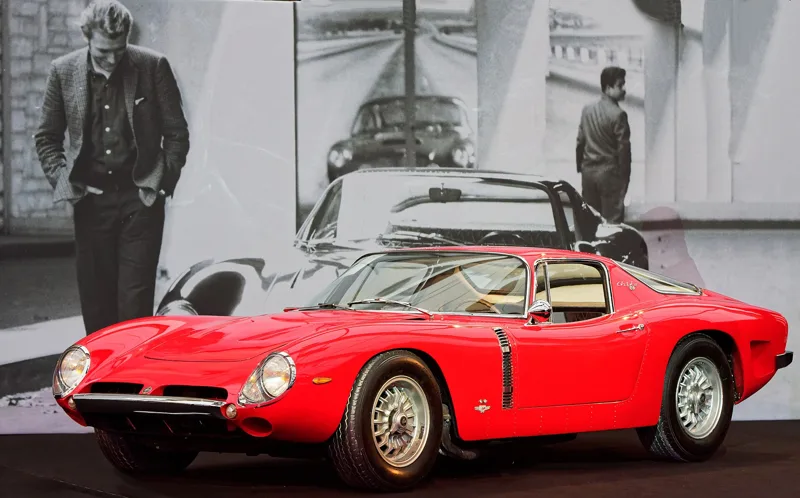
Bertone built the body. Giorgio Giugiaro, then still working there, drew a fastback coupe with faired headlights, and he used Ferrari styling cues on purpose so the car's link to Ferrari would be obvious without a badge. Bertone showed it in Turin that October as the Bertone Mille, meaning Bertone Thousand, though the maker had already been settled and the name had not.
The Mille's engine was a 1,000 cc (61.0 cu in) four with an overhead camshaft. The bonnet stayed shut during the show and no official dimensions were released, so the motoring press guessed it was a third of a Ferrari 250 V12. That would mean a 73 mm bore and 58.8 mm stroke, or 984 cc (60.1 cu in). With two Weber 38 DCO carburettors and 9:1 compression it made 98 PS (72 kW; 97 hp), with the peak reached at 6,800 rpm.
Who built the ASA and where?
Autocostruzione, shortened to ASA, was founded in Milan on 5 April 1962. Oronzio de Nora and his son Niccolo led it, and they also ran the electrochemical group de Nora, where the car was to be produced. Giotto Bizzarrini, who had quit Ferrari in 1961, and several racing drivers also took part in the firm.
Reportedly, Luigi Chinetti senior, who knew both parties well, had a major hand in bringing Ferrari and de Nora together. The founding news made clear who would build the "Ferrarina".
When did the car go on sale?
The ASA 1000 GT made its debut in Turin in autumn 1962, with a coupe and a spider on the stand. The first cars reached customers in early 1964, and they cost considerably more than had been estimated.
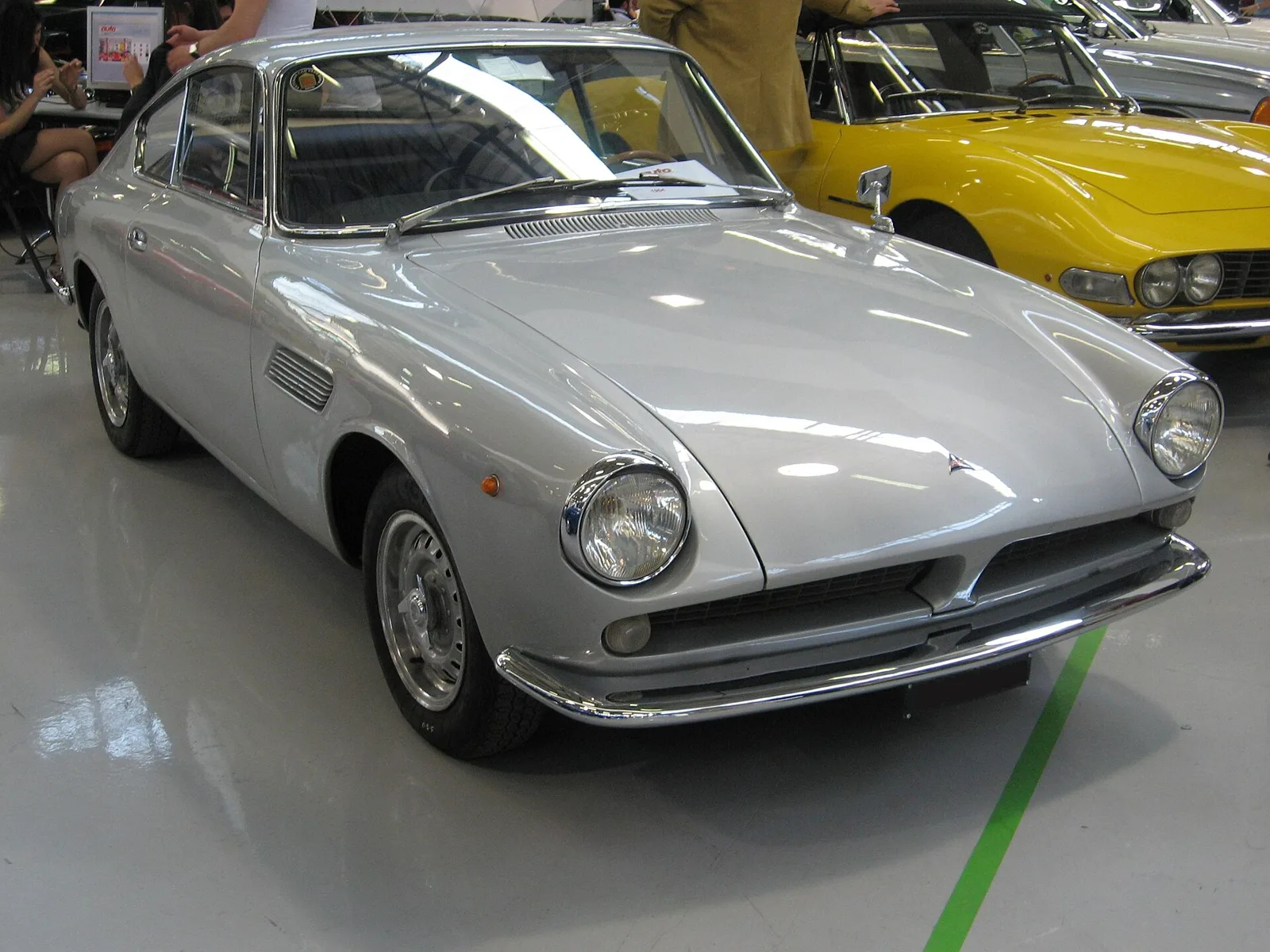
The production coupe was a slightly altered version of the Mille. Its headlights sat further forward and no longer had faired covers. Carrozzeria Touring built its steel-panel body. The spider kept the coupe's lines but was made of fibreglass by Carrozzeria Corbetta, and a light-alloy hardtop was available at extra cost.
1963 was quiet for production. A few newspaper pieces and tests of pre-series cars appeared, but nothing was delivered. Bizzarrini and Piero Drogo did make news with a racing car derived from the 1000 GT, the GTC, a racer based on the 1000 GT's underpinnings, which was to be used at Sebring and Le Mans, though that did not happen. GT stood for Gran Turismo and C for Competizione, meaning competition.
How was the ASA 1000 GT engineered?
The engine was an inline four with wet cylinder liners, a light-alloy head and block, and a chain-driven camshaft working through rocker arms. Each cylinder had two valves set at a 60-degree V. Two Weber 40 DCOE9 twin-barrel carburettors fed the mixture, and the radiator sat ahead of the engine.
The chassis used a tubular frame, with independent front suspension linked by an anti-roll bar. A rigid axle hung from trailing arms and was located by a Watt linkage. Each wheel had a hydraulic Dunlop disc brake on dual-circuit hydraulics, and the handbrake worked on the rear wheels. Rack-and-pinion steering needed 3.25 turns from lock to lock.
The gearbox offered four forward speeds plus reverse, with an overdrive on third and fourth and full synchromesh. Fourth was direct when the overdrive was off. Sunbeam supplied the gearbox in 1962, with a Laycock-de Normanville overdrive, and Humber took over from 1964 with an Auto-Transmissions overdrive. The final drive ratio was 9:41, about 4.56:1.
Specifications at a glance
| Model | Year | Engine | Output | Notes |
|---|---|---|---|---|
| Ferrari 854 project | 1959 | 849 cc (51.8 cu in), four cylinders | 75 PS (74 hp) at 6,800 rpm | Solex carburettor, 9:1 compression |
| Bertone Mille | 1961 | 1,000 cc (61.0 cu in), four cylinders | 98 PS (72 kW; 97 hp) at 6,800 rpm | Two Weber 38 DCO carburettors |
| ASA GTC | 1963 | 998 cc (60.9 cu in) | 92 PS (91 hp) | Five-speed gearbox, about 600 kg (1,323 lb) |
| ASA 411 | 1965 | 1.1 litres (67.1 cu in) | Not given | Plastic side and rear windows |
| ASA Roll-Bar | 1966 | 1.3-litre (79.3 cu in) six or 1.8-litre (109.8 cu in) four | Not given | Plastic body |
How did the racing versions perform?
The 1000 GT was not built for racing, but ASA converted two cars for the 1965 Targa Florio, where they took fifth and sixth places among prototypes of up to 1,600 cc. The GTC, the 411 and the Roll-Bar were the racing derivatives meant for that purpose, although some road cars were also converted for races.
The 411 appeared in autumn 1965 with a body that matched the Touring coupe's design but was built by Carrozzeria Marazzi. It used light-alloy panels, plastic side and rear windows, and a 1.1-litre engine to compete in the classes up to 1,100 cc. In 1966 a plastic-bodied 1000 GT entered the Targa Florio as an ASA 411 with race number 202, and it did not complete the race successfully.
The Roll-Bar was shown at the Geneva motor show in spring 1966, despite financial problems at the company. Luigi Chinetti junior drew its notchback body, which Corbetta built in plastic. Two of them, with 1.3-litre engines, were first used at the 1966 24 Hours of Le Mans, and both retired.
What did the cars cost and sell for?
The factory price quoted in 1960 was 1,600,000 lire. In 1964 it had reached 2,520,000 lire, more than 57 percent higher. The US market was important for sales, and an ASA 1000 GT was offered there for about $6,000, more than 30 percent above the roughly $4,500 asked for a Corvette 427.
The Italian automobile club's ACI, in its 1966 edition, records 52 cars built in 1964. A later edition from 1967 gives 190 for 1965. Production stopped in the first half of 1967, and nobody knows how many of the plastic-bodied coupes from 1966 were built.
Why do surviving cars still reach auction?
Surviving cars still reach the saleroom. Artcurial auctioned two cars from the de Nora family on 10 June 2013. Bonhams offered a heavily modified 1964 coupe at its Les Grandes Marques du Monde sale at the Grand Palais on 2 February 2015.
That 1964 car had been registered to Niccolo de Nora. In 1965 it was prepared for the Targa Florio with many features of the coming 411, including sliding side windows, a quick-release filler cap instead of a fuel flap, and a 1.1-litre engine. It ran in testing at the 1965 Targa Florio but not in the race itself. It sold for 103,500 euros.