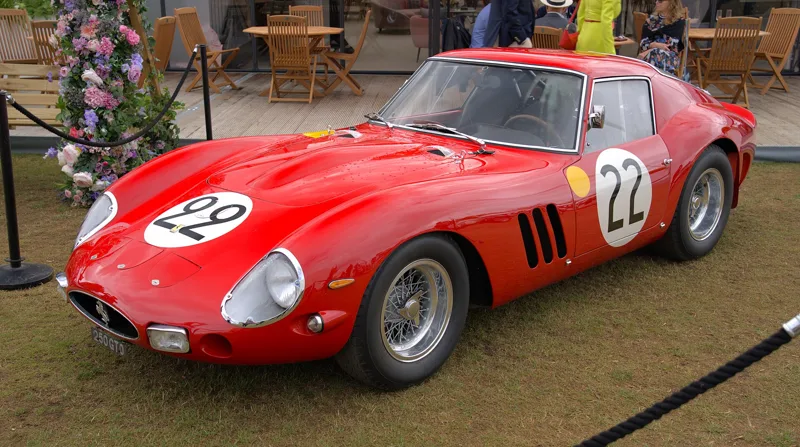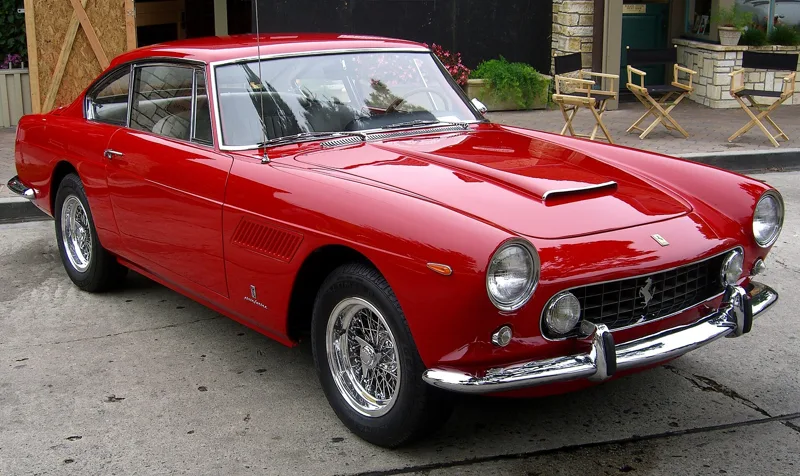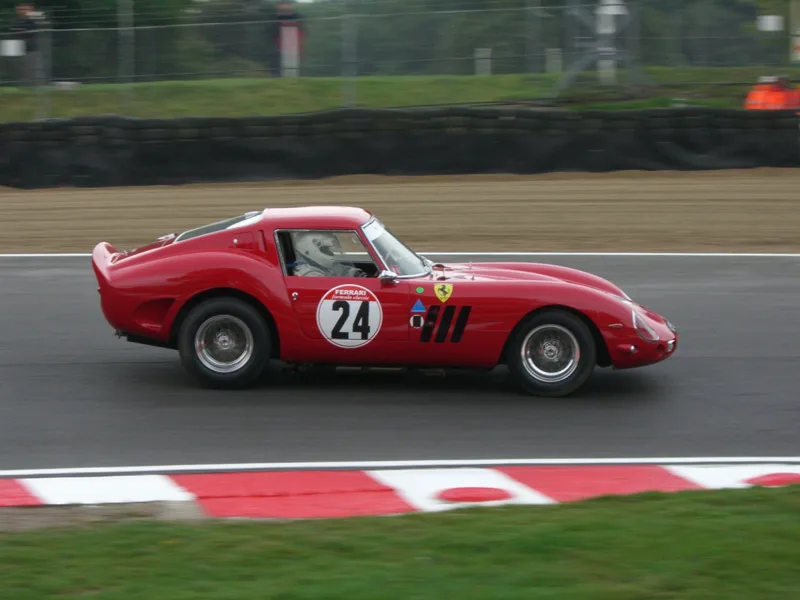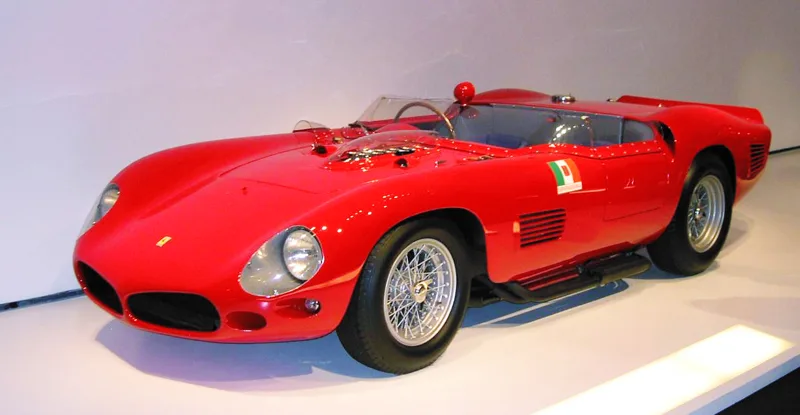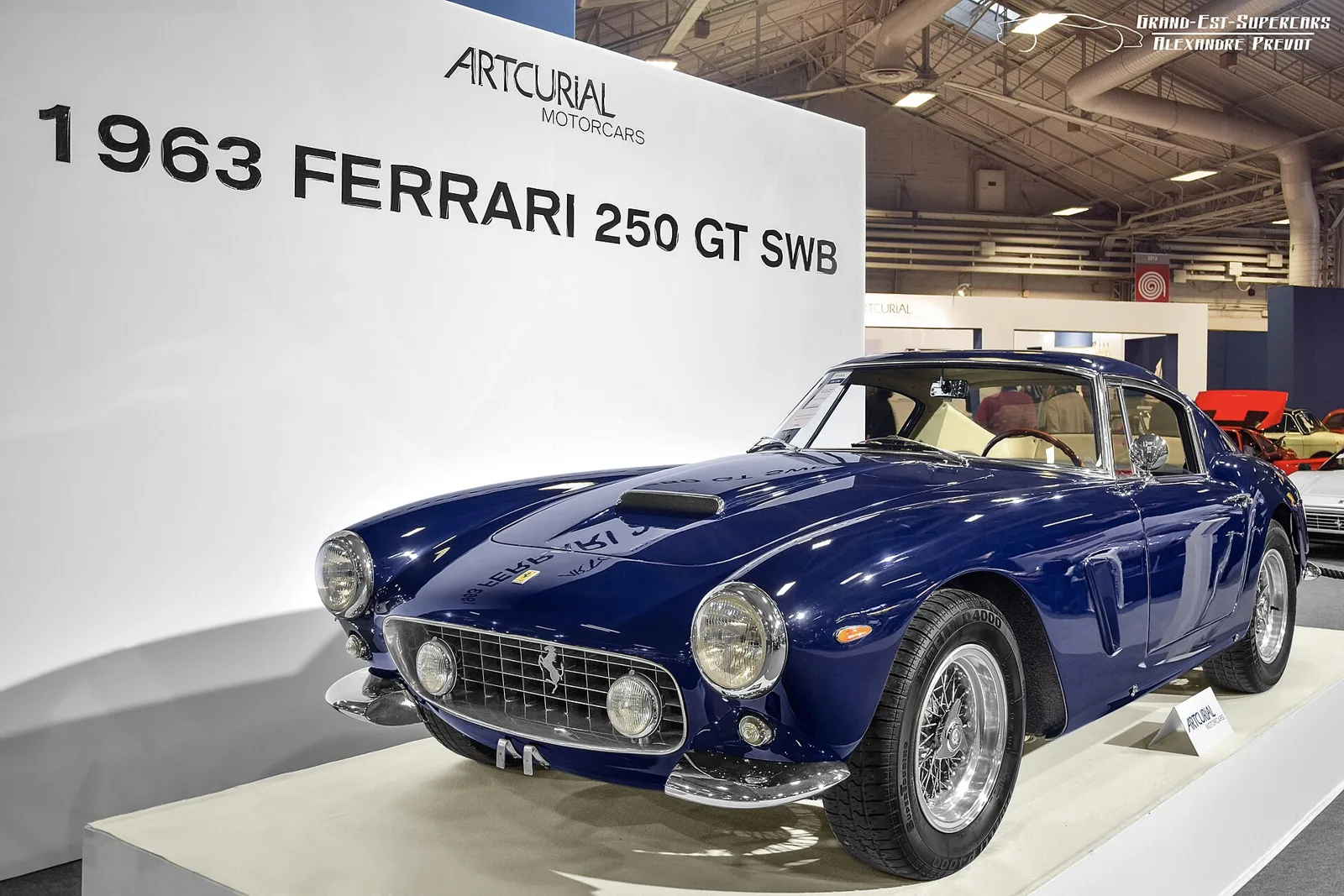
A Pininfarina-styled V12 coupe built from 1959 to 1962, with a shorter chassis, a Competizione racing version and a more civilised Lusso.
The Ferrari 250 GT Berlinetta SWB was a Pininfarina-styled sports car built from 1959 to 1962, with a 2,400 mm (94.5 in) wheelbase. Its 2,953 cc V12 produced up to 293 PS (216 kW; 289 hp) in its most powerful versions.
The Ferrari 250 GT Berlinetta SWB was a sports car from the Italian maker, built from 1959 to 1962 with 167 examples in total. Its short wheelbase made it lighter and more agile than the earlier long-wheelbase Berlinetta, and it became one of the most attractive and sought-after sports cars of the early 1960s.
Why did Ferrari build the Berlinetta SWB?
Ferrari built the SWB as the sporting partner to its touring coupes, the 250 GT Coupe and 250 GT 2+2. It replaced the larger 250 GT Berlinetta LWB 'Tour de France', which had been produced since 1955 and took its nickname from a win in the 1956 Tour de France Automobile.
After the Second World War, Ferrari had moved from one-offs and tiny runs into road sports cars. The 250 GT Boano/Ellena of 1955 gave the first low three-figure run, and the Pininfarina GT coupe reached about 350 units from 1958 to 1960.
Some writers call such sportier models Dual Purpose Ferraris, cars meant to work on the road and in competition. The 250 MM of 1952 started that line, and the LWB Berlinetta replaced it in 1955 with a more modern design.
The SWB was presented publicly at the Paris Motor Show in October 1959, and series production began shortly afterwards. The cars were built by Carrozzeria Scaglietti in Modena.
A shorter chassis, a Pininfarina body and a V12 that won overall at Spa and in the Tour de France Automobile.
What was different about the short wheelbase?
The SWB had a 2,400 mm (94.5 in) wheelbase, which was 200 mm shorter than the LWB. That made the cars lighter, more agile and more sporting, and the chassis was a new design known as Tipo 593 rather than a reworked older one.
The chassis is a tubular frame built from oval steel tubes, with the tubular skeleton of the body set on top. The front wheels had double wishbones and coil springs, Koni or Miletto telescopic dampers and an anti-roll bar.
The steering worked with a worm and roller. At the rear, as Ferrari favoured at the time, a solid axle ran on trailing links with semi-elliptic leaf springs and telescopic dampers, and every SWB variant kept that layout.
Specifications at a glance
| Specification | Detail |
|---|---|
| Chassis | Tipo 593, tubular frame |
| Wheelbase | 2,400 mm (94.5 in) |
| Engine | Tipo 168 V12, 2,953 cc (180.2 cu in) |
| Bore and stroke | 73 x 58.8 mm |
| Bank angle | 60 degrees |
| Compression ratio | 9.1:1 to 9.7:1 |
| Output | 240 PS (177 kW; 237 hp) to 293 PS (216 kW; 289 hp) |
| Body | Pininfarina two-door fastback coupe |
| Production | 167 cars, 1959 to 1962 |
How did the V12 engine work?
The engine was a development of the Colombo V12 that had powered every member of the 250 family since the 250 Europa GT of 1953. Its 2,953 cc (180.2 cu in) came from a 73 x 58.8 mm bore and stroke, with a 60-degree bank angle.
Each bank carried one overhead camshaft, driven by a chain, and each cylinder had two valves for inlet and exhaust. Early versions breathed through three Weber 36DCL twin-barrel carburettors, while the most powerful versions ran six twin-barrels.
Compression varied between 9.1:1 and 9.7:1 depending on the version. Output spanned 240 PS (177 kW; 237 hp) to 293 PS (216 kW; 289 hp).
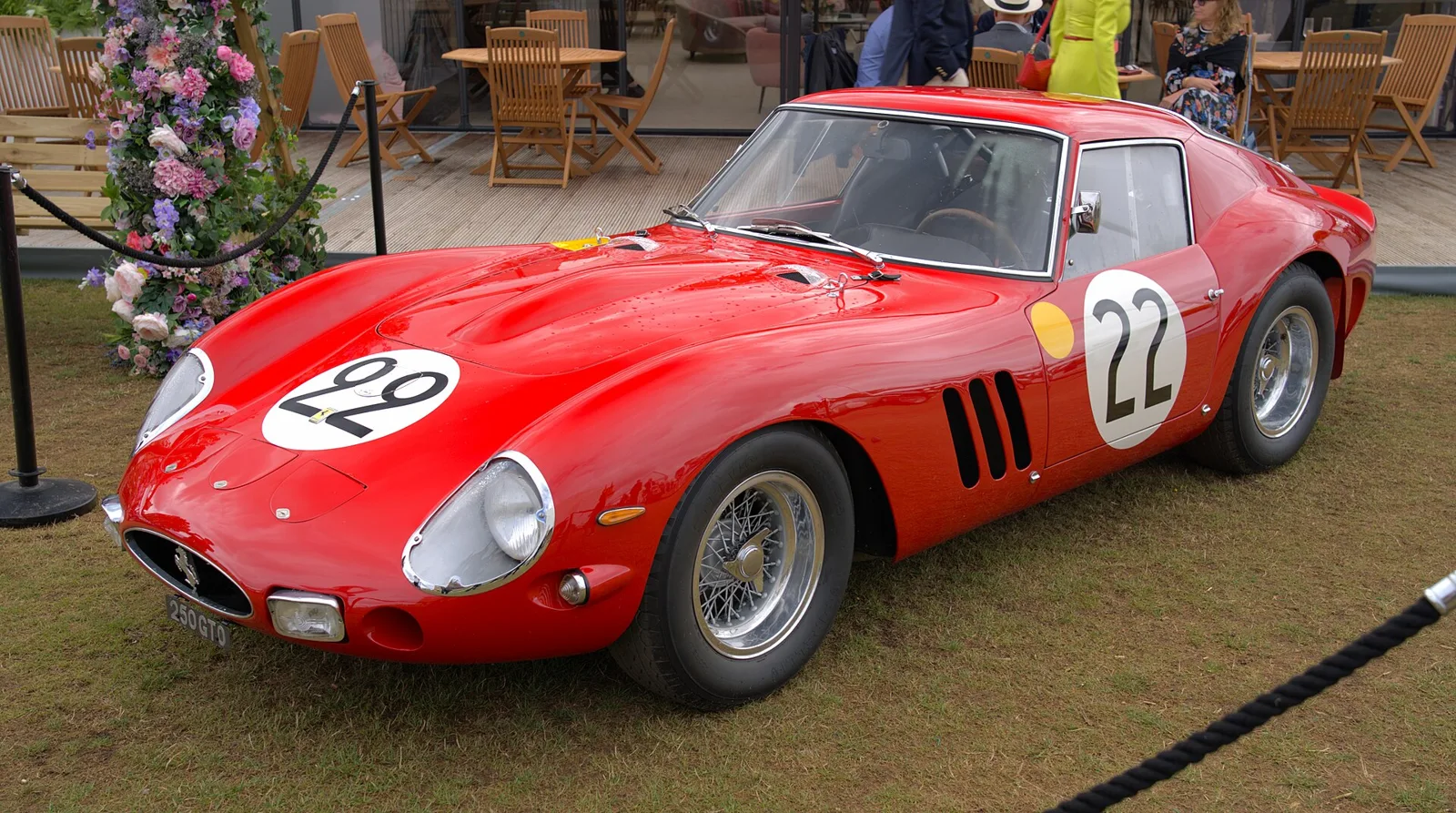
The same design went into the successor, the 250 GTO, where output was higher at 302 PS (222 kW; 298 hp). Ferrari claimed the GTO was a mere development of the SWB, though almost every detail was new.
How did the bodywork look and change?
The Pininfarina body was a two-door fastback coupe with rounded forms, a low oval radiator opening and two auxiliary headlights set into it. Its shape changed only slightly over the production cycle.
The front wings sloped gently down toward the doors, and a striking hip curve swept over the rear wheels. The rear roof section was slightly tucked in.
Cars built from May 1960 had angled vents in the front wings. Later the fuel filler moved into the left rear wing, the boot lid received more ventilation slots, and the shape of the side windows changed a little.
Competition bodies were made of aluminium sheet. Road cars were steel bodies with individual aluminium parts.
What were the Competizione and SEFAC Hot Rod?
The Competizione was the first racing version. Scaglietti built about 45 of them in 1959 and 1960, with output of around 280 PS (206 kW; 276 hp). The SEFAC Hot Rod followed in 1961 as a lighter and more powerful successor, of which about 20 were built.
Competizione cars had aluminium-sheet bodies and a spartan interior designed for low weight. Details such as bumpers were missing, and the windows slid instead of being wound with a crank.
The Hot Rod's frame tubes had thinner walls, and its body skin used 1.1 mm thin aluminium sheet. The side and rear windows were plastic, and the interior had no trim at all.
The Hot Rod's engine was revised again, with Testa Rossa cylinder heads, larger inlet valves and magnesium valve covers. It ran 9.7:1 compression and six Weber 46DCL3 twin-barrels, and its output was quoted at 293 PS (216 kW; 289 hp).
The SEFAC name stood for Scuderia Enzo Ferrari Automobili Corsa, the abbreviation the factory used. The Hot Rods accelerated from 0 to 100 km/h in five seconds and reached almost 260 km/h (162 mph) on the Mulsanne straight at Le Mans.
How did the SWB perform in motor racing?
The Competizione won in several countries. The first overall win came at the Grand Prix de Spa on 29 May 1960, for Wolfgang Seidel and Willy Mairesse. Two weeks later, four Competizione cars were entered in the GT class at Le Mans.
At the 1960 24 Hours of Le Mans, Fernand Tavano and Pierre Dumay took the class win, and the other three customer cars finished second to fourth in the class standings.
Mairesse and Georges Berger later won the Tour de France Automobile in September 1960. Lucien Bianchi and Olivier Gendebien won the Paris 1,000 km race.
In Britain, Stirling Moss won the 1960 RAC Tourist Trophy in a Competizione run by the Rob Walker Racing Team. The SEFAC Hot Rods also won, and Noblet and Guichet took the GT class at Le Mans in 1961, while Moss repeated his Tourist Trophy win in a Hot Rod.
What was the Lusso, and how did it differ?
The Lusso arrived in 1960 as a slightly toned-down version of the uncompromising sports car. It used steel bodies with only the doors and bonnets in aluminium, glass side and rear windows, and usually about 240 PS (177 kW; 237 hp), well below the Competizione.
Lusso cars had bumpers, some with two-part front bumpers and others with a bumper across the full width of the car. Customers could order crank windows and leather-covered seats.
Some buyers fitted more powerful engines, or Competizione units, into Lusso bodies, so the output of individual cars varied. The Lusso was also needed to win the Berlinetta SWB its admission to motor sport as a series production car.
Published figures for Lusso production vary between 89 or 90 and about 100 cars, which shows how hard the individual versions are to pin down.
Which special bodies were built on the SWB chassis?
Around a dozen vehicles were built on SWB chassis by various Italian coachbuilders, and most of them were intended for road use. Only three were racing models: Piero Drogo's version, a Pininfarina coupe and the Breadvan. The last special body was built in 1974.
Pininfarina gave special bodies to six SWB chassis. Five two-seat notchback coupes were built in 1961 and 1962 as the 250 GT SWB Esperimentale, with bodies that followed the line of the Ferrari 400 Superamerica.
Chassis 2613GT carried the 400 Superamerica lines almost faithfully and was built in 1961 for Prince Bernhard of the Netherlands. Chassis 2643GT had the engine of the Ferrari 250 GTO, a heavily rounded front and no bumpers.
Another Pininfarina one-off, chassis 3469GT, was built in 1962. It had a notchback body with a welded, angular hardtop, and it was assembled from leftover stock after the end of SWB production.
What made the Bertone cars different?
Bertone built two stylistically independent coupes on the SWB chassis, both with bodies designed by the company's design chief at the time, Giorgio Giugiaro. The first was the Wax coupe, a straight-lined notchback for the Genoese entrepreneur Enrico Wax.
The Wax car used one of the first Competizione chassis built in 1959 (number 1739GT), with a more powerful engine that anticipated the later SEFAC Hot Rod. It had 9.8:1 compression and a Testa Rossa cylinder head.
Its body had six side windows, very thin A, B and C pillars and an unpainted steel roof. The full-width radiator opening was fitted with wire mesh, and Bertone showed the car publicly at the Turin Motor Show in March 1960.
The Bertone Speciale on chassis 3269GT followed two years later. Company owner Nuccio Bertone used it privately, and through this show car he tried to build a business relationship with Ferrari. Its front has the radiator grille split by a pulled-forward sheet-metal nose, a device that quotes the Formula One Ferrari 156, also known as the Sharknose.
The Bertone Speciale was last sold in 2015 for US$16.5 million.
What is the Breadvan?
The 250 GT 'Breadvan' was an unusually styled, competition-built one-off on Berlinetta SWB technology. Count Giovanni Volpi di Misurata, who ran the Venice-based Scuderia Serenissima, commissioned it to rival the 250 GTO after failing to obtain a new one.
Giotto Bizzarrini drew on a 1961 SEFAC Hot Rod chassis, number 2819GT, and kept the chassis and drive technology unchanged, so the car's new character came entirely from its body. The aluminium body was new, with a Kamm tail based on the aerodynamic principles of Wunibald Kamm, and a roof that fell only slightly toward the rear.
The roof ended in a vertical cut-off tail, and a Perspex hatch was installed at the rear. Because of its estate-like body, the French press mocked it as the Cammionette, meaning small delivery van, and the British press called it the Breadvan, meaning bread wagon.
The Breadvan faced the 250 GTO only once, at the 1962 Le Mans 24-hour race. It ran ahead of the GTOs in the first laps but retired after three hours with a technical fault. Later it made only a few appearances in smaller races and won none of them.
What happened to the Carrozzeria Sports Cars chassis?
Piero Drogo's firm Carrozzeria Sports Cars re-bodied an older SWB chassis, number 2057GT, in 1962. Ferrari had first used that chassis in 1960 for a prototype of the future 250 GTO, and at the end of 1960 it received a series Competizione body.
Drivers including Miro Toselli, Luigi Taramazzo, Jean Blaton, Georges Berger, Edgar Berney and Jacques Swaters used the car in sports car races until summer 1962. Berger won the Coupe de Bruxelles with it in April 1962.
In late summer 1962 the car received Drogo's body, with a strongly curved beltline, headlights behind Perspex covers, a pulled-forward nose and no bumpers. Two almost rectangular air intakes sat across the width of the car, with large side vents in the front wings.
The best result came when Blaton finished fourth at the 1962 Grand Prix of Angola. At the 500 km race of Spa-Francorchamps in May 1964, Francis von Lysbeth wrecked the car in an accident, and it was never reconstructed.