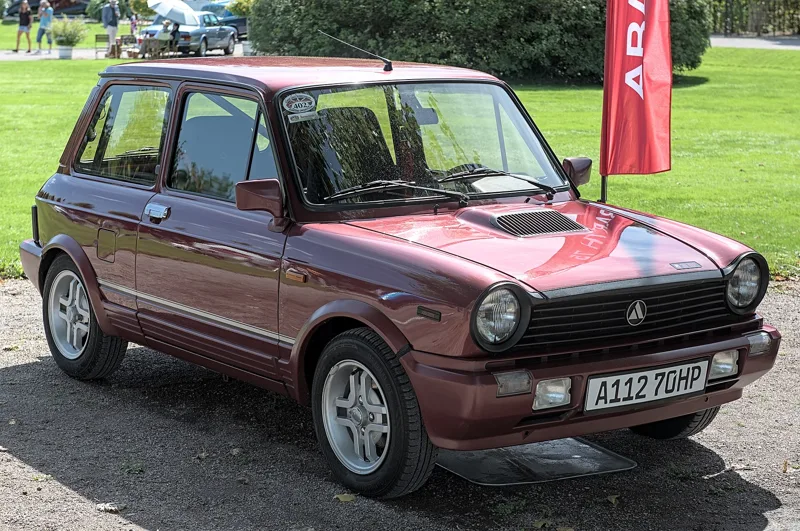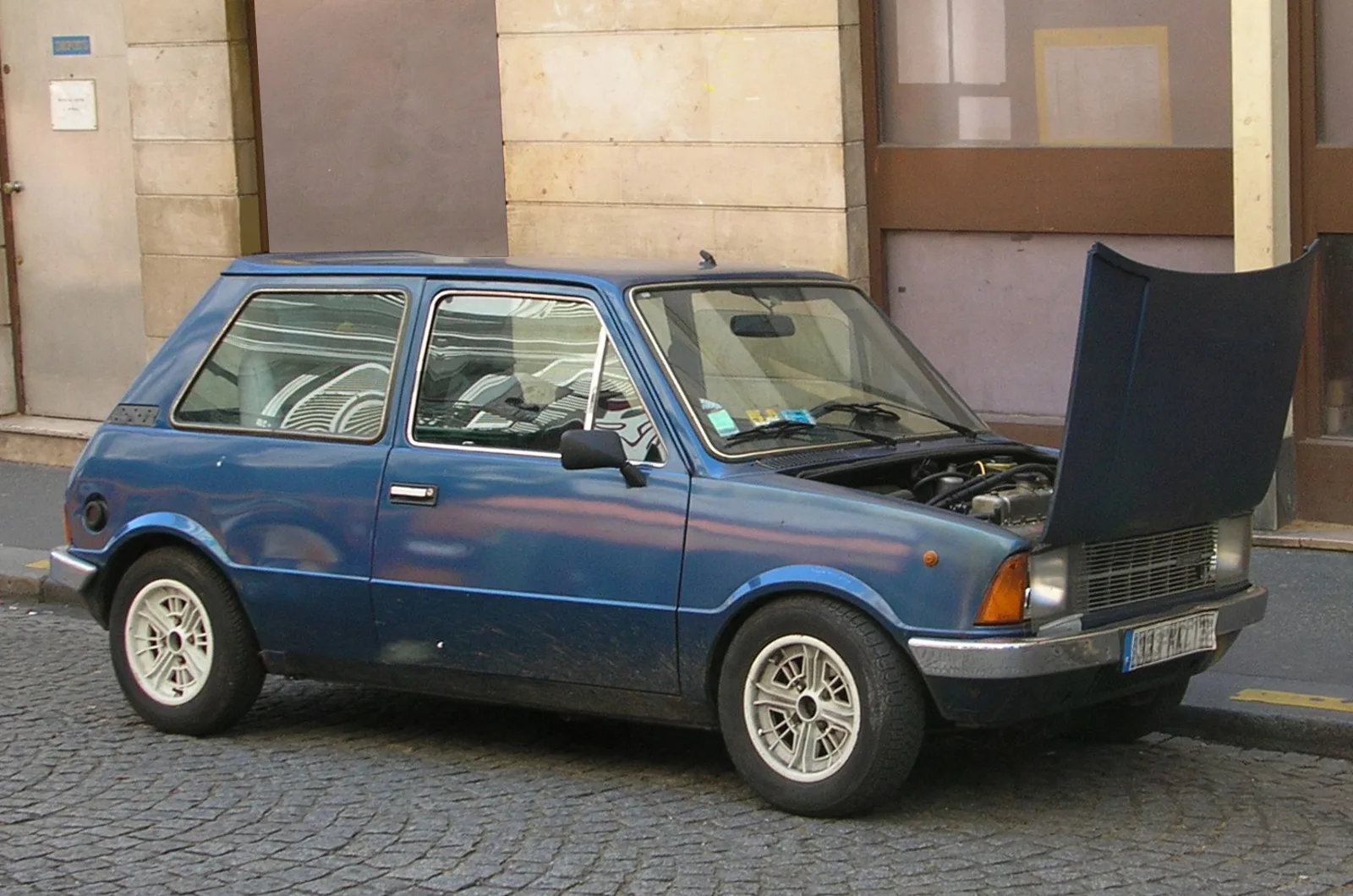
A rebodied Mini that passed through British Leyland and De Tomaso hands before ending its run with Daihatsu three-cylinder engines in 1993.
The Innocenti Mini was a Bertone-styled, rebodied three-door hatchback version of the Mini, introduced in 1974. After passing through British Leyland and De Tomaso, it received Daihatsu three-cylinder engines and stayed in production until 1993 in petrol, turbo, diesel and commercial forms.
The Innocenti Mini was a rebodied Mini with a three-door hatchback body styled by Bertone, launched in 1974. The car passed through British Leyland, De Tomaso and Fiat hands before it ended its run on Daihatsu three-cylinder power in 1993. Along the way it produced petrol, turbo, diesel and commercial variants.
Where did the Innocenti Mini come from?
Innocenti first assembled the original Mini from CKD kits, introducing the Mini 850 in November 1965. Only the earliest cars were true kit builds, and most used locally sourced shells and componentry. The rebodied hatchback followed in 1974, when Innocenti was still owned by British Leyland.
The kit-era range grew to include the 1000, the 1001, the Cooper, the Cooper 1300 and the Mini T. The Mini T estate was the only non-saloon variant, and assembly ceased in early 1975.
British Leyland Motor Corporation (BLMC) owned Innocenti at that stage. Plans for the Bertone-designed car to replace the English original came to nothing, and BLMC went bankrupt within a year of the launch.
In May 1976 Innocenti was sold to De Tomaso and GEPI. BL kept a 5% stake, and the company was renamed Nuova Innocenti.
A Bertone-styled hatchback that passed through three owners and ended on Daihatsu three-cylinder power.
What were the British Leyland-era Minis like?
The first rebodied models, the 90L and 120L, launched in 1974 with British Leyland A-series engines. The 90L used a 998 cc unit producing 44 PS (32 kW; 43 bhp), while the 120L's 1275 cc engine delivered an extra 15 kW (20 bhp). Four-speed manual gearboxes were fitted to every Leyland-engined car.
Output later rose to 50 PS (37 kW; 49 bhp) for the smaller engine and 66 PS (48 kW; 65 bhp) for the larger one.
Innocenti's version was generally better equipped and finished than the English car. That helped it sell well in several continental markets outside Italy, and the most useful practical change was a rear hatch that made the small luggage bay easier to reach. The drag coefficient came down to 0.41 Cd from 0.42 on the original Mini.
How did the Innocenti Mini drive?
The original Mini's rubber cone suspension carried over to the Innocenti, giving excellent handling at the expense of a very bumpy ride. Drag was slightly better as well, at 0.41 Cd against 0.42 for the English car, which added a little efficiency to a small body.
The bumpy ride was the trade-off for that handling, and the change of April 1982 was a clear break from it. Later cars moved on from the rubber cones: the Daihatsu conversion brought MacPherson struts up front and a transverse leaf spring out back.
Overall, the car kept the character of its original design while its underpinnings changed several times. The rubber cones gave way to a more conventional layout, and the turbo and diesel versions brought a different feel to the range.
How did De Tomaso change the car?
De Tomaso's sporting model entered series production in early 1977, with moulded plastic bumpers and integral foglights in place of the chromed units. A bonnet scoop and wheelarch extensions for alloy wheels completed the look, and the sporting version set the tone for the range that followed the 1976 sale.
The 1980 Mille replaced the 120 in most markets. It brought a facelift, headlights that sloped backwards, redesigned taillights and an overall length increase of about 5 cm (a couple of inches). The 90 LS II followed in 1981 and the 90 SL in 1982.
Why did the car switch to Daihatsu engines?
Innocenti moved to Daihatsu three-cylinder engines in April 1982, the same moment the suspension was reworked. The suspension became MacPherson struts at the front and a transverse leaf spring at the rear. The new engines and suspension added about 55 kg (121 lb), but the car was otherwise nearly unchanged.
The early Daihatsu petrol engine was a carburetted 52 PS (38 kW) unit. Innocenti then renamed the cars Tre Cilindri, or simply Tre, and in January 1984 they became the Minitre, offered in S, SL and SE trims.
Warranty figures were the main argument for the switch. In 1984 De Tomaso said warranty repairs were down 70% compared with the BL-engined cars. Daihatsu engines cost more than the English units, but the saving on claims more than paid for the difference.
The Minimatic offered an automatic alternative from July 1984. It was a two-speed semiautomatic with a torque converter and a planetary gear train, which gave buyers a choice beyond the five-speed manual.
How well did the Minitre and its diesel sell?
Production fell from 23,187 cars in 1981 to 21,646 in 1982 and 13,688 in 1983, the first year in which every car had a Daihatsu engine. Output had fallen from the forty-thousands to the mid-teens by 1984 and 1985.
The diesel was part of an effort to lift output towards a target of around 20,000 cars a year for profitability. Innocenti launched a 37 PS (27 kW) diesel from a 1-litre engine in April 1984. At introduction it was the smallest passenger car diesel in the world, and it had the highest specific output of any naturally aspirated series diesel.
The diesel took thirty percent of production against an expected 20%, which made it a bigger success than planned.
Exports in 1982 and most of 1983 were limited to France, Belgium and Switzerland. German importer Walter Hagen took over sales in 1983. Canada was served from 1984 by Incacars, which sold 2,000 cars in its first year before sales dropped to 196 in the first half of 1986.
What did the Turbo de Tomaso offer?
The Turbo de Tomaso was presented in December 1983 with a turbocharged 993 cc three-cylinder engine rated at 72 PS (53 kW). It used a two-valve engine rather than the more powerful multivalve unit found in the Charade GTti, which Innocenti never used.
The first turbo engine was the CB-DT, with an IHI RHB5 turbocharger, 9.1:1 compression and a 0.37 bar boost. It peaked at 6200 rpm and drew mixed reviews from testers.
Road tests criticised that upright seating, mediocre comfort and instability under braking. The steering, light weight and appearance earned praise, so the car had clear strengths beside its faults.
The CB60 later took over from the CB-DT. Its smaller IHI RHB32 unit ran 8:1 compression, and the boost reached 0.5 bar. Maximum power came at 5700 rpm.
How did the 990, 650 and 500 extend the range?
The 990 arrived at Turin in 1986 with a wheelbase 160 mm (6.3 in) longer than the standard car. Its rear seat folded and split down the middle, and the windscreen was more sloped. The 650 and 500 used smaller two- and three-cylinder engines.
The 990 was built on the longer Mini Traveller chassis, following a 1982 concept from Embo. Even two adults found its rear seat uncomfortable, although luggage space grew to 295 L (10.4 cu ft) from 280 L (9.9 cu ft).
The 990 Serie Speciale of July 1991 added an Alcantara interior by Missoni. Commercial versions included the 990 C and the 990 diesel C vans.
The 650 was shown at Turin in November 1984 with a 617 cc two-cylinder engine producing 31 PS (23 kW). Twin balance shafts were fitted, which kept the two-cylinder engine smoother than its layout suggested.
The 500 was first shown in November 1987 and went on sale in January 1988 with a 550 cc three-cylinder engine. That engine grew to 660 cc in late 1990. It produced 31 PS (23 kW) at 6400 rpm and a top speed of 116 km/h (72 mph).
How did the Innocenti 500 compare with rivals?
The 500 found a ready market in France, where its 3CV tax rating was as low as that of the Fiat 126. The Fiat was considerably less habitable, which left the Innocenti with a clear practical edge. By late 1988 about 75% of home market sales were 500s.
On paper the 500 was modest, with 31 PS (23 kW) and a 116 km/h (72 mph) top speed, so its tax rating was a large part of its appeal in France. Its role at home was just as important, because the 500 became the car most people bought from the range.
What happened after Fiat took over?
Fiat bought Innocenti in 1990, and the diesel, Matic and Turbo de Tomaso versions were dropped. The little 500 gained a 659 cc engine after the kei car rules changed in March 1990, allowing 660 cc of displacement.
Torque rose from 42 Nm (31 lb ft) at 4,000 rpm to 49 Nm (36 lb ft) at 3,400 rpm, and top speed rose to 120 km/h (75 mph). The Small 500 SE of 1993 used the smaller engine in the longer 990 body.
The line closed on 31 March 1993, although sales ran on into the following year.
What is the Innocenti Mini remembered for?
The Innocenti Mini is remembered for a better finish and equipment than the English-built Minis, which helped sales across continental Europe outside Italy. Its Daihatsu-era engines cost more to buy but cut warranty claims, and the 500 was popular in France.
The rebodied hatchback sits between two worlds: a Bertone body on Leyland engines at first, then Daihatsu three-cylinder and diesel power later. That mix explains much of its character, from the early rubber cone ride to the turbo and diesel variants.
Its production history is also a story of one model kept alive through several owners. Each owner changed the engines, the trim or the markets served, and the car stayed on sale until 1993.
Innocenti Mini specifications at a glance
| Specification | Detail |
|---|---|
| Introduced | 1974 |
| Body | Three-door hatchback, styled by Bertone |
| Drag coefficient | 0.41 Cd, against 0.42 for the original Mini |
| Leyland petrol engines | 998 cc, 44 PS (32 kW; 43 bhp); 1275 cc, up to 66 PS (48 kW; 65 bhp) |
| Daihatsu petrol engine | Carburetted 52 PS (38 kW) |
| Turbo de Tomaso | 993 cc, 72 PS (53 kW), from December 1983 |
| Diesel | 1-litre, 37 PS (27 kW), from April 1984 |
| Mini 650 | 617 cc two-cylinder, 31 PS (23 kW) |
| Innocenti 500 | 550 cc, 660 cc from late 1990, 31 PS (23 kW) |
| Gearbox | Four-speed manual; five-speed on Minitre; Minimatic two-speed |
| End of production | 31 March 1993 |