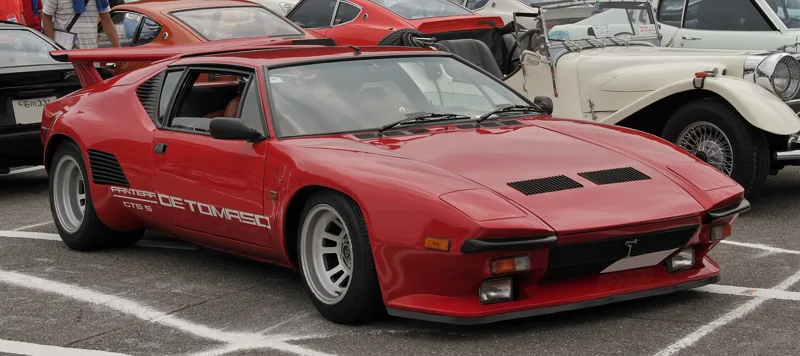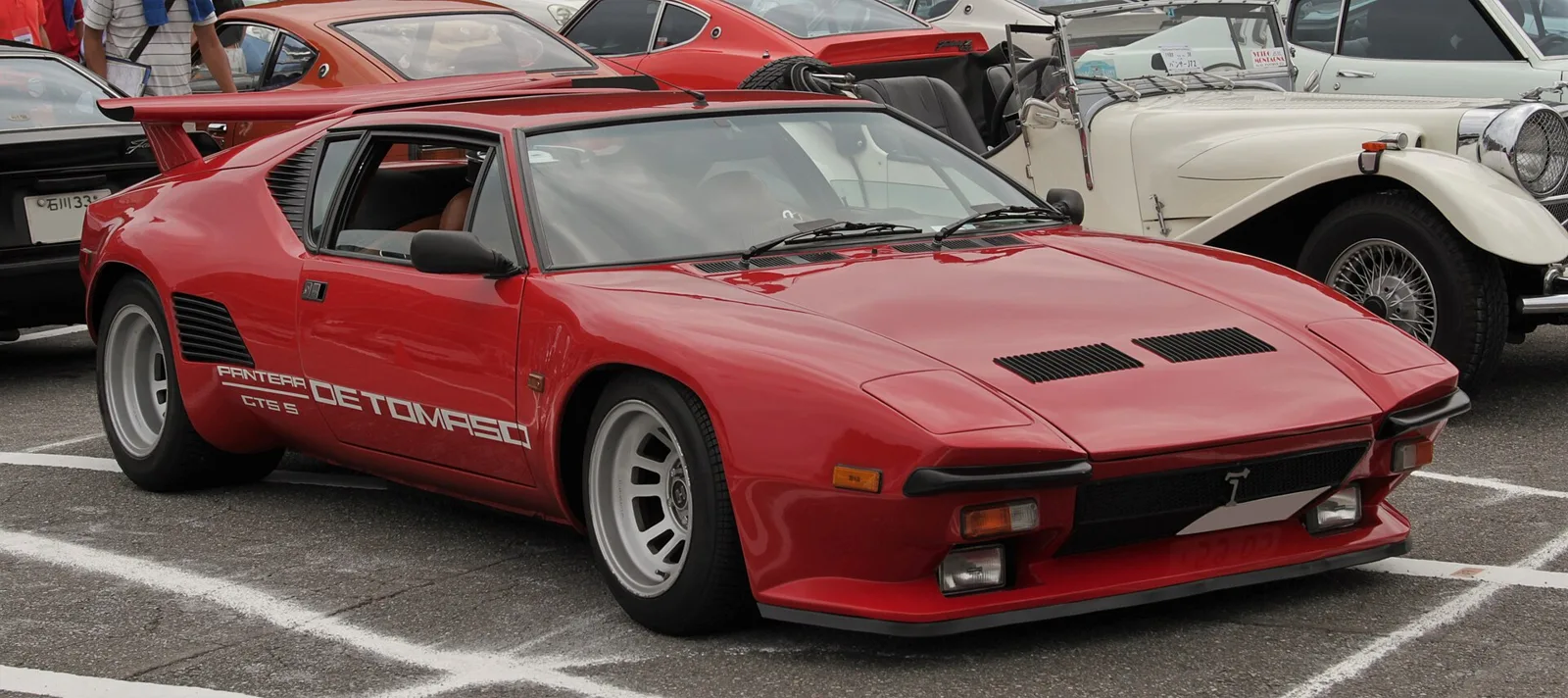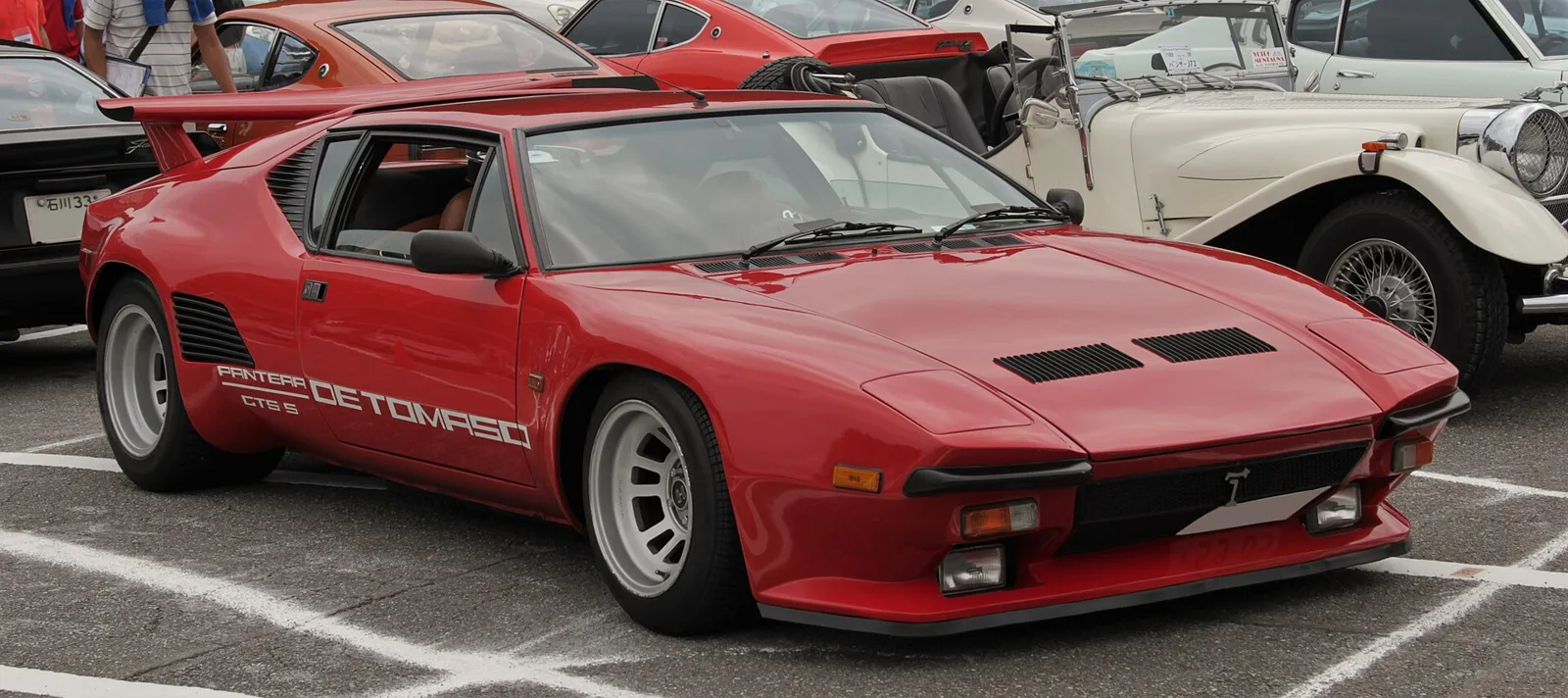
A steel monocoque sports car with a Ford Cleveland V8, sold through American Lincoln-Mercury dealers and raced from Group 3 to Group 5.
The De Tomaso Pantera was an Italian mid-engined sports car built from 1971 to 1992, with a Ford V8 in its early years. Over 7,000 were made, more than three quarters of them sold through American Lincoln-Mercury dealers between 1972 and 1975, and it later raced in Group 3, 4 and 5 categories.
The De Tomaso Pantera was a mid-engined sports car from the Italian maker De Tomaso, built from 1971 to 1992. It used a Ford V8 for most of its life, and more than three quarters of the cars sold in the United States went through Lincoln-Mercury dealers between 1972 and 1975.
Over its twenty-year run De Tomaso built more than 7,000 Panteras, making it the company's most popular model. This guide covers the design, the transatlantic sales arrangement with Ford, the engine changes, the GTS, GT5 and 90 Si variants, the racing history, and the specification figures.
Where did the De Tomaso Pantera come from?
The Pantera was a mid-engined sports car designed by Tom Tjaarda of the Italian design house Carrozzeria Ghia and built by De Tomaso. It replaced the Mangusta and was the first De Tomaso to use a steel monocoque chassis. The name is the Italian word for panther.
The car debuted in Modena in March 1970 and appeared at the 1970 New York Motor Show a few weeks later. The first production cars were sold about a year afterwards, and output rose to three cars per day. The slat-backed seats shown in New York drew criticism, so the production car received conventional body-hugging sports seats instead.
Headroom was tight for drivers taller than about 6 ft (1.83 m), and the pedals were offset. The interior was generous in other respects, with electric windows, air conditioning and door buzzers that looked exotic to European buyers. A cigarette lighter was poorly placed, and a resting arm could switch it on by accident.
The badge drew on the family's cattle ranching symbol and a sideways Argentine flag. Both nods reflected the company's roots, because founder Alejandro De Tomaso was born and raised in Argentina.
An Italian mid-engined car with a Ford V8, sold through American dealers and raced from Group 3 to Group 5.
How did Ford become involved with the Pantera?
De Tomaso sold the rights for the United States to Ford, which distributed the car through its Lincoln-Mercury dealers. Alejandro De Tomaso kept the right to market the Pantera in Europe. Ford began importing cars late in 1971, and the first 75 were European imports with push-button door handles.
A total of 1,007 cars reached the United States that year. Early American cars had minimal rust-proofing and poor fit and finish, with body solder hiding panel flaws. Ford later introduced precision stampings for the body panels, which improved the overall quality of the build.
The 1972 model year brought a revised 5.8 L Cleveland with its compression ratio cut from 11:1 to 8.6:1, mainly to meet US emissions rules and run on lower-octane fuel. A more aggressive camshaft and a dual point distributor were added to recover some of the lost power. The Pantera L followed in August 1972 with a single black front bumper and a built-in airfoil.
The 1973 car was named Road Test Magazine's import car of the year, ahead of rivals from Ferrari, Maserati, Lamborghini and Porsche. That year the dashboard also changed from two separate gauge pods to a single unit with the dials angled toward the driver.
What engine powered the first Pantera?
The first 1971 Pantera used a 5.8 L (351 cu in) Ford Cleveland V8 rated at 335 PS (246 kW; 330 hp). Its high torque meant fewer gear changes at low speed, which made the car far easier to drive in town than many locally built rivals.
The transaxle was the ZF unit also used in the Mangusta, and the same gearbox family appeared in the Maserati Bora, which launched in 1971. A passenger in an early car found the transaxle noise more intrusive than the engine. Power-assisted four-wheel disc brakes and rack-and-pinion steering were standard, and Car and Driver measured 5.5 seconds to 60 mph (97 km/h) for the 1971 car.
How did the GTS differ from the standard Pantera?
The GTS arrived in spring 1972 as a sportier model for Europe, developed for Group 3 racing. It produced 350 PS (257 kW; 345 hp) at 6,000 rpm from an 11.0:1 compression ratio, against 8.0:1 in the US Pantera, and it carried wider wheels and ventilated disc brakes.
Larger Holley carburetors, a forged aluminium intake manifold and freer-flowing exhaust headers all added to the engine's output. The GTS also had a more aggressive steering rack, revised spring rates and gear ratios, and matte black body elements that set it apart visually.
Grey-market GTS cars reached the United States before a factory American version appeared in the first half of 1974. The first 40 were sold only in California. They had GTS badging, matte black sections, a special steering wheel and an electric clock, but not the higher compression engine or the performance wheels.
Because of legal disputes between De Tomaso and Ford, all De Tomaso badging was removed from these cars. The wheels carried GTS badges, and the front bumper badge was replaced with the Ghia logo.
Why did Ford stop importing the Pantera?
Ford stopped importing the Pantera into the United States in 1975, by which time it had sold around 5,500 cars. De Tomaso kept building the car for the rest of the world for almost two decades, and gray-market importers brought some cars into the US during the 1980s.
After 1974 Ford discontinued the Cleveland 351, but production continued in Australia until 1982. De Tomaso sourced its engines there while the supply lasted, and those engines were tuned in Switzerland with outputs up to 360 PS (265 kW; 355 hp). From late 1986 De Tomaso began fitting Ford 351 Windsor engines instead.
Bodies were another problem. After Ford had its pressing tools destroyed and Vignale went bankrupt, the stock of about 175 bodies-in-white ran out. De Tomaso moved to bodies hand-built by Maggiora in mid-1976, then switched to Embo S.p.A., which built the final 504 Panteras from 1979. About 7,260 cars were built in total.
What were the GT5 and GT5-S?
The GT5 arrived in May 1980 with bonded and riveted fibreglass wheel-arch extensions, a more luxurious interior and much larger wheels. The GT5-S followed in November 1984 with blended arches. Analysis of vehicle identification numbers by the Pantera Owners Club of America suggests fewer than 197 GT5 and fewer than 183 GT5-S cars were built.
The GT5 also gained better brakes and an air dam and side skirts within its fibreglass body kit. Production of the wide-body GT5 continued until 1985, when the GT5-S replaced it. The factory has not published its records, so these counts rest on the club's analysis.
The S stood for steel. The GT5-S kept the GT5's basic layout but used single-piece flared steel fenders in place of bolted-on fibreglass flares, along with a smaller steel front air dam. Custom-order GTS production continued in very small numbers until the late 1980s.
What was the Pantera 90 Si?
The Pantera 90 Si arrived in 1990 with a 4.9 L Ford 302 V8 fitted with electronic fuel injection, new styling by Marcello Gandini and ventilated, drilled disc brakes. Only 41 were made before the Pantera was phased out in 1993 to make way for the Guara.
The Ford 302 replaced the 351, and the engine received revised cylinder heads, intake manifolds, camshafts, valves and pistons. Stopping power came from four-wheel ventilated and drilled discs with Brembo calipers, the same parts used on the Ferrari F40. The taillights came from the facelifted first-series Alfa Romeo 33, and in the UK the model was sold as the Pantera 90.
Of the 41 cars, two went to crash tests and one was kept by the company for its museum. That left 38 for sale to the public, and four of those were converted to targa roofs by Pavesi.
How did the Pantera perform in motorsport?
De Tomaso offered a Group 3 competition Pantera to special order from 1972 to 1984, and about 30 went to private customer teams. Group 4 cars followed in 1972 with 14 built, and private teams converted cars for Group 5 racing from 1976 to 1981. Group 3 cars pushed Porsche to speed up development of the 911 Carrera RS.
Group 3 rules allowed little modification, and early cars were built largely by hand, which earned them the nickname push-button chassis cars. They ran 15 x 8 inch Campagnolo wheels at the front and 15 x 10 inch wheels at the rear, with adjustable Koni shocks. The engine made 336 PS (247 kW; 331 hp) and was mated to a 5-speed close-ratio gearbox.
British engineer and driver Mike Parkes, who had developed racing cars for Ferrari, led the Group 4 development. The car had no front or rear bumpers, aluminium doors and a deep chin spoiler, and it weighed 1,100 kg (2,425 lb) in its final form. Ford refused to supply engines for the racing version, so De Tomaso turned to a private US engine builder, Bud Moore.
The Group 4 engine was claimed at 507 PS (373 kW; 500 hp), and it ran at 446 PS (328 kW; 440 hp) at 7,000 rpm. Weber 850 CFM carburetors raised that to 477 PS (351 kW; 470 hp). The first Group 4 cars ran at the 1972 24 Hours of Le Mans, where the engine proved unreliable and the car's weight rose to 1,250 kg (2,756 lb).
Replacement engines with lower compression ratios were fitted, and the car kept racing. Two cars were heavily modified for other categories: chassis 001, built from a new chassis by Sala and Marveti, and chassis 1603, a Group 4 car campaigned in the US by Hugh Kleinpeter.
Did Elvis Presley own a Pantera?
Yes. Elvis Presley bought a De Tomaso from a Cadillac dealership in 1974 for $2,500. He sold the car in 1976, and it later passed to Robert Peterson in the late 1990s before being placed at the Peterson Automotive Museum.
The story is well known because Presley fired two shots into the dashboard with a small-calibre revolver after he could not get the car to start. The shots shattered the windscreen and deflated the front tyre.
Is there a modern Pantera?
In 2019 the Italian firm Ares Design unveiled the Project1, a newer take on the Pantera that uses the Lamborghini Huracan chassis. It was a new car built on another manufacturer's platform, which sets it apart from the original Pantera's own steel monocoque.
What are the De Tomaso Pantera specifications?
| Specification | Detail |
|---|---|
| Production | 1971 to 1992; about 7,260 cars built |
| Chassis | Steel monocoque, first used by De Tomaso on this car |
| Engine (1971) | 5.8 L (351 cu in) Ford Cleveland V8, 335 PS (246 kW; 330 hp) |
| Engine (US 1972) | Cleveland, compression 8.6:1, 264 hp (197 kW) at 5,400 rpm |
| GTS output | 350 PS (257 kW; 345 hp) at 6,000 rpm, compression 11.0:1 |
| 0-60 mph (97 km/h) | 5.5 seconds, 1971 car (Car and Driver) |
| Group 3 engine | 336 PS (247 kW; 331 hp) |
| Group 3 top speed | Up to 280 km/h (174 mph) with long ratio gears |
| Group 4 weight | 1,100 kg (2,425 lb); 1,250 kg (2,756 lb) after penalty |
| Group 4 output | Claimed 507 PS (373 kW; 500 hp); 477 PS (351 kW; 470 hp) with Weber carburetors |
| Engine (1990) | 4.9 L (302 cu in; 4,942 cc) Ford 302, electronic fuel injection |
| Pantera 90 Si | 41 built; 38 sold to the public |
| GT5 and GT5-S | Fewer than 197 GT5 and fewer than 183 GT5-S built |
| Ford US sales | 1,007 cars in 1971; around 5,500 before imports ended in 1975 |