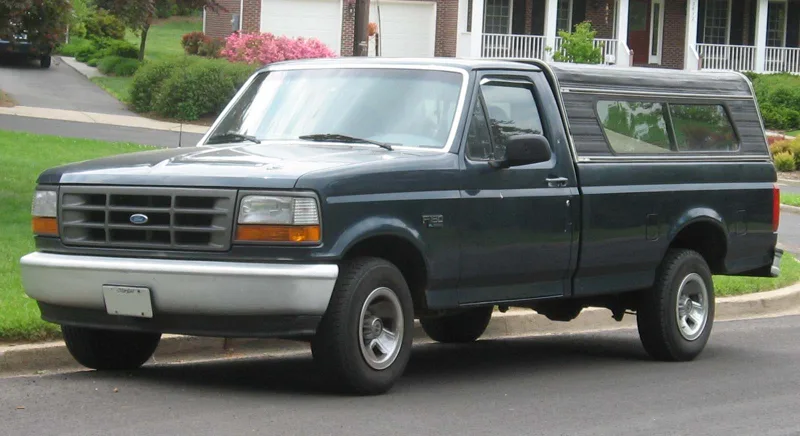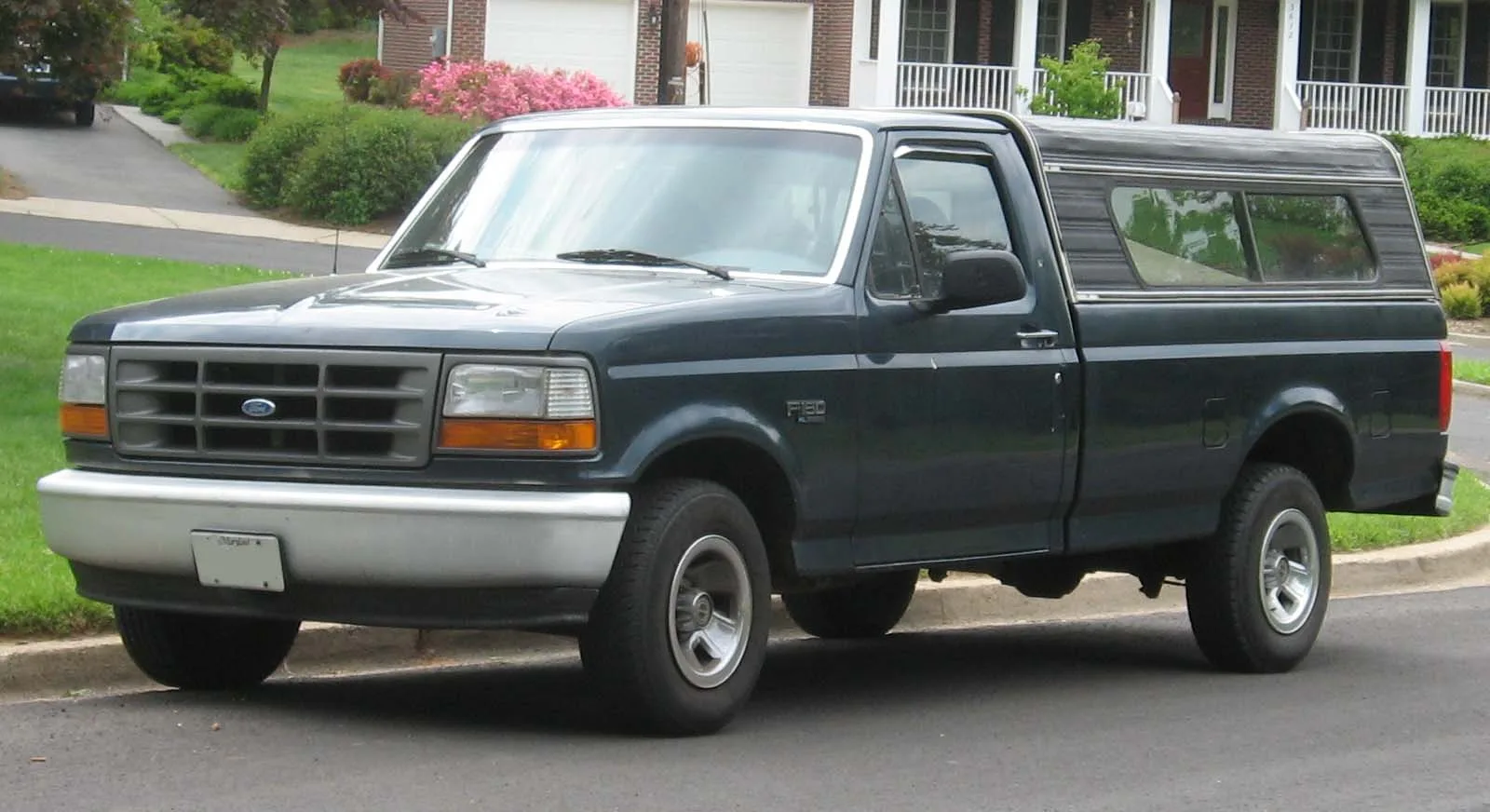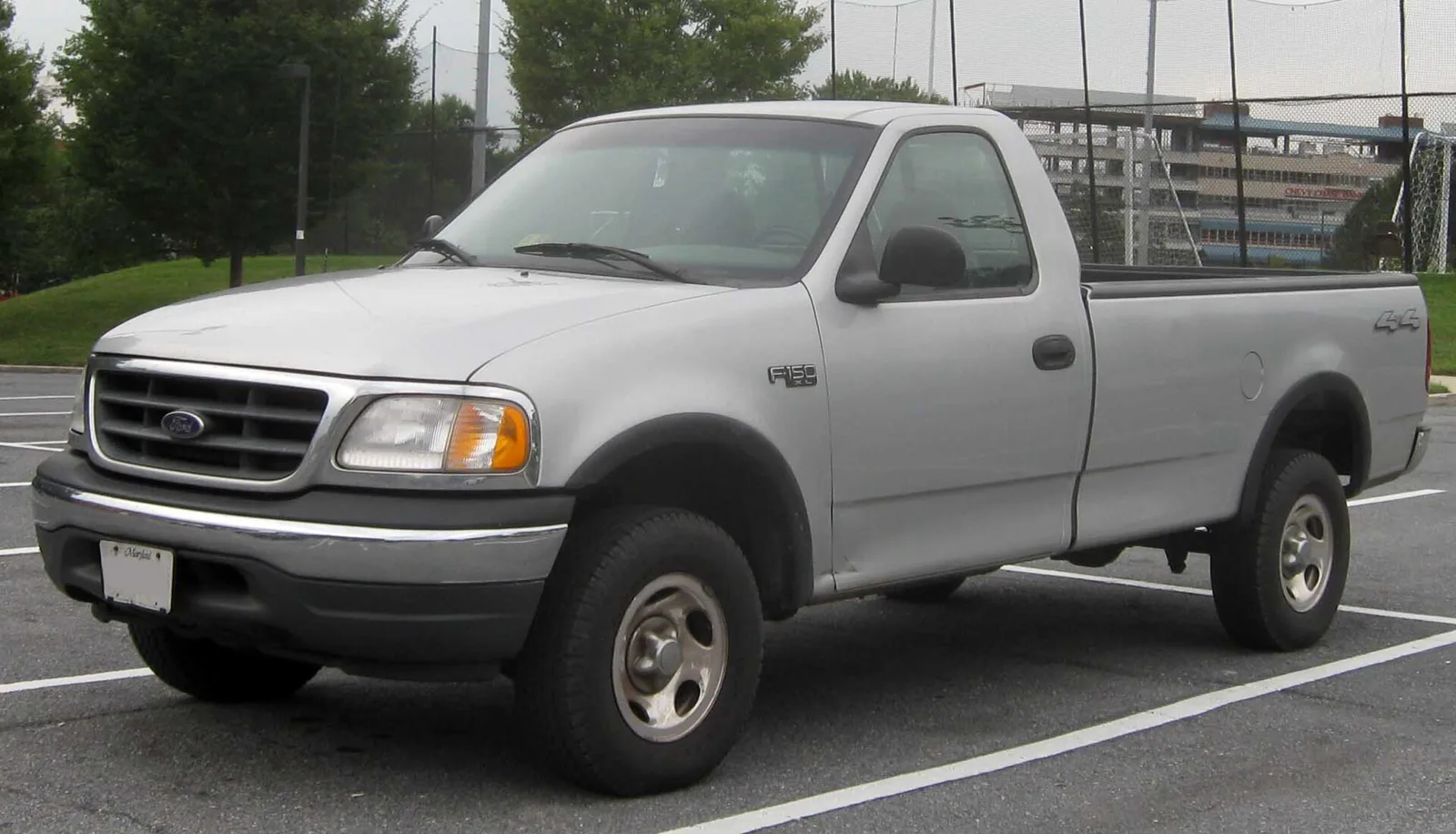
The first ground-up F-150 redesign since 1979 brought independent front suspension, a new Triton V8 family and the second-generation SVT Lightning.
Sold from 1997 until 2004, this F-150 generation was Ford's first ground-up redesign since 1979. It introduced independent front suspension, the Triton V8 family, the SuperCrew body and a second-generation SVT Lightning.
The tenth-generation Ford F-Series ran from 1997 to 2004, and it was the first ground-up redesign of the line since 1979. Its all-new chassis and body were developed mainly for the F-150, and the same generation brought independent front suspension, a new V8 family and the first Lincoln pickup. Sales climbed past 900,000 in 2001, and the design served as the basis for the Lightning performance model.
Why did Ford redesign the F-150 in the 1990s?
Ford started the PN-96 programme in late 1989, while a facelift for the 1992 model year was still in development. Thomas Baughman was named chief engineer, and Andrew Jacobson became design director for the truck programme in mid-1990. By 1991 the designers had produced clay models with a car-like look based on a new styling theme.
Focus groups disliked the softer styling during 1991 and 1992, but Ford management backed the aero design direction. Bob Aikins's design was completed in November 1992 and frozen for production in February 1993. It added a rounded nose to the new F-Series. Prototypes ran from early 1994, and pilot production started in 1995.
Ford also gave the truck an independent front suspension in place of the twin-beam arrangement, aiming for a more comfortable and manageable ride. The change made the F-150 the first Ford light truck to drop the Twin-I-Beam front end.
A radical aero design with a new Triton V8 family and an independent front end, which took the F-150 past 900,000 sales in 2001.
How was the 1997 F-150 launched?
The redesigned truck first went on a nationwide tour of 87 stops at Ford plants and parts suppliers in October 1995. The 1997 model was released on 25 January 1996, and its first advertising ran during Super Bowl XXX. The styling was so radical that Ford expected traditional truck buyers to react coolly. It therefore kept building the previous 1996 model alongside the new one for a few months.
The launch paid off. The new F-150 was named Motor Trend magazine's Truck of the Year for 1997. Sales surged in this generation, rising from 750,000 to more than 900,000 in 2001, at a time when General Motors and Chrysler products lagged behind. Ford's sales dropped in the final years, as newly redesigned rivals from Dodge and refreshed models from Chevrolet and GMC reached showrooms.
Which body styles were on offer?
The range had a two-door regular cab for two or three passengers and a three-door SuperCab for five or six, which became a four-door after the 1999 model year. Beds measured 8 ft (2.4 m) or 6.5 ft (2.0 m), and the 6.5-foot models could be had as Styleside or Flareside.
A crew-cab SuperCrew with four full-size doors arrived for the 2001 model year, and production of it started on 13 December 1999. A facelift in September 1998 brought a redesigned instrument cluster and new door panels to suit the extra door. The Lariat lost its manual transmission for 1999, which was also the final year of the regular cab in Lariat trim.
How did the light-duty F-250 and Super Duty fit in?
At its January 1996 launch the PN96 F-Series was offered only as an F-150, while the F-250 and F-350 continued as 1996 models on the earlier chassis. A PN96 version of the light-duty F-250 followed nearly a year later, still as a 1997 model, slotted between the F-150 and the earlier F-250HD. It looked almost identical to the F-150 in options and styling, but it gained load capacity from a Sterling 10.25-inch rear axle and a heavier rear suspension. Seven-lug wheels set it apart.
The light-duty F-250 was sold from 1997 to 1999, and Ford offered two generations of the truck under that name in the period. The heavier F-250HD and F-350 gave way to the Super Duty line for 1999. Meanwhile the PN96 F-250's suspension hardware lived on in a 7700 option package from 2000 to 2003, keeping that load-carrying gear in use for a few more years.
What trims and special editions did the F-150 get?
The base Standard trim arrived in 1998, and the Work Series followed in 1999. The Work Series became a more basic XL package in 2001. The XL had chrome bumpers, styled-steel wheels and a bench seat. The XLT added aluminium wheels, a tachometer, air conditioning and power windows and locks. The Lariat brought the 4.6L Triton V8, cast aluminium wheels, leather trim, automatic headlamps and anti-lock brakes. The King Ranch offered leather, heated seats and captain's chairs.
Special editions came steadily. The high-performance Lightning arrived in March 1999, a Harley-Davidson edition appeared for 2000 and a King Ranch edition for 2001. The Sport 4x4 came in 1999 with the 5.4L Triton V8 and colour-matched bumpers and mirror housings. In 2002 the FX4 added skid plates, a carbon steel frame, Rancho shock absorbers and 17-inch aluminium wheels. In 2003 the STX aimed at younger buyers, with clear-lens headlamps, chrome step rails and 17-inch chrome wheels.
A Heritage Edition marked the 100th anniversary of the Ford Motor Company in 2003. It was offered only on the 139-inch wheelbase SuperCab. Separate F-150 Heritage trucks were built with 2003 body styling. For 2004 the only exterior change was amber turn signal lenses in the headlamps, and the SuperCrew and Lariat were dropped.
What engines did the tenth-generation F-150 use?
Every engine was new. A 4.2-litre OHV V6, based on Ford's 3.8-litre Essex V6, replaced the 4.9-litre six. The 4.6-litre and 5.4-litre SOHC V8s replaced the older 5.0 and 5.8 OHV units. The new V8s were marketed as the Triton family, and they were the first Modular single-overhead-cam engines in an F-Series pickup.
The chassis details changed too. Ford's own 8.8-inch torsion-bar front suspension replaced the Dana 44 Twin-Traction Beam, and the Ford 8.8-inch rear axle stayed standard. A Ford 9.75 axle came behind the 5.4-litre V8 as standard and was optional behind the 4.6-litre. From 2000 the Sterling 10.25 axle was included in the package rated at 7,700 lb GVWR.
What made the SVT Lightning special?
The second-generation Lightning arrived in 1999 on the PN96 platform, three years after the first one had ended its run. Like its predecessor it was based on the F-150, with a regular cab, rear-wheel drive and a 6.5-foot bed. Its payload was 800 pounds (360 kg), half that of a Ranger, and it rose to 1,350 pounds (610 kg) for 2003.
Where the first Lightning mixed F-150 and F-250 parts, the second used the stock F-150 frame to save weight and cost. The front was lowered one inch with a 31mm stabiliser bar, and the rear solid axle was lowered two inches with a 23mm bar. Monroe shocks were fitted from 1999 to 2001, and Bilstein from 2002 to 2004. The wheels grew to 18 inches, and they carried Goodyear Eagle F1 tyres developed for the truck.
Power came from a 5.4-litre Triton SOHC V8 with an Eaton M112 supercharger. At launch it delivered 360 hp (268 kW; 365 PS), and its torque figure was 440 ft lbf (597 N m). By 2001 that had grown to 380 hp (283 kW), with torque at 450 ft lbf (610 N m). It used the 4R100 four-speed overdrive automatic, shared with the Super Duty. The rear axle ratio was 3.55:1 in 1999 and 2000, and 3.73:1 in 2001, when a 4.5-inch aluminium driveshaft replaced a 3.5-inch steel one. Car and Driver measured 0-60 mph in 5.2 seconds after the 2001 revisions.
The Lightning came in Bright Red, Black and White at first, with Silver added for 2000. True Blue arrived for 2002, and Sonic Blue and Dark Shadow Gray followed for 2003. Ford of Canada built the car at its Oakville, Ontario, truck plant, which closed in 2004. Its specification included a Detroit Locker rear differential, a heavy-duty battery and four-wheel disc brakes with ABS.
What was the Lincoln Blackwood?
For 2002 Lincoln-Mercury introduced the Lincoln Blackwood, the first pickup the Lincoln brand had sold. It was based on the F-150 SuperCrew introduced for 2001 and followed a positive reception to a 1999 concept. It carried the front end of the Lincoln Navigator, and it had no open pickup bed. Instead it had a stainless-steel cargo area with carpeting and a power tonneau cover.
The Blackwood's panels were styled to look like black wood with pinstripes, and black was the only body colour offered. It was fitted with four seats and a centre console between the rear seats, and it shared the Navigator's 300 hp 5.4-litre 32-valve V8. Only rear-wheel drive was available.
What were the Mexican and safety stories?
In Mexico the generation remained on sale alongside the eleventh-generation F-Series through 2008. It was offered only as a Regular Cab in XL trim, while the newer model carried the Lobo badge on its SuperCab and SuperCrew versions.
On safety, the generation earned two five-star ratings from the National Highway Traffic Safety Administration, while the Insurance Institute for Highway Safety rated its frontal offset test as Poor. In 2007 Ford recalled 155,000 2003 full-size pickups and SUVs after finding that cruise control switches could corrode and overheat. The wider cruise control recall covered 5.8 million vehicles from the 1994 to 2002 model years, and it was one of the largest in history.
What are the tenth-generation F-150 specifications?
| Specification | Detail |
|---|---|
| Model years | 1997 to 2004; released 25 January 1996 |
| V6 | 4.2-litre OHV, based on the 3.8-litre Essex |
| V8 family | 4.6-litre and 5.4-litre SOHC Triton |
| GVWR package, 2000 | 7,700 lb, with Sterling 10.25 rear axle |
| Lightning output, 1999 | 360 hp (268 kW; 365 PS), 440 ft lbf (597 N m) |
| Lightning output, 2001 | 380 hp (283 kW), 450 ft lbf (610 N m) |
| Lightning payload | 800 lb (360 kg) for 1999 to 2002; 1,350 lb (610 kg) from 2003 |
| Lightning 0-60 mph | 5.2 seconds, Car and Driver |
| Blackwood output | 300 hp, 5.4-litre 32-valve V8 |
| Sales | Over 900,000 in 2001 |
| Final F-150 built | 28 June 2004 |
Read the table with the sections above, as the engine and payload figures changed through the years. The Lightning and Blackwood numbers apply only to those models.