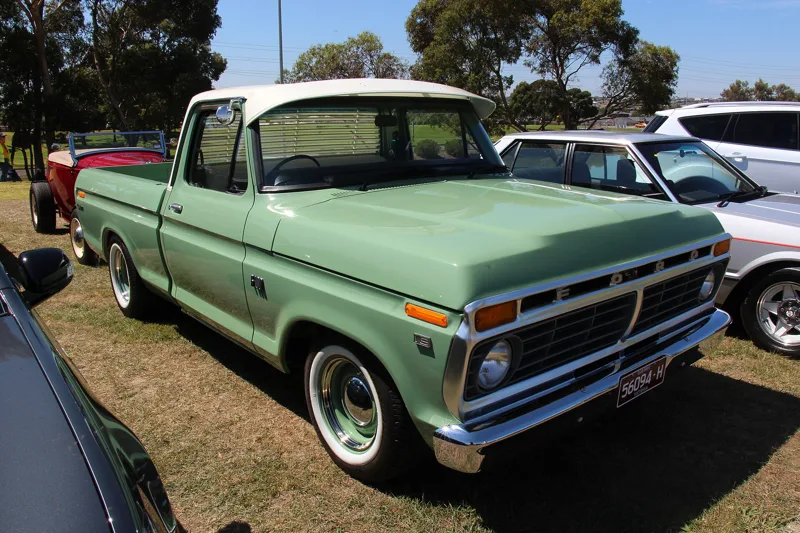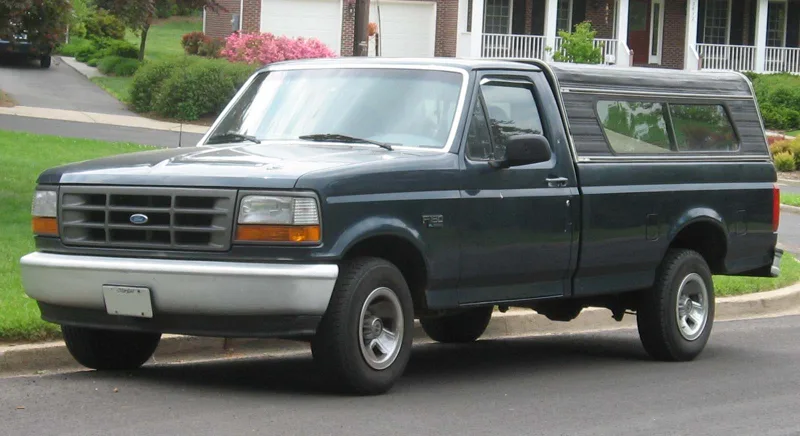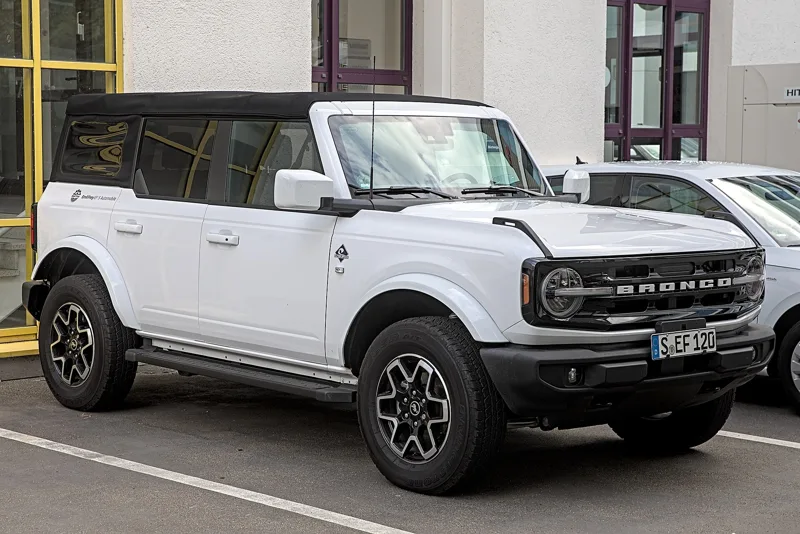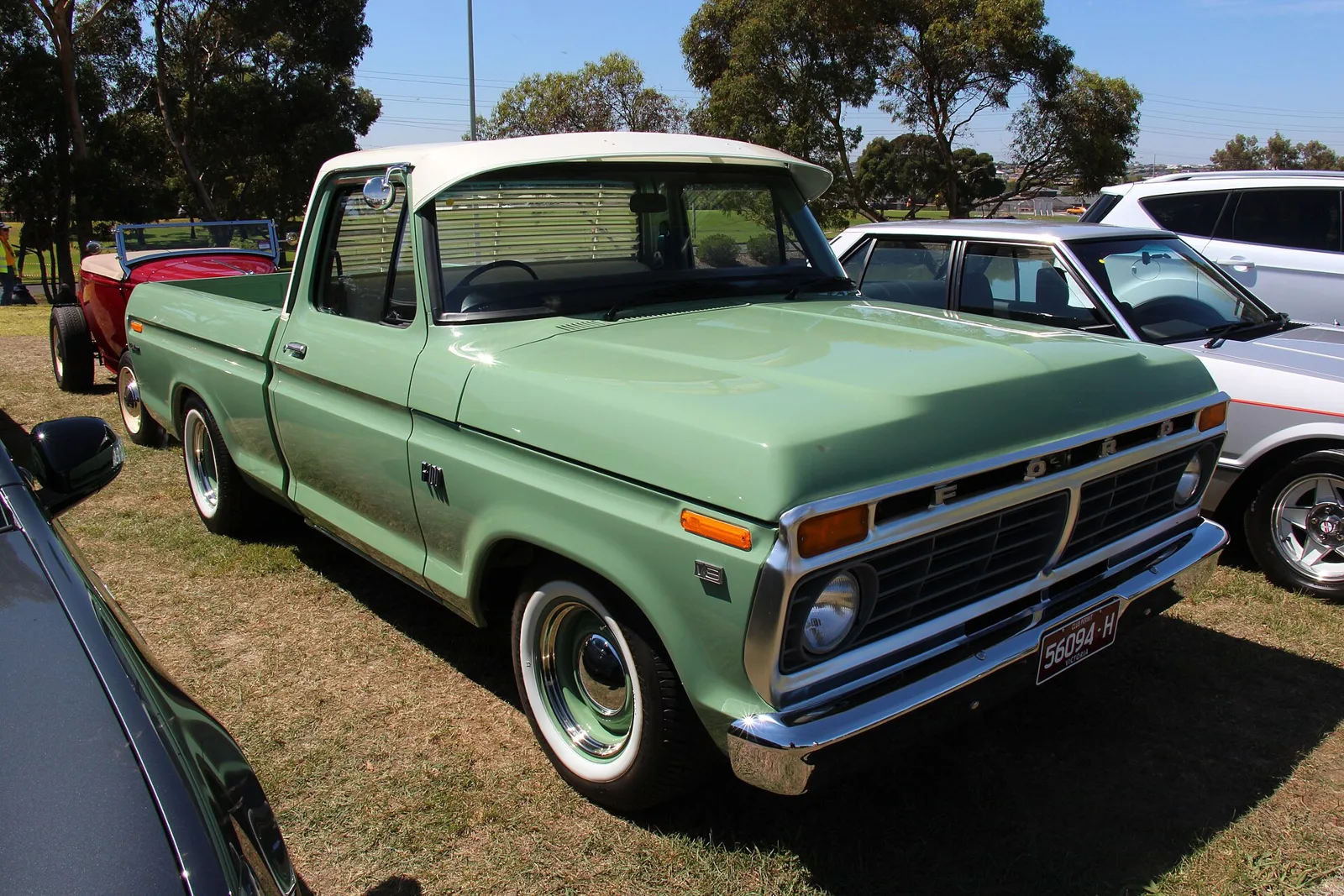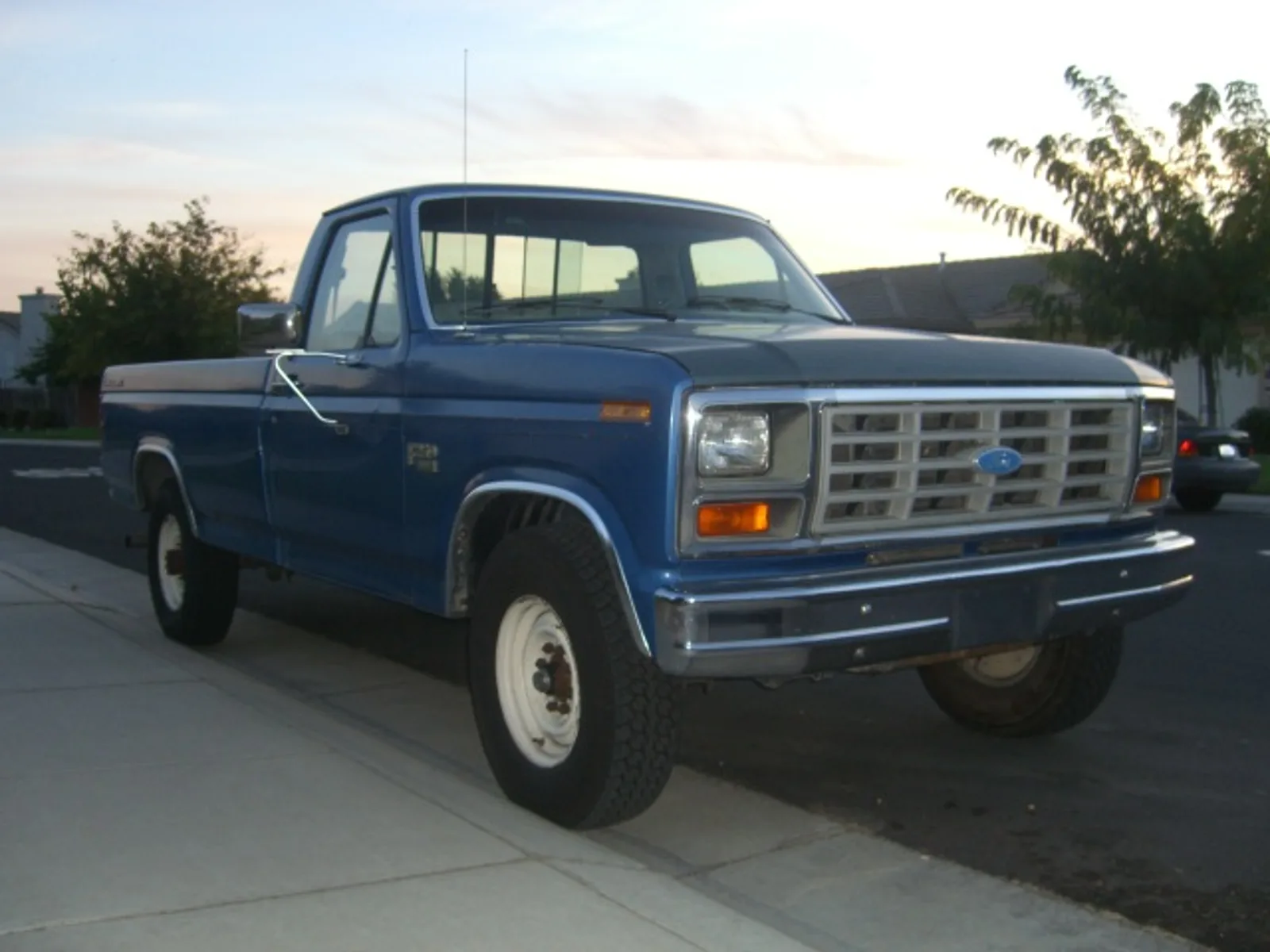
The first all-new F-Series since 1965 brought a bullnose front, the Blue Oval badge, a first diesel and a V6, and the end of the F-100.
The seventh-generation Ford F-Series was a 1980 to 1986 range with a completely new chassis and body. It gave the line its Blue Oval grille emblem, its first diesel and its first V6, and it provided the platform for the Ford Bronco.
The seventh-generation Ford F-Series was built from the 1980 to 1986 model years. It was the first complete redesign of the F-Series since 1965, with a new chassis and body, and enthusiasts still call its flatter, squarer front the bullnose. It also brought the Blue Oval grille badge and the line's first diesel engine, and it marked the end of the long-running F-100.
Why was the 1980 F-Series so different?
The seventh generation arrived with a completely new chassis and body. Its panels were flatter, its grille was squarer, and enthusiasts gave it the bullnose nickname. Ford did not downsize the trucks, as it had done with some of its large cars, because preserving payload capacity was central to the brief. Designers also kept the features that buyers had liked in the previous generation.
Two outside forces shaped the project. The 1979 oil crisis put fuel economy in the spotlight, and light trucks, including most F-Series models, became subject to federal fuel economy standards, known as CAFE. Corrosion was another priority. The previous generation had introduced plastic fender liners in 1977, and Ford went further by reshaping the cab and bed to reduce trapped road grime.
The F-Series architecture became the foundation for the eighth and ninth generations and lasted through the 1997 model year. It also underpinned the Ford Bronco from 1980 to 1996, and the line shared mechanical parts with the Ford E-Series. Production took place at several North American sites and at Ford Argentina and Ford Australia.
A ground-up redesign that kept payload at the centre of the brief, added a diesel and a V6, and then shared its platform with the Bronco.
What happened to the F-Series in 1980 and 1981?
The 1980 model arrived with a standard cab and the SuperCab extended cab. Functional updates included a column-mounted ignition switch and an interior hood release. The four-door crew cab was dropped, and a Six Wheeler dual-rear-wheel option was added for the standard cab F-350.
For 1981 the body and interior were largely carried over, while Ford concentrated on the powertrain. Radial-ply tyres became standard on all pickups, halogen headlamps were introduced, and the F-250HD arrived as a hybrid of the F-250 and F-350, with a GVWR above 8,500 pounds.
What did the 1982 and 1983 updates change?
For 1982 the front received a modest facelift. The grille was simplified and the Ford Blue Oval emblem was placed in the centre of it, replacing the FORD lettering on the hood. Fender badges were redesigned to emphasise the model series. The Ranger trim was dropped to make way for the new Ford Ranger compact pickup, and the Camper Special package was folded into the Trailer Towing package.
The four-door crew cab came back in 1983, although only on the single-rear-wheel F-350. The Free-Wheelin package became the stand-alone XLS trim, the sporty choice in the range. Because the F-100 was being overshadowed by the F-150 and the smaller Ranger, 1983 was its final year.
What changed for 1984 to 1986?
For 1984 the F-150 became the smallest model in the line after the F-100 retired. A clutch interlock was added so the engine could not start without the clutch pedal being pressed. Ford also used more galvanised and pre-treated steel panels to fight corrosion.
For 1985 the interior received a modest update, with new woodgrain and seat trim. The F-350 crew cab gained dual rear wheels as an option, and higher trims could be fitted with a brushed-aluminium tailgate overlay. For 1986 every truck received a full set of instruments, with only the tachometer left as an option, and two-tone paint options were trimmed back.
Which engines did the seventh-generation F-Series offer?
The standard engine in 1980 was a 4.9 L inline-six known as the 300 Truck Six. Optional V8s included a 4.9 L unit branded as a 5.0 L, a 5.8 L 351M and a 6.6 L 400. Ford removed the 7.5 L V8 from the range altogether. Transmission choice was a column-shifted three-speed manual, with a four-speed manual as an option, and the three-speed Select-Shift C6 automatic was the only automatic offered that year.
The engine line then grew and changed. A 4.2 L V8 arrived for 1981, exclusive to the F-100, with 115 hp, making it the smallest-displacement V8 on a modern American pickup. For 1982 a 110 hp 3.8 L V6 became the standard F-100 engine. It was the first V6 offered in the F-Series, and the smallest engine the line had offered since 1953.
In 1983 the 4.2 L V8 was discontinued and the 3.8 L V6 became the base engine for the F-100. The 5.8 L 351M and 6.6 L V8s ended, and Ford introduced a new 5.8 L 351W, the first F-Series engine with computerised engine controls. The 7.5 L V8 returned in the F-250HD and F-350, now available with four-wheel drive. The International 6.9 L IDI V8 became the first diesel in a light-duty F-Series.
The 5.8 L gained a high-output option in 1984, when a four-barrel carburettor lifted output from 150 to 210 hp. In 1985 the 5.0 V8 and 4.9 I6 received EEC-IV computer control, and the 4.9 V8 became the first Ford light-truck engine with fuel injection, adding 52hp. The 1986 engine line was virtually unchanged.
Were the suspension and axles different?
Two-wheel-drive trucks brought back the Twin-I-Beam independent front suspension. Four-wheel-drive trucks used the Twin Traction Beam, a variant of Twin-I-Beam in which one of the coil-sprung front I-beams carried the front differential. It was the first standard independent front suspension in a four-wheel-drive pickup.
The F-150 used a light-duty Dana 44 TTB at the front. From 1980 to 1984 the rear axle was usually Ford's 9-inch unit, and the 8.8 was phased in gradually. The 9-inch ended production in 1986 alongside the generation. The F-250 ran an eight-lug Dana 44 TTB, named TTBHD, with the Dana 50 TTB as an option, and used a Dana 60 rear axle until Ford moved to its own Sterling 10.25 in mid-1985.
The F-350 carried a Dana 50 TTB up front until mid-1985, when a Dana 60 solid front axle replaced it. The F-250HD took the Dana 70 single-rear-wheel axle from the F-350 from 1983. Factory lifts used 2-inch rear blocks, or 2-inch front and 4-inch rear on the heavier trucks.
How did the four-wheel-drive system work?
Four-wheel drive was offered on every version except the F-100. Trucks had manual front hubs, though automatic locking hubs were also available. The line used the New Process Gear NP208F transfer case or units from Borg-Warner. The system was a manual two-speed design, engaged by a stick with the positions 4 Low, 4 High, Neutral and 2 High.
What were the body styles and bed options?
All three cab styles carried over: the two-door cab, the two-door SuperCab and the four-door crew cab. The beds included a fendered six-and-three-quarter-foot Flareside, six-and-three-quarter-foot and 8-foot Styleside, and an 8-foot Six Wheeler Styleside for dual-rear-wheel F-350s. The 8-foot Flareside was dropped, along with wooden floorboards, and every truck received a steel bed floor. The Styleside bed interior was 5 inches wider than in 1979.
Aerodynamics drove the outside. The clamshell hood was retired because Ford faired the hood into the fenders, and the grille became flatter and more rectangular. The cab had larger windows and a more steeply raked windshield, and Styleside tailgates carried a central panel for the Ford lettering.
What was the interior like?
The two-spoke steering wheel was the one interior part carried over from the previous generation. The dashboard was larger and padded on every trim, the A-pillars and door panels received colour-keyed trim, and higher trims gained a full instrument cluster with a tachometer for the first time. Entry-level trims had black dash trim, while higher trims used imitation wood. The factory CB radio was dropped after 1980, and the 8-track player was withdrawn after 1982.
Which trim levels did the F-Series offer?
For 1980 and 1981 the trim names carried over from the 1973 to 1979 range. The Custom was the base trim, the Ranger and Ranger XLT were the mid levels, and the Ranger Lariat was the top. Everything except the Custom had wood-trim dashboards. The Camper Special and Free-Wheelin packages returned, and the sporty Free-Wheelin took on subdued pinstripes.
For 1982 the trims were reorganised. The Ranger name moved to the new compact pickup, and the Standard replaced the Custom. The XL took the Ranger's place, and the XLS became the sporty counterpart of the luxury-oriented XLT Lariat. In 1984 the XLS was dropped and the XLT Lariat was renamed XLT, and the Lariat name returned in 1985.
What about the medium-duty and Bronco variants?
The medium-duty F-600 through F-800 trucks were redesigned in 1980 for the first time since 1967. They adopted a trapezoidal grille and separate front fenders, which had not been used since 1957. The forward-tilting hood became available and soon outsold the earlier rear-hinged type. Power came from a 6.1 L (370) or a 7.0 L (429) V8, and diesels from Caterpillar and Detroit Diesel were offered before inline-six engines, eventually from Cummins, took over.
The third-generation Ford Bronco arrived for 1980 as the second model based on the F-Series. It was derived from the F-150 and shortened to a 104-inch wheelbase, and it competed with the Chevrolet K5 Blazer and the Dodge RamCharger. It shared its 4.9 L six and V8 engines with the F-150 4x4. In 1985 an outdoors-themed Eddie Bauer package appeared on the Bronco.
How was the seventh generation built overseas?
Ford Motor Argentina began local F-Series production in 1982 at General Pacheco. It built the F-100 pickup from 1982 to 1987, sharing its sheetmetal with the North American truck but using different engines, including a 3.3L Perkins diesel. The F-600 and F-700, later known as F-7000, were also built locally, and the medium-duty line ended there in 1990.
Ford Australia introduced the seventh generation in 1981, making it the third F-Series generation built in Australia. The Australian trucks used Falcon-derived powertrains, with a 4.1 L six as standard and a 5.8 L V8 available. They were built for right-hand drive and used dashboards sourced from Ford Canada.
What are the seventh-generation F-Series specifications?
| Specification | Detail |
|---|---|
| Model years | 1980 to 1986 in North America |
| Base engine, 1980 | 4.9 L inline-six, the 300 Truck Six |
| Largest V8, 1980 | 6.6 L (400) |
| V6 introduced, 1982 | 3.8 L, 110 hp, standard on the F-100 |
| Smallest V8, 1981 | 4.2 L, 115 hp, F-100 only |
| First diesel, 1983 | International 6.9 L IDI V8 |
| 5.8 L HO, 1984 | Output raised from 150 to 210 hp |
| Fuel injection, 1985 | 4.9 V8, adding 52hp |
| Bronco wheelbase | 104 inches |
| Argentine F-100 | Built 1982 to 1987; 3.3L Perkins diesel option |
| Australian standard engine | 4.1 L inline-six |
Read the table alongside the year-by-year notes above, as the engine line changed almost every year. The Argentine and Australian rows apply only to those markets.