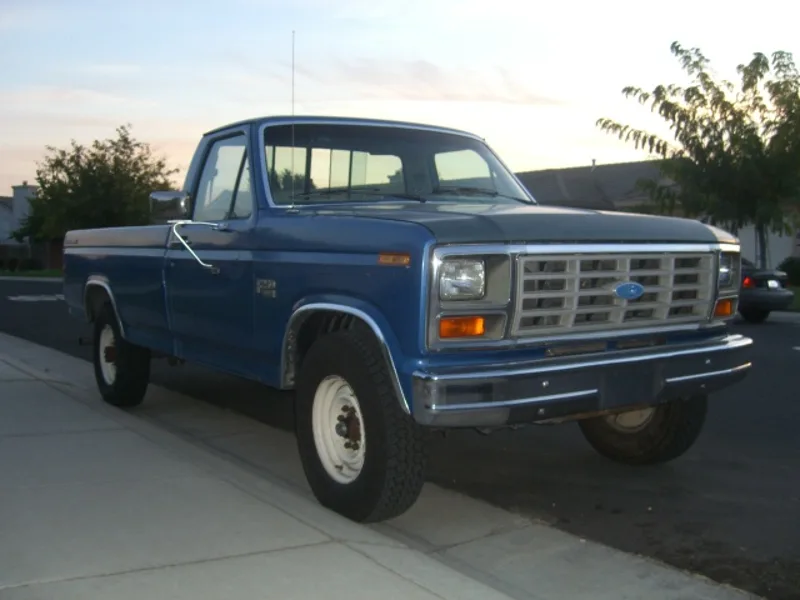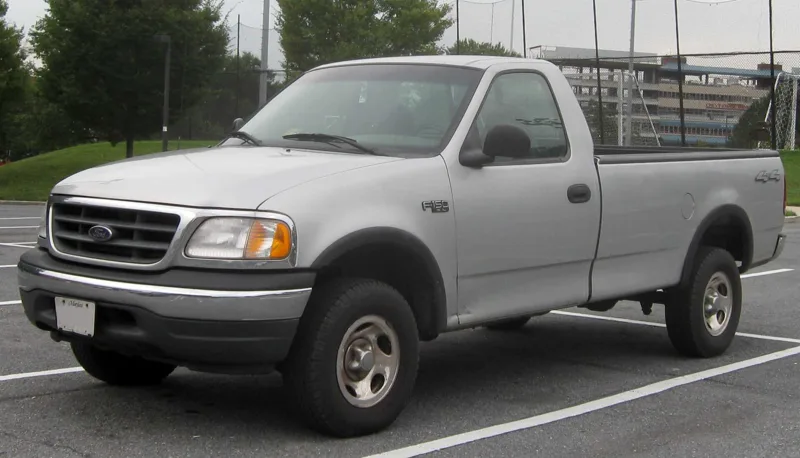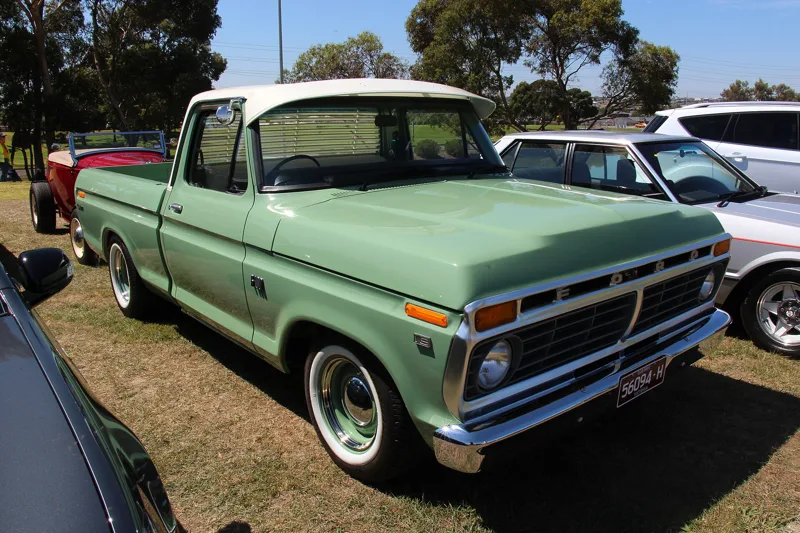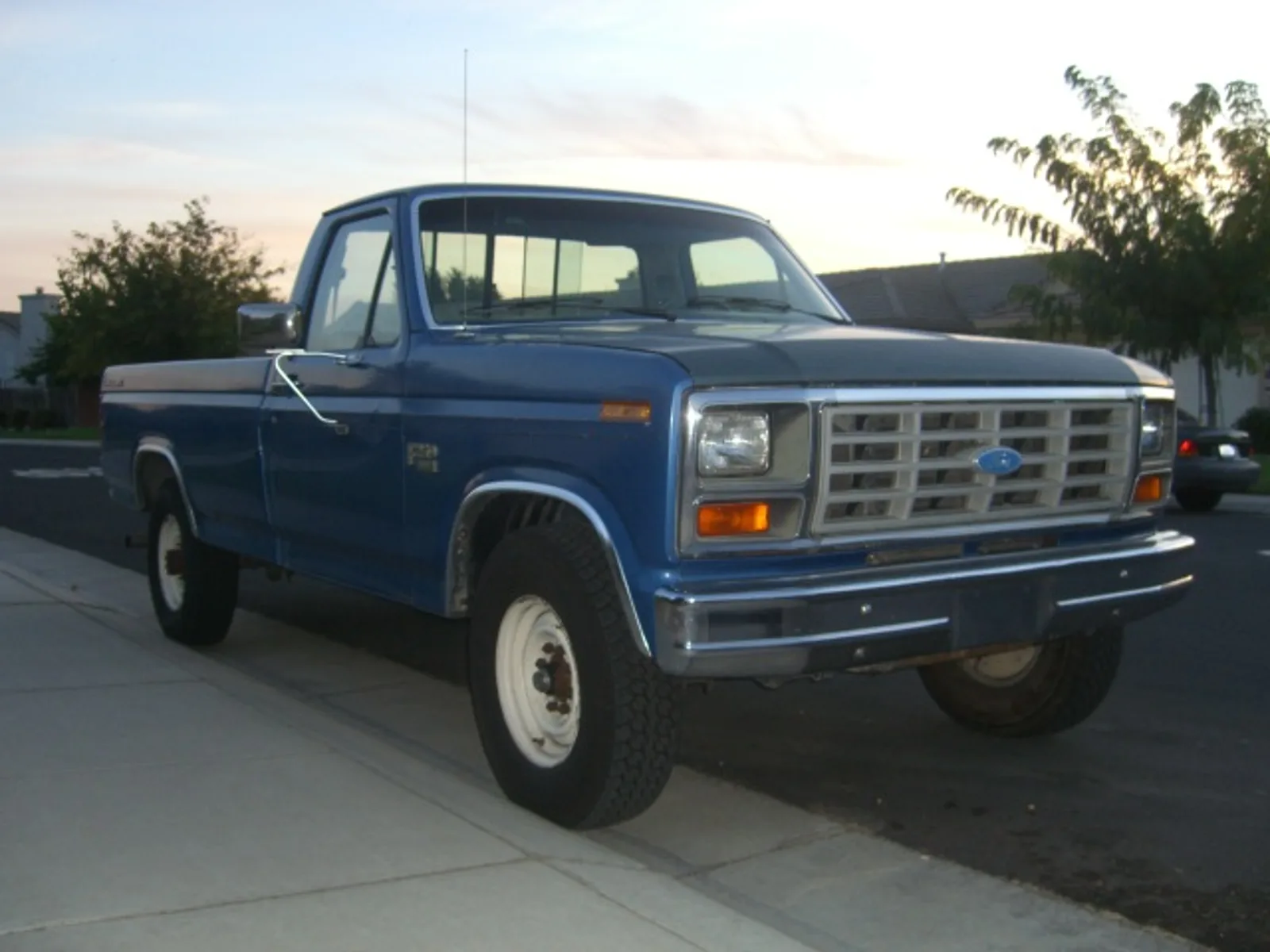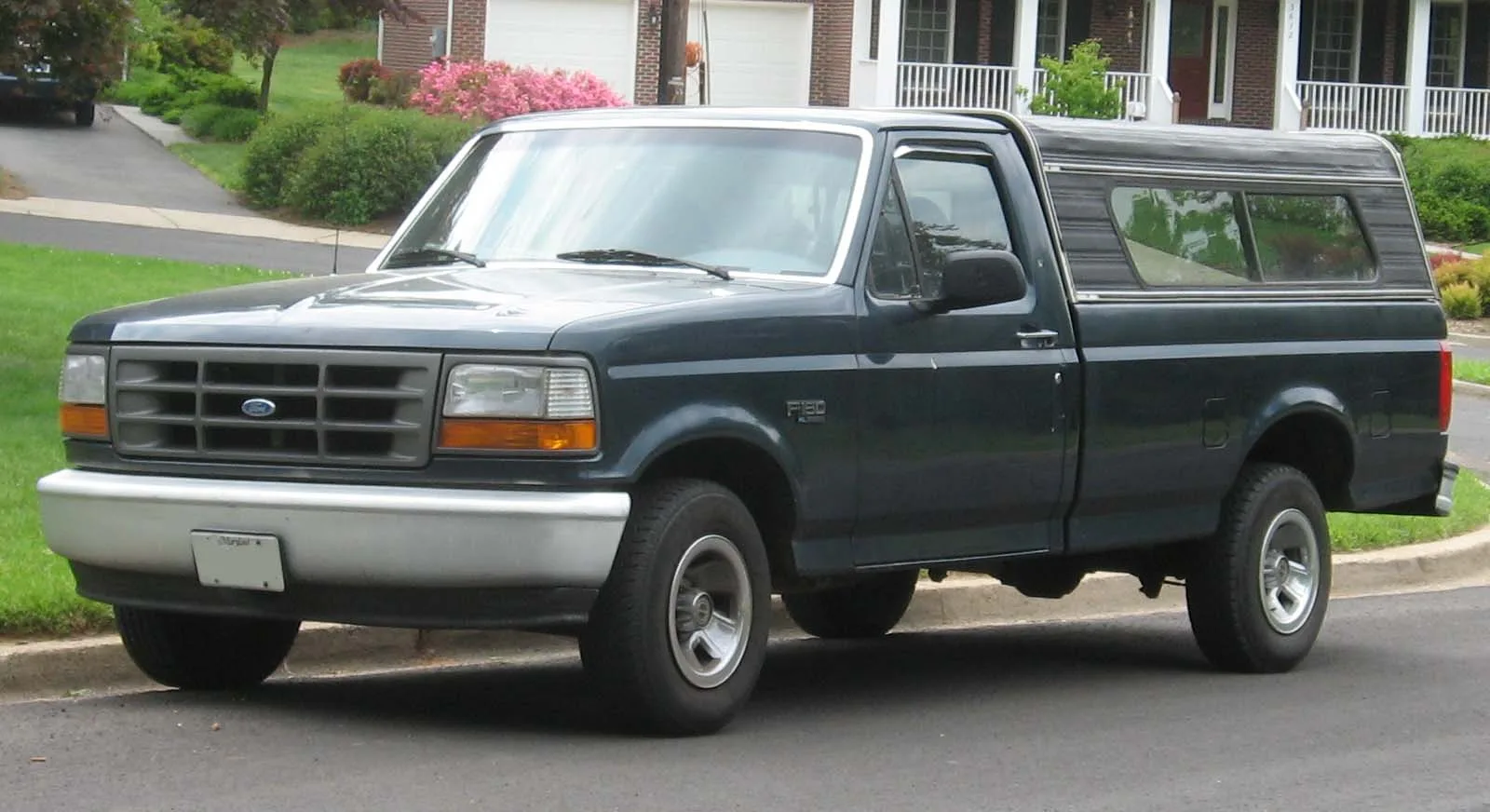
A rounded-off F-Series with a return of the Flareside bed, the first Power Stroke diesel and the 240 hp SVT Lightning.
Built between 1992 and 1998, this F-Series was the last generation to cover the whole truck range, from the half-ton F-150 to the F-800 medium-duty. It also brought back the Flareside bed and launched the 240 hp SVT Lightning.
The ninth-generation Ford F-Series was built from the 1992 to 1998 model years and was the last F-Series to offer a complete range, from the half-ton F-150 up to the F-800 medium-duty truck. It was the third generation of the body and chassis that Ford had introduced for 1980. It also gave the world the SVT Lightning, a high-performance F-150.
What did the 1992 redesign change?
The 1992 update was driven by aerodynamics. The hood, front fenders and grille lines were rounded off, and the front fascia was revised. The grille grew larger, the headlights were enlarged, and the turn signals moved down beneath them. Inside, the dashboard and seats were redesigned, and extended-cab SuperCab models received larger rear side windows.
The most talked-about change was the return of the Flareside bed, which had last been built in 1987. The new version was a narrow-body form of the dual rear-wheel bed, and the rear fenders were repositioned to match the cab width. Unlike the classic Flareside, the new bed could be ordered with dual fuel tanks, though only on two-wheel-drive models. The F-150 badges on the front fenders were swapped for Flareside badging.
Rounded lines, a returning Flareside bed and a 240 hp Lightning gave the ninth-generation F-Series a sharper identity in the early 1990s.
What changed for 1994?
The 1994 models brought a slightly updated dashboard and a standard driver's-side airbag, although only on the F-150 and the light-duty F-250. A centre high mount stop lamp, a brake-shift interlock and CFC-free air conditioning were added. Buyers could also specify remote keyless entry with an alarm, a compact disc player in the regular stereo, and a power driver's seat. An electrochromic rear-view mirror came as part of a luxury light package in 1994 and 1995.
How did the ninth-generation F-Series sell against GM?
For much of the generation Ford was behind General Motors in combined truck sales, although its figures climbed every year. Roughly 500,000 F-Series trucks found buyers in 1992, and the total reached almost 800,000 by 1996. That year Ford finally passed the combined truck sales of Chevrolet and GMC, something it had not managed for ten years.
Which trim levels were available?
The range started with the Custom, which was sold only in 1992 and included a cargo box light, tinted glass, an argent grille, steel wheels with hubcaps and a vinyl bench seat. The Special, for 1995 and 1996 on the F-150 only, followed the same specification. For 1993 the Custom was dropped and the XL became the base model, adding argent steel wheels, air conditioning and a cloth bench seat.
The XLT ran from 1992 to 1997 and added a black rub strip, a chrome grille, deep-dish aluminium wheels and carpeted map pockets. A monochrome Nite package, introduced in 1990, featured an all-black exterior with a pink or blue-purple stripe, and it was dropped at the end of the 1992 model year. The Eddie Bauer line arrived for 1995 on the F-150 only, bringing a slotted front bumper, Eddie Bauer floor mats, two-tone paint and forged aluminium wheels. It followed the lead of the Aerostar, Bronco and Explorer, which had already used the same kind of upscale treatment.
Where did the SVT Lightning come from?
The SVT Lightning was a performance-oriented F-150 engineered in Ford's Truck Division and sold through the Special Vehicle Team. It was introduced in 1992 to compete mainly with the Chevrolet 454SS and to add a sportier image to the F-Series. Its handling was developed with the help of Jackie Stewart, a three-time World Champion driver.
Ford launched the Lightning on 15 December 1992 through its president, Ed Hagenlocker. The model drew more than 150 favourable articles in newspapers, magazines and television, and it helped Ford hold on to its lead in the personal-use truck market. In the market it sat between rivals from Chevrolet and GMC, and it sold between 1993 and 1995 as an SVT model based on the XLT.
What made the Lightning different from a standard F-150?
The Lightning shared the F-150's basic platform, but Ford made many changes beneath it. A special 240 hp (179 kW) version of the 351 cu in (5.8 L) Windsor V8 replaced the standard engine. It used GT40 intake and high-flow heads, hypereutectic pistons for response and durability, and stainless steel shorty headers. Torque reached 340 ft lbf (461 N m).
The E4OD automatic was the only gearbox offered, and it was paired with an aluminium driveshaft and a 4.10:1 gear in a limited-slip differential. The suspension had custom-tuned shocks, front and rear anti-roll bars, and a rear leaf spring with a rubber snubber that acted as a traction bar and limited rear-wheel hop. The frame rails came from the four-wheel-drive F-250, and extra gussets were added at high-stress points. Stock, the Lightning managed 0.88 g of lateral acceleration, and it kept most of the F-150's towing ability.
Visually the car was distinct. It had 17-inch aluminium wheels with Firestone Firehawk tyres, Lightning badging, a front air dam with fog lamps, colour-matched bumpers borrowed from the Bronco, a 120 mph gauge and blacked-out trim. Bucket seats with electrically adjustable side bolsters and lumbar support came as part of the package. The ride height was lowered by 1 in at the front and 2.5 in at the rear.
Which engines did the ninth-generation F-Series use?
The 1992 redesign carried over the engine line-up from the previous generation. Its list ran from the 4.9 L inline-six through the 5.0 L and 5.8 L Windsor units to the 7.5 L big-block and the 7.3 L IDI diesel. The diesel gained a turbocharger in mid-1993, and the 1994 engine line-up was re-tuned to raise output.
Later in 1994 the IDI diesel was replaced by the T444E V8, which Ford called the Power Stroke and which was supplied by Navistar International. It had the same displacement as its predecessor but was an all-new design with direct fuel injection. It was the second light-duty truck diesel with electronic fuel injection, after the GM 6.5 L Turbo Diesel with its Stanadyne DS-4 pump, which had arrived in 1992. The Dodge Ram did not offer EFI on its diesel until 1998.
The ninth generation was also the last F-Series to offer the pushrod 5.0 L V8. The 5.0 L was not offered in trucks above 8,500 lbs GVWR, and the F-Super Duty was available only with the 7.5 L V8 or the diesel.
What were the GVWR and payload classes?
The F-150 was the half-ton with a maximum GVWR of 6,250 lb. The light-duty F-250 was a three-quarter-ton with a 6,600 lb GVWR and was offered only as a two-wheel-drive Regular Cab from 1992 to 1996. The F-250 HD was also a three-quarter-ton, with an 8,800 lb GVWR, and ran from 1992 to 1997.
The F-350 was a one-ton, rated at 9,200 lb GVWR on single-rear-wheel pickups and 10,000 lb on dual-rear-wheel models, with 11,000 lb for chassis cabs. The F-Super Duty chassis cab covered one-and-a-half tons and above, with a 15,000 lb GVWR. Those heavier trucks shared the generation's chassis but used heavier-duty axles.
Which axles and diesels were fitted to the trucks?
The F-150 4x4 kept the Dana 44 Twin-Traction Beam front axle from the 1980 to 1991 trucks, and it used the Ford 8.8 inch rear straight axle. The four-wheel-drive F-250 carried the Dana 50 Twin Traction Beam at the front and the Sterling 10.25 from the previous generation at the rear. The F-250 HD and the four-wheel-drive F-350 used the Dana 60 straight front axle, with a Sterling 10.25 inch straight axle at the rear.
The first diesel was the 7.3 L IDI V8 from International Harvester, built from 1992 to 1993.5. From 1993.5 to 1994.5 a turbocharged IDI with stronger internals was offered as emissions, power and torque demands rose. The direct-injected 7.3 L Power Stroke V8 (T444E) from Navistar arrived in the second half of 1994. Service technicians later called the earlier trucks OBS, or Old Body Style, to tell them apart from the later Super Duty parts.
How did the F-250 Heavy Duty change in 1997?
The F-250 wore Heavy Duty badging for 1997. It was only slightly different from the earlier F-250, with different moulding, the F-350 4407 transfer case, and more cab and bed options. The term was not a sign of extra capability. It separated the truck from the light-duty F-250, which was in fact a tenth-generation F-150 with seven-lug wheels.
After 1997 the heavier-duty models split from the F-150 line and became the 1999 Ford Super Duty. The F-150 came with a 6.5-foot short bed or an 8-foot long bed, in regular or extended cab. Short-bed F-250 HDs were available only with the 7.3 L Power Stroke or 7.5 L V8, and they were built for a little over a year. The ninth generation officially ended production in December 1997.
What happened to the medium-duty F-Series?
Starting with the F-800, Ford gave its medium-duty trucks new exterior styling in 1994, the first revision since their 1980 redesign. A tilting-cowl hood became standard, the turn signals moved beside the headlamps, and a single F-Series badge replaced the earlier model designations. The F-600 was discontinued for 1995, and the F-700 was refreshed that year before its own discontinuation in 1999.
Medium-duty trucks kept a 7.0L gasoline V8, although the 6.1L V8 had gone after 1991, and most models relied on diesels. Rather than the Navistar T444E used in the pickups, the medium-duty range used inline-six diesels from Caterpillar and Cummins. The F-800 ended in 2000, alongside the derivative B-Series bus chassis. Ford re-entered the segment that year with the F-650 and F-750 Super Duty, developed in a joint venture with Navistar.
How did the ninth generation compare with its rivals?
Rival performance trucks from Chevrolet and GMC set the bar, and the Lightning was built to answer them with a performance bias the regular F-150 lacked.
What were the ninth-generation F-Series specifications?
| Specification | Detail |
|---|---|
| Model years | 1992 to 1998 |
| F-150 GVWR | 6,250 lb, half-ton |
| F-250 HD GVWR | 8,800 lb, three-quarter ton |
| F-350 GVWR | 9,200 lb SRW; 10,000 lb DRW; 11,000 lb chassis cab |
| F-Super Duty GVWR | 15,000 lb, chassis cab |
| Lightning engine | 351 cu in (5.8 L) Windsor V8, 240 hp (179 kW) |
| Lightning torque | 340 ft lbf (461 N m) |
| Lightning lateral grip | 0.88 g stock |
| Power Stroke | 7.3 L T444E V8 turbo-diesel from Navistar, second half of 1994 |
| Early diesel | 7.3 L IDI V8 from International Harvester, 1992 to 1993.5 |
| Sales, 1992 | About 500,000 F-Series trucks |
| Sales, 1996 | Nearly 800,000 F-Series trucks |