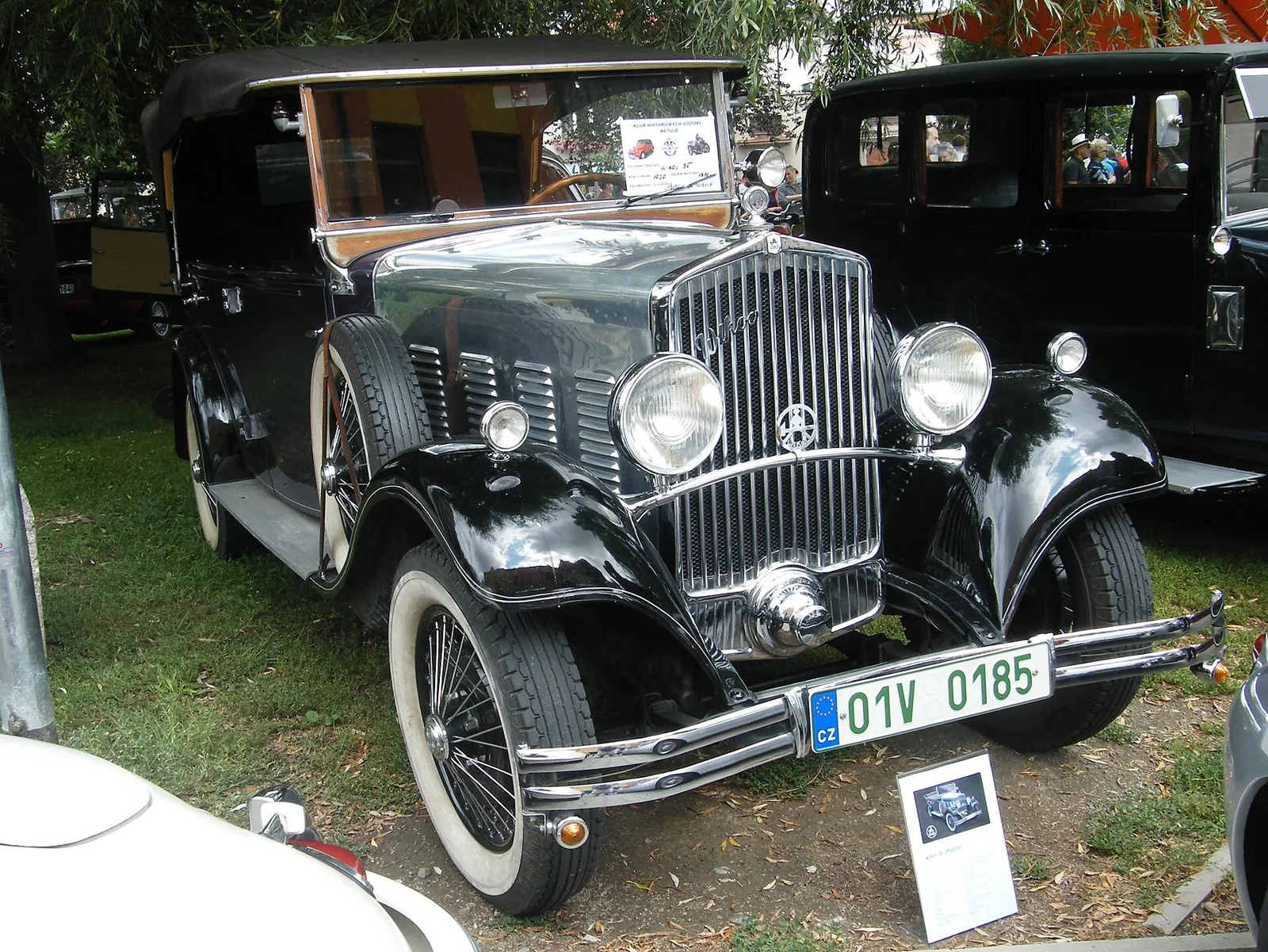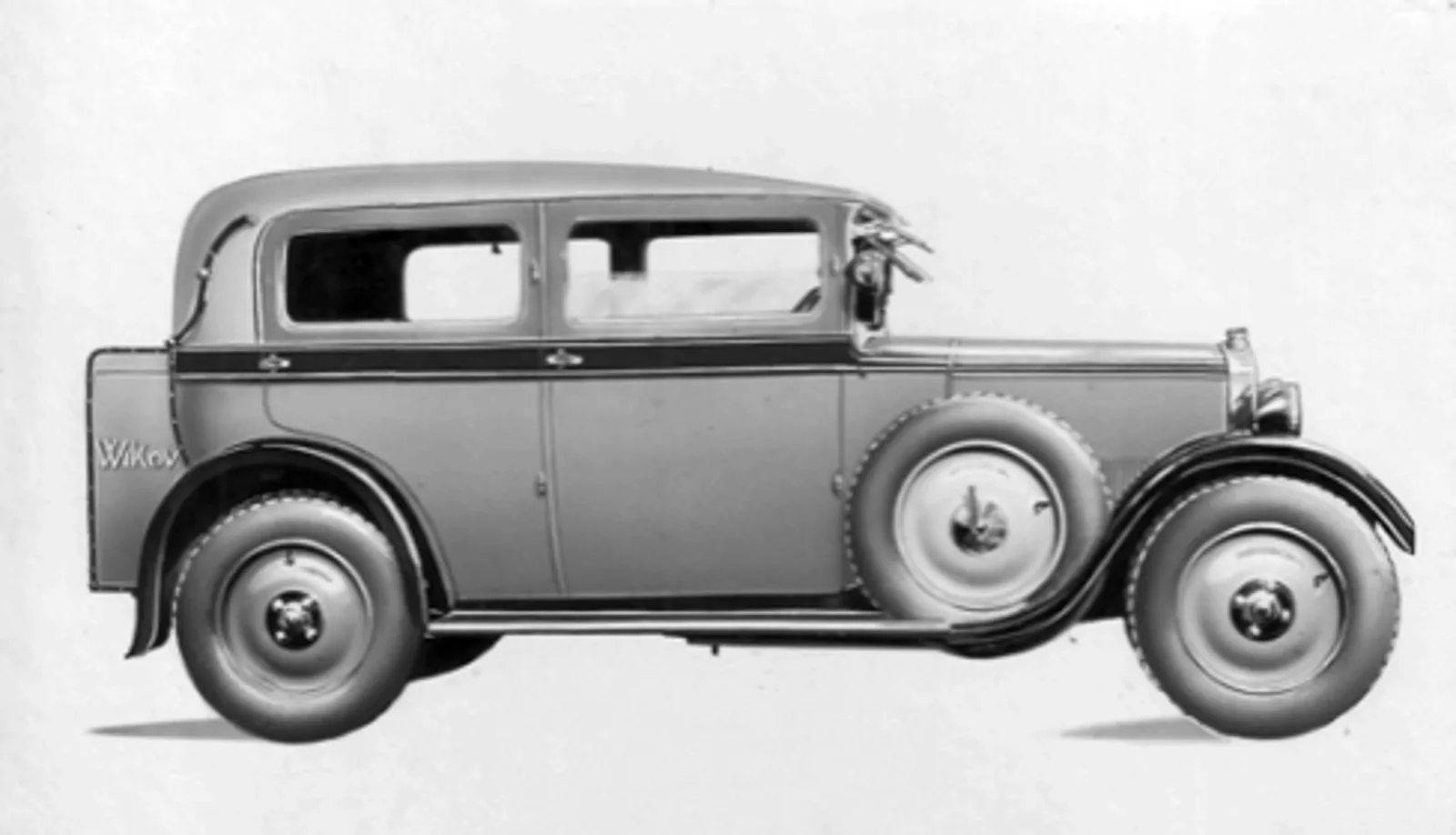
A Czechoslovak car from Prostejov that won reliability trials, was built in small numbers and had a light two-seat sports version.
Built from 1927 to 1932 at Prostejov, the Czechoslovak Wikov 7/28 used a 1,478 cc OHC four rated at 28 PS and came in ten body variants. It was known for its reliability-trial wins and for the Sport roadster that raced in hill climbs and circuit races.
The Wikov 7/28 was built by a Prostejov company better known for farm machinery. It was shown in Prague in 1927 with a 1,478 cc OHC four and ran until 1932 in a range of bodies, from four-seat tourers to a light sports roadster.
Where did the Wikov 7/28 come from?
Frantisek Wichterle founded the factory at Prostejov in 1878 to build agricultural machinery. Preparations for car production started there in 1922, and the first car was the Wikov IV/16, which led to the series-produced 7/28. Its name came from its tax rating, with 7 taxable horsepower and 28 maximum horsepower.
Leadership of the car-making side went to two men: Frantisek Kovarik Jr., whose father was Ing. Josef Kovarik, and Eugen Wichterle, whose father was Lambert Wichterle. From 1926 the design office was headed by Ing. Boleslav Hanzelka, an engineer who had gained experience at Tatra and later worked for the Pearl car maker in Vienna-Liesing.
The new model was shown to the public at the XIX. International Motor Show in Prague, early in September 1927. The type had been built since 1925, it is said, and it was modernised in 1929 with engine and chassis updates.
A small Czechoslovak car that won reliability trials and raced in a sports version.
How good was the Wikov 7/28 engine?
The engine was a water-cooled, four-stroke, in-line four with overhead camshaft valve gear. Its 1,478 cc (90.2 cu in) capacity came from a 66 mm bore and a long 108 mm stroke, and it gave 20.6 kW (28 PS; 28 hp) at 2,600 rpm, with maximum torque of 98 Nm (72 lb ft) at 1,800 rpm.
For its time the engine was a modern design. The pistons were made of electron alloy, and the connecting rods of drop-forged duralumin. The cylinder head was cast iron, with slightly inclined overhead valves, and the replaceable cylinder liners were hardened steel. The lower part of the two-piece crankcase was cast from aluminium alloy.
The valve gear gave every cylinder the same compression, under a Wikov patent. The camshaft was driven by helical gears from the front of the crankshaft, and the crankshaft ran in three plain bearings. Ignition was battery-based, with Bosch equipment on a 12 V system, and the water cooling used a thermosiphon with no pump, helped by a fan.
Later, from 1929, the compression ratio was raised slightly and the Zenith carburettor was changed, lifting the output to 23.5 kW (32 PS; 32 hp) at 3,000 rpm. The original iron block was swapped for a silumin casting with dry steel liners, and maximum speed rose to between 90 and 100 km/h (56 and 62 mph).
What were the Wikov 7/28 specifications?
| Item | Detail |
|---|---|
| Engine | Water-cooled in-line four, OHC, 1,478 cc (90.2 cu in), bore 66 mm, stroke 108 mm |
| Output (original) | 20.6 kW (28 PS; 28 hp) at 2,600 rpm |
| Output (from 1929) | 23.5 kW (32 PS; 32 hp) at 3,000 rpm |
| Torque | 98 Nm (72 lb ft) at 1,800 rpm |
| Fuel tank | 40 litres in the engine compartment, fed by gravity |
| Wheelbase (1926) | 2,750 mm (108.3 in) |
| Track (1926) | 1,210 mm (47.6 in), later 1,250 mm |
| Four-seat length and width | 4,000 mm (157.5 in) long, 1,480 mm (58.3 in) wide |
| Weight | 950 kg (2,094 lb) with open four-seat body; chassis 750 kg |
| Six-seat weight | 1,050 to 1,100 kg |
How was the Wikov 7/28 chassis built?
The chassis was a sturdy rectangular ladder frame riveted from pressed U-section steel with five cross-members. The engine sat at the front along and behind the front axle, and the rear wheels were driven. The steering was right-hand, and the front I-section axle was drop-forged from chrome-nickel steel.
Both axles were rigid and sprung on longitudinal semi-elliptic leaf springs. The rear banjo axle used Gleason spiral bevel gearing and was bolted together from pressed sheet steel. The brakes were mechanical at first, then changed at the end of 1929 to a Lockheed hydraulic system, which acted on all four wheels, with a hand brake on the rear.
The 1929 modernisation brought hydraulic dampers, which were not common on Czechoslovak designs at the time. Wikov was also one of the first Czechoslovak makers to adopt low-pressure balloon tyres, size 730 x 130 mm, in place of 14x15 inch tyres. Wire wheels by Rudge-Whitworth were offered for an extra charge.
Which Wikov 7/28 bodies could buyers order?
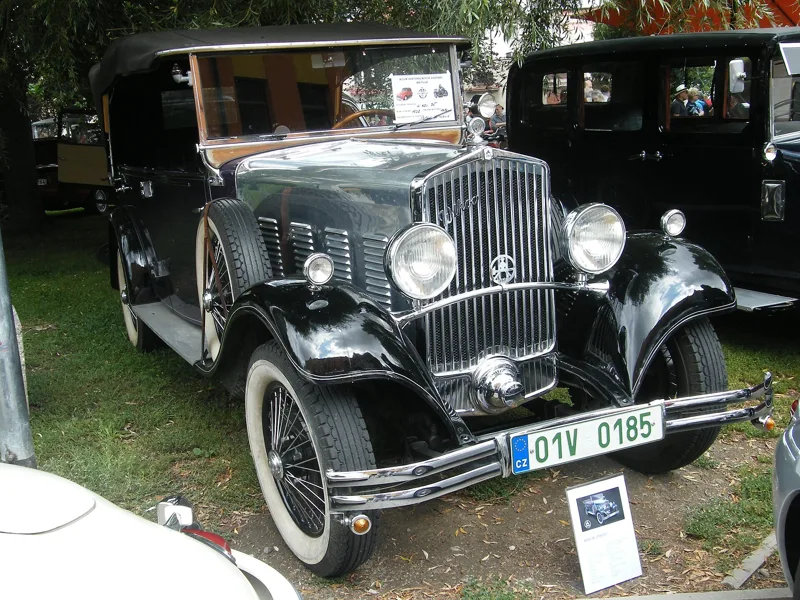
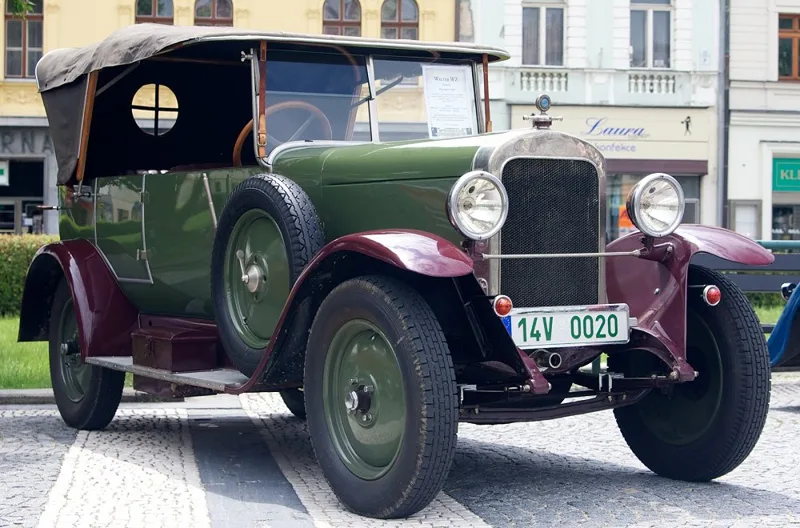
Wikov bodies were composite: a wooden frame clad in thin, deep-drawn sheet metal. Buyers could pick from ten versions, varying in wheelbase length and body type. Open bodies included the phaeton, roadster and cabriolet, while closed types included the coach, tudor, sedan, limousine and landaulet.
Utility variants included flatbed trucks for a payload of up to 750 kg, along with ambulances. Specialist fire-service firms bought the chassis in small numbers, including the Sigma pump works at Lutin and the Hrcek and Neugebauer company at Brno-Kralovo Pole.
The specialist press called the bodies elegant, with a plain, smooth and flat line that kept air resistance low. The body was 2,310 mm (90.9 in) long, with 203 mm (8.0 in) of ground clearance. A Webasto sliding roof could be ordered on the closed bodies, and from 1929 the bodies took on a more rounded roof.
How many Wikov 7/28 were built and sold?
Wikov never planned for more than tens of units. In February 1930 Czechoslovakia had 128 Wikov passenger cars in service, plus 8 vans and one ambulance. In 1932, when production of the 7/28 was essentially over, the company sold 112 cars on the domestic market.
Tatra, with 3,337 cars, Praga with 3,243, Skoda with 2,508, Aero with 1,321, Zetka with 377 and Walter with 374 all sold more in that market. Wikov's share of Czechoslovak domestic car sales that year was about one percent.
Between 1927 and 1932 about 280 cars of this type left the factory. Prices ranged from 51,000 Kc for the four-seat open phaeton to 63,000 Kc for the six-seat limousine. Larger limousines reached 80 km/h (50 mph), while smaller cabriolets and coupes reached up to 90 km/h (56 mph).
How did the Wikov 7/28 perform in reliability trials?
Wichterle's company valued its cars for reliability and power, qualities that its engine design delivered. Those strengths produced wins and top placings in reliability events across Bohemia, Moravia and Slovakia, and abroad in Poland and Austria.
At the Moravian reliability trial of 20 and 21 April 1929, all five starting Wikov 7/28 cars finished a 630 km route without penalty points, and the company won two team prizes, two gold plaques and seven silver plaques. At the East Bohemian rose-badge run on 16 June 1929, both Wikovs finished a 612 km route without a penalty.
The Luhacovice automobile days in August 1929 brought more success. Eugen and Frantisek Wichterle, B. Gardavsky and Ing. K. Vaclavik reached the finish without penalty points. In the tournament for cars over 1.4 litres, Eugen Wichterle won and Frantisek Wichterle came second.
Ministry of Defence tournaments tested passenger cars for possible military use. Out of ten held in 1929, the Wikov 7/28 finished first nine times.
What was the Wikov 7/28 Sport?
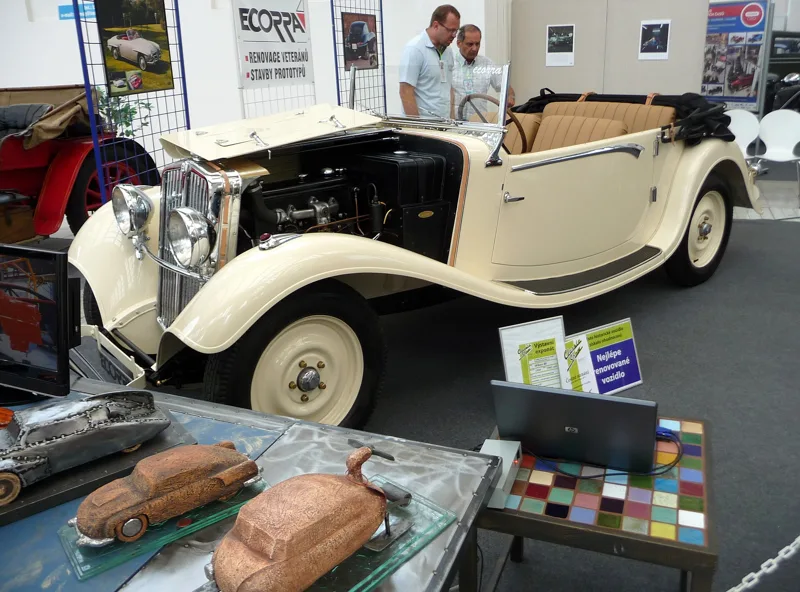
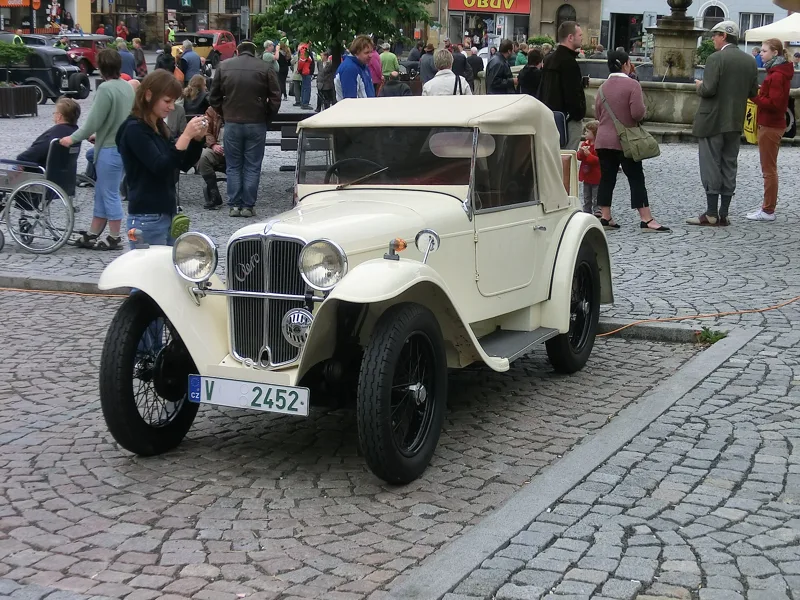
The Sport was a two-seat open sports roadster with the engine at the front and rear-wheel drive. Its chassis was shortened and lightened, and it used a three-speed gearbox, later a four-speed. The engine produced 29.4 kW (40 PS; 39 hp) and reached 130 km/h (81 mph), with fuel use of about 12 L/100 km (23.5 mpg-imp; 19.6 mpg-US).
Only four Sport cars were built in 1928. The Super Sport followed as a 1931 modification of the Sport, with a radiator set slightly at an angle, hydraulic brakes and the doors removed. Its output rose to 33 kW (45 PS; 44 hp), and it reached 140 km/h (87 mph). Its weight fell to 830 kg (1,830 lb), from 900 kg (1,984 lb) on the Sport.
Several Sport cars survive to this day. The earlier cars had an upright radiator, while the later ones had the radiator set at a slight angle. The Sport's two-seat open body gave it a number of notable sporting results.
How did the Wikov 7/28 Sport race?
The first race outing of the raw car, without mudguards or headlamps, at the III edition of the Pradsky circuit event in 1928 was not successful. The works drivers Adolf Szczyzycki and Jaroslav Konecnik did not finish the first lap at Karlova Studanka on 3 June 1928.
The second outing went much better. Szczyzycki won the sports cars up to 1500 cc class at the Ecce Homo hill climb on 22 September 1929 and finished 23rd overall. At the Zbraslav-Jiloviste race of 11 May 1930, interest centred on the duel between Stuck and Caracciola, and Ing. Jiri Weinfurter won the national class up to 1500 cc in 4:22.9 min.
At the Ecce Homo race of 1930, Szczyzycki again won the sports class on a Wikov 7/28 Sport and finished 13th overall. He cut his previous year's time by almost 20 seconds, to 6:59.60 min, and set the fastest time of all cars without a supercharger.
Szczyzycki also won his class at the 1931 Zakopane hill climb, on 10 August, with a course record time of 7:14.07 min. The touring version's last sporting success came at the first 1000 Miles of Czechoslovakia in 1933, where Jiri Kreml and Vitezslav Valek took second place in the class up to 1500 cc in a four-seat closed car.
Racing successes in 1931
At the 14th Zbraslav-Jiloviste race on 31 May 1931, Szczyzycki set a time of 4:17.48 min. That gave him 31st overall and third among sports cars up to 1500 cc, with two Bugattis ahead of him.
On 7 June 1931 Szczyzycki also drove a Wikov 7/28 Sport in the Lviv Grand Prix, a non-championship race in the 1931 Grand Prix season. He finished 4th overall, and 2nd in his class, after 43 of the 50 laps had been completed. Hans Stuck won the race in a Mercedes-Benz SSK.
The same day brought the III edition of the Ostrava circuit in the Belsky les, where cars started alongside the motorcycles for the first time. In the cars' black-diamond contest, Jiri Kreml took the win in his Wikov 7/28 Sport, with Siebenschein (Lancia) and Kadlcak (Zetka) behind him. At the Barrandov hill climb on 12 July, Weinfurter took third in the class of sports cars up to 1.5 litres behind two Bugatti cars.
At the autumn star run to the Prague motor show, Weinfurter won the class up to 2000 cc in a sports Wikov 7/28 Sport with 790 points, and took second overall behind Stanislav Kafunek in an Aero 662.
What was the Wikov 7/28 Super Sport?
The Super Sport was the later modified version of the Sport. Two of the earlier Sport cars were converted by the factory in 1931.
Jiri Kreml adapted a Sport for touring use in 1934, adding front and rear mudguards and cutting out the body to fit doors on both sides. Kreml and Landauf finished outside the time limit, so they were left unclassified in the class up to 1.5 litres.