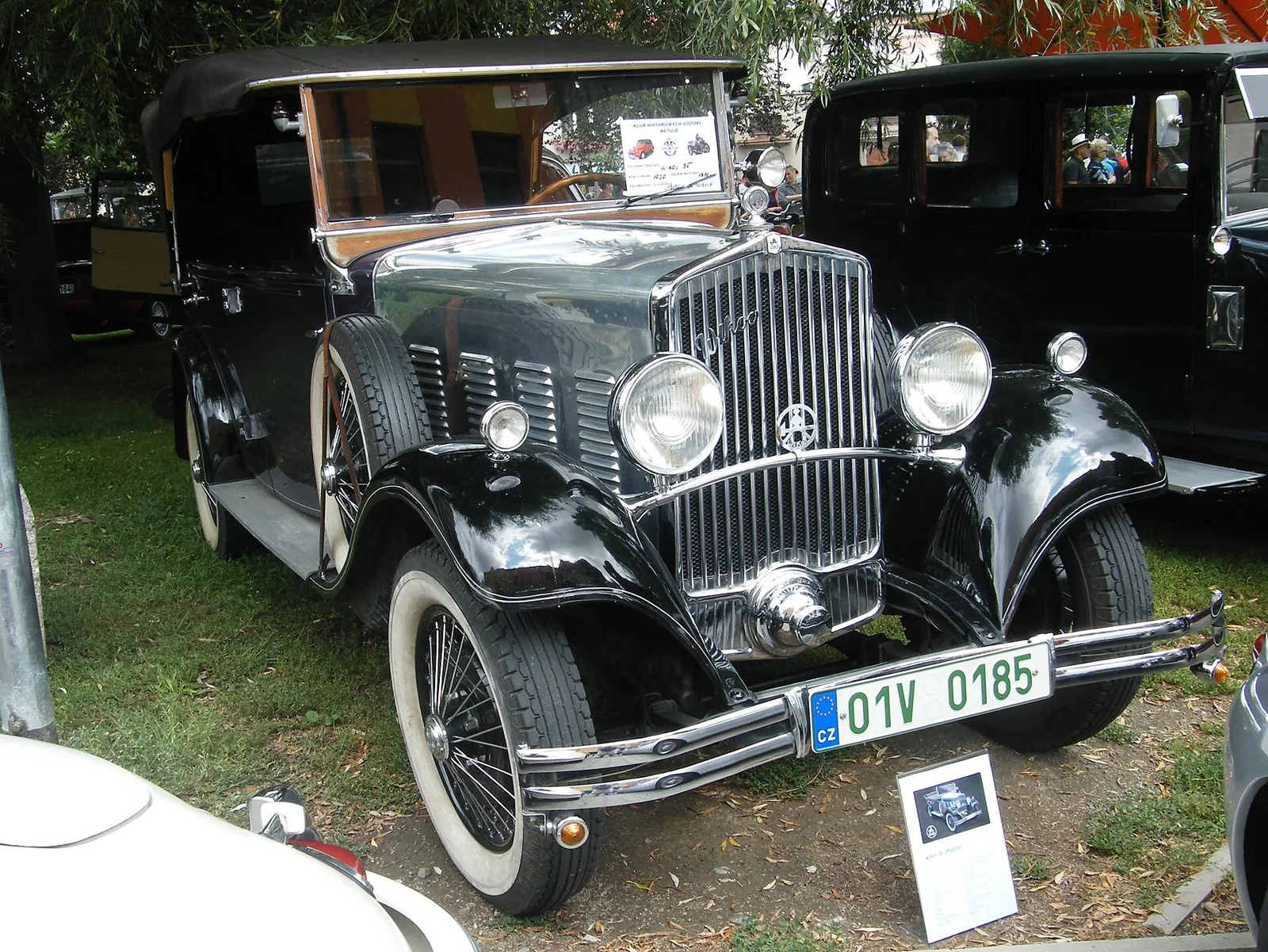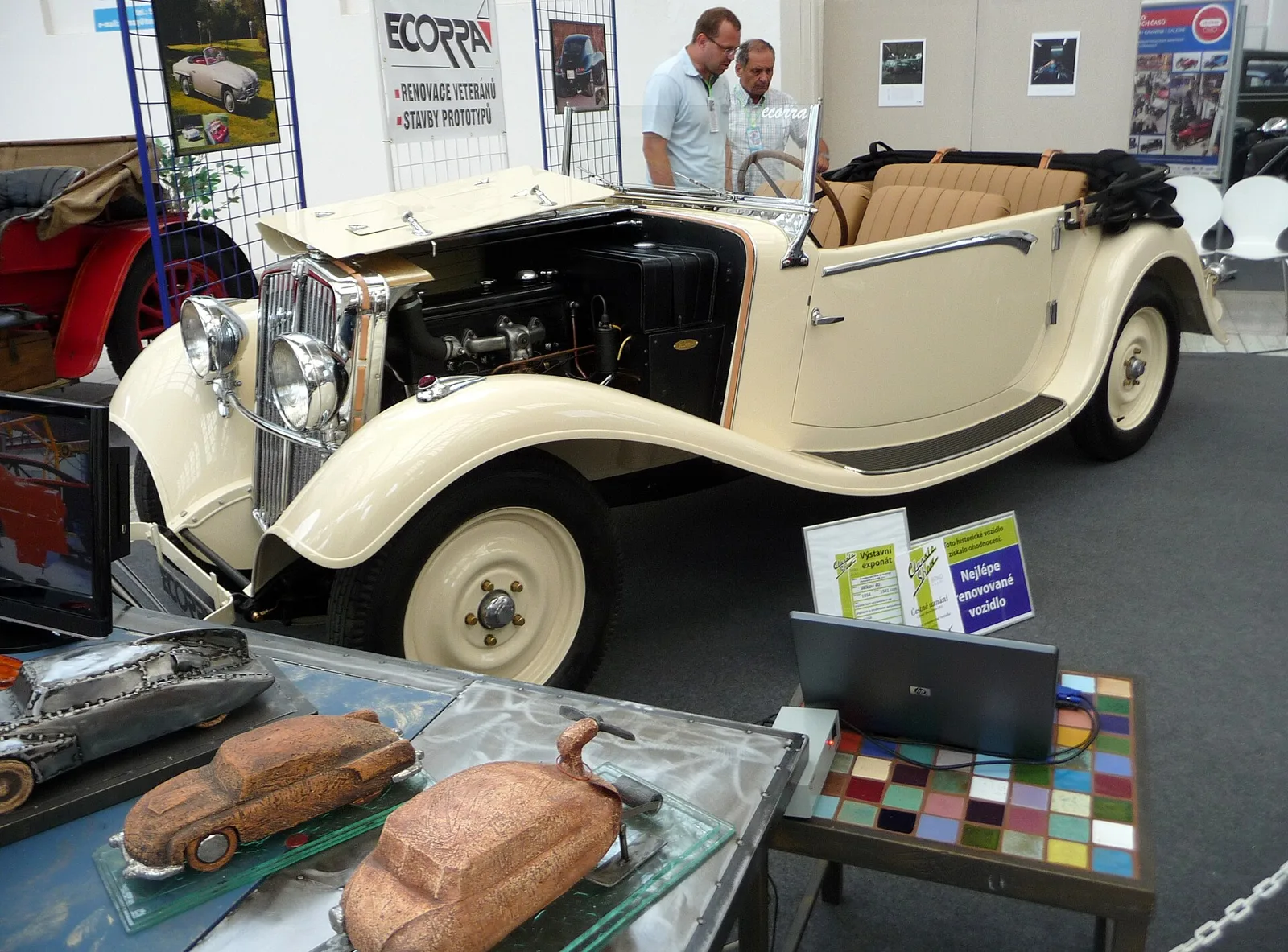
Wikov's last series-built car: a 1,941 cc overhead-camshaft four, a range of saloons and convertibles, and a racing record from 1933.
The Wikov 40 was the last car series-built by the Wichterle and Kovarik company at Prostejov. It used a 1,941 cc overhead-camshaft four-cylinder engine producing 43 PS (32 kW; 42 hp), came in several bodies, and was built from 1933 to 1937, although the company quit car production in 1936.
Wikov was a works that also made tractors, locomotives and electric motors, and its car of the years 1933 to 1937 was the 40. Its engine was larger than that of the Wikov 35 it followed, and the four-door Standard saloon became the most common version of a range that ran from saloons to convertibles.
Where did the Wikov 40 come from?
The Wikov 40 was developed from the earlier Wikov 35 and differed from it mainly in its engine. The new unit displaced 1,941 cc (118.5 cu in), where the Wikov 35 had 1,742 cc (106.3 cu in), and a few new elements and improvements were added. Designers Maly and Kostal worked under Ing. Boleslav Hanzelka and followed developments abroad closely.
The works was headed by Ing. Frantisek Kovarik, whose father was Ing. Josef Kovarik, and by Eugen Wichterle, whose father was Lambert Wichterle. Both men ran a works that also built machinery, tractors, locomotives and stationary and electric motors alongside its cars.
After its official type test, the Wikov received approval on 16 June 1932 for a chassis with a three-metre wheelbase, a maximum body length of 4 metres and a total weight of 850 kg (1,874 lb). The type 40 made its official debut in spring 1934 at a Prague motor show held from 7 to 15 April, after a two-year gap with no show.
A 1,941 cc overhead-camshaft four, and a range of bodies from the family Standard to a bespoke convertible.
How much power did the Wikov 40 make?
The Wikov 40 produced up to 43 PS (32 kW; 42 hp) at 2,800 rpm from its 1,941 cc four-cylinder engine, with 131 Nm (97 lb ft) of torque at 1,600 rpm. Its top speed was 105 km/h (65 mph), and a later modernised engine raised it to 110 km/h (68 mph).
| Specification | Wikov 40 |
|---|---|
| Engine | Inline four-cylinder, overhead camshaft, two valves per cylinder |
| Displacement | 1,941 cc (118.5 cu in), bore 76 mm, stroke 107 mm |
| Power | 43 PS (32 kW; 42 hp) at 2,800 rpm |
| Torque | 131 Nm (97 lb ft) at 1,600 rpm |
| Compression ratio | 5.2, without supercharging |
| Engine weight | 132 kg |
| Top speed | 105 km/h (65 mph), later 110 km/h (68 mph) |
| Kerb weight | 1,200 kg (2,646 lb) |
The engine was largely unchanged in its design from the Wikov 35, apart from a bore enlarged by 4 mm from the original 72 mm. Its water-cooled block sat at the front, and the cylinder liners were pressed in and honed, which gave the engine both solid output and considerable durability.
Performance came from the shape of the combustion space rather than from capacity or thirst. The Ansaldo-type chamber gave equal compression in every cylinder, and a downdraught carburettor, a Zenith U, 30 TD or Solex 30 AVR, lifted the output to 33 kW (45 PS; 44 hp).
How was the Wikov 40 engine built?
The block and the crankcase cover were cast from an aluminium and silicon alloy known as silumin. The pistons were cast from electron, a magnesium alloy with 10 percent aluminium, and the connecting rods were drop-forged from duralumin. The cylinder head was the only part made from heavier material, in cast iron.
The camshaft sat above the cylinders on three bearings and was carefully balanced both statically and dynamically. A three-row roller chain with a tensioner drove it, and the overhead valves were slightly inclined. Lubrication came from a gear pump with a full-flow felt filter, using an 8 l sump, and oil consumption ran between 0.2 and 0.23 L/100 km.
Power went back through a three-speed gearbox, a cardan shaft with two enclosed universal joints, a bevel differential and a spiral Gleason final drive in the rear axle. The gears were synchronised from 1935. The electrics used two 6 V (12 V) Varta batteries of 75 Ah, a Bosch RJC 12 dynamo and a Bosch BJH 06/12 starter.
How were the chassis, brakes and steering set up?
The chassis was built on a frame with two long main members, which received lightened pressed reinforcements at the weak points. The frame was reinforced by welding the U-section into a box shape, which made it much stiffer, and the chassis was rigid enough for a patented screw jack to slot into a guide on the running board.
The car had conventional rigid axles front and rear, sprung on semi-elliptic leaf springs with Doko oil shock absorbers. Hydraulically operated Lockheed drum brakes worked on all four wheels, and Willi Vogel central lubrication served the chassis. Steering was a worm type with no power assistance.
Wheels were disc or wire, and carried balloon tyres of 5.50-18, 6.00-16 or 6.50-16 inches, or super balloon tyres of 7.00-16 inches on 18-inch disc wheels, later 16-inch. Chassis weight alone was 780 to 870 kg (1,720 to 1,918 lb), and the extended version with the longer wheelbase weighed 950 kg (2,094 lb).
Which side of the road was the Wikov 40 built for?
The Wikov 40 came with left-hand steering. A draft road law requiring drivers to keep to the right was under discussion in parliament, and by 1932 Europe outside Hungary and England already drove on the right.
The law only took effect in the turbulent days of March 1939, a delay that was not the fault of Wikov. The instrument panel carried an ignition switch box, a speedometer with daily and total odometers, an eight-day clock, an oil pressure gauge, and a lever for setting the ignition point and the carburettor starting flap.
What bodies did the Wikov 40 wear?
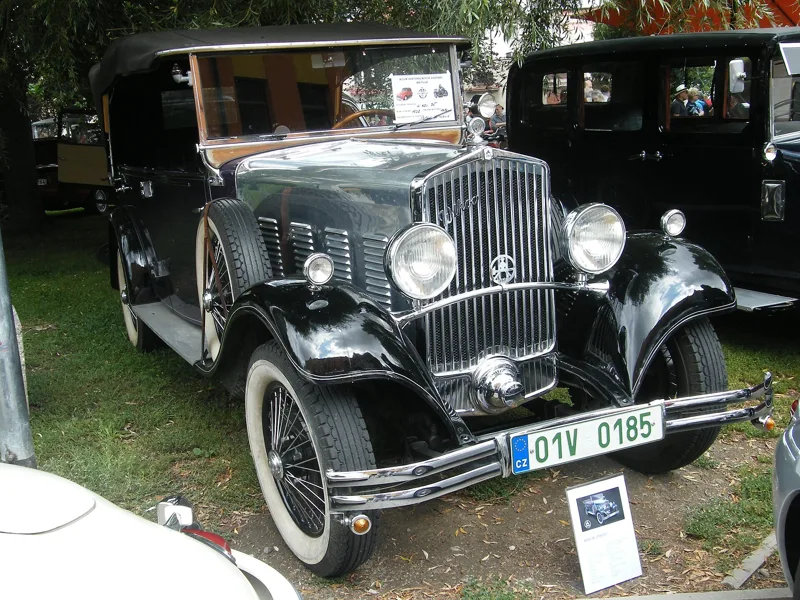
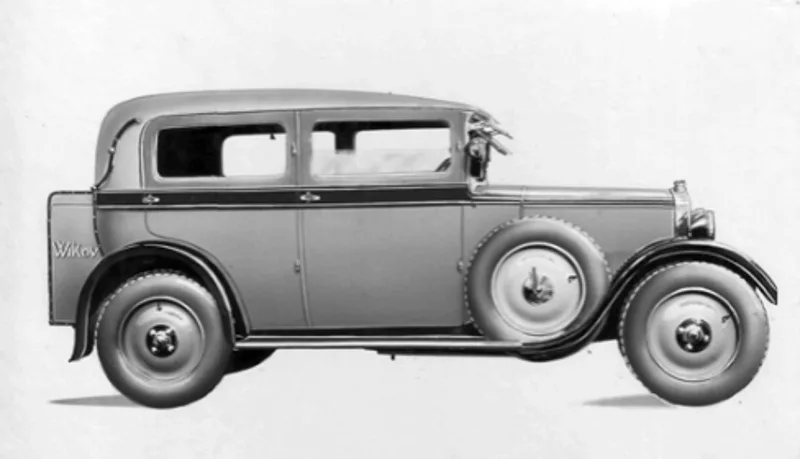
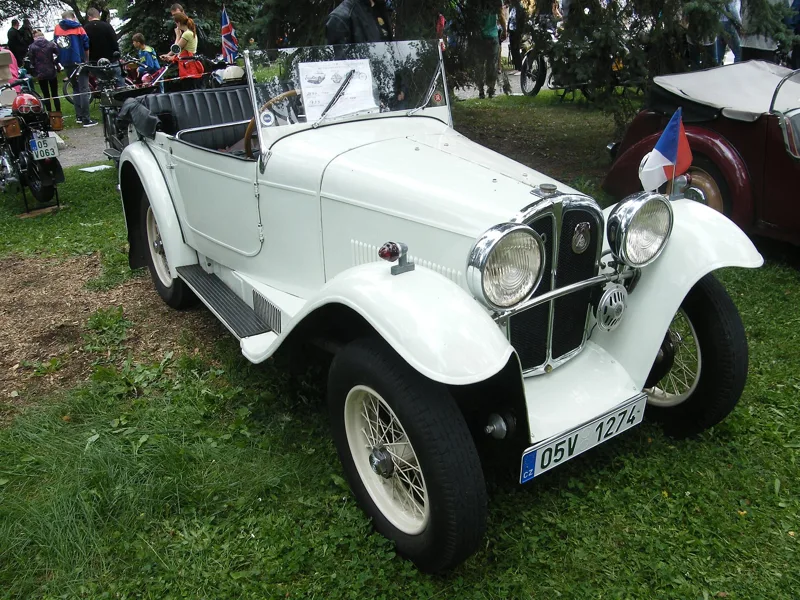
The most common version was a four-door, four-seat closed saloon, sold as the Standard. The range also included tudor and sedan forms, open phaetons and convertibles with folding roofs for four to seven passengers, in two-door or four-door layouts. Body weights ran from 1,370 to 1,550 kg (3,020 to 3,417 lb).
The coachbuilding shop applied the aerodynamic shapes that were fashionable at the time. Most versions had a slanted radiator mask and a sloping front window, and a limousine on the extended chassis for six or seven people could be ordered with a glazed partition behind the driver. The body frame was of wood, covered with thin sheet metal, and the front doors hinged on the centre pillar so they opened against the direction of travel.
The flagship cars were five metres long, built on an extended chassis with a 3,250 mm (128 in) wheelbase and on a lowered frame. The four-door luxury saloon, called the swan, had a slanted chrome-masked radiator, a rounded roof and a flowing tail. Two spare wheels sat in chrome covers at the rear of most cars.
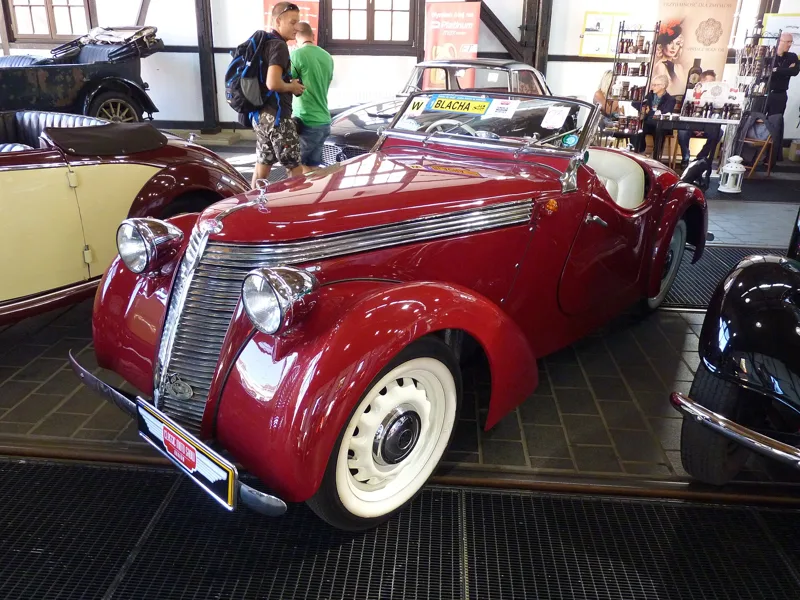
Buyers who wanted something else could turn to private coachbuilders such as Sodomka, Patera or Brozik. One Wikov 40 convertible from 1934, with a bespoke body by the Paris firm Carrosserie Vanvooren made in 1937, was built for Hana Wichterlova while she studied sculpture in Paris. A restored example with that body was shown at the Memoria Auto Wikov in 2009.
What did a Wikov 40 cost?
From spring 1934 the carmaker offered the Standard, a four-seat four-door saloon, for 57,000 Kc. Standards with more individual bodywork started at 67,000 Kc, and a two-door convertible with a large boot sold for the same price. Luxury cars on the extended chassis were the top of the price list.
The 1934 list on the standard 3,000 mm chassis ran from 50,000 Kc for an open four-seater with a boot to 70,000 Kc for an aerodynamic four-seat conduite interieure. The limousine on the extended 3,250 mm chassis cost 65,500 Kc, and the other models on that chassis were about 4,000 Kc dearer than the standard 3,000 mm versions.
Prices fell in 1935. In early March a four-seat open car on the extended chassis cost 49,000 Kc and the closed Standard 52,000 Kc. By October, on the eve of the Prague motor show, every model was under 60,000 Kc. The cheapest was a four-seat phaeton at 47,000 Kc, and even the luxury cars were priced at 59,000 Kc, roughly three times the cost of a four-seat Jawa 700 limousine.
How many Wikov 40 cars were sold?
Registrations of Wikov passenger cars on Czechoslovak roads were 81 in 1932, 54 in 1933 and 58 in 1934. Sales fell further as the decade went on.
Only 38 cars were sold in 1935, and in 1936 just 25 were sold, the year the last passenger cars were assembled. In 1937 seven passenger cars of the Prostejov brand found buyers. Across the company's 12 years of car building, from 1925 to 1936, almost 750 passenger cars were built.
The board of Wichterle and Kovarik had decided at the end of 1934 to wind down passenger car production gradually.
How did the Wikov 40 perform in races?
The company rated high operational reliability and great power as its main strengths, and it won prizes in reliability trials and elegance contests. Two Wikov 40s were shown to the public at a new elegance contest in Luhacovice on 14 August 1932: one a limousine with an upright grille, the other a two-door phaeton with a slanted mask.
The first Czechoslovak 1,000 Miles race in 1933 drew two sports roadsters built from the experimental Wikov 35 Kapka and fitted with Wikov 40 engines. The car could reach 125 km/h (78 mph). Adolf Szczyzycki and Frantisek Kudlacek led the field into Bratislava in the first stage, averaging 92 km/h (57 mph), but neither car finished the race.
A year later, on 9 and 10 June 1934, the Prostejov team entered a two-litre Wikov 40 in the same race. Szczyzycki and Kudlacek won the class for cars up to 2,000 cc (122 cu in) in a Wikov 40 roadster, with a time of 17:56:55 hours and an average speed of 88.763 km/h (55.2 mph).
Why did Wikov stop making cars?
Car production at the Wikov company had been loss-making from the start, and the works made one last attempt at a people's car. The prototype, called the Wikov Baby, was meant to answer a market where interest in large luxury cars had faded.
The Baby carried a three-cylinder radial engine at the rear, driving the rear axle, and sat on a tubular backbone frame, with a front parallelogram axle and rack-and-pinion steering. The factory's choice of unconventional elements made production needlessly complicated, and the project was doomed. Wikov ended car production in 1936, after which only spare parts, bodies and repairs were handled.
Where can you see a Wikov 40 today?
Most of the surviving cars are displayed at the Veteran Arena in Olomouc, the Museum of Historic Vehicles, which holds the largest complete collection of the Prostejov marque. The museum opened to the public in 2010, and it now includes several Wikov 40s.
The leading exhibit is the luxurious four-seat Wikov 40 Fulnek convertible, which stands out among the Wikov 40s on show.