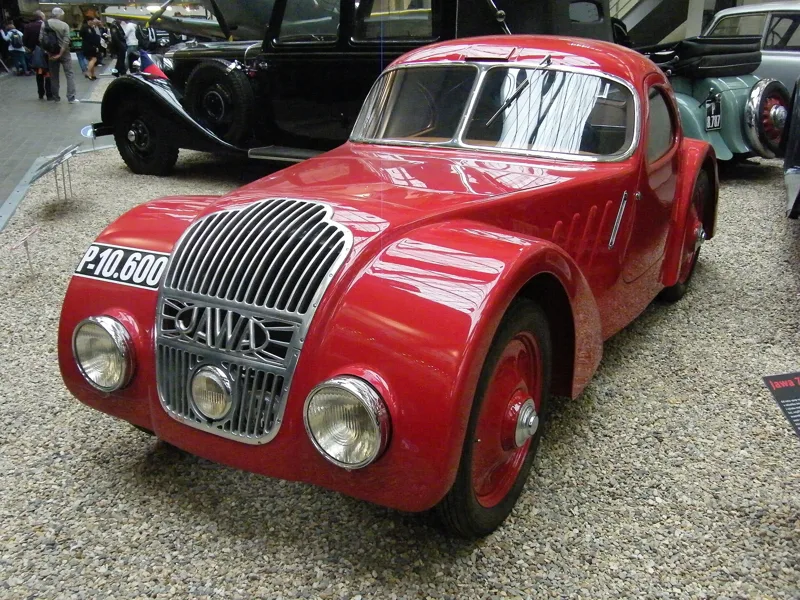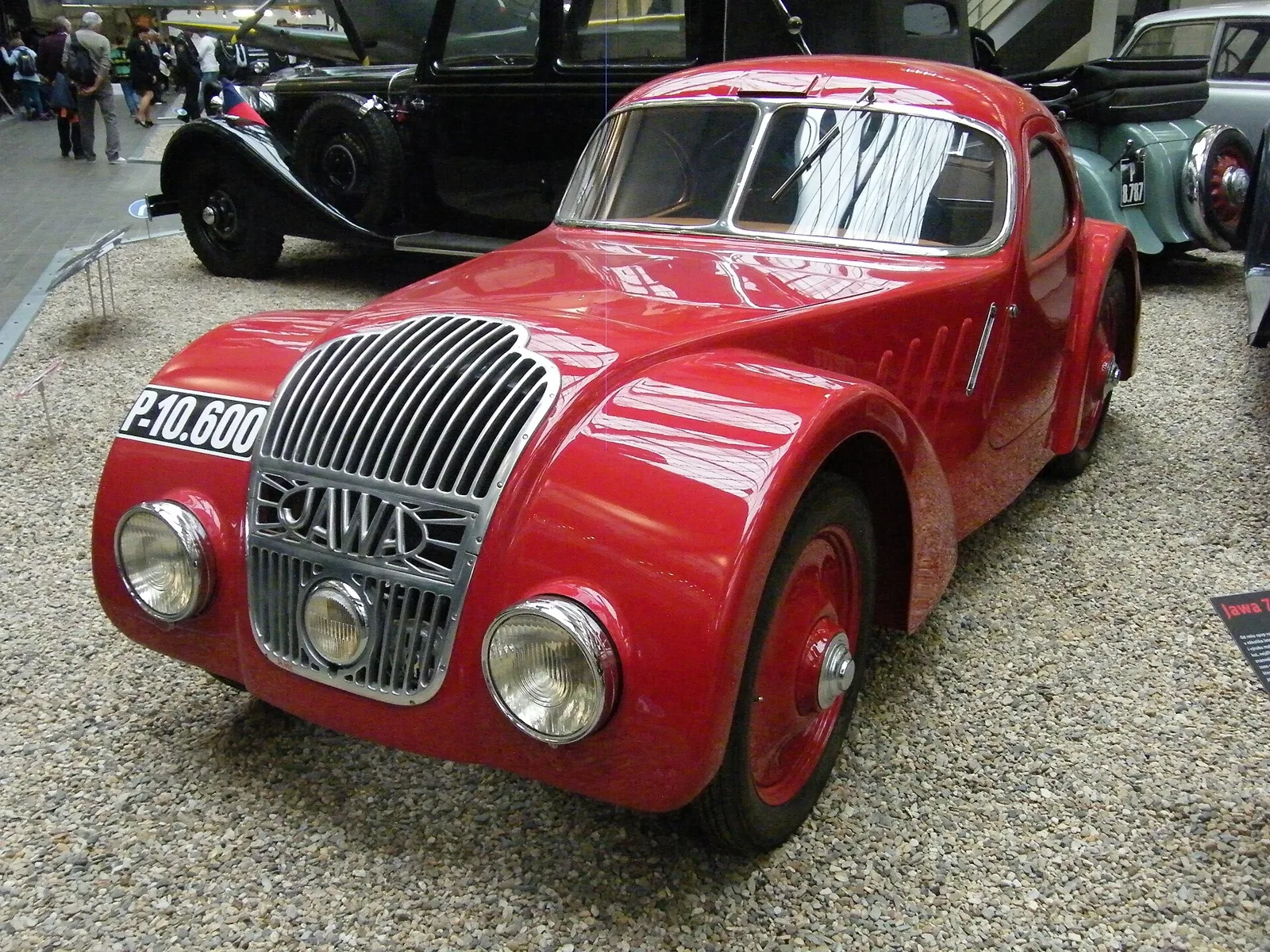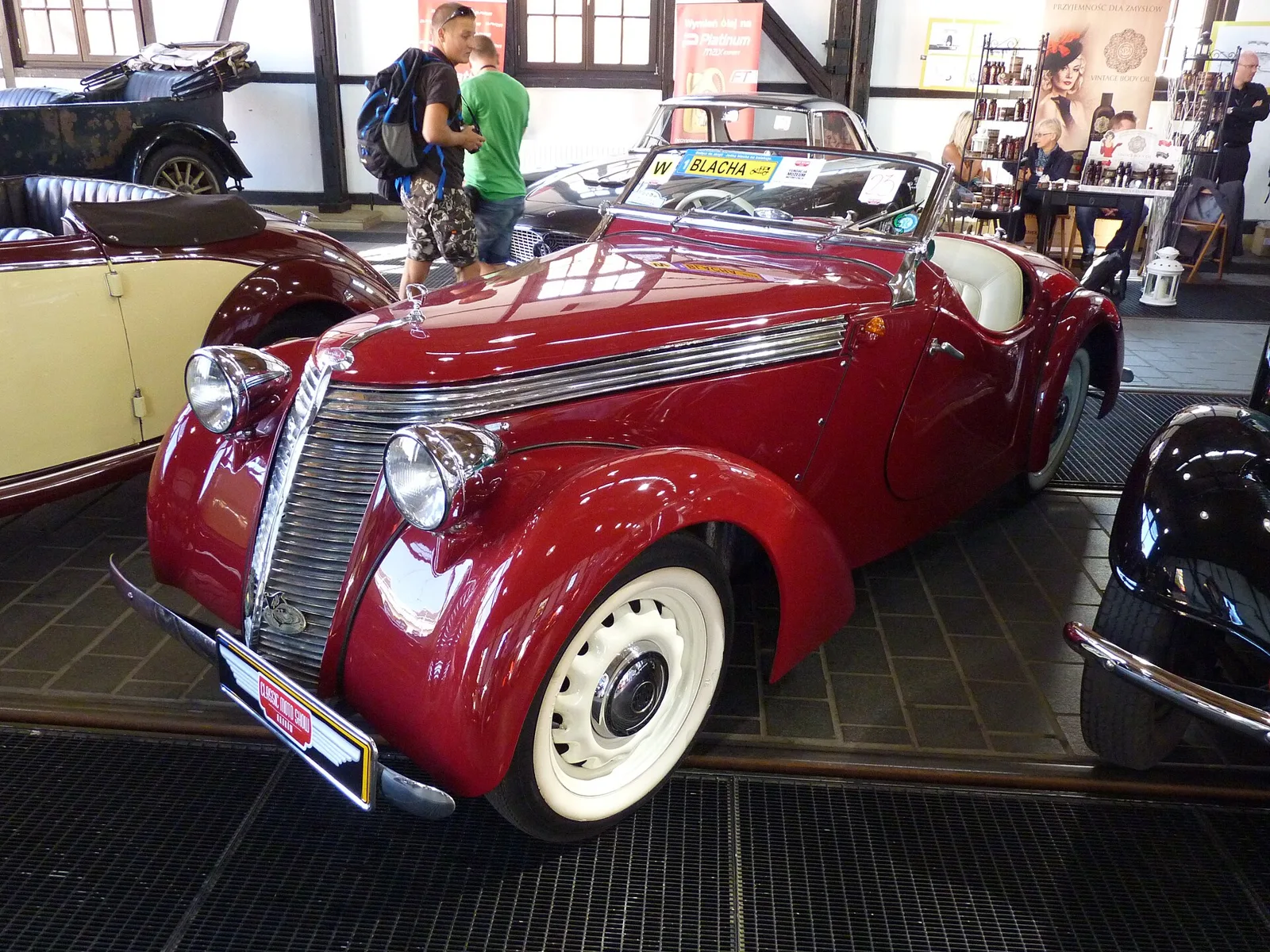
A small front-engined car with front-wheel drive and a 616 cc two-stroke twin, sold from a show stand in 1937, with almost 2,700 built by 1947 before the Jawa car line ended in 1951.
The Jawa Minor was a small Czechoslovak car first built in 1937 with a 616 cc two-stroke twin. Rudolf Vykoukal designed its engine and chassis. A reworked version prepared secretly in wartime became the Aero Minor from 1946, and the Jawa car line ended in 1951.
Jawa's second car was the Minor, sometimes written as the Jawa 600. It was built from 1937 with a 616 cc two-stroke twin and front-wheel drive, and 112 cars were sold from the show stand at its Prague debut.
Its story runs from a prewar drawing board in Prague, through secret development during the war, to a post-war car that was built under another name.
Who designed the Jawa Minor?
Rudolf Vykoukal designed the engine and chassis, and Zdenek Kejval the bodywork. Both came to Jawa in 1936 from the Praga factory. Zdenek Pilat had drawn an earlier light two-cylinder with the gearbox ahead of the front axle, but the factory chose Vykoukal's version in 1937.
Management liked Pilat's design but asked him to correct its asymmetry in a second draft, because the two-cylinder had been set off the centre line, which was unusual at the time. The factory judged his route too untested and risky. Vykoukal's alternative differed mainly in placing the power unit behind the front axle.
Development began in 1935, and series production started two years later. The car was given the name Jawa Minor when it was put into production in 1937.
A two-stroke twin, a show stand that sold 112 cars, and a Monte Carlo finish.
How many body styles did the Minor come in?
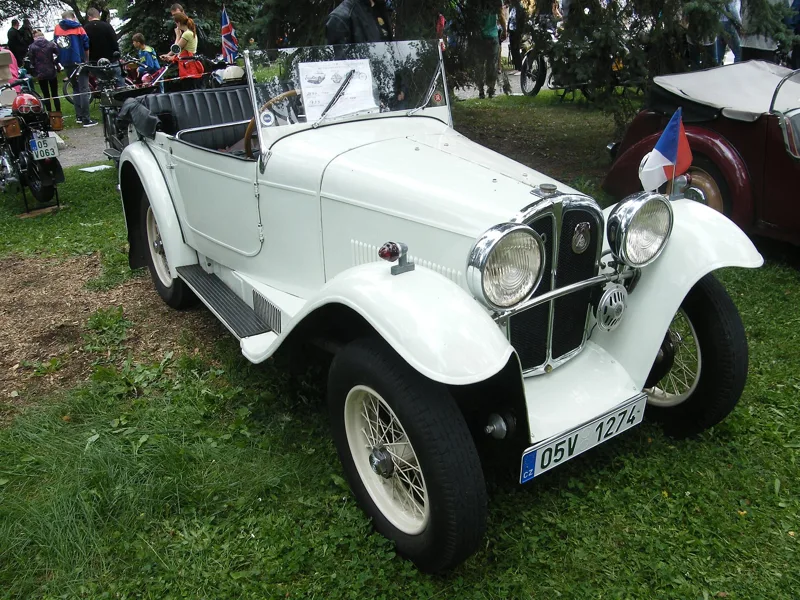
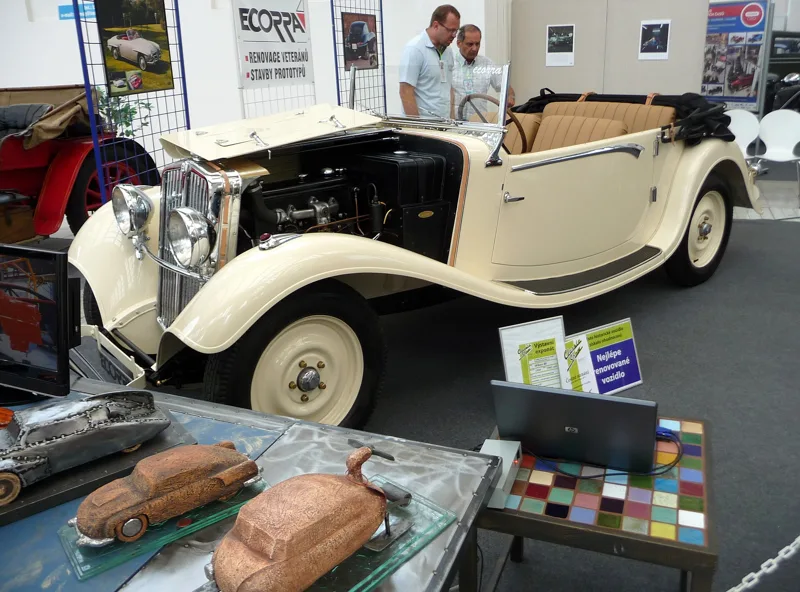
The Minor was most often built as a four-seat, two-door closed car. It also came as a convertible and as a two-seat roadster with two emergency seats at the back. Prototypes included a two-door, two-seat business coupe, a version with an enlarged boot for the Czechoslovak Post, and a pick-up body.
Kejval gave the bodies graceful, discreetly elegant shapes. The bodies were built at the Kvasiny factory, the engines and chassis came from the parent works in Prague-Nusle, and final assembly took place at Tynec nad Sazavou-Brodce.
The four-seat tudor had a rounded, spacious boot reached from inside after the rear backrests were folded down, while its spare wheel sat under the floor and could be reached from outside. The bodies had a wooden frame covered in sheet steel, and the car was right-hand drive with its gear lever on the dashboard.
How did the two-stroke engine work?
The Jawa Minor's engine was a two-stroke in-line twin with a 70 mm (2.8 in) bore and an 80 mm (3.1 in) stroke, giving 615.75 cc (37.6 cu in). It used loop scavenging under a Schnurle patent, which allowed flat aluminium alloy pistons without deflectors. The engine sat longitudinally at the front.
A horizontal Solex carburettor fed the engine a mixture of petrol and oil at 1:25. The 23 l (6.1 US gal) tank under the bonnet was gravity-fed to the carburettor, and a Bosch 6V dynamo-battery ignition with a 60 Ah battery supplied the spark. The radiator used thermosiphon cooling, with no fan and no pump.
Key specifications
| Specification | Figure |
|---|---|
| Engine | Two-stroke in-line twin, 616 cc (37.6 cu in) |
| Output | 14 kW (19 hp); 14.3 kW (19.5 hp) at 3,500 rpm |
| Compression ratio | 6:1 |
| Fuel tank | 23 l (6.1 US gal) |
| Top speed | 95 km/h (59 mph) |
| Fuel consumption | Generally no more than 7.5 l/100 km |
| Wheelbase, tudor (1938 version) | 2,410 mm (94.9 in) |
| Length, tudor (1938 version) | 3,600 mm (141.7 in) |
| Height, tudor (1938 version) | 1,400 mm (55.1 in) |
| Weight (1938 version) | 690 kg (1,521 lb) |
| Tyres | 4.75-16 |
How was the chassis built?
The chassis, designed by Vykoukal, used a backbone frame of square section that forked at the front to take the engine. All four wheels had independent suspension, and transverse leaf springs suspended both split axles. The front axle had triangular lower arms, and the rear was a swing axle made of tubular half-axles.
Front-wheel drive ran through a bevel gear set and a spur differential. Steering was rack-and-pinion, right-hand drive, with separate steering rods. The foot brake was mechanical with cables and acted on all wheels, while the handbrake acted on the rear wheels. The disc wheels were 16-inch, shod with 4.75-16 tyres.
What did the 1938 version change?
In autumn 1938 a new version was presented, with a longer tudor wheelbase of 2,410 mm (94.9 in), a roomier body measuring 3,600 mm (141.7 in) in length and 1,400 mm (55.1 in) in height, and a weight of 690 kg (1,521 lb). The control system was modernised, and some cars were already fitted with left-hand drive.
Earlier cars had weighed slightly over 600 kg (1,323 lb). The convertible drew the most attention, so Jawa ordered a series of 25 more luxurious convertibles from the Sodomka coachworks in 1939.
How much did the Minor cost before the war?
Before the war the convertible, a 2+2 with folding roof, sold for 16,950 Kc. The tudor saloon cost 17,950 Kc, and the sporty roadster with leather upholstery 19,500 Kc. The roadster had a front bumper as standard, while the tudor and convertible could take one for an extra charge.
How many were built for the army and after the war?
About 400 cars were built in a special military version for the Czechoslovak army in 1938. Up to 1940, a total of 1,990 Minors had been built.
During the war development of passenger cars was banned, but work continued in secret under Vykoukal on a second version. That version had a four-speed gearbox, hydraulic brakes, a completely different and more spacious body, and a revised rear suspension, with the engine turned to sit ahead of the front axle.
After the war about 710 cars were assembled from hidden components, and they were sold for 35,500 Kc. Almost 2,700 Jawa Minors were built between 1937 and 1947 in all.
What happened to the design after the war?
From 1946 the second version, developed in secret during the war, entered series production, but as the Aero Minor rather than as a Jawa Minor II. The reasons were commercial and strategic. It was built in the nationalised car industry outside Jawa, which from then on could make motorcycles alone.
The series of Jawa cars ended at the beginning of 1951. Other cars were developed, such as the Minor III, but they did not go into series production.
How did the Minor do in competition?
Three military-trim cars entered the Little Entente competition, held from 12 to 19 September 1937 from Prague through Bratislava, Uzhorod and Bucharest to Belgrade. Among 88 cars, 10 sidecars and 55 motorcycles, a Minor crew of Ing. Kratky and L. Turek took third place overall. Minors also took the first two places in the class up to 750 cc.
In January 1939 Antonin Vitvar and Jaroslav Musil finished the Rallye Monte Carlo from Athens without penalty points, eighth in the class up to 750 cc and 84th overall. Their saloon Minor also won the first prize in the comfort competition.
Results at home were just as useful. In March 1938 Ladislav Turek, driving a Minor, won outright the second finishing run that led to the spring sample fair in Prague. In June 1938 the junior driver Sova won the 500 km Slovak competition for cars up to 1,100 cc.
Other drives went further afield. Adolf Tuma covered more than 5,000 km towards Baghdad in summer 1938, averaging 7 l/100 km before turning back. In March 1939 Fanny Kronbauerova and her husband won the women's five-stage competition on a Minor, returning to Prague with four cups.
Which elegance prizes did the Minor win?
The Minor collected numerous prizes at elegance contests. At Marianske Lazne in August 1938 it won the public prize and a laurel wreath. At Luhacovice the roadster took first prize and a silver plaque, and at Bohdanec the car and its owner received an honorary prize for 254 points.
At the Belgrade car exhibition in April 1939, the two-seat roadster took first prize in the sports class, and the Minor saloon took second place among the closed cars.