Six sports cars from Czechoslovakia, a coupe body still counted among the country's most beautiful, and a 1935 race that ended in tragedy for two other crews.
A Jawa-built sports car with a 745 cc two-stroke twin, the Jawa 750 was made in six examples in 1935. Three were coupes and three were roadsters. They took the first three places in the 750 cc class at the 1000 Miles of Czechoslovakia, and the engine was an enlarged version of the Jawa 700 unit.
The Jawa 750 was a short run of six sports cars that the Czechoslovak maker built in Prague in 1935. Three had coupe bodies and three were open roadsters, all made for the third running of the 1000 Miles of Czechoslovakia. The cars took the first three places in their class, and the coupe is still counted among the most beautiful cars in Czechoslovak car-making history.
Where did the Jawa 750 come from?
The Jawa 750 grew out of a car programme that began in 1934, when the Jawa works started building cars under licence from DKW. The first Jawa car was a DKW-based design, and the 750 was a sporting development of it, with a larger engine. Six examples were built in 1935 for that race.
Ing. Frantisek Janecek, owner of the arms works that carried his name, began building German Wanderer motorcycles under licence in 1929. Those machines wore the Jawa badge (Janecek-Wanderer). In 1934 he also began making cars under a licence he had signed with Jorgen Skafte Rasmussen, the DKW owner who also ran Auto Union's technical side. The first model was the Jawa 700/DKW Meisterklasse 701, type F 2.
Sporting cars arrived early in the programme. In summer 1934, apart from tudor saloons, the works built several sports cars, roadsters and coupes. Kaiser and Kronberger, the Prague firm that represented Jawa, commissioned a coupe from Ing. Zdenek Klika, who imported British cars and motorcycles.
Six cars built for the 1000 Miles of Czechoslovakia, and a coupe that Czechoslovak car history still ranks among its most beautiful.
How was the Jawa 750 assembled?
Each car needed parts from three factories. The chassis and engines came from the parent works at Praha-Nusle, while the bodies came from the Kvasiny works in the Rychnov area. Final assembly was finished at the Jawa plant in Tynec nad Sazavou, now JAWA Moto, where the pieces finally came together.
Getting the parts to one place called for logistical skill. The bodies from Kvasiny, at Solnice in the Rychnov region, were made at a works that is now part of Skoda Auto.
What engine did the Jawa 750 use?
The Jawa 750 used a water-cooled, two-stroke, twin-cylinder upright engine, designated R2. Its 745 cc (45.5 cu in) came from boring out the Jawa 700 unit. Peak output reached 18.5 kW (26 PS; 26 hp) at 4,200 rpm, against 14.7 kW (20 PS; 20 hp) before, and the car topped out at 120 km/h (75 mph).
The bore was 79 mm and the stroke 76 mm, where the Jawa 700 had a 76 mm bore and 692 cc. The engine used a patented reverse scavenging system, the Schnurle system, and it sat transversely at the front, ahead of the front axle. Ignition came from a Bosch dynamo-battery set, or a Luma alternative, working at 6 V.
Fuel was petrol mixed with oil at 1:20, metered by a Zenith carburettor with an intake silencer. Starting was electric, using a dynamo-starter that formed one unit on the crankshaft. Behind the engine sat a three-speed gearbox (3+Z) with a multi-plate clutch.
The front wheels were driven. Power passed through a freewheel and a chain to a clutch running in an oil bath, then through the gearbox and differential, and finally by universal-joint shafts to the wheels.
Key specifications
| Specification | Figure |
|---|---|
| Capacity | 745 cc (45.5 cu in) |
| Bore and stroke | 79 mm bore, 76 mm stroke |
| Power | 18.5 kW (26 PS; 26 hp) at 4,200 rpm |
| Top speed | 120 km/h (75 mph) |
| Tyres | 4.00x19 in |
| Wheelbase | 2,300 mm (90.6 in) |
| Width | 1,400 mm (55.1 in) |
| Length | 3,650 mm (143.7 in) |
| Height | 1,550 mm (61.0 in) coupe; 1,450 mm (57.1 in) roadster |
| Kerb weight | 705 kg (1,554 lb) coupe; 700 kg (1,543 lb) roadster |
| Track | 1,200/1,200 mm |
How did the chassis and brakes work?
The chassis followed the proven concept of the Jawa 700, with a frame pressed from steel U-sections and worm-type steering. The car was front-wheel drive, with a wheelbase of 2,300 mm (90.6 in) and a track of 1,200/1,200 mm. Hydraulic drum brakes were fitted at both ends.
The front and rear wheels, on split axles, hung from two transverse leaf springs with hydraulic dampers. Both ends had hydraulic drum brakes, the handbrake acted on the rear wheels, and the rear wheels carried removable covers. The cars were shod with 4.00x19 in tyres.
Why was the coupe body so admired?
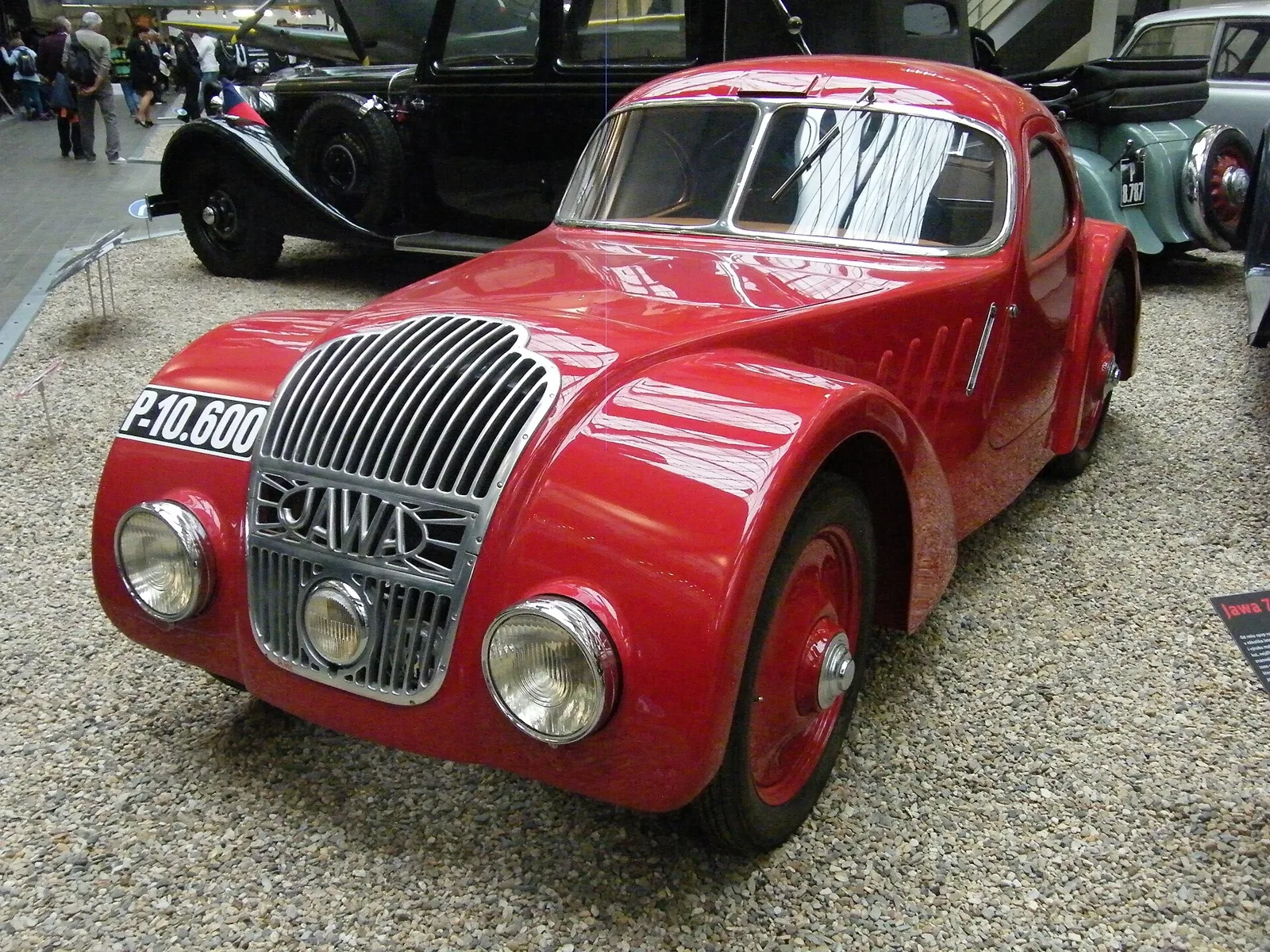
The coupe drew inspiration from Paul Jaray's enclosed coupe of 1934, but Jawa's version gained a distinctive flair and elegance. Its balanced proportions and flowing curves still look timeless, and it is regarded as one of the most beautiful cars in Czechoslovak car history.
The aerodynamic rules showed everywhere. The rear section flowed smoothly, the windscreen was in two parts, and there were no external mirrors and no outside door handles, since the doors opened from the inside. Only one windscreen wiper was fitted, which matched the demand for low weight.
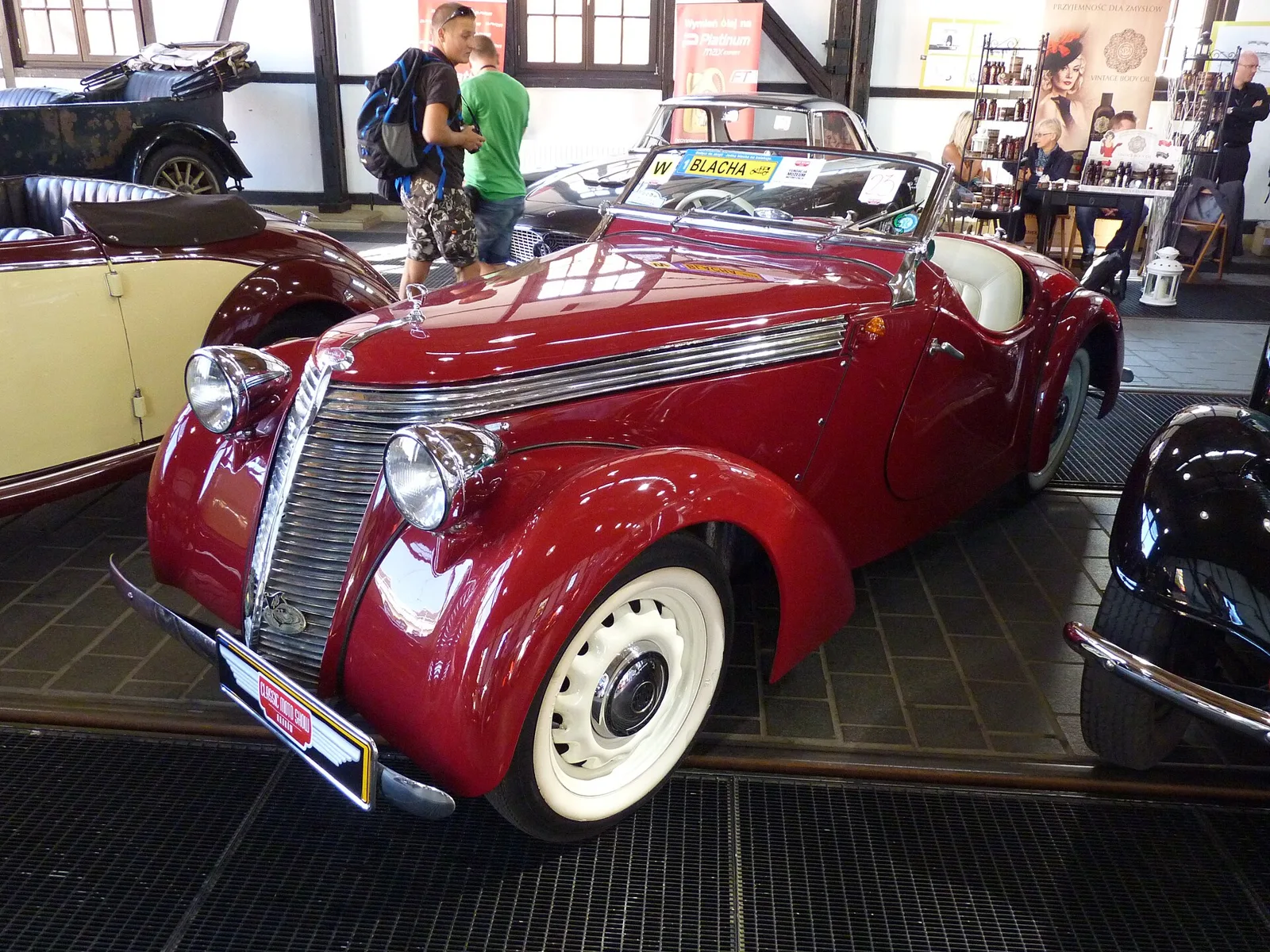
The roadster was different, with two small wind deflectors and three headlamps at the front. Its rear had no conventional light clusters at all. The cars were frameless, relying on a load-bearing timber lattice that carried the axles and the engine, so the body was self-supporting.
The body and car were honoured at the Concours d'Elegance in the spa town of Luhacovice on 18 August 1935, where Antonin Vitvar showed the coupe and won a silver wreath.
How did the Jawa 750 perform at the 1935 race?
In 1935 the Jawas took the first three places in the up-to-750 cc class at the 1000 Miles of Czechoslovakia. The race covered 1,540.4 km on a Prague to Bratislava route, which competitors drove twice without a break. The winning roadster, crewed by Jaroslav Kaiser and Frantisek Kronberger, averaged 83.7 km/h.
The route had changed for 1935. The Slavkov-Hodonin-Sekule stretch was dropped from Brno and replaced by a run through Mikulov, Lednice, Breclav, Lanzhot and Kuty, which shortened the course. Taken together, the entrants covered almost 1,600 kilometres of hard driving without rest.
The race left Prague on 15 June 1935, starting in the afternoon at half past five. The works entered six cars painted red and built only for this race. The coupes carried numbers 71 to 73, and the drivers dressed in white overalls, red balaclavas and brown gloves.
The Jawa 750 roadsters also took the travelling President of the Republic prize for the most successful team. The winning crew beat the 1934 class record by almost two and a half hours, and the prize was presented by Edvard Benes, the newly elected president.
Vitvar and Eichler were second, in 18:59:54 h, just ahead of the Protiva brothers in third, on 18:59:56 h. The race also brought tragedy: a serious accident involved the Aero 30 crew of Bohumil Turek and Ela Slavikova, and Frantisek Kurka died in a Walter Junior SS. Ing. Janecek decided the firm would not use the success in its advertising.
Did the Jawa 750 race again after 1935?
The Jawa 750 kept racing after 1935 at Czechoslovak events. Antonin Vitvar drove it most often, taking it round the Krakonos Circuit three times between 1935 and 1937. He won overall there in 1935, and in 1937 he won his class after a puncture had cost him the lead.
The first Bohdanec Circuit followed shortly after the 1000 Miles, on 7 July 1935. The up-to-750 cc class ran 12 laps, or 180 km, with four starters. Vitvar led early on, with Feuerstein behind him, but spark plug trouble cost him three plug changes and he dropped to third. Otto Freund won on a Zetka Z 6 in 2:23:21.2 h, and the two Jawas finished second and third.
At the 3rd Cesky Brod Circuit on 3 May 1936, the open Jawas led the up-to-750 cc class from the flag. The event covered five laps, 132.5 km in all. The Jawas won with unusual regularity at an average of 75.5 km/h, with Vitvar first in 1:46.13.6 h and Jar. Kaiser second in 1:46.43.5 h.
Vitvar drove the roadster around the Krakonos Circuit three times between 1935 and 1937. On 14 July 1935 he won overall in 2:47:40.6 h, averaging 85.2 km/h over 34 km per lap and 7 laps, although he started in the weakest class. A year later, on a shortened 22 km circuit, the 7 laps (154 km) went to him overall in 1:42:07.5 h at 90.5 km/h.
In 1937 Vitvar led from the start in a tense senior event for cars up to 1,100 cc, but punctured a tyre and fell to eighth. He fought back to the front by the fifth lap and won his class in 1:19:21.7 h. He was due to race the roadster again at the 6th Krakonos Circuit in 1938, but withdrew out of respect for works teammate Frantisek Haupt, who was killed in that race for 350 cc motorcycles.
From 1938 the new Jawa Minor was used for sporting representation. In 1939 Vitvar and J. Musil took 8th in the up-to-750 cc class and 84th overall with it at the 18th Rallye Automobile de Monte-Carlo.
What survives of the Jawa 750 today?
Probably one Jawa 750 survives, and it is the coupe. The National Technical Museum in Prague acquired a complete car, though in wreck condition, in 1992. The coupe was then restored in 2001-2005 at a cost of 1 million Kcs, and it has been in the museum's main hall since 2005.
In 2006 the 4th National Museum Competition, Gloria musaealis 2005, announced its results. The museum won a special prize for restoring the seventy-year-old sports car, in the 2005 achievement category.
The roadster is displayed at the Auto-Moto Museum, the V.I.T.V.A.R. car gallery in Nova Paka, though it is probably a replica. The Jawa 750 became the most famous pre-war car of the Jawa brand.