Rocket-age styling, the first great V8s, cruising strips and drive-in screens: what happened when America went from 40 million cars to more than 67 million.
1950s American car culture grew from a jump in registered cars from 40 million to over 67 million. It brought tailfin styling, the first powerful overhead-valve V8s, hot rodding, drag racing and NASCAR, cruising strips, and drive-in restaurants and cinemas, all of which put the car at the centre of daily life.
By the end of the 1950s, one working American in six earned a living, directly or indirectly, from the car industry. Ten years earlier the country had been driving around in about 40 million registered cars, most of them built before the war and in poor shape. By 1958 that figure had passed 67 million.
That jump rebuilt more than the car park. It changed what Detroit put on the road, from rocket-inspired tailfins to the first genuinely powerful V8s, and it gave teenagers a place to be on a Friday night: the cruising strip, the drive-in restaurant, the drive-in cinema.
How American cars of the 1950s took over a country
The war had stopped car production entirely, because of rationing and restrictions on cars and parts. Once factories converted back to consumer goods, output came quickly: more than 8 million cars were built in 1950 alone, and American makers produced and sold almost 58 million over the decade. The United States became the world's largest car manufacturer, and the industry grew many times larger than the car industries of the rest of the world put together.
Henry Ford had dreamed three decades earlier of cars within reach of every man in steady work, and now that was reality. The decade also left a long shadow. By 1960 the industry supported one-sixth of the American workforce, though automation and imports would shrink that within a couple of decades.
By the end of the 1950s, one working American in six earned a living, directly or indirectly, from the car industry.
The 1950s Detroit car industry: three giants and a squeezed field
Detroit had once been home to at least 100 car companies, all of which began operating by the start of the twentieth century. By the 1920s, Ford was the biggest, and the Big Three of General Motors, Ford and Chrysler had each grown by buying rivals. Between them they took 94 percent of all American car sales in 1955, 1956 and 1959.
That left little room for anyone else. In 1954 Hudson merged with Nash-Kelvinator to form American Motors, a deal worth almost USD 200 million that was the largest corporate merger in US history at the time. AMC did well enough but never grew large enough to challenge the giants, and Chrysler bought it in 1987.
Studebaker had a harder time. It was the first independent to build an overhead-valve V8, a 232.6 cubic inch unit with 120 hp, but its cars cost more than the Big Three's. In 1954 it merged with Packard, itself in financial trouble, and the Packard name was retired in July 1958. The decade closed with the field reduced to the Big Three, Studebaker and AMC.
The V8 and the horsepower race
Of all the technical changes, the overhead-valve V8 is arguably the most influential in automotive history, and it started a horsepower race that laid the foundation for the muscle car era. The 265 cubic inch Chevrolet small block arrived for the 1955 model year and is still the basis for General Motors V8s. Chrysler had already gone its own way with a hemispherical design in 1951, and Ford kept its old flathead going until the Y-block took over.
| Engine | Year | Size | Output |
|---|---|---|---|
| Chrysler Firepower V8 | 1951 | 331.1 cubic inches | 180 hp at 4000 rpm |
| Chevrolet small block (two-barrel) | 1955 | 265 cubic inches | 162 hp |
| Chevrolet small block (four-barrel, Corvette) | 1955 | 265 cubic inches | 195 hp |
| Chevrolet fuel-injected V8 | 1957 | 283 cubic inches | 283 hp |
| Chrysler 300 V8 | 1959 | 413 cubic inches | 375 hp |
The Chrysler engine of 1959 produced triple the average horsepower of a decade earlier. The fuel-injected Chevrolet was the first engine to make one horsepower for every cubic inch. Chrysler's hemispherical combustion chambers needed bigger cylinder heads, so those engines were larger and heavier than their GM and Ford rivals.
Ford used its flathead V8 across most of its range early in the decade. It introduced the Y-block, and a similar but larger Lincoln version, in 1952. The Windsor engine replaced both in 1962, and its descendants underpin Ford's range today. American Motors built its own overhead-valve V8, the Gen-I, in 1956.
Tailfins, rockets and dynamic obsolescence
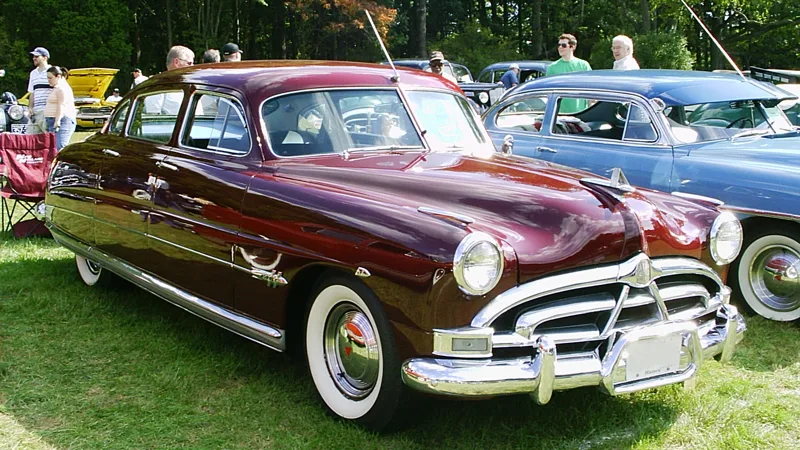
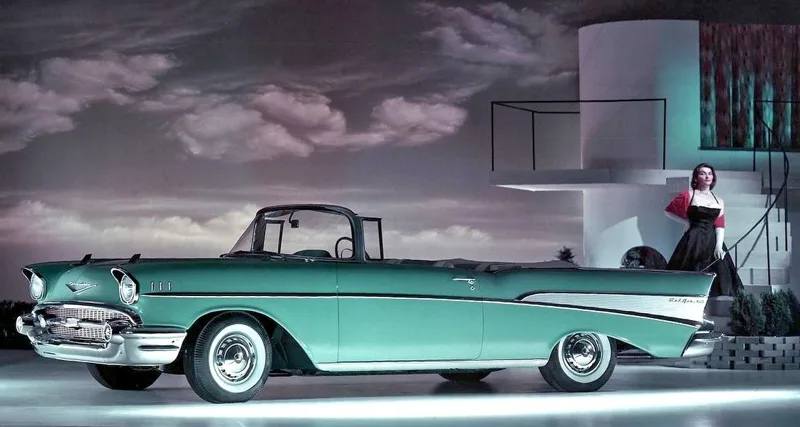
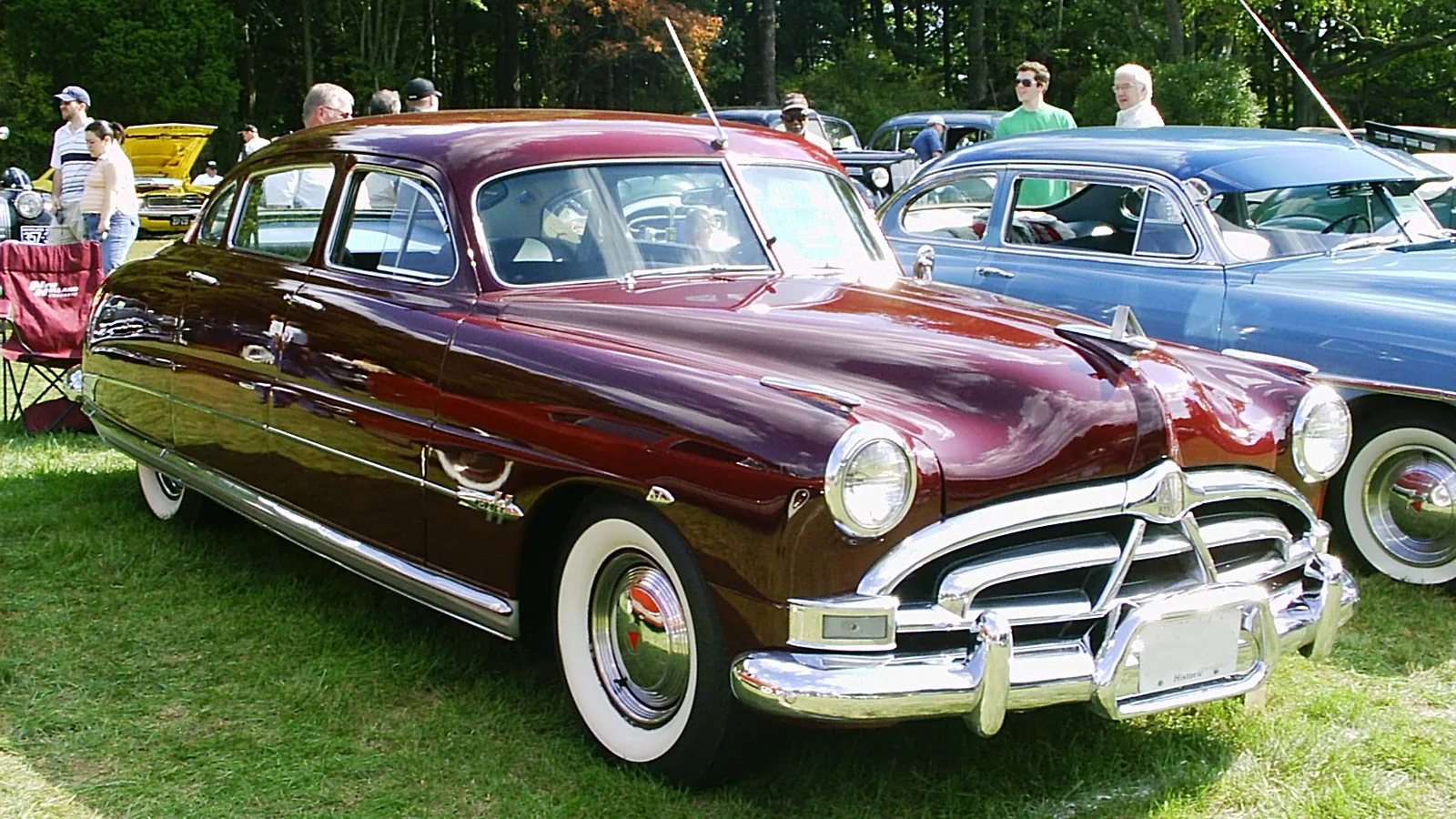
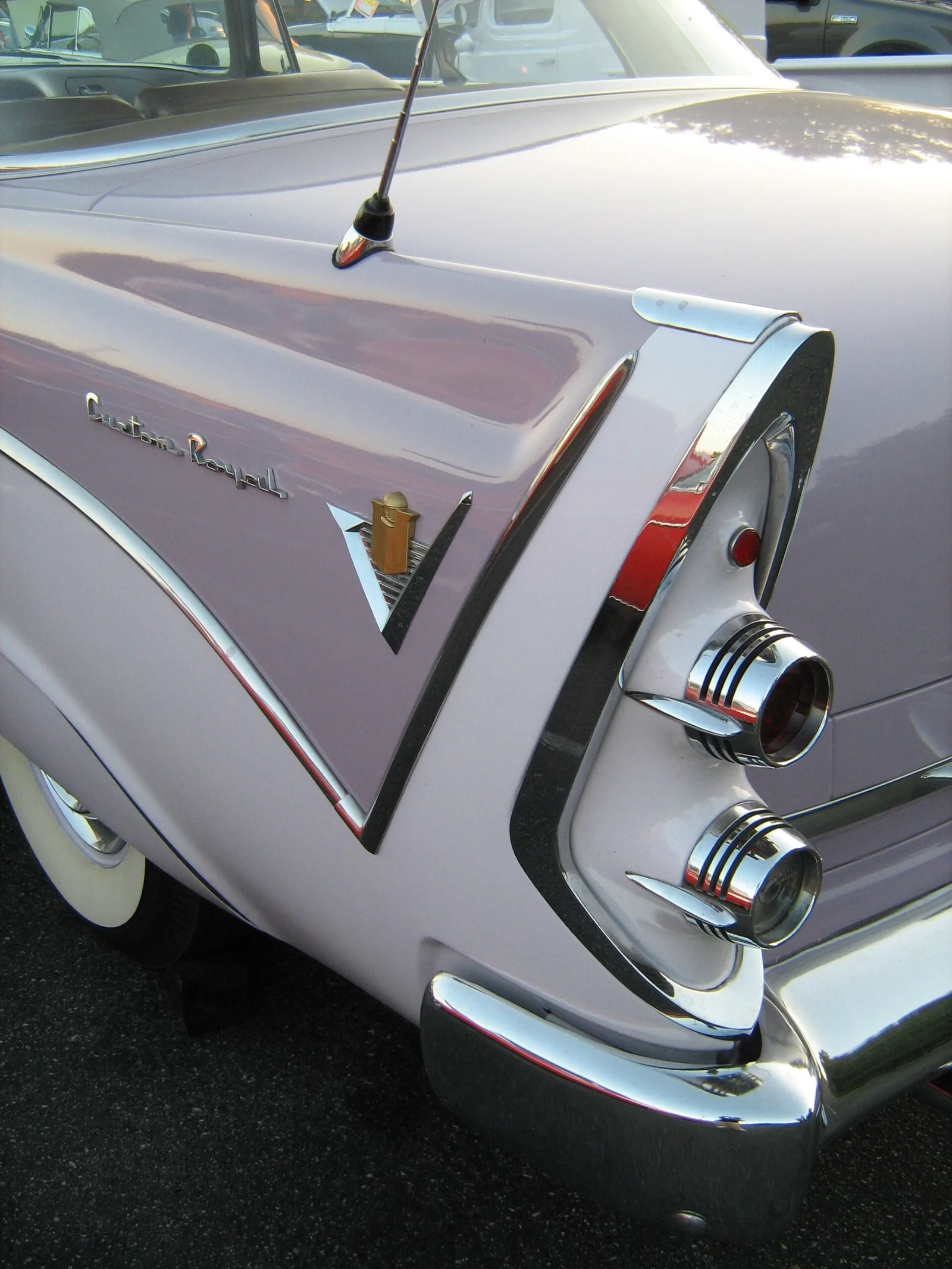
The Space Age arrived on the showroom floor. Big tailfins and rocket-like curves were everywhere, and some aerials were styled after Sputnik 1, a look credited to design pioneers such as Harley Earl. Cars were becoming statements. Buyers accepted for the first time that the car they drove said something about their social standing and their affluence, and for many it became an extension of their personality.
The makers fed that appetite with a philosophy known as dynamic obsolescence, which pushed buyers to upgrade every few years and so guaranteed future sales.
The gadgets that changed how people drove
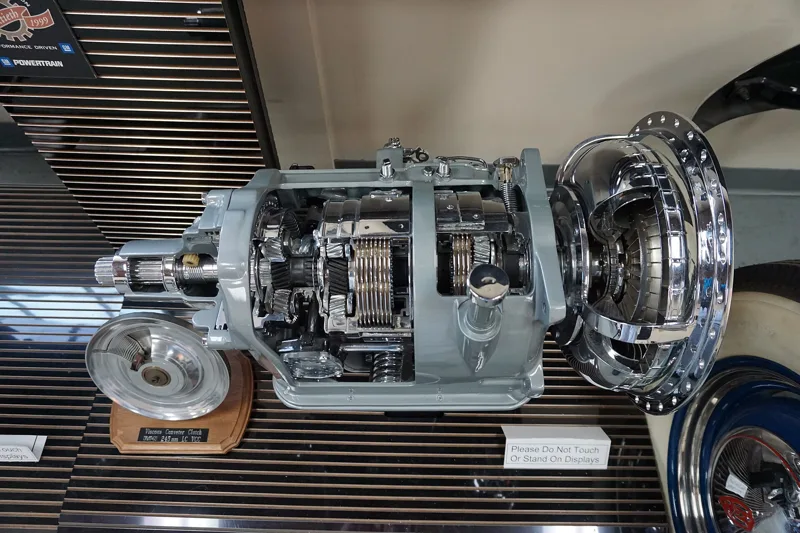
Automatic transmission was the biggest. General Motors developed the first ones in the 1930s and launched the Hydra-Matic in the 1940 Oldsmobile, then fitted it to tanks in the war and marketed it afterwards as battle-tested. It was the Powerglide, a two-speed automatic for low-cost cars made from 1950 to 1973, that spread the idea. Variations are still used in drag racing because they are simple and durable. Before the decade ended, more than half of new American cars had an automatic gearbox.
Power steering reached passenger cars with the Hydraguide option on the 1951 Chrysler Imperial, priced at less than $200. Cadillac offered it a year later and made it standard two years after that. Air conditioning returned after a gap of twelve years on the 1953 Chrysler Imperial, and by 1960 it was fitted to about 20 percent of American cars.
Underneath, higher road speeds exposed the weakness of pre-war suspension, and independent front suspension became general. Air suspension was less successful. Cadillac offered it as a $215 option in 1958 and several rivals followed that year, but it proved unreliable and was dropped. Decades later it became common on luxury cars, buses and large trucks.
Seat belts were optional at first. Nash offered them in some models by 1949, and Ford followed in 1955. The three-point belt was patented in 1955 by Roger Griswold and Hugh DeHaven, then refined by Nils Bohlin for Volvo, which made it standard in 1959. Most American cars had three-point front belts as standard by 1964 and rear belts by 1968.
Highways, suburbs and the car as identity
The roads changed as fast as the cars. Interstate highways expanded from 1955 to support military transport, and the wide, multi-lane routes carried traffic at higher speeds with few or no stoplights. The Federal Aid Highway Act of 1956 authorised construction. President Eisenhower, who had come to appreciate the German Autobahn network while Supreme Commander of Allied forces in Europe, saw such roads as part of national defence.
The roads made new places to live. After the war developers bought land beyond the city limits for rows of inexpensive tract houses, and Levittown, Pennsylvania, built by William Levitt from 1951 as a suburb of Philadelphia, was one of the first planned examples. Returning soldiers had low-interest loans and free college under the G.I. Bill, and about 4 million babies were born every year in the 1950s. Almost 77 million baby boomers had arrived by 1964. By the end of the 1950s a third of Americans lived in the suburbs, and economist Richard Porter put the link in a sentence: cars enabled the suburbs, and the suburbs made owning a car indispensable.
The cities paid for it. Eleven of the twelve largest recorded falling populations during the decade, and only Los Angeles, a centre of car culture, grew. Detroit was the fifth largest city in 1950 with 1,849,568 residents and was down to 706,585 by 2010, a drop of 62 percent.
Hot rods, drag strips and NASCAR
Alongside the factory cars grew a do-it-yourself scene. Hot rodding, which meant modifying cars for more performance, thrived on cheap, plentiful Model Ts and other machines built between the 1920s and 1940s. Hot Rod magazine, founded in 1948 by Robert E. Petersen with Wally Parks as its first editor, is the oldest title of its kind. In November 1950 its cover trumpeted the first hot rod over 200 mph, a hand-built car with an Edelbrock Mercury flathead V8 that set its record on the Bonneville Salt Flats, a 30,000-acre (47 sq mi) expanse nicknamed American hot rodding's holy grail.
Drag racing moved into the mainstream. The country's first drag strip, Santa Ana Drags, was set up on an airport runway in southern California by Pappy Hart, Creighton Hunter and Frank Stillwell, and it ran from 1950 until 21 June 1959. Parks founded the National Hot Rod Association in 1951, still the sport's biggest governing body.
Bill France Sr. incorporated NASCAR on 21 February 1948, and the sport put down its roots in the 1950s. Darlington Raceway in South Carolina opened in 1950 as the first asphalt superspeedway, and its success led to a high-banked superspeedway of two and a half miles (4.0 km) near Daytona Beach. Stock car racing has roots in bootlegging during Prohibition, and Junior Johnson, one of the bootleggers who raced in the 1950s, was arrested in 1955 over his father's moonshine still.
Cruising culture in the 1950s
Cruising, a social kind of driving with a random, often aimless route, has no clear starting date. It generally began in the years after the war when young drivers of Mexican heritage took their lowriders out on Southern California streets, and teenagers across the country soon joined in. It descended from the older ritual of promenading along Main Street or the square. Boys mostly showed off their cars, supposedly to meet girls, though groups of girls cruised too, and one attraction was escaping the supervision of parents.
The routine was to drive slowly down long, straight streets, ideally with plenty of traffic lights, and to gather in parking lots, particularly at drive-ins. As one Tucson journalist put it, cruisers gather around brightly lit places like moths. Impromptu street races were part of it.
Certain strips became famous. Whittier Boulevard in East Los Angeles was one of the oldest, with lowriders cruising it in the 1940s before the habit spread to nearby neighbourhoods in the 1950s. In the San Fernando Valley, Van Nuys Boulevard has drawn cruisers since the 1950s, and its Wednesday night cruise drew up to 40,000 cars in the late 1970s. Perhaps the best known of all is McHenry Avenue in Modesto, California, whose late 1950s and early 1960s cruising was depicted in the film American Graffiti, set in director George Lucas's hometown. In Detroit, Woodward Avenue from Ferndale to Pontiac was the main route from the 1950s to the 1970s and peaked in the mid-1960s with muscle car showdowns that drew reporters from CBS, Car and Driver and Motor Trend.
Not everyone approved. By the 1960s some towns had ordinances against driving through parking lots without stopping, and police issued tickets for loitering and curfew breaches. Los Angeles police began a crackdown on Van Nuys Boulevard in 1974, and the next summer as many as 15,000 youths converged there anyway. A 1982 Californian law gave cities express permission to close streets used for cruising, and by 1990 cruising in southern California was generally suppressed. Some towns tried alternatives: Cedar Rapids, Iowa, and Columbus, Indiana, set aside parking lots, while Big Stone Gap, Virginia, gave prizes for the best customised vehicles.
The drive-in theatre
The drive-in cinema predates the 1950s but found its audience in the decade. Richard Hollingshead Jr. tested the idea in his driveway in Riverton in 1932, with a 1928 Kodak projector on the bonnet of his car and a radio behind the screen. He applied for a patent on 6 August 1932 and received it on 16 May 1933. His theatre opened in Pennsauken Township on 6 June 1933 with 400 slots and a screen about 12 by 15 m (40 by 50 ft), and the first film was Wives Beware. He sold it after three years without turning a profit, but the idea spread.
Sound was the early problem: speakers on the screen tower delayed the audio for patrons at the back, and RCA brought in-car speakers with their own volume dials in 1941.
After 1945 rising car ownership and suburban growth set off a boom of hundreds of new theatres each year. The United States had 155 drive-ins in 1947 and 4,151 by 1951, and the peak years were around 1958, with more than 4,000 across the country, particularly in rural areas. They were cheaper to build and to attend than indoor cinemas. Families came in pyjamas without paying a babysitter, and drive-ins offered bottle warmers, nappy vending machines and later miniature golf, swimming pools and motels with windows facing the screen. Teenagers found them ideal for a first date.
Lynn, Massachusetts, had the world's largest, Loew's Open Air, holding 5,000 cars, while Copiague, New York, had the Johnny All-Weather Drive-In, which covered more than 29 acres and parked 2,500.
The decline began in the late 1960s, with colour television, cable and later videocassette recorders. The 1970s energy crisis brought daylight saving time, which pushed start times back an hour, and rising land values made the big sites too valuable to keep. By the late 1980s fewer than 200 remained open in the two countries combined, the United States and Canada. Former sites became storage lots, flea markets, industrial parks, shopping centres and even churches.
Drive-in food and the walk-up window
New businesses grew around the same idea. The drive-in restaurant came first, then the drive-through window. In the 2010s the Sonic Drive-In chain still offered carhop service in 3,561 restaurants across 43 states, serving about 3 million customers a day, and it holds an annual contest for the best skating carhop. McDonald's, which expanded around 1955, had no dining room at all, so customers parked and walked to the window. Automation and the absence of dining facilities let it sell burgers at 15 cents rather than the typical 35 cents.
Where this goes next
Cruising is moving from banned to celebrated in places. San Jose repealed its prohibition in June 2022, and in 2023 the California State Legislature repealed the 1982 law that had let cities and counties restrict cruising and lowrider vehicles, which legalised both across the state. Sacramento renamed a scenic street Lowrider Lane. The Woodward Dream Cruise, held each August on the third Saturday along the original strip, draws about 1 million people and 40,000 vehicles, and Renton, Washington, put up a sculpture in 2020 to honour cruising the loop.
The drive-in has seen a revival of its own. Between the late 1970s and the mid-1990s the remaining theatres took on novelty status, serving boomer nostalgia and loyal patrons, and that retro appeal brought a partial comeback by the close of the 1990s.
What the 1950s left in the cars people drive
Many of the decade's ideas are still on the road. The Chevrolet small block is the basis of GM's V8s, the Ford Windsor line continues from 1962, and the Hemi name survives on Chrysler engines. Powerglide variants still turn up in drag racing, air suspension is common on luxury cars and large trucks, and the three-point belt that Volvo made standard in 1959 is the design used in most consumer vehicles today. The drive-through window, descended from the walk-up burger stand, is still part of daily life.