How a 1950 Los Angeles-inspired name became a trim level, then a V8 star, and how the Impala started as an unbadged Bel Air before taking over.
The Chevrolet Bel Air began in 1950 as the name for two-door hardtops, became a premium trim level in 1953, and peaked as the 1955 to 1957 Tri Fives. The Impala arrived in 1958 as the top Bel Air, became its own series in 1959, and gained the SS in 1960.
The first Impala was a Bel Air that was never allowed to say so. When Chevrolet introduced it for 1958 as the top-of-the-line Bel Air hardtop and convertible, the badge was missing from the car, from the brochure and from the advertising, and the new model went on to outgrow its parent entirely.
Between the 1950 hardtop that gave the Bel Air its name and the 1964 Impala that lowrider builders adopted, the full-size Chevrolet changed shape again and again. Along the way a trim level became a V8 sensation, a show car became a flagship, and a Super Sport badge turned into the Chevrolet signature of performance.
Chevrolet Bel Air: a Los Angeles name on a two-door hardtop
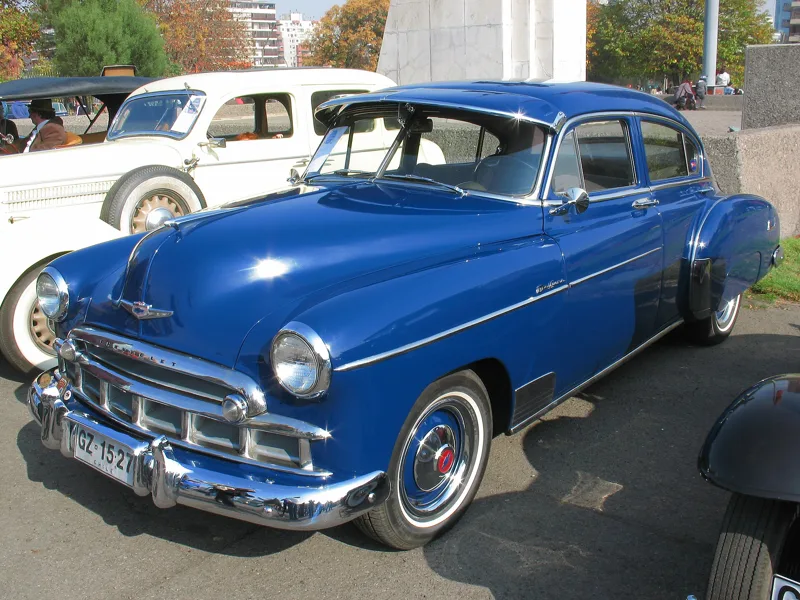
The Bel Air was a full-size Chevrolet sold across the 1950 to 1981 model years. It took its name from the wealthy Bel Air neighbourhood on the Westside of Los Angeles, and for the first three years, 1950 to 1952, the name belonged only to the two-door hardtops, separating them from the Styleline and Fleetline models.
The first year brought only 76,662 cars. A Bel Air cost US$1,741 and weighed 1,463 kg (3,225 lb), with independent "knee-action" front suspension and a standard 3.5-litre (216.5 cu in) "Thriftmaster" six-cylinder engine rated at 92 hp (69 kW). Underneath, it shared its chassis and mechanicals with the rest of the Chevrolet range, and only the front sheet metal ahead of the A pillar was common to all models. The roof, rear quarters and three-piece rear window were unique to the Bel Air, giving a lower roofline and a longer, more balanced look.
The first Impala was a Bel Air that was never allowed to say so.
1953: the Bel Air becomes a trim level
For 1953 Chevrolet renamed its series. The Bel Air name stopped meaning one body shape and began marking a premium trim level offered on several, with the 150 and 210 sitting below it as successors to the Special and Deluxe. Advertising called the car "Entirely new through and through", though the frames and mechanicals were essentially those of the 1949 to 1952 cars.
Still, the old technology began to leave. Torque tube drive, splash-feed six-cylinder engines, knee-action suspension and split windshields were phased out, and 1953 brought the first curved one-piece windshield. A wide chrome strip ran from the rear fender bulge to the bumper, carrying "Bel Air" scripts, while lesser models wore only a Chevrolet crest. Manual-transmission cars now used the "Thrift-King", a lower-compression 3.9-litre (235.5 cu in) Blue Flame engine making 108 hp (81 kW).
Popular Mechanics measured a 1953 Bel Air at 97 km/h (60 mph) in 19.6 seconds. In 1954 the engine gained insert bearings and higher oil pressure to suit a full-flow oil filter, replacing Babbitt bearings that had run at 15 to 30 psi. Power rose to 115 hp (86 kW) on stick-shift cars and 125 hp (93 kW) with Powerglide. Buyers could specify a convertible, a hardtop coupe, two- and four-door sedans and, for 1954, the Beauville wagon with woodgrain around its side windows. Options once seen only on luxury cars appeared: power steering and the Guidematic headlight dimmer in 1953, then power brakes, a power front seat and power front windows in 1954.
The 1955 to 1957 Bel Air: Tri Fives and the small-block V8
Restyled for 1955, the Bel Air weighed 1,568 kg (3,456 lb), measured 4.9 m (16 ft) in length and was sold as the "Hot One". It wore a Ferrari-inspired grille and gained a V8 option. The all-new 4.3-litre (265 cu in) unit had overhead valves, high compression and a short stroke, a design so sound that it stayed in production in various sizes for decades. The base engine made 162 hp (121 kW), the four-barrel "Power Pack" 180 bhp (134 kW), and a later "Super Power Pack" added another 15 bhp (11 kW).
It was not the first V8 in a Chevrolet. That distinction belongs to the Series D of 1917, which was built for two years, before Chevrolet joined General Motors.
Reviewers liked the 1955 car. Motor Trend gave it top marks for handling, and Popular Mechanics recorded 97 km/h (60 mph) in 12.9 seconds for a V8 Powerglide. The criticisms were small but real: a horn ring hid part of the speedometer, regular fuel made the engine knock, and early V8s used too much oil. A new air-conditioning option arrived for V8 cars, though from 1957 onward it required an automatic gearbox or a four-speed manual.
The 1956 car answered the people who did not like the 1955 front end, with a more conventional full-width grille. It added two-tone paint and a new pillarless Sport Sedan, and the Nomad, a two-door wagon, topped the price list at US$2,608 (US$30,884 in 2025 dollars), with only 7,886 built. The cheapest Bel Air was the two-door sedan at US$2,025 (US$23,980 in 2025 dollars). Seatbelts, shoulder harnesses and a padded dashboard were on the options list, yet Popular Mechanics found only 7.4 percent of owners ordering belts. A 1956 four-door hardtop prepared by Zora Arkus-Duntov set an endurance and speed record on Pikes Peak.
1957 Chevy Bel Air: fuel injection and an enduring image
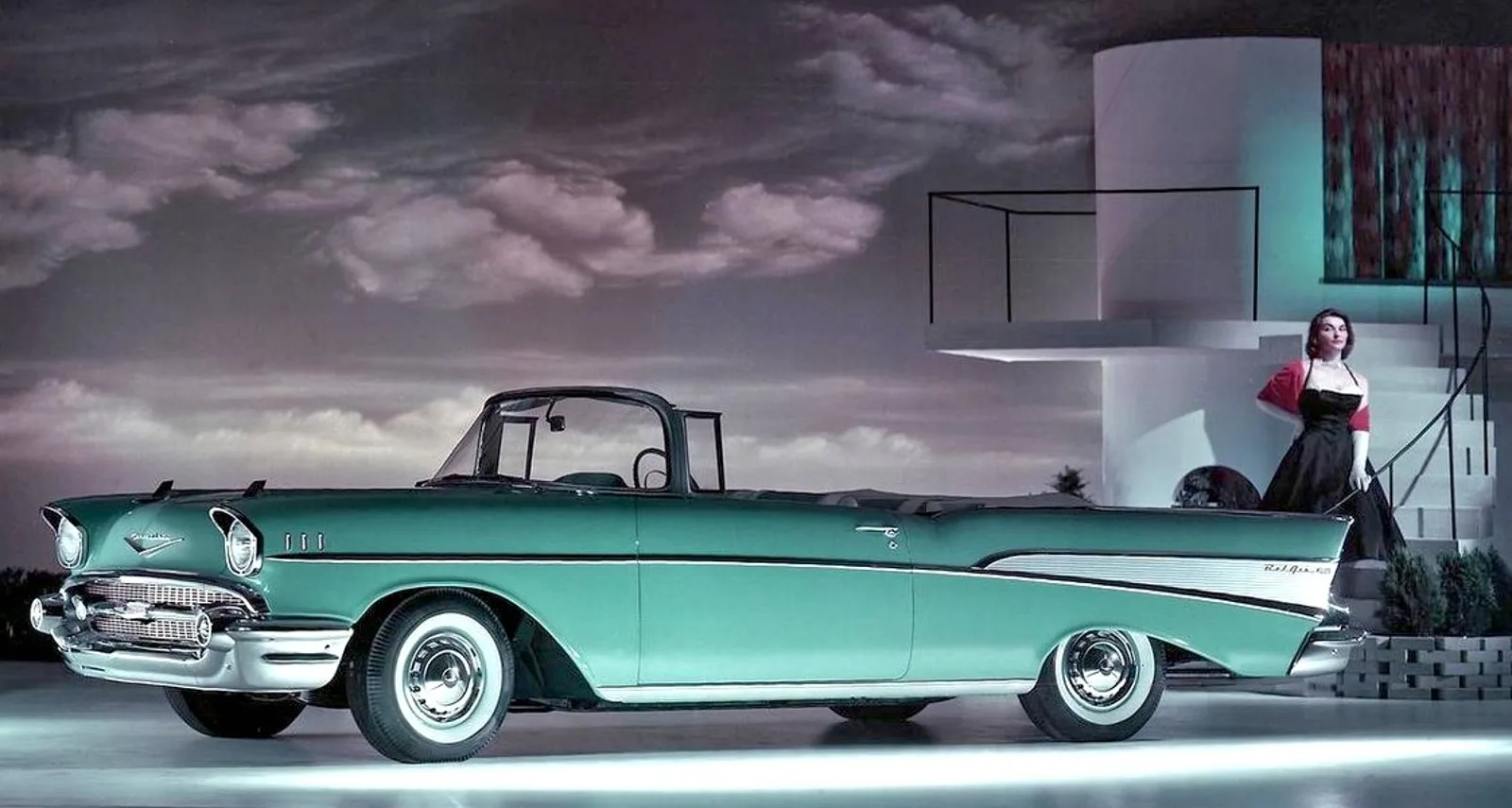
For 1957 the engine grew to 4.6 litres (283 cu in). With the Rochester Ramjet continuous mechanical fuel injection shared with the Corvette, the "Super Turbo Fire V8" made its peak 283 hp (287 PS; 211 kW) at 6200 rpm, and its 393 Nm (290 lb ft) of torque came in lower, at 4400 rpm. These "fuelie" cars are quite rare, because most Bel Airs were fitted with carburettors.
The 1957 Bel Air is described as "an icon of its age", ranked beside Elvis and Marilyn Monroe, and it is often named among the most recognisable American cars of all time. A second automatic, Turboglide, joined the two-speed Powerglide, using a continuously variable ratio that made shifting imperceptible.
The 1955 to 1957 cars are known collectively as the Tri Fives. The two-door Nomad wagon belonged to the Bel Air series in those years, with a body unique to it, after first appearing as a Corvette-based concept in 1954. Chevrolet has since shown two concept cars called Nomad, most recently in 1999. A black 1955 Bel Air with a hood scoop and a cowboy hat in the rear window also starred in the 1973 film American Graffiti, racing a yellow 1932 Ford Deuce Coupe before crashing into a ditch; it was driven by a young Harrison Ford.
Bel Air and Impala in Australia
For drivers Down Under, these cars were not just imports. The 1955 to 1957 Bel Airs were built in right-hand drive at Oshawa, Ontario, and shipped for local assembly in Australia from complete kits, and in New Zealand and South Africa too. The Impala followed the same route, and right-hand-drive Impalas were assembled by hand on the GMH Holden lines. The Australian Impala was the first post-war American import to come standard with a V8.
1958: the Impala arrives as the Bel Air halo
For 1958 the full-size Chevrolets moved to the B-body and became longer, lower and heavier, with a 5.7-litre (348 cu in) V8 on the options list. The Bel Air range gained its halo car in the Impala, available that first year only as a hardtop coupe and a convertible. Two much cheaper models sat below it: the Biscayne, which replaced the 210, and the Delray, which replaced the 150. In a recession year, Chevrolet was the number one make, with the Bel Air central to its popularity.
Where the Impala name came from
The name first appeared on a full-size General Motors Motorama show car in 1956, finished in emerald green metallic over a white interior and borrowing Corvette-like cues, especially the grille. It was named after the graceful African antelope, which became the car's logo. Clare MacKichan's design team and designers from Pontiac began working out basic packaging and dimensions for a shared 1958 body in June. Styling vice-president Harley Earl saw the first sketch to directly shape the finished Chevrolet in October, and seven months later the basic design had been developed.
GM marked its 50th year in business in 1958 with anniversary models across five brands, and the Impala was the Chevrolet entry.
The Impala differed structurally from the lesser Chevrolets from the windshield pillar rearward. Hardtops had a slightly shorter greenhouse and a longer rear deck, and the wheelbase was longer although overall length was identical. Inside were a two-spoke steering wheel and colour-keyed door panels with brushed aluminium trim. No other series offered a convertible. Outside, Impalas had three taillights on each side, against two on lesser models and one on wagons, plus crossed-flag insignia and dummy rear-fender scoops. That was also the first year of dual headlamps, and the 1957 tailfins gave way to deeply sculptured rear fenders.
The conventional perimeter frame gave way to an X-shaped design, which Chevrolet said improved torsional rigidity and let the passenger compartment sit lower. It was later criticised for giving less protection in a side impact, and it lasted until 1965. Coil springs took over at the rear from leaf springs, with air suspension as an option.
The standard V8 was the 283 (4,640 cc), rated at 185, 230 or 250 hp (138, 172 or 186 kW), the last with Rochester Ramjet fuel injection. The 348 (5,700 cc) was the first big-block Chevrolet had built and produced 250 hp (186 kW) with a single four-barrel carburettor or 280 hp (209 kW) with three two-barrels. Impala production was 55,989 convertibles and 125,480 coupes, 15 percent of all Chevrolet output, and it helped the company regain first place.
Impala 1959 and 1960: a series of its own
As part of a GM economy move, the 1959 Impala shared bodyshells with lower-end Buicks, Oldsmobiles and Pontiacs. The roof line was 3 inches lower, the body 2 inches wider and the wheelbase 1-1/2 inches longer, and flattened tailfins now pointed outward rather than upward. Large teardrop taillights and two slim, non-functional air scoops above the grille completed the look.
The Impala also became a separate series, with a four-door hardtop, a four-door sedan and a five-door wagon alongside the two-door sport coupe and convertible. A six-cylinder was standard, with the base V8 a 4.6-litre (283 cu in) of 185 hp (138 kW), and options reached 335 hp (250 kW) from the 348.
The 1960 cars brought back three round taillights per side and a white band along the rear fenders. Seven V8 versions were offered. The 283 Turbo-Fire made 170 or 230 hp, the 348 made 250 to 320 hp, and a 350 hp (261 kW) Special Super Turbo-Thrust used triple two-barrel carburettors, 11.25:1 compression and dual exhausts. Fuel injection was no longer offered on full-size Chevrolets, cruise control arrived and production reached 490,000.
Impala 1961 to 1964: boxy, bubbleback and fast
Chevrolet moved the Impala onto the GM B platform for 1961, and the car looked more trim and boxy than before. The Sport Coupe adopted a "bubbleback" roof, a two-door pillared sedan appeared for that year only and was rarely ordered, and the Super Sport option debuted. The top station wagon carried the Nomad name for the last time.
For 1962, new C-pillar styling arrived, and Sport Coupes took on a "convertible roof" shape that proved popular. It was the final year for the 235 six. The small-block was enlarged to 5.4 litres (327 cu in) with 250 or 300 bhp (224 kW), while the 348 gave way to a 6.7-litre (409 cu in) V8 of 380 bhp (283 kW) or 409 bhp (305 kW), available only with a manual gearbox. Reliability problems ended the Turboglide, leaving Powerglide as the only automatic until 1965. The Beach Boys recorded a hit single, "409", about the engine.
The 1963 car turned rectilinear, with an engine-turned aluminium taillight panel on SS models. The old Stovebolt six was replaced by the 3.8-litre (230 cu in) Turbo-Thrift, which stayed the standard Chevrolet engine through 1979. The year also brought a rare piece of hardware. Under Regular Production Option Z11, a 7.0-litre (427 cu in) version of the 409 went into the Impala Sport Coupe for drag racers and NASCAR, together with aluminium body parts made in Flint, Michigan, and a cowl-induction air intake. A longer 93 mm (3.65 in) stroke, a high-rise aluminium manifold and two Carter AFB carburettors fed 13.5:1 compression, giving 430 horsepower (320 kW) and 780 Nm (575 lb ft). Only fifty Z11 cars were built.
1964 Impala and the lowrider connection
For 1964 the Impala took a rounder, softer look, with an "upside-down U" of aluminium trim above the taillights and a body-coloured panel around each lamp. The 409 returned as the big-block, with dual four-barrel Carter AFB carburettors good for 425 bhp (431 PS; 317 kW) at 6,000 rpm, with 576 Nm (425 lb ft) of torque arriving at 4,200 rpm. The Impala Super Sport became its own series.
Lowrider culture treats the 1964 model year as a staple, and West Coast hip hop songs mention it often.
Impala SS: how the Super Sport badge began
Chevrolet introduced the Impala SS option on 17 December 1960. The SS badge went on to become the Chevrolet signature of performance on many models, although it was often only an appearance package. In 1961, however, it was a genuine performance package, with mandatory suspension and engine upgrades: a 348 rated at 305, 340 or 350 hp, or the new 409 at 360 hp (268 kW; 365 PS). Uniquely, the 1961 SS could be ordered on any Impala, including sedans and wagons, and it brought special springs, shocks and sintered metallic brake linings. Only 142 of the 1961 Super Sports left the factory with the 409. Dealers could also fit SS trim to ordinary Impalas lacking the upgrades.
From 1962 the SS was an appearance package limited to hardtop and convertible coupes, available with every engine from the base 3.9-litre (235 cu in) six of 135 hp (101 kW), although buyers could still order big-block engines and heavy-duty parts. In 1964 it became a series of its own.
Hottest Impala engine by year
| Year | Top engine | Output |
|---|---|---|
| 1958 | 348 cu in (5.7 L), three two-barrels | 280 hp (209 kW) |
| 1959 | 348 cu in (5.7 L) | Up to 335 hp (250 kW) |
| 1960 | 348 cu in, Special Super Turbo-Thrust | 350 hp (261 kW) |
| 1961 SS | 409 cu in (6.7 L) | 360 hp (268 kW) |
| 1962 | 409 cu in (6.7 L) | 409 bhp (305 kW) |
| 1963 Z11 | 427 cu in (7.0 L) | 430 hp (320 kW) |
| 1964 | 409 cu in (6.7 L), dual four-barrel | 425 bhp (317 kW) |
What became of the Bel Air and Impala after the 1960s?
The Bel Air slid down the range. It went from mid-level trim to a budget fleet sedan, US production stopped in 1975, and the Canadian market kept it through the 1981 model year.
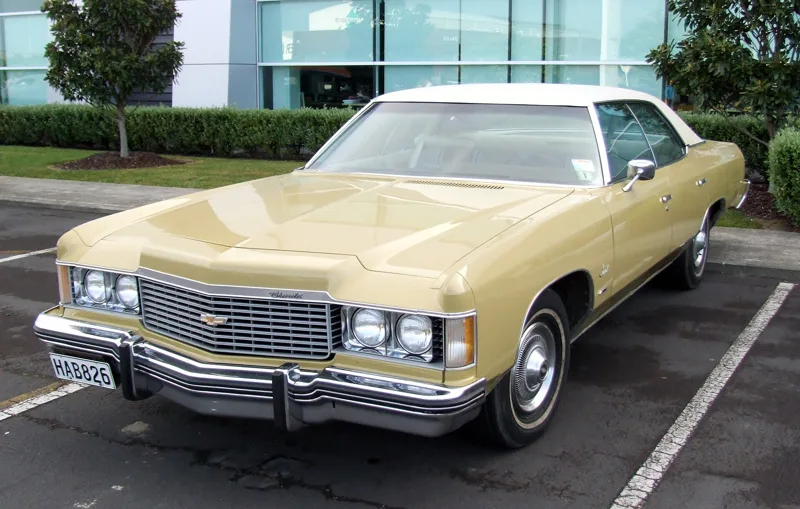
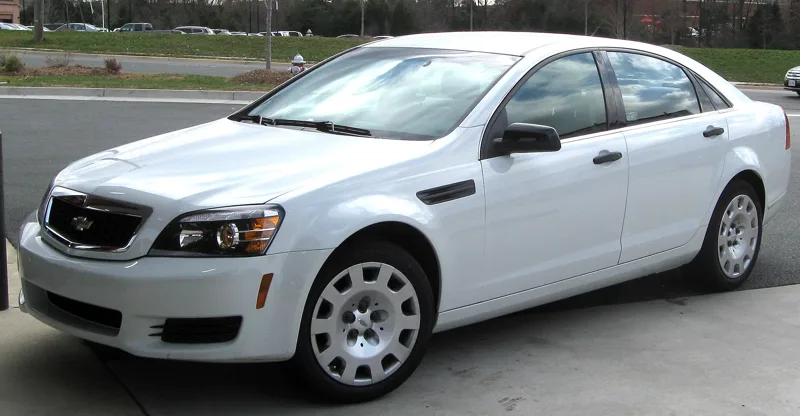
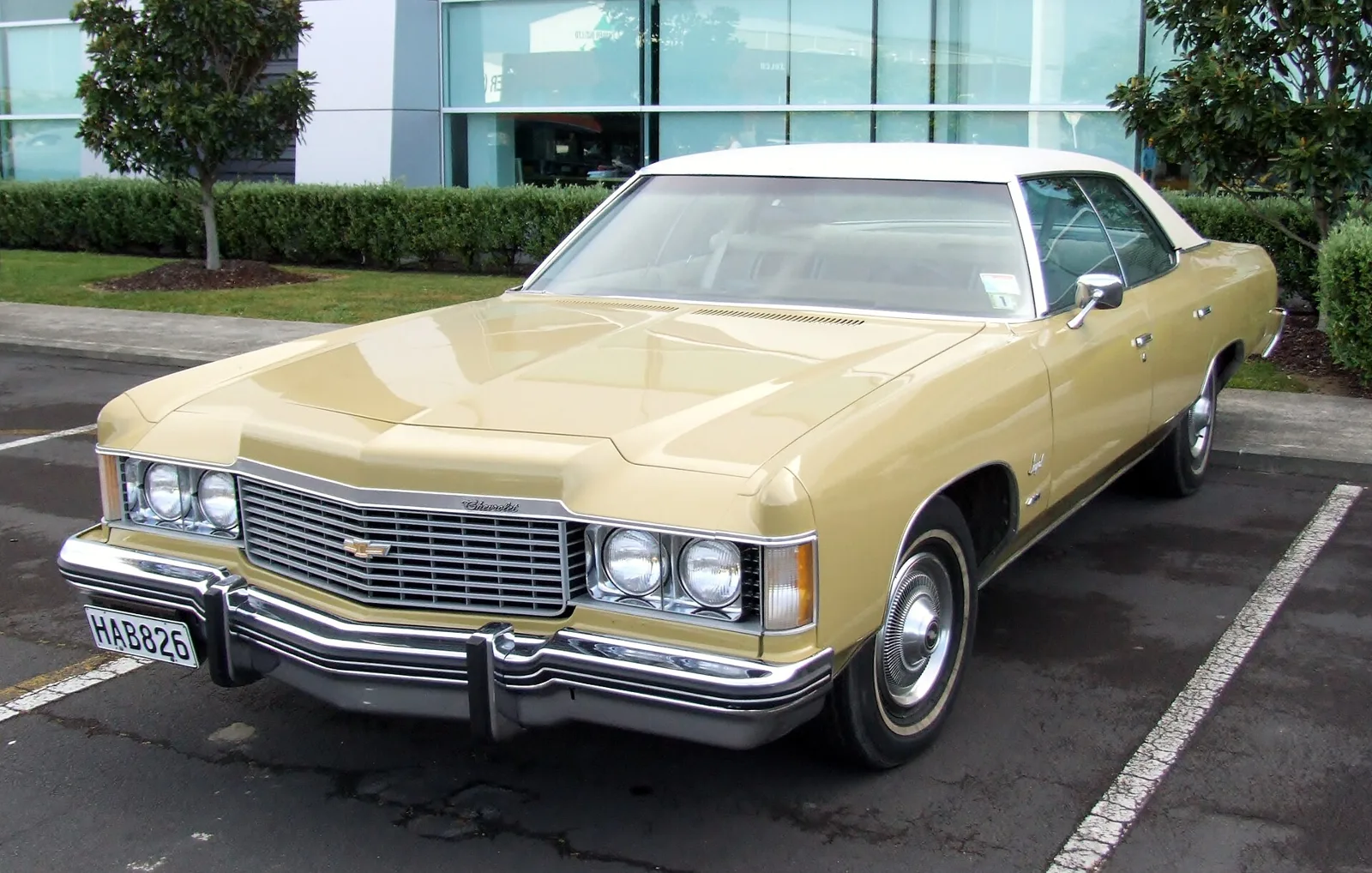
The Impala went the other way for a long time. The Caprice began as a top-line Impala Sport Sedan for 1965, then became a separate series above the Impala in 1966. Through the mid-1980s the Impala remained the most popular full-size Chevrolet, returned in 1994 to 1996 as a 5.7-litre V8 version of the Caprice Classic, and in 2000 it was reintroduced as a front-wheel-drive mainstream model. In February 2014 the Impala topped the Affordable Large Cars ranking published by U.S. News & World Report. When the tenth generation arrived for the 2014 model year, the ninth was rebadged the Impala Limited and sold to fleet customers only through 2016. The tenth-generation car found buyers in the Middle East and South Korea too, and the nameplate's model years run to 2020.