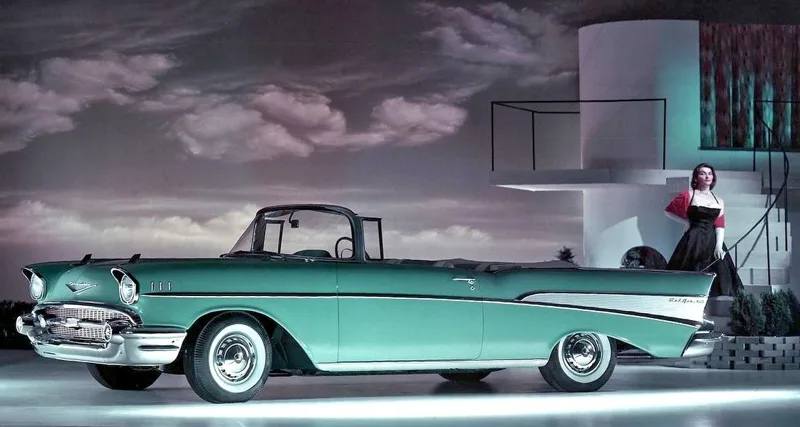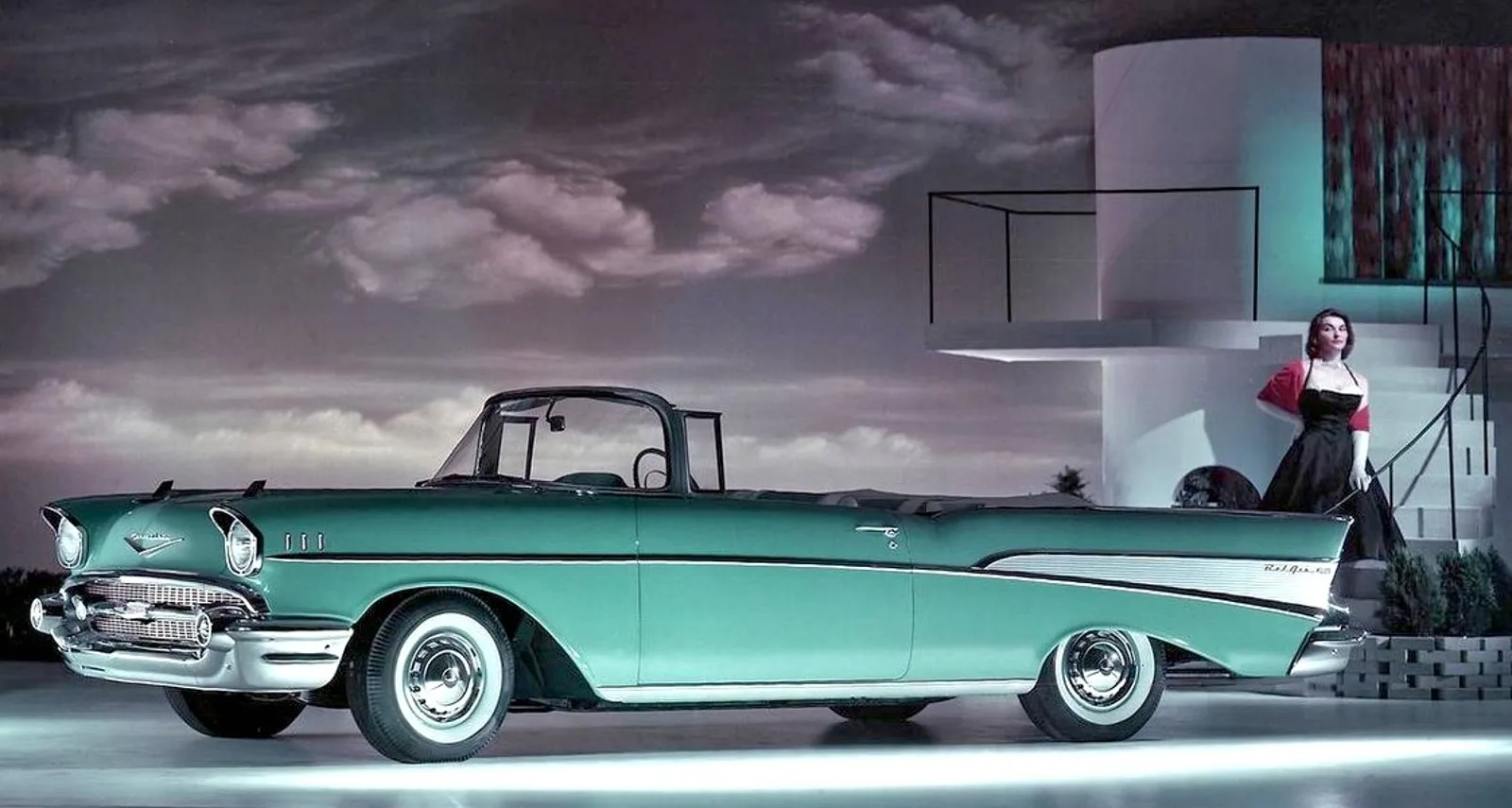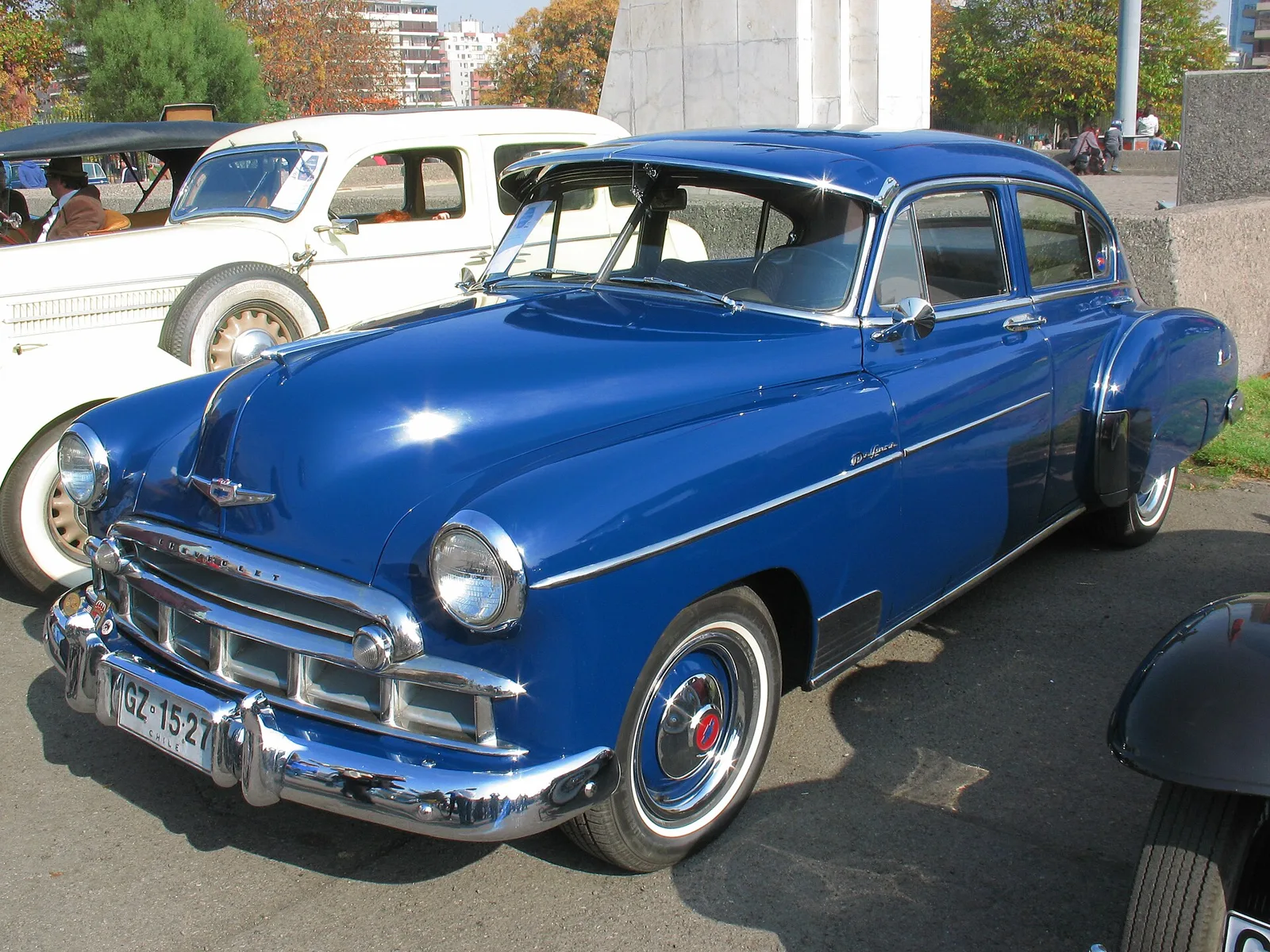
The Master that Toyota took apart, the Deluxe that outsold the lot, the Delray that fleets bought and the Brookwood wagon that came back.
The Chevrolet Master was the top Chevrolet from 1933 to 1942, the Deluxe the sales-leading upper trim from 1941 to 1952, the Delray the bottom-priced model in 1958 after starting as a trim in 1954, and the Brookwood a station wagon sold from 1958 to 1961 and 1969 to 1972.
When Toyota set out to build its first sedan, the Toyota AA, it took a locally assembled Chevrolet Master apart to see how a car like that ought to be engineered. The Master was one of four names, with the Deluxe, Delray and Brookwood, that came to mean quite different things on the price ladder in Chevrolet showrooms between 1933 and 1975.
What was the Chevrolet Master?
Between 1933 and 1942 Chevrolet built the Master and the Master Deluxe as successors to the 1933 Master Eagle. The Master was the most expensive model in the range at the time, while the Standard Mercury covered the affordable end from 1933 to 1937. All General Motors cars took on a corporate look from Harley Earl's Art and Color Section.
Chevrolet exported the Master in knock-down kits for assembly abroad, and it was the last model shipped that way to the factory in Osaka, Japan, before the Imperial Japanese Government appropriated the plant. The kits themselves were crated at an export boxing plant in Bloomfield, New Jersey, repurposed in May 1925 to pack Chevrolet, Pontiac, Oldsmobile, Buick and Cadillac car kits, plus truck parts, for rail shipment to the docks at Weehawken.
When Toyota built its first sedan, it began by taking a locally assembled Chevrolet Master apart.
How did the Master change from 1933 to 1942?
The 1933 Series CA began life as the Eagle and became the Master midway through the model year, once the cheaper Standard arrived. One easy way to tell them apart is the chrome divider between the front wing window and the winding window, which dropped with the glass on an Eagle but stayed fixed on a Master.
For 1934 the Series DA Master got a wheelbase of 112 in (2,844.8 mm), 5 in (127.0 mm) longer than the Standard, and an upgraded 206 cu in (3,380 cc) Stovebolt six of 80 hp (60 kW). GM called its independent front suspension Knee-Action, with trailing arms and coil springs. The 1935 redesign introduced the Turret Top, with a steel roof and no wood in the body or chassis. Streamlined Art Deco lines arrived in 1936, with bodies shared with the Pontiac Deluxe.
In 1937 the Master replaced the cheaper Standard Six, and a better-equipped Master Deluxe lifted the top of the range. The two looked alike apart from trim, but only the Master Deluxe had independent front suspension, while the Master kept a beam axle on leaf springs. In 1938 the Master sold 162,430 and the Master Deluxe 302,728. A station wagon appeared in 1939, built by an outside firm, Mid States Body Corp, when the base car was renamed the Master 85. The even better-equipped Special Deluxe followed for 1940.
For 1941 Series AG, the Master Deluxe, and Series AH, the Special Deluxe, got a new grille, new suspension and headlights set into the wings, and the Special Deluxe introduced a Fleetline sedan. The 1942 cars could seat six in a sedan, and the Master Deluxe was the economy model, lacking the engine cover nameplate that the Special Deluxe carried. Civilian production stopped on 1 February 1942. When it resumed, the names became Stylemaster and Fleetmaster for 1946.
What was the Chevrolet Deluxe?
The Chevrolet Deluxe was a trim line sold from 1941 to 1952 and the volume sales leader of the 1940s. The line opened with a four-door sedan, then added a fastback two-door aerosedan and further bodies. The 1941 car was the first generation to look different from Chevrolet trucks.
That generation was also wider, so that three people could sit on each bench seat, which GM achieved by deleting the running boards. The first series lasted from 1941 to 1948, and a new body followed for 1949 to 1952. Through those years the Deluxe was the Chevrolet best seller, with more style and luxury than the base Special, and a wider choice of bodies including a convertible, a Sport Coupe hardtop from 1950, sedans and wagons.
The 216 cu in (3,540 cc) Victory Six produced 85 horsepower at 3300 rpm, rising to 90 in 1947, and a Deluxe of that period could comfortably top 80 miles per hour without overdrive. The three-speed gearbox had a vacuum-assisted shift, so that the three-on-the-tree lever moved with the slightest pressure. A torque tube enclosed the driveshaft, and the brakes were hydraulic drums at all four wheels. Shock absorbers were lever-type until 1948 and the airplane type afterwards. The windscreen was a split flat pane until 1948 and split curved glass for 1949 to 1952, and the wipers ran on vacuum.
The cabin had cloth seats and a metal dash, sometimes painted to look like burl wood. The radio carried the throttle knob, marked T, on one side and the choke knob on the other, and a 7-day wind-up clock sat in the glove compartment door. The 1949 grille had five teeth and round parking lights, the teeth vanished in 1950, the lights moved to the bottom corners in 1951 and the teeth returned in 1952.
How did the Deluxe change after 1949?
The 1949 restyle made the Deluxe the new upper-end model, and the cheapest, the Styleline six-passenger sedan, cost $1,492. Both the Deluxe and the lower Special came as Fleetline, a fastback sedan only, or as Styleline, a three-box notchback that was also built as a coupe, convertible and wagon.
In 1950 Chevrolet added the Bel Air, a luxurious hardtop coupe with better trim, full carpeting and a range of two-tone schemes. For its first three years it was officially part of the Deluxe range, sharing only the front sheet metal ahead of the A-pillar with the other cars. Another 1950 novelty was Powerglide, a two-speed automatic offered only on Deluxe and Bel Air models. It was paired with a 235 cubic inch six of 105 horsepower and a 3.55:1 rear differential, an engine that went on to be known as the Blue Flame six. Manual cars kept the 216.5 cubic inch engine, rated at 92 horsepower.
The fastback was ageing fast. In 1951 Chevrolet built fewer than 200,000 Fleetline sedans against more than 780,000 Styleline notchbacks, and by 1952 only one Fleetline remained, the Deluxe two-door. It cost the same as the equivalent Styleline, $1,696, but 37,164 were built against 215,417. It was the last fastback of the GM line introduced in 1941: Cadillac had stopped building streamliners after 1949, and Buick, Oldsmobile and Pontiac after 1951.
Tinted glass arrived in 1952. Popular Mechanics rated fuel economy at twenty miles per gallon at 50 mph. Afterwards the Special and Deluxe were retired in favour of the 150 and 210, with similar trim, and the Bel Air became a full series with sedans, a wagon and a convertible. Abroad, GM-Holden's assembled a four-door Special and its own coupe utility in Australia, Hindustan Motors built the Deluxe in India until 1955, and in 1947 GM New Zealand assembled cars at Petone from kits sent from Oshawa, Ontario, because tariffs favoured Canada over the United States.
What was the Chevrolet Delray?
The Chevrolet Delray took its name from the Delray neighbourhood of Detroit. It arrived in 1954 as a trim option for two-door models of the mid-range 210 and became a series of its own in 1958, at the bottom of the lineup in place of the discontinued 150, where it lasted one year.
For 1954 the 210 series was cut back, losing its hardtop coupe and convertible and gaining the Delray club coupe. The Delray used the same chassis and mechanical parts as the other cars, with independent Knee-Action front suspension, and it was the last year for the Blue Flame straight-six as the top engine before the small block V8 of 1955, and the last year for six-volt electrics. The 235 cu in six made 115 hp (86 kW) with the manual gearbox and 125 hp (93 kW) with Powerglide. All were overhead-valve units, known as stovebolt sixes after the big slotted screws that held their covers.
Through the Tri-Five years the Delray amounted to an interior package for the plain two-door 210, with vinyl upholstery pleated like a waffle and colour-matched to the exterior, plus carpeting. The 1955 car brought a new chassis, the well-received small block V8 and 11-inch (280 mm) drums, and a 210 buyer could pick any powertrain. The 235 six made 123 hp (92 kW), or 136 hp (101 kW) with an automatic, and the 265 Turbo-Fire V8 offered 162 hp (121 kW) or 180 hp (134 kW). In 1956 the V8 came in three states of tune, topping out at 225 hp (168 kW) with dual four-barrel carburettors. In 1957 the 283 small block arrived, and even the Rochester Ram-Jet fuel-injected version, rated at 283 hp (211 kW), could be had on a 210.
Why did the 1958 Delray sell to fleets?
For 1958 the Delray became a distinct series, positioned as the price leader of the Chevrolet range, with no frills. Above it sat the Biscayne, the Bel Air and the Impala, which that year was a Bel Air sub-model. It used GM's X-frame and came as a two-door sedan, a two-door utility sedan, a four-door sedan and a sedan delivery. The one-year station wagon counterpart was the Yeoman.
The 1958 Chevrolets were longer, lower and heavier, and the 348 cu in (5,700 cc) engine was the first production big block V8 in the line. The styling carried less chrome than Pontiacs, Oldsmobiles, Buicks and Cadillacs, with a broad grille and quad headlights that gave a baby Cadillac look. In a recession year buyers still made Chevrolet the top make, ahead of Ford, which had held the title in 1957.
Consistent with its place at the bottom, the Delray carried minimal trim and few options, and police departments and businesses bought plenty of them. Private buyers could order one too, if cheap, basic transport with full-size convenience mattered more than anything. Any engine could be fitted, from the 235 cu in (3.9 L) six to the 283 V8 of 195 to 220 bhp (145 to 164 kW) and the 348 of 250 to 350 bhp (186 to 261 kW). The Powerglide shifted to the safer PRNDL pattern. All 1958 to 1964 full-size cars used the Safety-Girder cruciform frame, later criticised for giving less protection in a side impact.
What was the Chevrolet Brookwood?
The Chevrolet Brookwood was a full-size station wagon built from 1958 to 1961 and again from 1969 to 1972. It started as the mid-range wagon between the cheaper Yeoman and the more luxurious Nomad, became the entry-level wagon once the Yeoman went in 1959, and in its second life was again the least expensive wagon.
In 1958 it came only as a four-door, in six- or nine-passenger form, trimmed like the Biscayne, replacing the 1957 210 Townsman and Beauville. The 1959 cars were all new. Their headlights sat as low as the law allowed, the tail lights were cat's-eye shapes and the flat, wing-shaped tailfins were the biggest change. The wheelbase was 119 in (3,023 mm) and the length 211 in (5,359 mm), 11 in (279 mm) more than in 1957, which turned Chevrolet from the shortest car in the low-priced class into the longest. Width grew by 3 in (76 mm) outside and 5 in (127 mm) inside, partly because the doors were thinner.
That year the Brookwood became the cheapest wagon, in two-door and four-door six-passenger forms, with the Parkwood and Kingswood as the middle range and the Nomad on top. Speed options took horsepower up to 315. For 1960 the front end was calmer and the double cone tail lights returned. Fuel injection was no longer offered, but a package of triple twin-barrel carburettors, a special camshaft and 11.25:1 compression lifted the 348 to 335 horsepower at 5800 rpm.
Hot rodders and collectors prefer the two-door Brookwoods, which also gave rise to the 1959 El Camino. They were the last full-size Chevrolet two-door wagons, and the 1964 Chevelle 300 two-door was the next. The 1961 Brookwood came on another new body, a little shorter at 209.3 in (5,320 mm), with a standard 235.5 CID six of 135 hp (101 kW) or a 283 V8 of 170 hp (127 kW). The V8 cost $110 more and weighed 5 lb (2.3 kg) less. The two-door was dropped and the nine-passenger returned. For 1962 the Brookwood, Parkwood and Nomad names went, and wagons took the Biscayne, Bel Air and Impala names.
How did the Brookwood come back in 1969?
In 1969 every Chevrolet wagon regained its own name, with the Brookwood, related to the Biscayne, as the cheapest and the Townsman, Kingswood and Kingswood Estate above it. Buyers could pick a six or a V8 until 1970, when the six went and the loop bumper-grille was replaced by a conventional front end.
The 1971 restyle brought GM's clamshell tailgate, sold as Glide-away. The rear glass disappeared upward into the roof while the lower gate dropped fully beneath the load floor, so the opening stayed clear even in a closed garage. A manual gate needed a 35 lb push to lower, counterbalanced by a torque rod, and a 5 lb pull to raise. An optional third row faced forward, and with the seats folded the wagon could swallow a 4 x 8 foot sheet of plywood. Midway through 1971 Turbo-Hydramatic became standard on all full-size wagons, though almost every Brookwood had an automatic anyway.
For 1972 the Brookwood took the restyled front end and was listed in the Biscayne line. The name ended in the United States for 1973, with the Bel Air, Impala and Caprice Estate continuing in place of the Townsman, Kingswood and Kingswood Estate. In Canada the Biscayne replaced it, for wagon and sedan alike, until 1975. Oshawa, Ontario, built the 1969 to 1972 cars.
Four names at a glance
| Name | Years | Place in the range | Notable figure |
|---|---|---|---|
| Master | 1933 to 1942 | Most expensive Chevrolet when new | 302,728 Master Deluxes in 1938 |
| Deluxe | 1941 to 1952 | Upper trim line and volume leader | $1,492 for the cheapest 1949 Styleline sedan |
| Delray | 1954 to 1958 | Trim level, then bottom-priced series in 1958 | 348 cu in big block option in 1958 |
| Brookwood | 1958 to 1961, 1969 to 1972 | Mid-range, then entry-level wagon | Glide-away tailgate in 1971 |