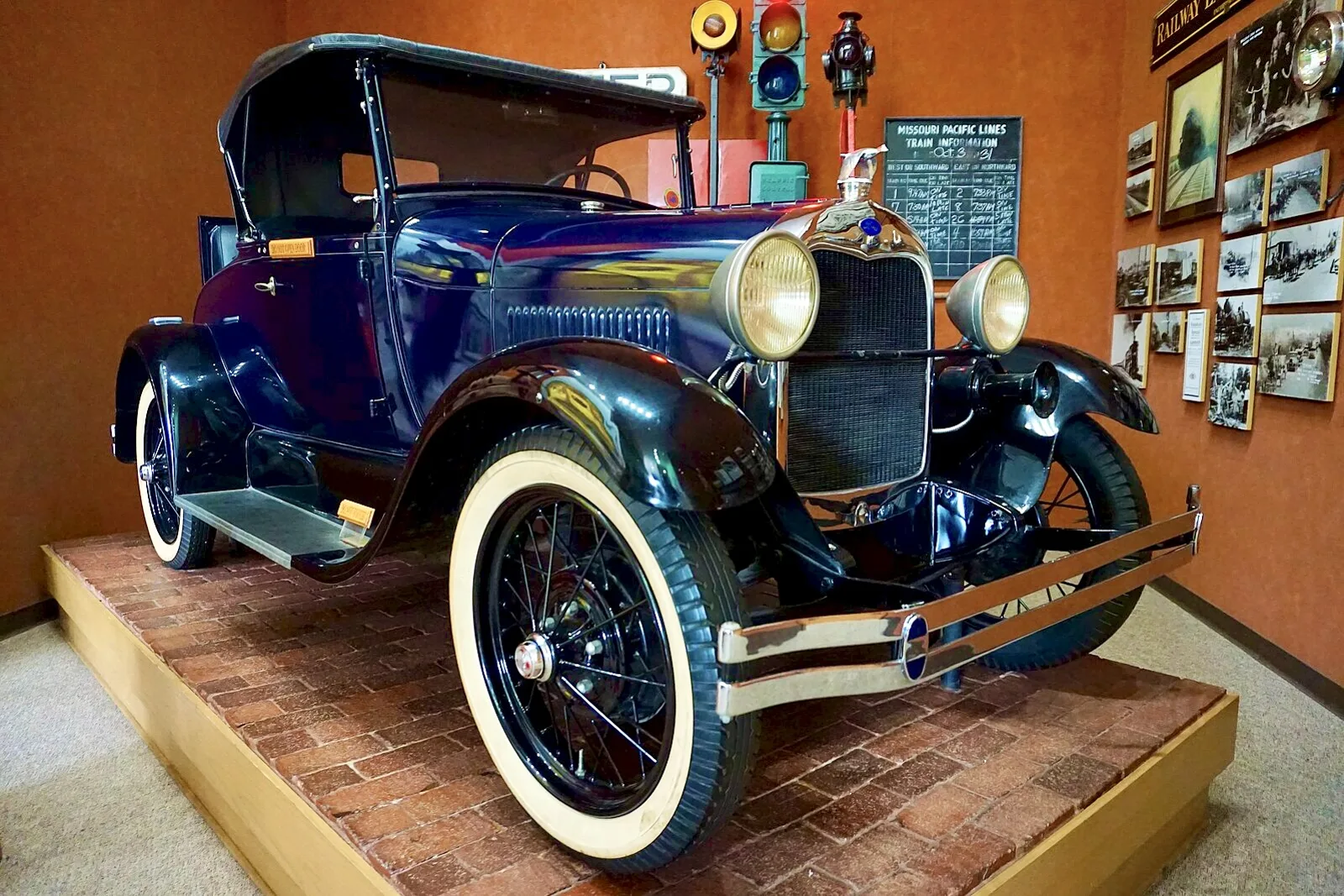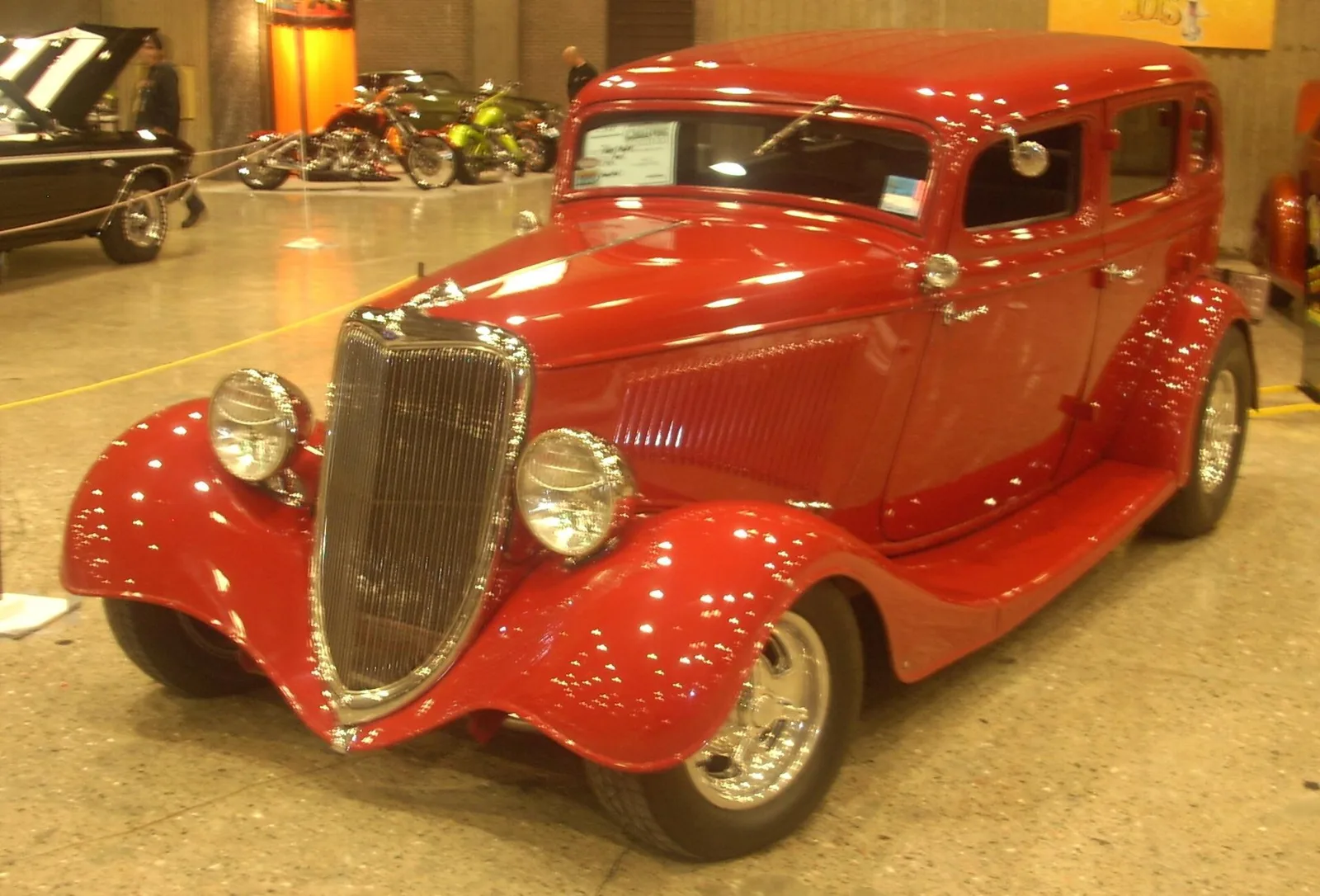
The 1932 Ford range paired a cheap four-cylinder Model B with the V8 Model 18, and the V8 won the sales race and later became the basis of the hot-rod deuce coupe.
The Ford Model B was a four-cylinder car sold from 1932 to 1934 within Ford's 1932 range, alongside the V8 Model 18. It shared bodies and trim with the V8 but used a 201 cu in engine rated at 50 hp, and buyers chose the V8 by a wide margin.
Ford's Model B looked almost exactly like the V8 sold beside it, and it was built to be the cheaper choice. It shared most of its trim with the V8, yet the V8 won the showroom contest easily. The Model B's story is a useful example of how a cheaper engine can lose out when the dearer option is only slightly more expensive.
What was the 1932 Ford range?
The label 1932 Ford covers three cars made from 1932 through 1934: the Model B, Model 18 and Model 40, which succeeded the Model A. The Model 18 was the first Ford with the flathead V8, and the Model B shared its body and trim with a four-cylinder engine.
Ford did not simply refresh the Model A. The company launched an entirely new vehicle for 1932, with a longer wheelbase, a chassis with an outward-curved double drop and a fuel tank moved to the rear. Edsel Ford oversaw the design, while Henry Ford was closely involved in the flathead V8.
A four-cylinder Ford that looked like its V8 sibling and sold far fewer units.
Why did the V8 overshadow the Model B?
The Model B was engineered with minimal changes from the V8 to hold down its price, and it looked almost the same apart from the engine and badges. Its job was to be the price leader, and on paper it offered more than the popular Model A.
The V8 took the show. Ford sold 298,647 V8-powered 18s in 1932, while the four-cylinder B managed only 133,539, partly because the V8 cost only US$10 more. Ford struggled to keep up with V8 demand, and dealers moved some customers from the four to the V8.
The Model B was dropped partly because buyers disliked four-cylinder models generally, and partly because the V8 sold so strongly. It was not an inferior car. It lasted a little longer in Europe, where tax systems often favoured smaller-displacement engines.
What engine did the Model B use?
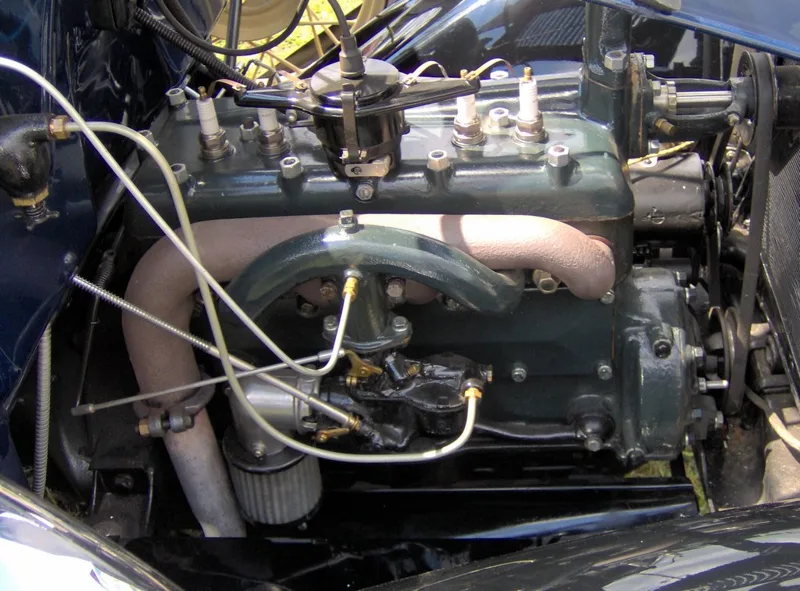
The Model B used an improved Model A four-cylinder of 201 cu in (3.3 L), rated at 50 hp (37 kW; 51 PS). The V8 was 221 cu in (3.6 L) and rated at 65 hp (48 kW; 66 PS) at launch, and it was the more advanced design of the two.
The V8 was developed from scratch and was the first low-priced, mass-marketed car with a V8 engine, a milestone for the American car industry. Its power grew once carburettor and ignition improvements arrived in the following years.
The four-cylinder was essentially a variant of the Model A engine, improved in balancing and lubrication. Before Ford's V8, the engine had been exclusive to Lincoln, which dropped V8s and offered only V12 engines from 1932 onward.
How did the 1933 cars change?
The Model 40 and the new Model B arrived on February 9, 1933 with substantial revisions. The wheelbase was lengthened, moving from 2692 mm (106 in) to 2845 mm (112 in) on a new crossmember frame, and the car gained a more streamlined look.
The grille gained a pointed forward slope at the bottom, and both the grille and the hood louvers curved down and forward. The English Ford Model Y provided the inspiration for the new look, and the hood now covered the cowl to add a sense of length.
Inside, the cars received an oval instrument insert in front of the driver, plus a passenger-side glove box. Closed Deluxe models had heavy DI-NOC woodgraining on the dash and window frames, plus deeper seat cushions.
There were 10 body styles, or 14 when trims are counted separately. The Model B now got Deluxe models too, and the woody, the most expensive car in the line, was offered only in Standard trim at US$590 with the four-cylinder engine.
Weight rose by about 3 percent, and the engines were uprated to cope. The V8 gained 15 percent more power, which kept it ahead of the four.
What was the so-called Model C?
Some enthusiasts call the four-cylinder the Model C, but Ford never used that name for its Improved Four-Cylinder engine. The confusion comes from a counterbalanced crankshaft and a letter C casting mark on some Model B heads, as well as Canadian cars that used a C prefix on their identification plates.
Ignition revisions lifted the V8 to 75 hp (56 kW), while the four ran unchanged. The integrally counterweighted crankshaft first appeared in truck engines and was adopted for four-cylinder cars once it proved smoother and longer lasting.
Ford also had large stocks of B-code engines to use up, so both B and C codes appear in some model years. Model Bs carried the prefix AB, while V8s used 18-1.
What changed for 1934?
The 1934 Ford, badged Model 40B, was a smaller change than the two previous years. It introduced a flatter grille with a broader surround, straight louvers on the hood, and two handles on each flank of the bonnet, smaller headlamps and cowl lamps, and a reworked badge.
V8 output rose again to 85 hp (63 kW). The four-cylinder Model B engine reached its last year, and the Victoria body was dropped, yet the range still offered fourteen body options, with the Tudor the top seller.
Deluxe cars gained pinstriping, twin chromed horns and twin back lights, and their interiors received more elaborate wood graining.
Why are 1934 Fords linked to Bonnie and Clyde?
The 1934 Ford V8 is tied to the end of Bonnie Parker and Clyde Barrow, the Depression-era pair who were ambushed in one. Barrow preferred to steal powerful Fords, and on May 23, 1934 the couple were in a 1934 sedan when a posse opened fire in Bienville Parish, Louisiana.
A heavily armed posse fired on the pair, riddling them with bullets and buckshot.
What was the 1934 Model 40 Special Speedster?
Edsel Ford commissioned chief designer E.T. Bob Gregorie to design a personal sports car based on a European style he had seen. The result was a two-seat roadster built from aluminium and fitted with a flathead V8, and only one was built.
The Speedster is now at the Ford House museum. It stands apart from the production cars because it was a one-off design rather than a model in the range.
Why did hot rodders adopt the 1932 Ford?
After the Second World War hot rodders favoured the Model B and the Model 18. During the 1940s the Model 18 was common and cheap, so young men could afford one, making it an ideal base for a hot rod.
The roadster and coupe are now the most prized body styles, which makes unmodified cars scarce. Reproduction bodies in fibreglass and, more recently, steel have raised the number of cars built or restored, and show-quality examples can command $60,000 or more.
What is a deuce coupe?
A deuce coupe is a 1932 Ford coupe, with the name taken from the year's final digit. The Model 18 coupe with its V8 outsold the four-cylinder Model B coupe, and customisers stripped surplus weight and hopped up the engine for more power.
These hot rods came in two body styles, the common five-window and the rarer three-window suicide-door version. Typical pre-war builds wore wire-spoke wheels from the '35 Ford, and most postwar builds switched to hydraulic brakes.
Its hot-rod fame was enough to prompt The Beach Boys' 1963 hit Little Deuce Coupe, which also gave the title to their album. American Graffiti in 1973 featured the deuce coupe prominently, and Bruce Springsteen's 1973 song Blinded by the Light referenced the car, a version popularised by Manfred Mann's Earth Band in 1977.
What was the Little Deuce Coupe?
The car on the cover of the Beach Boys' 1963 album was the coupe of Clarence Chili Catallo, a three-window 1932 Ford he had bought in 1956 for $75 as a 15-year-old in Michigan. The picture was supplied by Hot Rod magazine.
Catallo chopped and channelled the body, lowering the top by 6 in (150 mm), and swapped the flathead for a more powerful OHV Oldsmobile Rocket V8. Stacked headlamps from a 1960 Chrysler 300H, along with the grille and side trim, came from work by Mike and Larry Alexander in Southfield.
After Catallo moved to Southern California, George Barris' Kustom City added the chopped top in 1960-61. Catallo sold the coupe, then bought it back in the late 1990s for $40,000 and restored it with many original parts, so it looks nearly identical to the famous photo.
It took the People's Choice prize at the Meadow Brook Concours d'Elegance in 2000.
Where was the Model B built?
The Model B had no plant of its own. It came off the line alongside the V8 at River Rouge, and the cars were shipped as knock-down kits to local assembly sites, which then built and sold them.
Across the world in 1932 Ford ran 32 American plants, plus one in Canada, seven in Europe, four across Central and South America and single sites in Turkey, Japan and Australia. European assembly included Dagenham in the United Kingdom, Cologne in Germany, and Gorky in the Soviet Union.
What were the BB trucks?
The Model BB was the commercial version of the 1932 range, replacing the Model AA truck. It came with a four-cylinder engine as standard, while the V8 was an option even for heavy trucks, and it had wheelbases of 3340 mm (131.5 in) and 3988 mm (157 in).
The frame was strengthened, the gearboxes and axles were heavier, and the wheels were bigger. Wire wheels came on light cars, while the heavier trucks used steel wheels, some dual at the rear.
Many local coachbuilders made bodies for buyers who needed something more specific, and during the Depression ambulances, hearses and fire trucks found their way to budget-minded communities.
What are the Model B and 1932 Ford specifications?
| Specification | Detail |
|---|---|
| Years | 1932 to 1934 |
| Model B engine | 201 cu in (3.3 L) four-cylinder, 50 hp (37 kW; 51 PS) |
| Model 18 engine at launch | 221 cu in (3.6 L) flathead V8, 65 hp (48 kW; 66 PS) |
| V8 output after 1933 | 75 hp (56 kW) with revised ignition; 85 hp (63 kW) in 1934 |
| Wheelbase, 1932 | 2692 mm (106 in) |
| Wheelbase, 1933 | 2845 mm (112 in) |
| Prices | US$490 coupes, US$495 roadster, US$650 convertible sedan |
| Woody station wagon | US$590 with the four-cylinder engine |
| 1932 V8 Model 18 sales | 298,647 units |
| 1932 four-cylinder Model B sales | 133,539 units |
| B400 cabrio coach | 842 built, the rarest 1932 Ford |
| BB truck wheelbases | 3340 mm (131.5 in) and 3988 mm (157 in) |
| 1934 body options | Fourteen |