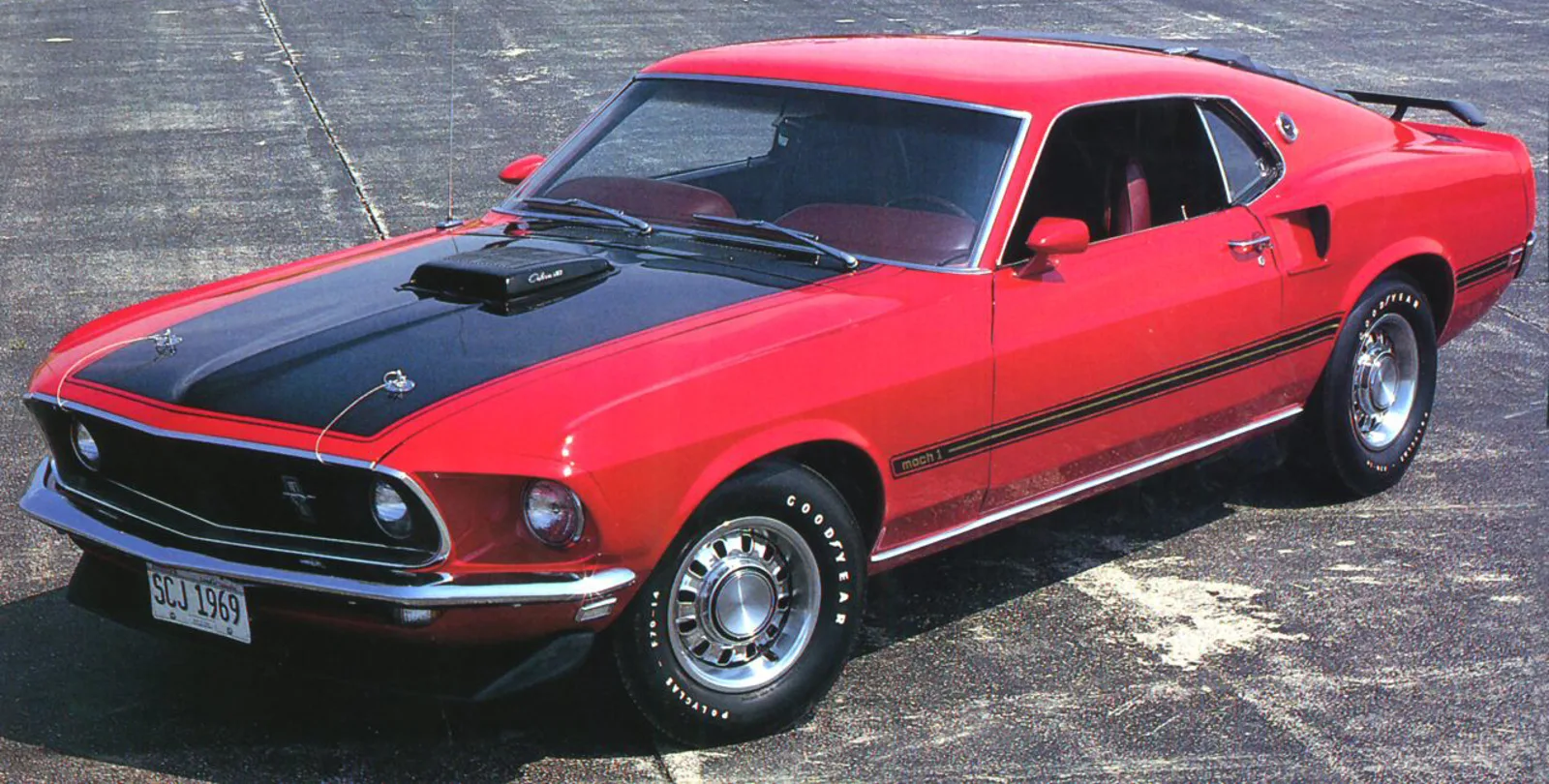
A performance and appearance package for the Mustang that ran from 1969 to 1978, returned in 2003 with the R-code DOHC V8, and came back again in 2021.
The Ford Mustang Mach 1 was a performance and appearance package for the Mustang, first offered for 1969 and revived in 2003 and again in 2021. Its engines ranged from the 351 Windsor and 428 Cobra Jet of the first generation to the 5.0-litre Coyote V8 of the sixth.
The Ford Mustang Mach 1 was a combined performance and appearance package for the Mustang. It first appeared in 1968 for the 1969 model year, ran until 1978, and came back briefly in 2003 and 2004 and again from 2021 to 2023.
The first Mach 1 arrived at the height of the muscle-car era, when horsepower sold cars. Emissions rules, unleaded petrol, fleet mileage targets and dearer fuel steadily wore away that performance, and the package's extras changed with them.
What was the original Mach 1 package?
The package answered the horsepower race that had escalated across the pony-car market. Late in the 1968 model year Ford fitted its 428 Cobra Jet engine to a small group of Mustang GTs, along with the Shelby GT500KR, which carried the company's most potent performance engine.
For 1969 Ford built a full performance package around two smaller V8s, the 351 Windsor and the 390 FE, with the Cobra Jet at the top. Handling upgrades and heavy styling additions came with it, and the result was dubbed the Mach 1.
The 1969 Mustang offered six factory performance models, including the GT, the Boss 302, the Boss 429, two Shelbys and the Mach 1. Many of the V8s offered through the 1973 model year could also be fitted to the Mach 1.
A package born in the horsepower wars that outsold the GT and returned three times, each time with a different engine.
Why did the Mach 1 outsell the GT?
The Mach 1 proved far more popular than the GT, which was dropped after 1969 with 5,396 sales. The Mach 1 found 72,458 buyers in the same year, and that gap settled the matter. The gap was wide. The Mach 1 was offered only as a fastback.
The GT badge did not return to the Mustang until 1982, so the Mach 1 became the main high-performance name of the period.
What did the 1969 Mach 1 include?
The Mach 1 came only on the SportsRoof fastback body, which had earlier been known simply as the fastback. Its visual and performance items included a matte black hood with pins, a hood scoop, competition suspension, a chrome pop-open gas cap and Goodyear Polyglas tyres.
Other kit included revised wheels, chrome exhaust tips on most cars, a deluxe interior, a chin spoiler available from the factory or a dealer, a rear deck spoiler and rear window louvers called SportSlats.
The standard engine was the 351 Windsor 2V with a three-speed manual gearbox and a 9-inch rear axle. Buyers could take the 351 Windsor 4V, the 390 FE or the 428 Cobra Jet, and a drag pack added a modified 428 Super Cobra Jet.
How did the Mach 1 handle?
The suspension varied with the engine. Big-block cars had reinforced front shock towers, thicker anti-roll bars and heavier springs and shocks. Four-speed Cobra Jet cars also had staggered rear shocks, which shows how seriously the chassis was taken. Each suspension package matched its engine.
The standard hood scoop was non-functional, but a turn-signal light on its rear was visible to the driver. The optional shaker hood was a functional scoop mounted straight onto the top of the engine, so it rocked with the motor.
Inside, the cabin used simulated teak trim, thick sound insulation and high-backed sport buckets.
Did the Mach 1 set any Bonneville records?
Racers Mickey Thompson and Danny Ongais ran three Mach 1 cars on the Bonneville flats in 1968, and Hot Rod magazine covered the effort. Their runs covered 500-mile and 24-hour distances, and they set 295 speed and endurance records. The results were a useful piece of publicity.
Those runs gave the package a racing credential that marketing could use alongside its road appeal.
How did the 1970 Mach 1 change?
Ford kept the Mach 1 going into 1970 with a handful of appearance changes. The car got single dual-beam headlights, while the former inner high-beams became sport lamps, and the taillights sat recessed in a black honeycomb panel. The changes were modest, leaving the basic car intact.
The simulated side scoops behind the doors disappeared, the bucket seats were revised, and new deep-dish wheel covers arrived with fresh badging and striping.
The year also brought the 351 Cleveland, offered in 2V and 4V forms. The 4V, coded M, had 11.0:1 compression, with peak output of 300 bhp (224 kW; 304 PS) reached at 5400 rpm. It borrowed ideas from the 385 series and the Boss 302, including angled combustion chambers with canted valves.
What changed for the 1971 Mach 1?
For 1971 the standard equipment was pared back to a shorter list. The car kept a SportsRoof body with its own VIN code, a colour-keyed urethane front spoiler bumper, a black honeycomb grille with sport lamps and a base Mustang vinyl interior.
The engine list grew. It included the F-code 302 2V as the base unit, the H-code 2V, the M-code 4V and, from May 1971, the Q-code 351CJ. Two 429s were offered too, the C-code Cobra Jet and the J-code Cobra Jet Ram Air.
Buyers who took the Drag Pak with 3.91 or 4.11 rear gears turned a 429 into a Super Cobra Jet, complete with a solid-lifter cam, a Holley carburettor and forged pistons in a special rotating assembly.
The hood of the 1971 to 1973 car is one of its most recognisable features. It had two scoops. The 302 cars could have them at no charge, and all other cars had them as standard. With Ram Air the scoops worked, feeding cool outside air through a plenum to the carburettor.
Why did the Mach 1 lose power in 1972?
In 1972 the 429 engines were dropped and the ratings fell across the range. The drop came from the move to SAE net figures and a camshaft set with a four-degree retard. Sales bottomed out that year, the weakest of the 1971 to 1973 generation.
The 1972 car lost its pop-open gas cap in favour of the twist-on cap used on other Mustangs. The 302 stayed as the base engine, and three 351 Cleveland options were offered. The new R-code 351HO was essentially a lower-compression Boss 351, with its ratio cut to 8.8:1.
How did the 1973 Mach 1 look?
The 1973 Mach 1 changed in appearance. The lower accent paint and bright trim were removed, and the whole car became one colour. Every car wore a wide body-side tape stripe in black or argent, with a Mach 1 cutout at the leading edge of the quarter panel.
A bigger body-coloured urethane unit replaced the front bumper, sitting on impact-absorbing struts to meet new federal rules. The sport lamps went, and the parking and turn lights moved to a vertical position at each end of the grille. The grille reverted to black honeycomb, with a little running-horse emblem at its centre.
Ram Air was offered only on the 351-2V, because the system had run into emissions approval problems. A Tu-Tone hood treatment was available without the functional parts.
How did the Mach 1 name fare in the 1970s?
The Mach 1 name carried over to the Mustang II, introduced in 1974. That smaller car used a 2.8-litre V6 as its base engine, and it sold better than the Mach 1 cars of the four years before. The name survived the emissions battles of the decade.
From 1975 a heavily detuned 302 Windsor was on offer. The Mach 1 stayed much the same in 1976, when the Cobra II arrived as a separate performance model alongside it.
The 1977 model year was the weakest the Mach 1 had yet recorded. The package ended when the third-generation Mustang arrived for 1979, although the Cobra option carried on through 1981.
Did the Mach 1 return in the 2000s?
The Mach 1 came back in 2003, on the fourth-generation Mustang, making it the third incarnation. Through the 1990s, Ford's quickest Mustang was the SVT Cobra, and from 1996 its 32-valve 4.6-litre V8 came from Ford's Modular family of overhead-cam engines. It did, briefly, in 2003 and 2004.
Ford had planned to remove the 302 from the range. With GM leaving the pony-car fight in 2002, Ford had the market to itself, and its SVT Cobra of 2003 and 2004 was arguably the fastest stock Mustang to that point.
The gap in price between the GT and the Cobra worried Ford, and so did the wish to keep sales healthy until the all-new 2005 car arrived. The answer was two mid-range models: the 2001 and a half Bullitt GT and the Mach 1 of 2003 and 2004. Team Mustang, under Art Hyde and Scott Hoag, developed both cars.
The Bullitt started life as a 2001 GT with light modifications, and took its name from the film's chase car. The Mach 1 followed as Ford's way of reviving a name with heritage.
What was the 2003 Mach 1 engine?
The 2003 Mach 1 shared the Cobra's 13-inch Brembo front discs, Tokico gas shocks and struts, and lower, stiffer springs with the Bullitt. Its engine was a unique 4.6-litre DOHC V8, known to owners as the R-code engine after its VIN code.
The engine had the same high-flow heads as the SVT Cobra and borrowed intake camshafts from Lincoln's 5.4-litre InTech V8 to add mid-range torque. Its compression ratio was 10.1:1, where the 1999 and 2001 Cobras ran 9.85:1, and it used a Windsor Aluminum Plant block.
The five-speed cars had a redline of 6,800 rpm. The power rating was 305 hp (228 kW), which looked like a step back from the 320 hp of the 1999 and 2001 Cobras, although the Mach 1 made similar peak power and considerably more torque in practice.
How did the 2003 Mach 1 handle and perform?
Ford's 8.8-inch solid rear axle, geared to a 3.55 final ratio, sat under the Mach 1 instead of the SVT's independent setup. Steel box-section subframe connectors were fitted to stiffen the chassis, and a four-speed automatic sat alongside the Tremec five-speed manual.
Motor Trend's figures were impressive for the money. The automatic reached 101.9 mph (164.0 km/h) at the end of its quarter mile, after 13.88 seconds, and took 5.6 seconds to reach 0-60 mph. The five-speed covered the quarter mile in 13.5 seconds, reaching 105 mph (169 km/h) at the line, and reached 0-60 mph in 5.2 seconds.
The car also took a 600-foot slalom at 63.5 mph (102.2 km/h) and pulled 0.85 g on the skidpad. The higher centre of gravity of the larger engine gave it more understeer than the independent-suspension SVTs and the lighter Bullitts.
How did the 2003 Mach 1 look and sell?
The car had faux Magnum 500 polished alloy wheels, dark grey leather seats with 1970s-style Comfort Weave textures, a retro gauge cluster and a machined aluminium shift ball. The bulging hood with its cut-out and semi-functional Shaker Hood was the most visible difference from other Mustangs.
The 2004 model added 40th-anniversary tags ahead of the doors and bare aluminium valve covers. The only interior change was the removal of the overhead cargo net, and power and torque stayed the same.
The 2003 Mach 1 was priced at US$29,305 and weighed 3,380 lb (1,533 kg). Azure Blue was exclusive to it, and about 9,652 cars were built in 2003 and 7,182 in 2004, well past the roughly 6,500 cars Ford had first planned as a one-year run.
What did the sixth-generation Mach 1 bring?
Seventeen years after the last one, the fifth Mach 1 arrived with the sixth-generation Mustang. It used the GT's 5.0-litre Coyote V8, which produced 480 hp (358 kW), peaking at 7,000 rpm, with torque of 569 N-m (420 lb-ft) peaking at 4,600 rpm, matching the Bullitt.
Output for 2022 was 470 hp and 410 lb-ft, measured at 4,600 rpm, a small step down. Several Shelby parts were borrowed, including the intake manifold, oil cooler and front and rear subframes from the GT350, and the rear axle cooling system, toe link and diffuser from the GT500.
The sixth-generation car was built until the seventh-generation Mustang arrived after the 2023 model year. Its grille carried two large vents on each side of the pony badge, and Ford's marketing leaned on the model's heritage.
What were the Mach 1 specifications across generations?
| Generation | Years | Engine highlights | Notes |
|---|---|---|---|
| First | 1969 to 1978 | 351 Windsor 2V standard; 390 FE and 428 Cobra Jet options; 351C 4V at 300 bhp (224 kW; 304 PS) in 1970 | SportsRoof body only in the early years |
| Mustang II era | 1974 to 1978 | 2.8-litre V6 base; detuned 302 rated 140 hp (104 kW) from 1975 | Cobra II introduced in 1976 |
| Fourth | 2003 to 2004 | 4.6 L DOHC V8, 305 hp (228 kW), 10.1:1 compression | 9,652 cars in 2003 and 7,182 in 2004 |
| Sixth | 2021 to 2023 | 5.0 L Coyote V8, 480 hp (358 kW), 420 lb-ft (569 N-m) | 2022 output 470 hp and 410 lb-ft |