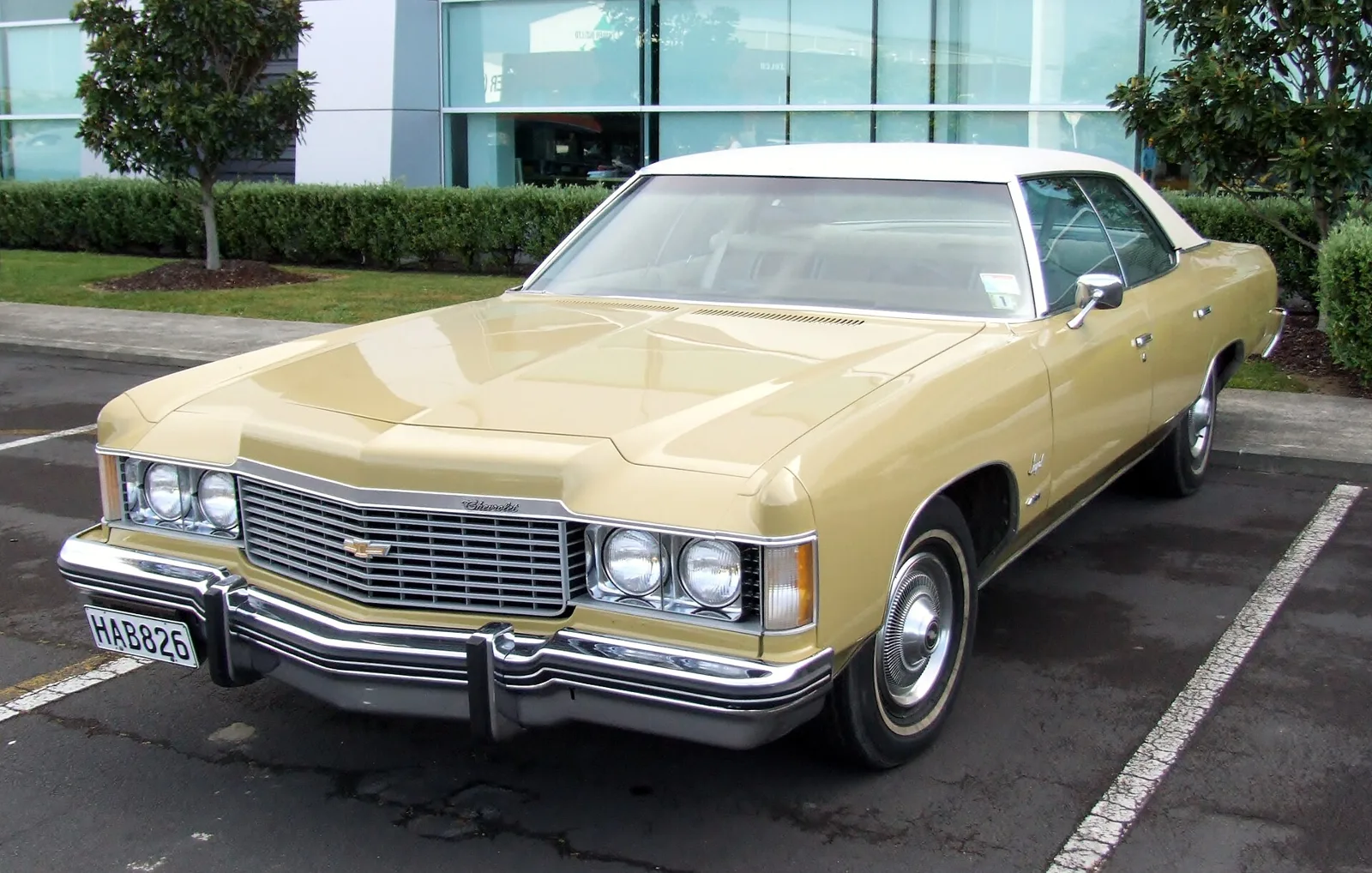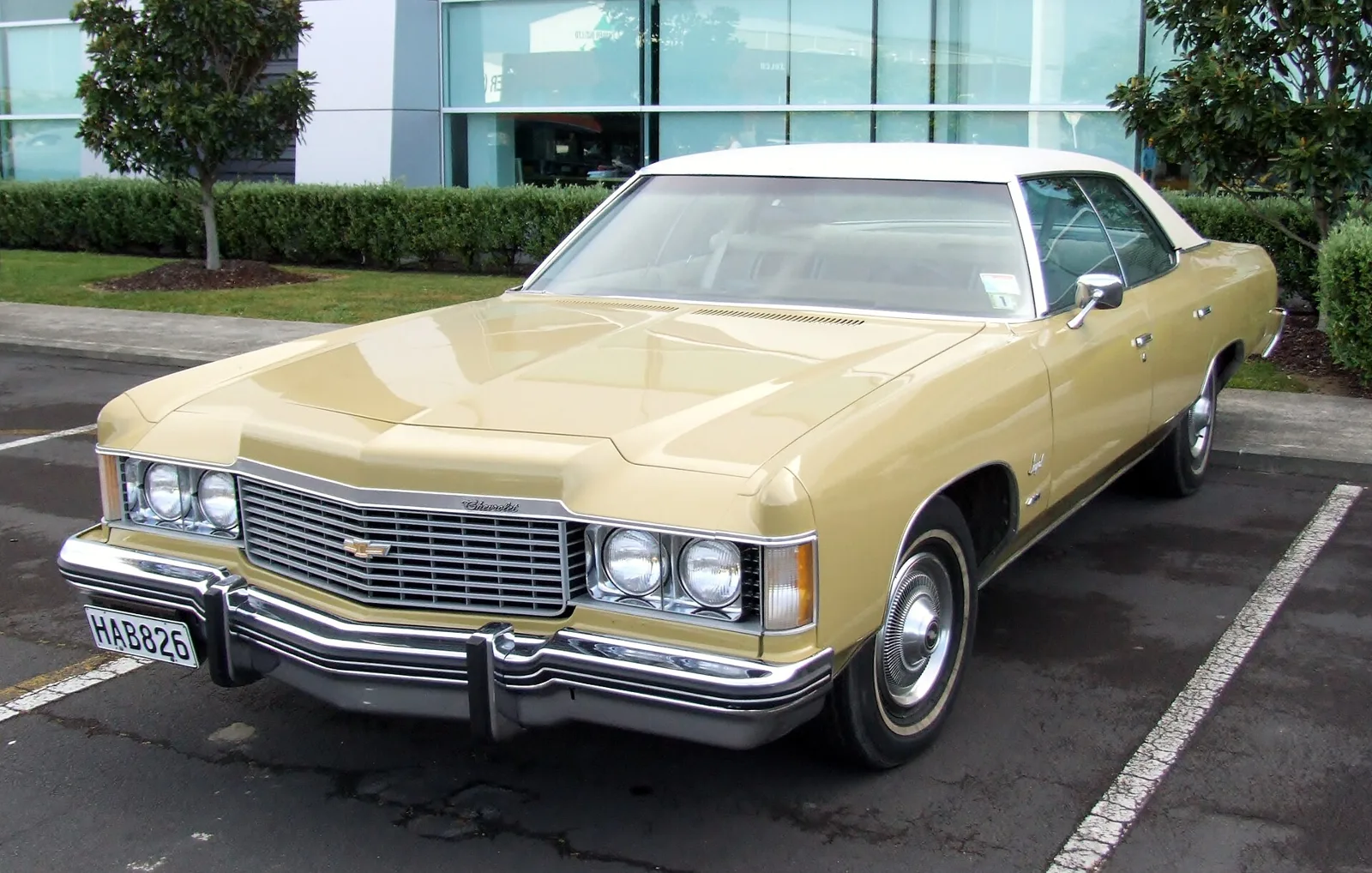
The largest Impala ever built, from its record-size debut and 1973 airbag fleet cars to the energy crisis and a 1976 finale.
The fifth-generation Chevrolet Impala was built from 1971 to 1976 on a 121.5-inch wheelbase, making it the largest in the nameplate's history. Its run included 1973 experimental airbag fleet cars, fuel-crisis sales lows and a final year with a Caprice nose.
The fifth-generation Chevrolet Impala was the largest generation of the nameplate, sold from 1971 to 1976 on a 121.5-inch wheelbase. It was also the last of the big-car Chevys before the line downsized for 1977.
Its six model years ran from a record-size debut to a fuel-price shock, a set of experimental airbag fleet cars and a 1976 finale with a Caprice nose. Few Chevrolets packed so much change into so short a run.
What was the fifth-generation Impala?
The fifth-generation Impala was a full-size Chevrolet built on the B-body from 1971 to 1976. It was the largest generation of the Impala line, with a 121.5-inch wheelbase and 125 inches for the station wagons.
The Impala came as a four-door pillared sedan, a four-door hardtop called the Sport Sedan, and a two-door Custom Coupe that shared its formal roofline with the Caprice. A semi-fastback two-door Sport Coupe and a two-door convertible completed the range.
By the end of its run the Impala had moved from a higher trim of the full-size sedan line to its base model, since the Biscayne and Bel Air had left the US market. In 1977 the Impala became the first of the Big Three's primary sedan lines to downsize.
The largest Impala ever built ended as the last of the truly big Chevys before the 1977 downsizing.
What made the 1971 Impala so large?
The 1971 redesign produced the largest car Chevrolet had ever offered, and the Impala gained a double-panel roof for better rollover protection. Its flush exterior door handles were a feature first seen on the mid-year 1970 Camaro.
Newly standard features included power front disc brakes, an inside hood release and a revised Astro-Ventilation system that drew air through grilles in the trunk lid. Those upgrades sat on a body that was bigger than anything Chevrolet had sold before.
Station wagons adopted a clamshell design in which the rear glass slid up into the roof while the tailgate dropped below the load floor. The power tailgate was the first of its kind, and it replaced the manual tailgate that took real effort to lift from storage.
The same design was shared with full-size wagons from Pontiac, Oldsmobile and Buick. Later generations went back to a door-style gate for their full-size wagons.
The 1971 model year was hit by a 67-day General Motors strike. It began in September 1970, after initial 1971 production had started, and ran until November. Even so, Impala output reached 427,000 units, including 2,300 six-cylinder cars and 425,400 V8s.
Which engines did the 1971 Impala offer?
The base engine was a 145 hp, 250 cubic-inch Turbo Thrift six, available only on the Impala sedan and Sport Coupe. Most Impalas came with a 245 hp, 350 cubic-inch Turbo Fire V8, and the optional engines included a 255 hp 400 and a 365 hp 454.
Compression was lowered so the engines could run on regular leaded, low-lead or unleaded fuel rated at least 91 octane, in line with a GM corporate mandate. The company was looking ahead to catalytic converters, which were planned for 1975 and later models.
The Turbo-Jet 454 produced 365 hp in 1971, but its power fell as the years went on. Early in the model year every Impala had a three-speed column-shift manual and manual steering, with power steering and an automatic optional.
Halfway through the year, Turbo-Hydramatic and variable-ratio power steering came as standard on every V8 full-size Chevrolet. The two-speed Powerglide could be ordered only with the six or the 350 V8 during the early months.
How did the energy crisis hit the Impala?
Gasoline prices doubled between 1973 and 1979, and industry car sales fell by a fifth between 1973 and 1974. Yearly passenger car travel in the United States dropped for the first time in recent memory.
Sales of the Impala slid to 176,376 in 1975, the lowest since the model arrived in 1958. An Econominder gauge package was offered for the 1975 and 1976 model years.
Total Impala production for 1972 reached 597,500 units, with the Caprice at 178,500, the Biscayne at 20,500, the Bel Air at 41,900 and station wagons at 171,700.
Why did the Impala convertible end in 1972?
The 1972 model year saw the last Impala convertible, and the following year the open car moved to the top-line Caprice Classic. The 1972 ragtop sold 6,456 units, a figure that stands beside the Corvette's 6,508, the Cutlass Supreme's 11,571 and the Mustang's 6,401.
From 1973 the Impala was offered only as closed bodies, a first for the nameplate. The Kingswood station wagon, which had been a separate model since 1969, rejoined the Impala series that year.
What were the 1972 Impala engine options?
The 1972 standard engine was a 165 net 350 cubic-inch Turbo Fire V8. Options included a 170 hp 400 Turbo Fire, a 240 hp 400 Turbo Jet and a 270 hp 454 Turbo Jet, with the wagon's Turbo Jet rated at 215 horsepower.
In California the only engines were the 165 hp 350 and the 170 hp 400 small-block V8s, because the state's emissions rules were much stricter. The 1972 Astro-Ventilation system was also redesigned, with vents moved from the trunk lid to the doorjambs.
The 1972 Impala had introduced a lower grille that extended below the bumper, and its taillights were set into the bumper.
Did the Impala keep its six-cylinder engine?
Only briefly. The 250 six with a three-speed manual was offered in Impala four-door sedans and Sport Coupes at the very start of the 1972 model year, and 1,500 Impalas were built with it.
After that short run, the six-cylinder engine and manual gearbox were moved to the low-line Biscayne and Bel Air sedans. For most of 1972, all Impalas were V8-powered, with Turbo Hydramatic, power steering and power front disc brakes as standard.
What changed with the 1973 federal bumper?
New federal rules required 5 mph (8.0 km/h) impact protection, so the 1973 Impala received a larger, shock-absorbing front bumper and new square taillights. The chassis was also tweaked for better roadability.
With the convertible moved to the Caprice Classic, the 1973 Impala was all-closed for the first time in the nameplate's history. A 145 hp 350 Turbo Fire V8, Turbo Hydramatic, variable-ratio power steering and power front disc brakes were standard on every Impala.
Options included a 175 hp 350 with four-barrel carburettor and a 245 hp 454 Turbo Jet. The Impala Custom Coupe, Sport Sedan and wagons could also be ordered with the 165 hp 400 Turbo Fire.
Did GM test airbags on the 1973 Impala?
General Motors equipped about 1,000 1973 Chevrolet Impala sedans with its experimental Air Cushion Restraint System, an early prototype of an airbag system. The cars had a driver airbag housed in a four-spoke steering wheel, along with a passenger airbag.
The passenger airbag was a dual-stage unit, which used impact sensors to choose how much force to use, depending on the severity of the crash. The instrument panel was borrowed from an Oldsmobile 88 to suit that airbag.
The ACRS cars were fitted with a reinforced chassis from the police-spec Impala and the 350 cubic-inch small-block V8 from the Corvette C3. They wore a unique green paint scheme and were sold only to fleet buyers, not the general public.
Chevrolet did not begin fitting airbags to its own cars until about 1990, although GM used a version of the system in some Buick, Cadillac and Oldsmobile models during the 1970s. An ACRS car appeared on the sitcom Seinfeld, where Michael Richards played Cosmo Kramer behind its wheel in several episodes.
Today a single ACRS Impala is known to survive, and a Maryland automotive safety expert owns it.
What changed for the 1974 Impala?
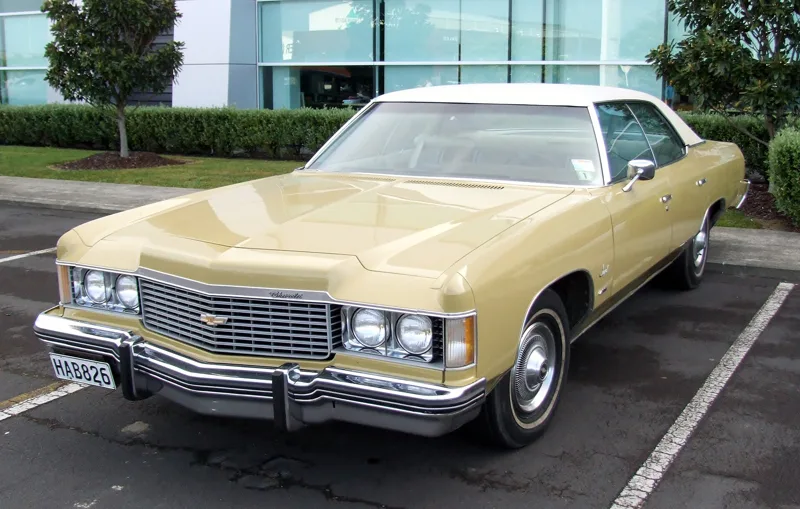
For 1974 the rear bumper gained shock-absorbing cylinders to meet the upgraded standards, with new taillights above the bumper. The front end received a new grille, new headlight bezels and a bumper with a drop-down centre section.
The 1974 Impala was the only year in the 1971 to 1976 run with a different front end from the Caprice Classic. Other years used a grille insert or the previous year's Caprice front to tell the two apart.
Coupe rooflines changed as well. The Custom Coupe stopped being a hardtop and gained a fixed rear quarter glass and a thick B pillar. The Sport Coupe stayed a pillarless hardtop, but with larger roll-down quarter glass and a narrower fastback-style back window.
A limited-edition Spirit of America package was offered on the Sport Coupe that year. It brought white paint and a white vinyl roof, with white seats trimmed in red or blue, plus special wheel covers and red pinstriping.
The standard engine on sedans and coupes was a 145 hp 350 Turbo Jet V8, with optional 150 and 180 hp 400s and a 235 hp 454. In California a 155 hp 350 with a four-barrel carburettor was standard.
What changed for 1975 and 1976?
For 1975 the Impala kept the Caprice's 1974 front end, with a different grille insert and emblem. It also added a high-energy electronic ignition system, catalytic converters and a Landau appearance package, while speedometers read up to 100 miles per hour (160 km/h).
Sport Coupe models were discontinued after 1975, which left the Custom Coupe as the only two-door Impala in 1976. Its wide B pillar and fixed rear window were the car's defining features.
For 1976 the Impala received the Caprice nose with an egg crate grille insert, but kept round headlamps where the Caprice had quad rectangular ones. The big-block 454 now yielded 225 horsepower.
The 1976 model year was the last for the four-door hardtop and the clamshell wagon tailgate. A lower-priced Impala S, sold only as a four-door sedan, replaced the Bel Air, which had been dropped after 1975.
The Impala S used the Bel Air's trim and standard features, but it kept the Impala's three rear taillights where the Bel Air had two. It was sold mainly to fleet and government customers, although private buyers could also choose it.
How big was the 1976 Impala?
The 1976 Impala measured more than 222 inches overall on its 121.5-inch wheelbase. That made it the last of the big-car Chevys, and its perimeter frame and full coil-spring suspension gave a smooth ride.
Inside, simulated rosewood vinyl trim covered the instrument panel, steering wheel and doors. Impalas rode on steel-belted radial tyres and came with an automatic transmission, power brakes and variable-ratio power steering, and a lighted visor vanity mirror was new to the options list.
Chevrolet Impala fifth generation specifications
| Specification | Detail |
|---|---|
| Model years | 1971 to 1976 |
| Wheelbase | 121.5 inches; 125 inches for station wagons |
| Length, 1976 | More than 222 inches overall |
| Standard V8, 1971 | 245 hp 350 cubic-inch Turbo Fire |
| Top engine, 1971 | 365 hp 454 cubic-inch |
| Standard V8, 1972 | 165 net 350 cubic-inch Turbo Fire |
| Standard V8, 1973 | 145 hp 350 cubic-inch Turbo Fire |
| Standard V8, 1974 | 145 hp 350 cubic-inch Turbo Jet |
| 454 V8, 1976 | 225 horsepower |
| Production, 1971 | 427,000 units |
| Production, 1972 | 597,500 units |
| Sales, 1975 | 176,376 units |