How Edsel Ford's middle-market brand grew from the 1939 Eight into the Grand Marquis, the Cougar and the Merkur years, and why it closed in 2010.
Mercury was a Ford Motor Company brand created by Edsel Ford in 1938 to sit between Ford and Lincoln. It sold medium-priced cars until Ford closed the division at the end of 2010, with the last car built in January 2011.
Mercury was a medium-priced car brand from Ford Motor Company that ran from the 1939 to the 2011 model years. Edsel Ford created it in 1938 to fill the space between Ford and Lincoln, and it spent most of its life sharing parts and engineering with both brands.
Why did Ford create Mercury?
By the mid-1930s Ford sold only its namesake brand and the Lincoln Model K at the top of its range, which left a wide gap in the middle. Edsel Ford filled it with Mercury, a V8 car sized between the Ford and the V12 Lincoln-Zephyr. The new brand was shown in 1938 and launched for 1939.
Rivals were far broader. General Motors ran seven brands and the Chrysler Corporation ran four, so Ford's two-brand line looked thin in comparison.
Edsel Ford chose the name Mercury personally from more than 100 options. The name had been used a few years earlier by Chevrolet and by several car makers that failed between 1903 and 1923.
Created to fill a gap between Ford and Lincoln, the brand spent seven decades looking for its own identity.
How did the Mercury Eight launch in 1939?
Mercury arrived in November 1938, when four body styles of the Mercury Eight were shown at the New York Auto Show. For 1939 the car started at US$916, and over 65,800 vehicles sold in the inaugural model year. The body design was overseen by E.T. 'Bob' Gregorie.
The range offered a two-door sedan, a four-door sedan, a convertible and a trunked two-door sedan. The Eight was an all-new car, not a restyled Ford, and it sat between the V8 Ford and the V12 Lincoln-Zephyr in size and price.
Ford also tidied up its own sub-brands. De Luxe Ford was dropped as a sub-brand after 1940 and returned to being a plain Ford trim line, while every Lincoln moved onto the Lincoln-Zephyr base as the Model K was retired.
What changed for Mercury in the early 1940s?
For 1941 the Eight received its first redesign and began sharing much of its bodyshell with Ford, with a wheelbase 4-inch (100 mm) longer. A decorative wood-bodied station wagon, later nicknamed the woodie, joined the range that year.
The 1942 car gained a dashboard similar to the Lincoln Zephyr and a Flathead V8 offered with 100 hp (100 PS; 75 kW) as standard. Liquamatic, Ford's first semi-automatic transmission, proved complex and unreliable, and many cars were fitted with conventional manual gearboxes instead.
Production was suspended after the outbreak of the Second World War. Ford built only 24,704 Mercury vehicles for 1942, a figure that shows how quickly the war cut the brand's output.
What happened after the 1945 merger with Lincoln?
On October 22, 1945, Ford merged Mercury with Lincoln to form the combined Lincoln-Mercury Division, which kept marketing both namesake lines. The Lincoln-Zephyr returned to production after the war without the Zephyr name, and the Continental ended production after 1948.
The first postwar Mercury rolled off the line on November 1, 1945. It was largely unchanged from the 1942 car, although the vertical grille trim returned. A wood-bodied Sportsman convertible was added alongside the wagon for a while before being dropped for 1947.
How did the 1949 redesign change the brand?
Ford's 1949 redesign put Mercury and Lincoln on one shared body, separated by headlights, grilles and interiors. Mercury sales rose six-fold over 1948, and the brand became the sixth-most popular in the United States.
Mercury kept the Eight as its only model line, while competing medium-priced brands from Chrysler and General Motors, along with independents such as Nash, Hudson and Packard, offered wider choices. For 1950 the Monterey name appeared on a special two-door coupe with a canvas or vinyl roof that imitated a convertible.
The one-millionth Mercury was built during 1950. In 1951 the division brought back an automatic option, the Merc-O-Matic 3-speed, which was a rebranded Ford Cruise-O-Matic.
What did the 1950s bring for Mercury?
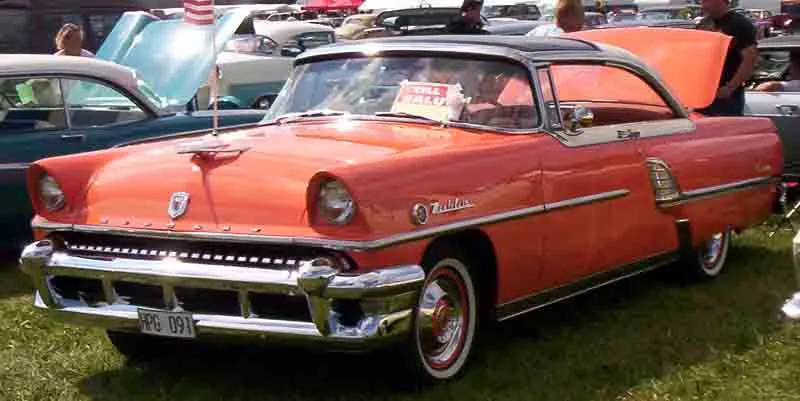
The 1950s brought the Monterey and Montclair, a Sun Valley glass-roof hardtop and, in 1957, the Turnpike Cruiser. Mercury reached 5% of the US market in 1953, its largest share ever, and it ranked eighth in sales.
For 1952 two nameplates replaced the Eight, with the Monterey returning as a distinct line above the base Custom. In 1954 Ford replaced the old Flathead with an overhead-valve Y-block V8, and each brand received its own version of that engine.
The 1957 range used a 122-inch (3,100 mm) wheelbase and moved upmarket, dropping the slow-selling Medalist. The Turnpike Cruiser, a retractable rear window car, was the pace car of the 1957 Indianapolis 500 and sat above the Montclair.
Why did the Edsel years hit Mercury so hard?
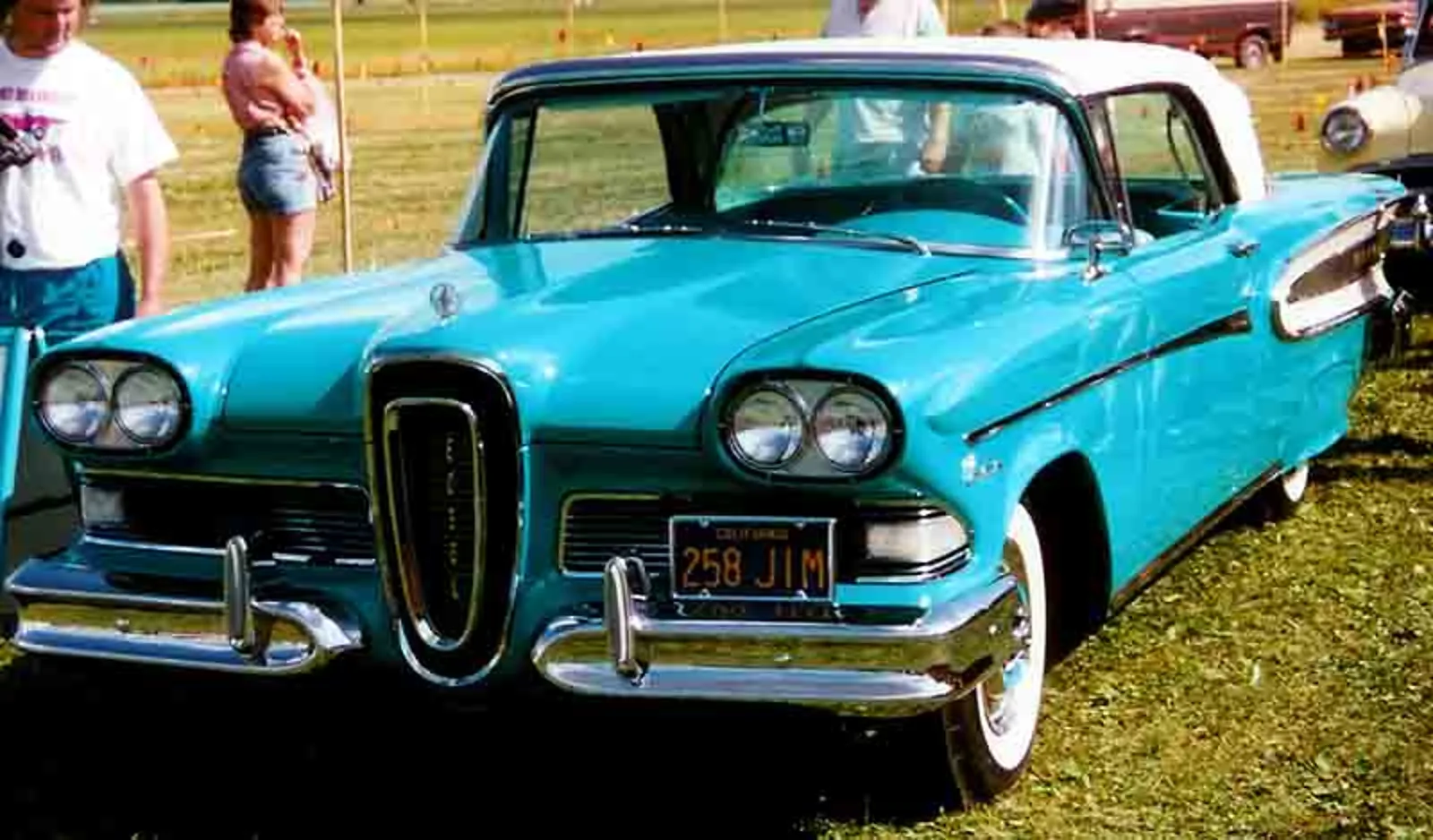
The Edsel shared Mercury's chassis and roofline, and the whole division overlapped in price, which was a key reason the Edsel failed. Mercury sales fell 60 percent in 1958, when Rambler outranked the brand, although Mercury still outsold the Edsel by more than two to one.
Lincoln lost over $60 million from 1958 to 1960, and the future of the Lincoln-Mercury Division was in doubt. Robert McNamara, then Ford's president, proposed cutting Ford down to its namesake division, but he allowed Lincoln-Mercury to remain on several conditions.
Lincoln reduced its range from three models to one, with the smaller Lincoln Continental. Mercury shared a body with Ford on its own wheelbase, and the 1959 car moved to a 126-inch (3,200 mm) wheelbase with its own body and chassis again, which had not happened since 1940.
What was the Comet and the 1960s Mercury range?
The Comet arrived in 1960 as Mercury's first compact, a counterpart of the Ford Falcon with four headlights and wide tailfins. It was sold as a standalone product until the brands merged for 1962.
For 1961 Mercury adopted a full-size range that shared its chassis with the Ford Galaxie on a 120-inch wheelbase. The Meteor returned in 1962 as an intermediate range that followed the design of the Ford Fairlane.
The 1961 Meteor 600 introduced the first six-cylinder engine to the brand, a Mileage Maker inline-6. From 1962 the S sub-models offered sportier content, including the S-22 Comet, the S-33 Meteor and the S-55 Monterey.
How did the muscle era shape Mercury's image?
The Cougar, introduced in 1967, bridged the gap between the Ford Mustang and the Ford Thunderbird. Mercury's performance image peaked in the late 1960s, when the aerodynamic Cyclone Spoiler II was approved as the brand's 1969 NASCAR entry.
In 1967 Mercury also debuted the Marquis, a competitor to large sedans from Buick, Oldsmobile and Chrysler. The Marquis name stayed in use until the 2011 closure. The Montego, based on the Ford Torino, replaced the Comet in 1968, and the Cyclone became a separate model range.
The 1969 Cougar could be configured as a pony car, a personal luxury coupe or a muscle car. Its Eliminator package offered an available 428 Cobra Jet V8, and the Marauder became a stand-alone full-size two-door.
Did Mercury keep its sporty image in the 1970s?
Mercury turned back toward its upmarket roots in the 1970s. The Capri arrived in 1970 as the division's first subcompact, a captive import of the European Ford Capri built in Cologne, Germany.
The De Tomaso Pantera, assembled in Modena, Italy, followed in 1971 with a 330 hp Ford 5.8L Cleveland V8. Lincoln-Mercury ended Pantera sales after 1974, when American production of its 5.8L engine stopped.
In 1975 the Grand Marquis slotted between the Marquis Brougham and the Lincoln Continental, and the Monarch became a new luxury compact segment. The Bobcat followed in 1976 as Mercury's version of the Ford Pinto, and the Capri II rose to rank second among imports in America, trailing only the Volkswagen Beetle.
Sales peaked at nearly 670,000 vehicles in 1979. The 1978 model year alone sold 580,000 vehicles, and one in ten was a Cougar.
What was the Merkur brand?
Merkur was a brand launched in 1985 to sell German-built captive imports designed by Ford of Europe, aimed at buyers of European executive cars. It sold the XR4Ti sports coupe and, from 1988, the Scorpio sedan before ending after 1989.
Merkur competed with European executive cars from Audi, BMW, Mercedes-Benz, Saab and Volvo. German production left its prices exposed to an unstable exchange rate, and the Scorpio sold for over US$26,400 even though it looked close to the Mercury Sable.
Ford ended Merkur after 1989 for several reasons, including weak sales and cars that lacked the airbags or motorised seatbelts required from 1990. At only five years, it was one of the shortest-lived brands in the modern American car industry.
How did Mercury respond to the 1990s?
Mercury renewed its best-selling lines and moved into minivans and SUVs. The 1992 Grand Marquis carried an all-new 4.6L overhead-cam V8, and in 1993 the Villager became the first Lincoln-Mercury minivan, built in a joint venture with Nissan.
Sales of the Grand Marquis doubled from 1991 to 1992, and it became the best-selling Mercury sedan through much of the decade. Overall sales for the renewed range climbed to over 480,000, the highest level since the 1978 peak.
The Mountaineer arrived in 1997 as the first Lincoln-Mercury SUV, sharing its body with the Ford Explorer but using all-wheel drive. In 1999 the Cougar returned as a compact sports coupe, the first version of the nameplate offered with front-wheel drive.
Why did Ford close Mercury in 2010?
Ford announced on June 2, 2010 that Mercury would close at the end of that year. The brand held a 1 percent share of North American sales against 16 percent for Ford, and it sold 93,165 vehicles in 2010.
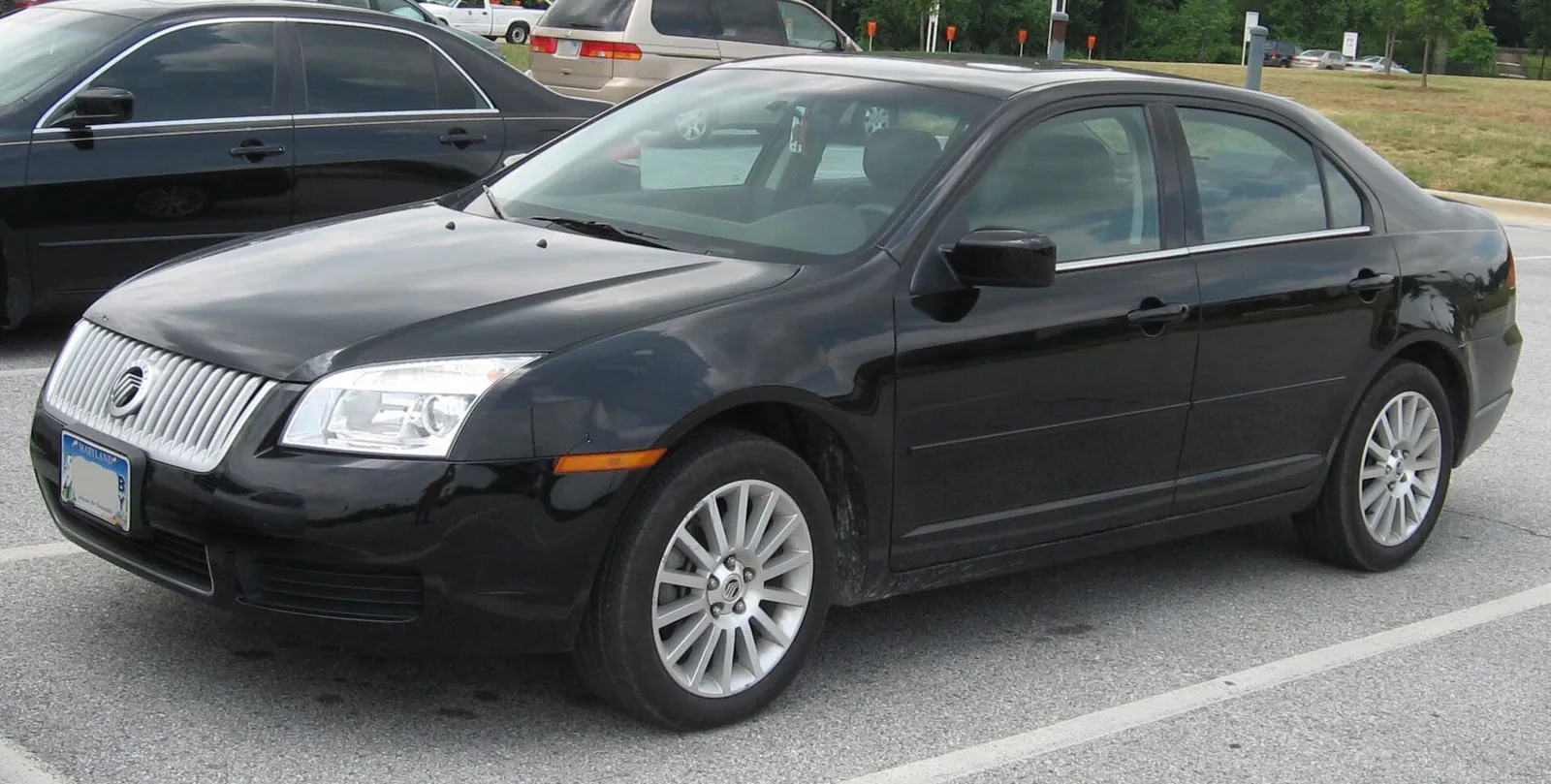
Mercury's flagship sedan had aged badly. The average Grand Marquis buyer was in their mid-60s, far above the age Lincoln-Mercury wanted to attract. Ford decided to concentrate its marketing and engineering on the Ford and Lincoln lines instead.
In 2008 Ford ran a campaign starring actress Jill Wagner that targeted female drivers. It narrowed the brand image further, and sales kept falling until the closure.
How did the final Mercury cars end?
A 2011 Grand Marquis, completed on January 4, 2011, closed out the brand's production at St. Thomas, the Ford of Canada plant. Nearly 2.8 million Marquis had been built, making it the longest-produced Mercury line, second only to the Cougar in overall sales.
The Grand Marquis had last been redesigned for 1992, and it was slated for retirement once Ford closed the St. Thomas plant. After 2011 its Panther chassis could no longer meet federally mandated electronic stability control rules.
Ford still holds the Mercury trademark, which remained active in 2019.
What was Mercury in Canada?
In Canada, Mercury was sold through Lincoln-Mercury dealers alongside the Monarch and Meteor. The Mercury 114, introduced in 1946, was essentially a Ford with Mercury grille, taillights and trim, named after its 114-inch Ford wheelbase.
Production of the 114 totalled 4,573 for 1946, 10,393 for 1947 and 2,716 for 1948. Larger Canadian Mercurys used a longer wheelbase and were sold as the Mercury 118.
The Monarch ran from 1946 to 1957 as Ford of Canada's medium-price line, with models matching the Mercury Monterey, Montclair and Park Lane. The Meteor served as Lincoln-Mercury of Canada's lowest-price brand from 1949 to 1976, and Mercury-badged trucks were sold in Canada until 1968.
What did Mercury's logos and grilles look like?
Mercury first used its Roman namesake in a silhouette, then the 'Big M' in the mid-1950s, and a crest emblem after 1959. The Cougar brought a prowling cat logo in 1967, and the stacked-angle emblem arrived in 1984 with the Topaz.
The waterfall grille first appeared on the 1946 Mercury Eight and returned on the 1997 Mountaineer. In 1986 a lightbar grille arrived with the Sable, and by 1992 nearly every Mercury had adopted the same feature.
What are the key Mercury specifications?
| Item | Detail |
|---|---|
| Created | 1938 by Edsel Ford, between Ford and Lincoln |
| Model years | 1939 to 2011 |
| Launch price | US$916 for the 1939 Mercury Eight |
| Inaugural sales | Over 65,800 vehicles in 1939 |
| 1942 engine | Flathead V8 with 100 hp (100 PS; 75 kW) |
| 1942 output | 24,704 vehicles before war production was suspended |
| 1958 Marauder V8 | 430 cubic inches (7.0 L); Super Marauder 400 hp (410 PS; 300 kW) |
| 1957 wheelbase | 122-inch (3,100 mm) |
| Peak sales | Nearly 670,000 vehicles in 1979 |
| Closure | Announced June 2, 2010; last car built January 4, 2011 |
| 2010 sales | 93,165 vehicles |