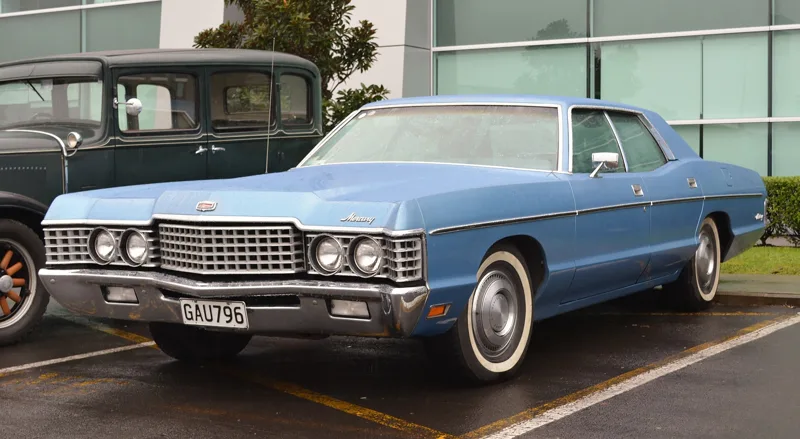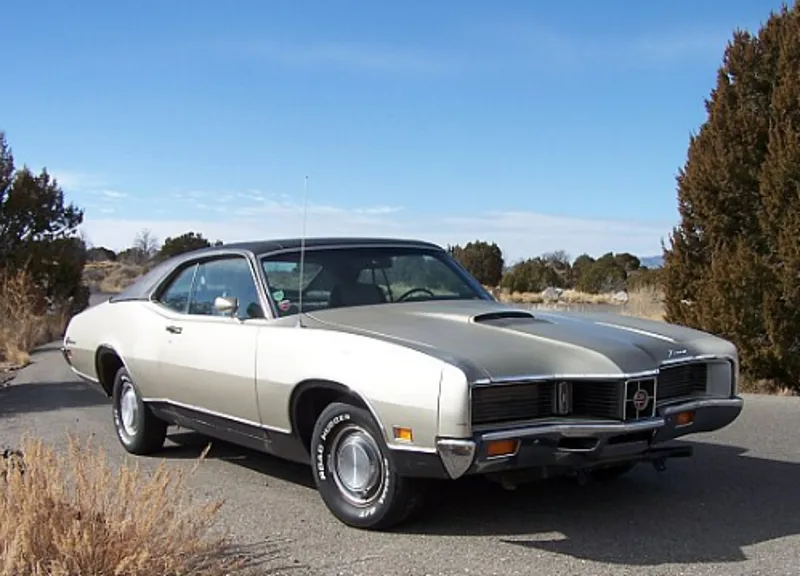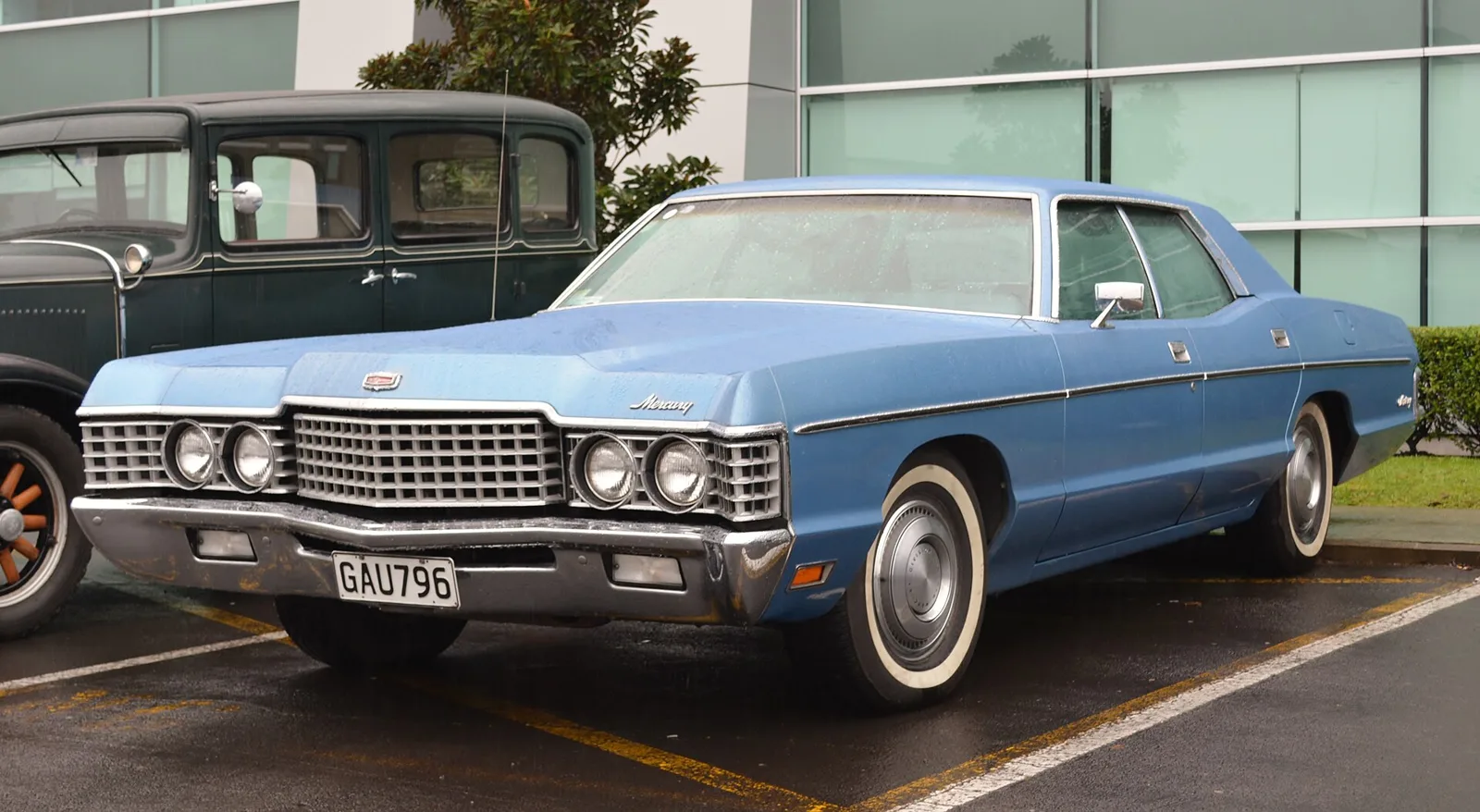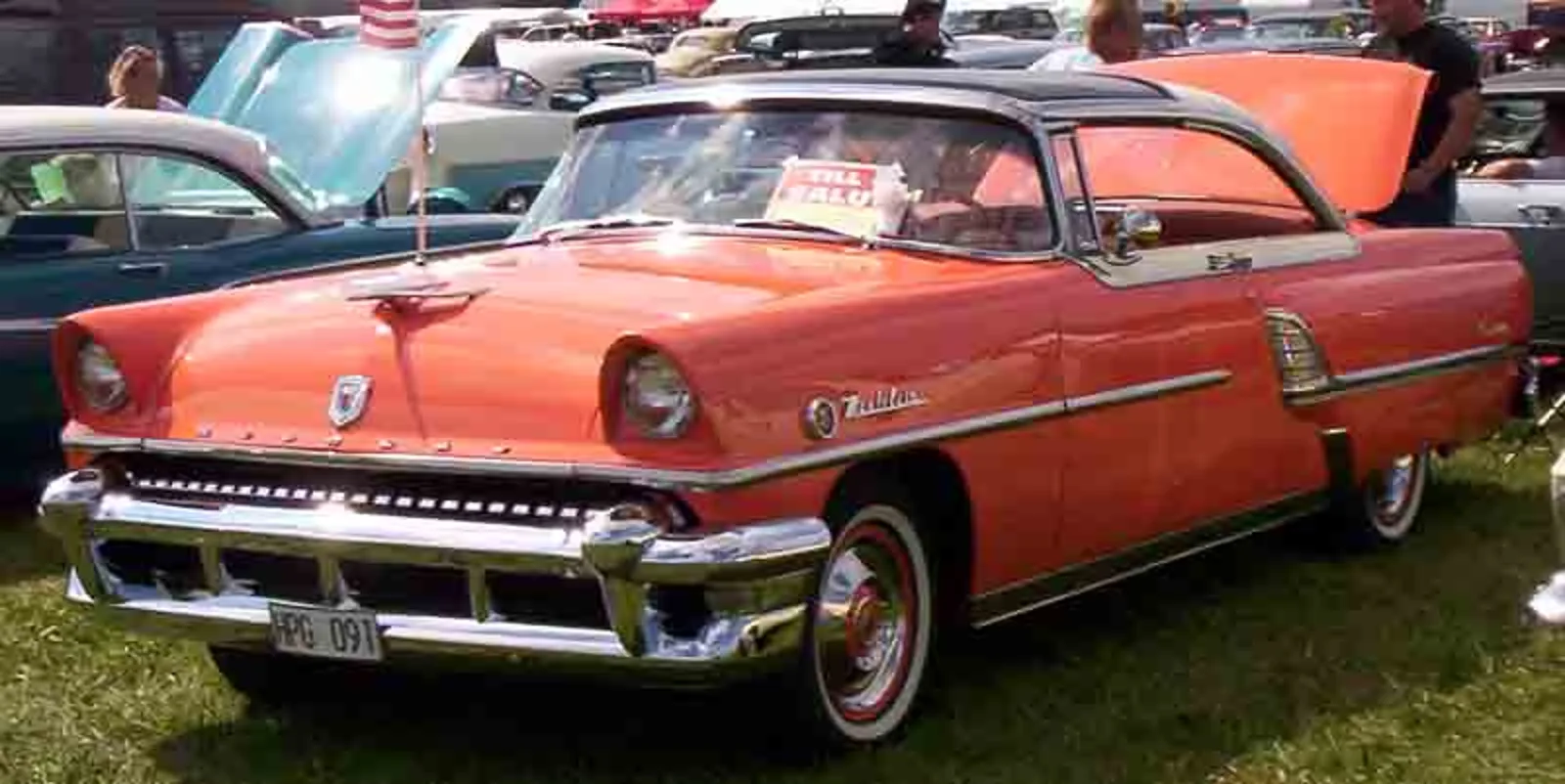
From the 1955 hardtops and Sun Valley roof to the 1968 finale, the Montclair moved through V8 power, pushbutton gears and Ford-based platforms.
The Mercury Montclair was a mid-range full-size sedan from Ford's Mercury division, built in five generations. It sold from 1955 to 1960 and again from 1964 to 1968, offering hardtops, a pillared sedan and, early on, a convertible.
The Mercury Montclair was a full-size sedan line that Ford's Mercury division built and sold over five generations. The name was used twice, from the 1955 to 1960 model years and again from 1964 to 1968, and it always sat in the middle of the Mercury range.
Buyers could choose a two-door or four-door hardtop, a four-door pillared sedan or, in the early years, a two-door convertible. The Montclair was usually the mid-range Mercury sedan and was always slotted above the Monterey.
Where did the Montclair name come from?
The true origin of the name is unknown to Ford historians. The consensus is that it comes from Montclair, New Jersey, an affluent community near Mercury's then-new Mahwah Assembly facility. The name also fitted the car's premium position, since the Montclair sat above the Monterey from its first year.
At various points the Montclair was slotted below the Turnpike Cruiser and below the Park Lane, so its place in the Mercury line changed with each redesign. Its position above the Monterey was the one constant across most of its life.
A premium Mercury nameplate that returned twice, each time as a mid-range full-size sedan with a V8.
What was the first-generation Montclair like?
The first Montclairs arrived for 1955 as a premium sedan line above the Monterey, sold as a two-door hardtop, a two-door convertible and a four-door sedan. A 292 cu in V8 borrowed from the Ford Thunderbird roadster produced 195 hp, with a 3-speed manual gearbox as standard.
A colour-contrast panel below the window line was the main styling feature, usually finished in the roof colour. A 3-speed automatic was available as an option, and the 1955 two-door hardtop was listed at US$2,631 ($31,621 in 2025 dollars). That model sold 71,588 units in its first year.
The interior came with cloth and vinyl upholstery, full carpeting and chrome mouldings around the windows. Buyers could add a heater, radio, power seat, power windows, power steering and power brakes, among other options.
For 1956 the sedans were restyled. A full-length multi-tier chrome spear ran along the side, and the paint range offered thirty-one two-tone and twenty-eight Flo-tone combinations. Two-tone meant the traditional roof colour over a different body colour, while Flo-tone painted the roof and lower body in one colour above a contrasting upper body. The crest on the bonnet gave way to a Big M emblem.
Under the skin, the 1956 update brought a 12-volt electrical system, which allowed power accessories such as air conditioning. Dual exhausts and automatic self-lubrication for the steering and front suspension were also introduced. The V8 grew to 312 cu in, rated at 225 hp, and a dual four-barrel option lifted output to 260 hp.
Mercury also added its own version of the Ford Lifeguard safety system, and a deep-dish steering wheel became standard. Padded dashboards, childproof rear door locks and seatbelts were offered as options.
What was the Sun Valley?
The Sun Valley was a 1955 Montclair variant with a tinted Plexiglas panel covering the front half of the roof. It was a hardtop rather than a pillared car, and it was built in very small numbers, with only 1,787 produced.
The Sun Valley succeeded the Monterey Sun Valley of 1954 in the Mercury range. The design followed the Ford Fairlane Crown Victoria Skyliner, but buyers did not take to a glass roof that trapped heat in summer. Factory air conditioning was not offered until 1956, which made the problem worse.
How did the 1957 and 1958 Montclairs change?
For 1957 the Montclair became Mercury's mid-range sedan, slotted below the new Turnpike Cruiser, and Mercury moved to a 122-inch wheelbase with a perimeter frame. A four-door hardtop joined the two-door, and both were called Montclair Phaetons. A Montclair convertible was also offered, and the 312 V8 was retuned to 255 hp.
Power options widened. The 368 cu in V8 from the Turnpike Cruiser was available at 290 hp, and a pushbutton Keyboard Control transmission arrived in 1957. It was a response to the Chrysler TorqueFlite pushbuttons.
The control buttons were labelled Drive, Brake, Neutral Start, Hill Control and Reverse. A separate Park lever locked the buttons until it was pulled to release them, and the panel sat to the left of the steering wheel. For 1958 the Drive button was split into Performance and Cruising, and the system was relabelled Multi-Drive.
In 1958 the Montclair sat below the new Park Lane, and the 312 V8 gave way to a 383 cu in unit rated at 330 hp. A special-order 430 cu in Super Marauder V8 produced 400 hp, a figure that made it the first American series-produced engine at that output.
The Keyboard Control was discontinued in 1959 in favour of a column-mounted gear selector.
Why were the 1959 and 1960 Montclairs criticised?
The 1959 Montclair was a ground-up redesign on a 126-inch wheelbase. It used a body and chassis exclusive to Mercury for the first time since 1940. Owners criticised it for limited interior room, poor fuel economy and its windshield design.
Automatic transmission became standard on the Montclair that year, and the Multi-Drive dual-range transmission remained an option. The 383 V8 was retuned to 322 hp and was the only engine offered. The hardtops were styled as Cruiser semi-fastbacks with a larger compound-curve rear window in place of the retractable design.
Mercury revised its exterior again in 1960, nearly removing the tailfins. The 430 V8 returned as the standard engine at 310 hp, and it was shared with the Colony Park and the Park Lane.
Why did the Montclair disappear in 1961?
For 1961 Mercury dropped the Montclair and Park Lane, in response to Ford's cancellation of the Edsel and a wider consolidation. The Monterey became the main sedan line, joined by the full-size Meteor and the compact Comet. From then on Mercury's full-size sedans used a Ford bodyshell and chassis.
The 1961 Monterey and Meteor kept their own wheelbase and slightly modified styling on top of the Ford platform. Mercury's full-size sedans remained Ford variants until the division closed after 2010.
What did the 1964 revival bring?
The Montclair name returned for 1964 as the mid-level full-size Mercury, between the Monterey and a revived Park Lane. That placed it back in the middle of the range, where the nameplate had sat for much of its first life. It used a 120-inch wheelbase, one inch longer than Ford's sedans, and a 390 cu in V8 rated at 266 hp as standard.
A convex grille replaced the concave design of the previous cars in a minor facelift. Hardtops came in two notchback forms, the Breezeway with its retractable rear window and the more conventional Marauder.
Power came from the 390 V8 at 266 hp, with 300 or 330 hp options, and a 427 cu in V8 at 410 or 425 hp. The standard engine was automatic only, while 3 and 4-speed manuals were optional.
How did the 1965 to 1968 Montclairs differ?
For 1965 Mercury gave its full-size sedans a new body on a 123-inch wheelbase, with coil springs on all four wheels in place of leaf springs. The Montclair was the only full-size Mercury not sold as a convertible, and the 410 hp 427 V8 was dropped.
The Marauder name was dropped from the non-Breezeway roofline, and the four-door hardtop took a roofline that matched the Ford Galaxie 500. The 1966 cars lost the Breezeway roofline on the four-door sedan, and the two-door hardtop roofline was updated to match the Galaxie 500 too.
Two new optional engines arrived for 1966, a 410 cu in V8 rated at 330 hp and a 428 cu in V8 at 345 hp.
The 1967 and 1968 hardtops matched the big Ford and were based on the LTD series. For 1968 the front and rear fascias changed to take federally mandated side market lights, and the two-door hardtop roofline moved closer to the Cougar and Marquis.
What replaced the Montclair after 1968?
Mercury discontinued the Montclair nameplate for the second time after the 1968 model year. The Marquis took over from the Park Lane, and the Monterey Custom trim covered the Montclair's price range from 1969 to 1974. The Marquis was also expanded to a full range of body styles at the same time.
The move mirrored the early 1960s, when Mercury had also consolidated its full-size range onto the Monterey.
What were the Montclair engines and specifications?
Engines grew from a 292 cu in V8 at 195 hp in 1955 to a special-order 430 cu in unit rated at 400 hp in 1958. The 1964 to 1968 cars used a 390 cu in V8 as standard, and the table below summarises the engines and wheelbases across the generations.
| Generation | Years | Wheelbase | Engines |
|---|---|---|---|
| First | 1955 to 1956 | n/a | 292 cu in V8, 195 hp (1955); 312 cu in V8, 225 hp, or 260 hp with dual four-barrel (1956) |
| Second | 1957 to 1958 | 122 in | 312 V8 at 255 hp; 368 V8 at 290 hp; 383 V8 at 330 hp; 430 V8 at 400 hp (special order) |
| Third | 1959 to 1960 | 126 in | 383 V8 at 322 hp (1959); 430 V8 at 310 hp (1960) |
| Fourth | 1964 | 120 in | 390 V8 at 266 hp; 427 V8 at 410 or 425 hp |
| Fifth | 1965 to 1968 | 123 in | 390 V8; 410 cu in V8 at 330 hp; 428 cu in V8 at 345 hp |
Did the Montclair leave a lasting mark?
The Montclair never stood alone for long. From 1961 Mercury's full-size sedans were Ford variants, and the first-year two-door hardtop alone sold 71,588 units in 1955. Its name survived to 1968, and the Monterey Custom took over the same price slot afterwards.
The model's record shows how Mercury moved the name between price levels, from a premium line above the Monterey to a mid-range sedan and back again. Each change tracked the wider reshuffles of the Mercury range rather than any single product decision.
Standard catalogue references are the usual sources for the model's figures and variants, which is why the dates and engine figures in this article are given by model year.