A cartoon-named, spartan muscle car from 1968 that carried a 383 V8 and an optional Hemi, then survived three generations, the 1970 Superbird and tougher emissions rules.
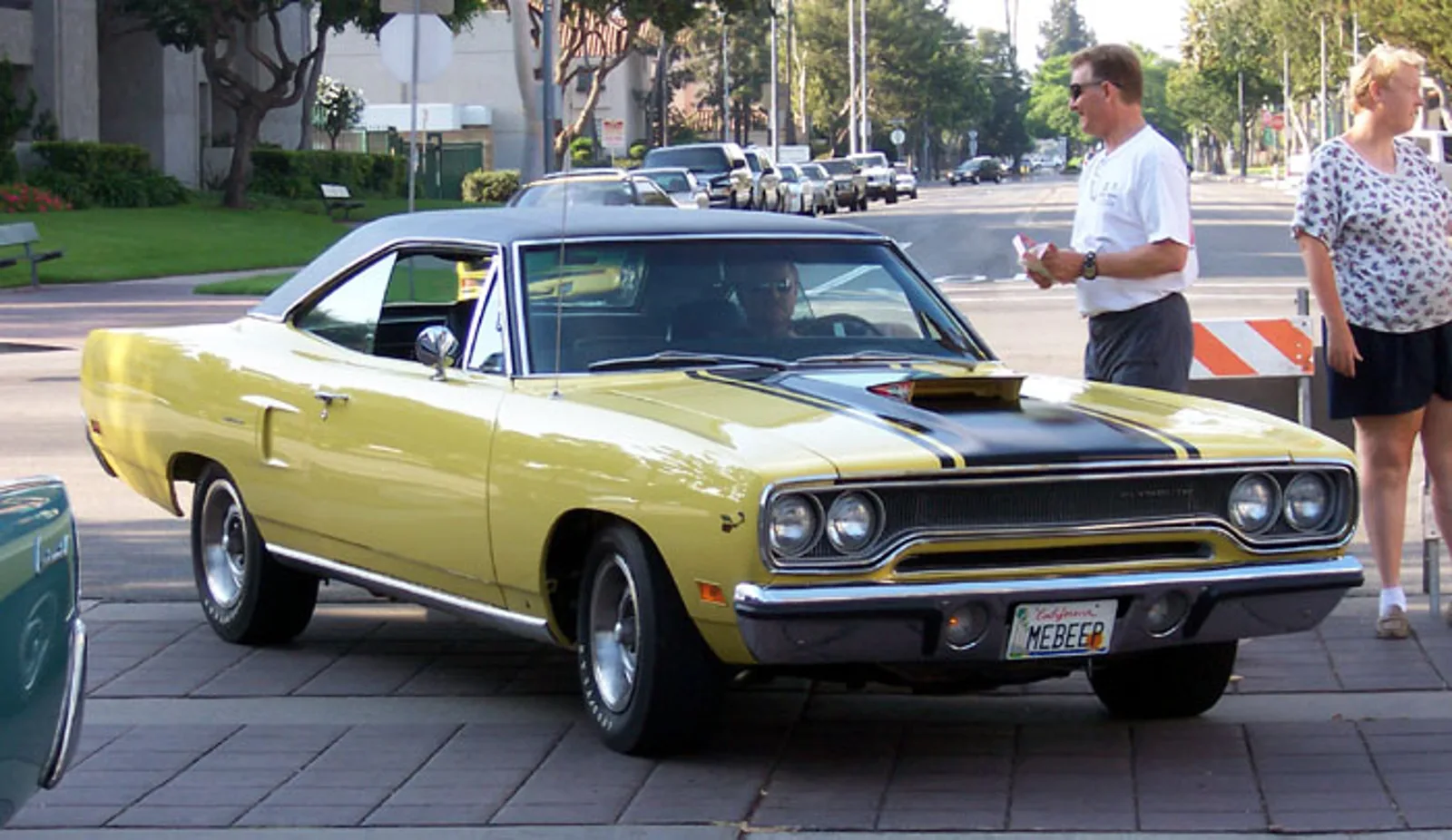
The Plymouth Road Runner was a stripped-down muscle car sold by Plymouth from the 1968 model year to 1980. It used a 383 V8 at launch, offered a 426 Hemi option, and produced the Superbird NASCAR special in 1970. The name survived as a Volare trim package until 1980.
The Plymouth Road Runner was a muscle car that Chrysler introduced for the 1968 model year under the Plymouth badge. It put a large V8 into a stripped-down mid-size car at a price below the more upmarket muscle cars of its day. The name lasted three generations and ended as a trim package on the Volare compact in 1980.
What was the Road Runner designed to do?
The Road Runner was a stripped-back mid-size performance car on the Chrysler B platform, shared with the Belvedere and Satellite. Plymouth priced it below rivals such as the Pontiac GTO and its own GTX, and it borrowed the name of a cartoon character to sell the idea.
The licence was not free. Plymouth paid a fee of $50,000 to Warner Bros.-Seven Arts for the use of the name and likeness from the Wile E. Coyote and Road Runner cartoons. A 'beep, beep' horn was also part of the package, and Plymouth spent $10,000 developing it.
The car began as a Belvedere derivative, the marque's plainest mid-size model. The GTX, by contrast, sat on the Sport Satellite with higher trim and small differences in grille and taillights.
A cartoon-named budget muscle car that became a NASCAR legend in the Superbird, then faded under insurance costs and emissions rules.
What did the 1968 Road Runner come with?
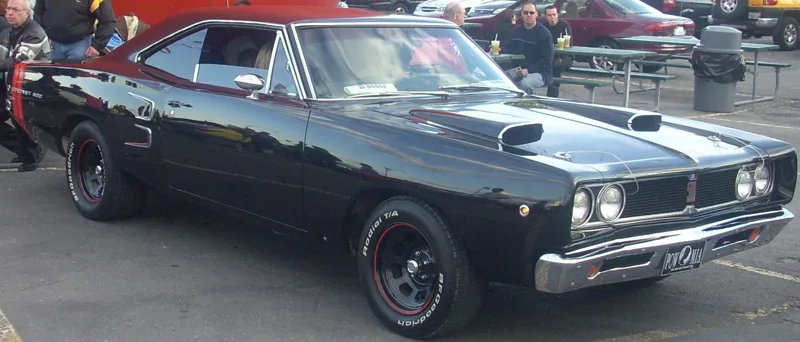
The 1968 Road Runner came standard with a 383 cu in (6.3 L) V8 producing 335 bhp (340 PS; 250 kW), and a four-speed manual was the usual gearbox. The 426 Hemi, 7.0 L (426 cu in), was a $714 option producing 425 bhp (431 PS; 317 kW), while the three-speed TorqueFlite automatic was an option.
Trim was deliberately plain. The interior had a basic vinyl bench seat and, in early cars, no carpets at all. Power steering, front disc brakes, an AM radio and air conditioning were among the few options, and air conditioning was not offered with the Hemi. Early four-speed cars used Inland shifters, which were swapped for Hurst units during the model year.
Chrysler squeezed a little extra from the standard engine by fitting the aggressive cam used in the 440 Super Commando and raising compression to 10.5:1 from 10.25:1 on the 330 hp version of the 383. Cars ordered with air conditioning received that softer 330 hp engine, because the sharper cam did not produce enough vacuum to run the system.
How well did the first Road Runner sell?
Plymouth expected to sell about 20,000 Road Runners in 1968, but actual sales came to around 45,000. That placed the car third among muscle cars, behind the Pontiac GTO and the SS-396 Chevelle from Chevrolet. Dodge followed in mid-1968 with the Super Bee, a close cousin built on the same idea.
What changed in 1969?
The 1969 car kept its overall look, with tweaks to the taillights, grille and side marker lights, bucket seats as an option and fresh Road Runner stickers. A convertible joined the range for 1969, and 2,128 were built. All were 383 cars apart from ten fitted with the 426 Hemi.
An Air Grabber option appeared that year. It was a fibreglass duct bolted under the bonnet that fed air from twin vents straight to the engine. A lever under the dashboard, labelled Carb Air, opened and closed the vents, and a decal of Wile E. Coyote on the air cleaner lid added to the joke.
Mid-year brought the A12 440 engine with three two-barrel Holley carburettors, sold as the 440 Six BBL. It came with a black fibreglass hood, a functional scoop and no hubcaps. Output was 291 kW (395 PS; 390 hp) at 4,700 rpm. Peak torque was 664 N m (490 lb-ft) at 3200 rpm, matching the Hemi but reached at lower revs. Production was approximately 1,432.
Motor Trend named the Road Runner Car of the Year for 1969. In the home market the three body styles together reached 81,125 units, with 3,295 more cars delivered to Canada and elsewhere.
How did engines change across the generations?
Standard power fell steadily across the Road Runner's life. The 383 V8 gave way to a 400 CID unit in 1972, a 318 V8 became the base engine by 1973, and by 1979 the standard engine was a 225 CID Slant 6. Emissions rules and insurance costs drove most of that decline.
| Years | Generation | Base engine | Notable option |
|---|---|---|---|
| 1968 to 1970 | First | 383 cu in (6.3 L) V8, 335 bhp (340 PS; 250 kW) | Hemi option at 7.0 L (426 cu in), 425 bhp (431 PS; 317 kW) |
| 1971 | Second | Detuned 383, 300 hp (224 kW) | 340 4-BBL; Hemi and 440 Six Barrel in their last year |
| 1972 | Second | 400 CID V8, larger bore | 440 at 280 hp (209 kW), the GTX basis |
| 1973 to 1974 | Second | 318 CID V8, 170 hp (127 kW) | 400 CID at 260 hp in 1973 with the four-speed |
| 1975 | Third | 318 V8, 145 hp (108 kW) | 400 CID, 235 hp (175 kW) with Code E68 |
| 1976 to 1980 | Volare trim package | 318 V8 | 360 CID, 160 hp (119 kW), rising to 195 hp (145 kW) in 1979 |
What did the 1970 Superbird add?
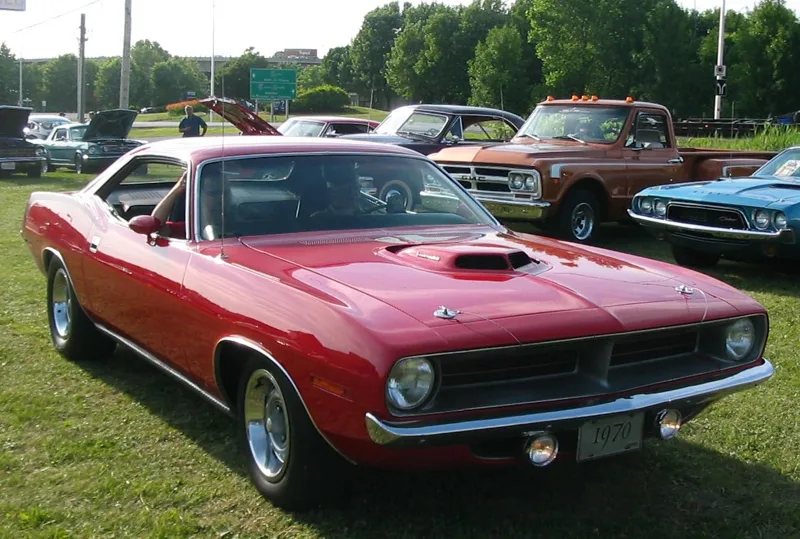
The Superbird was Plymouth's NASCAR-homologated version of the Road Runner for the 1970 season, with a tall rear wing and an extended pointed nose. The US market took 1,935 of them, and the model ran for that single year only. The Hemi-engined version was ordered by just 135 buyers.
The story began during the 1969 NASCAR aero wars. Chrysler's first answer was the Dodge Charger 500, and later that season the Charger Daytona appeared with a spoiler lifted 23 inches clear of the trunk, held up by pylons. Petty Engineering had asked Chrysler's managers for those Dodge cars, but the managers insisted the team was a Plymouth outfit. The Pettys switched to Ford almost at once. In 1969 the Petty team won 10 races and finished runner-up in the points standings.
To satisfy NASCAR homologation rules and win the Pettys back, Plymouth built its own version of the Dodge wing car for 1970. Consumers were lukewarm, and some dealers removed the wing and nose to make the cars look like ordinary Road Runners. Every public Superbird had a vinyl top, which the Daytona lacked. NASCAR had required 500 copies in 1969 but demanded one unit per dealer in 1970.
Which engines did the Superbird offer?
Superbirds came with three engines. The most common was the 440 V8 with a single four-barrel carburettor, rated 375 bhp (280 kW). The 440 Six Barrel followed at 390 bhp (291 kW), and at the top the 426 Hemi was rated 425 bhp (317 kW). Only 135 buyers ordered the Hemi.
Road Test magazine recorded 0 to 60 mph in 5.5 seconds, and the quarter-mile took 14.3 seconds, reaching 104 mph with the Hemi. Those figures showed how much the wing car could deliver on the road as well as the track.
How did the Superbird differ from the Daytona?
Although they looked alike, the Superbird rode on the Road Runner platform, and its nose, wing and body panels were not the same as the Daytona's. The Superbird used front fenders and a modified hood borrowed from the Dodge Coronet, which fitted the nose better. The mounting points for those fenders were identical on both cars, so the change was simple.
The nose made the car 19 inches (483 mm) longer overall, against 18 inches (457 mm) for the Daytona. The trunk spoiler was more angled and set higher than the Daytona's, and on both models it stood two feet high. The wing was designed for speedways, where it kept the rear wheels planted at 150 mph (240 km/h) and above. At normal highway speeds it was not needed.
Despite its success on the track, 1970 was the only year the Superbird was made.
What did the second generation bring in 1971?
The 1971 Road Runner adopted a rounder, fuselage-style coupe body with a steeply raked windscreen and a hidden cowl. The convertible was dropped, and the Hemi and 440 Six Barrel were offered for the last time. A four-barrel 340 and a detuned 383, rated at 300 hp (224 kW), also arrived.
It was a high-water mark for ride and handling. The overall length grew while the wheelbase shrank by an inch, and aerodynamics improved noticeably at speed. Road Runners fitted with the 340 or 383 avoided the surcharges that usually came with muscle cars and carried a standard insurance rating. The 383 could also run on regular petrol.
Interiors could be ordered with power leather seats and deep-pile carpeting, with extra sound-proofing added as well. Air conditioning and power steering were available except on Hemi cars.
How did emissions rules reshape the car in 1972?
For 1972 the big-block 383 gave way to a larger-bore 400 CID as the standard engine, and the Hemi was discontinued. Compression ratios fell across the range so the cars could run on low-lead fuel and meet early emissions rules. The 440 rated 280 hp (209 kW) became the basis of the GTX version of the Road Runner, which was no longer a separate model.
Power ratings looked much lower on paper that year because of the new SAE net measurement system. Only five 440 Six Barrel cars were built before that option was dropped in the fall of 1971, since the six-pack could not meet the stricter rules. The four-speed manual could still be ordered with each of the three engines.
Did the Road Runner race in NASCAR?
Yes, in a sense. Several NASCAR teams raced cars built on the 1971 to 1972 Road Runner bodies, and those cars performed strongly through the 1971 to 1974 seasons. Richard Petty won the championship in both 1971 and 1972 in Road Runner-based cars, winning 30 races across the two seasons.
The link shows how closely street cars and race cars were tied together at the time, even as the road models were moving away from their performance roots.
What happened to the Road Runner in 1973 and 1974?
The 1973 and 1974 models received completely new sheet metal, with squarer front-end styling that looked more like the four-door cars. Plusher carpeting and seat covers, with power seats and windows retained, moved the car up a level in luxury. Sales rose 40% on the 1972 models.
Performance had slipped too. Testers found quarter-mile times close to 16 seconds, and top speed had slipped to just over 125 mph (201 km/h). The base engine became Chrysler's workaday 318 CID V8 with dual exhausts, producing 170 hp (127 kW). The 440 still made 280 hp, but only with the TorqueFlite automatic, and the car moved further from muscle car status.
What was the 1975 Road Runner?
The 1975 Road Runner was built on the restyled, more formal B-body that Plymouth now called the Fury. It had a blacked-out grille, special striping, heavy-duty suspension with sway bars and Rallye wheels. The standard 318 made 145 hp (108 kW), and Car and Driver recorded 0 to 60 mph in 8.1 seconds in a test car with the Code E68 400.
Options were extensive, from a 170 hp (127 kW) two-barrel 360 to the 235 hp (175 kW) Code E68 400. That test car also posted quarter-mile times in the 16-second range and a top speed of 121 mph (195 km/h). Those figures were respectable for the period, though they were a shadow of 1970.
The 1975 run totalled 7,183 Road Runners, just over half of them with the 318. Plymouth's literature had planned to keep the name on a B-body for 1976, but it moved to an appearance package on the new Volare instead.
How did the Volare trim package end the story?
From 1976 the Road Runner name became a trim and graphics package on the two-door Plymouth Volare, the replacement for the compact Valiant and Duster. The standard engine was a 318 V8, with a 360 CID V8 offered as an option producing 160 hp (119 kW). The 360 was paired only with the three-speed automatic.
Police packages supplied some of the suspension parts. Between 1978 and 1979 the 360 gained a four-barrel carburettor, and for 1979 dual exhausts lifted output to 195 hp (145 kW). That year the standard engine was the 225 CID Slant 6, and for 1980 the 360 was dropped, leaving the 318 as the top engine.
Why did the Road Runner's performance fade?
Performance and sales declined through the 1970s as buyers and regulators turned toward fuel economy and tougher US emissions standards. Insurance surcharges on high-performance cars made them costly to own, and the Duster 340 offered similar pace with lower premiums.
The Duster 340 was a compact introduced for 1970, with a 340 4-BBL V8 making 275 hp (205 kW). It could perform as well as, or better than, a 383 Road Runner in the lighter A-body, and it was priced below the Road Runner and carried lower insurance rates.
The Road Runner's first sales were strong, which showed what the formula could do before those pressures arrived. Its name survived as a trim package until the Road Runner was discontinued in 1980.
What was the Plymouth Duster I?
The Duster I was a concept car, a high-performance take on the Road Runner from the late 1960s that Plymouth never sold. It used a 383 four-barrel V8 and featured a low, racing-style windscreen, aircraft-style flaps and adjustable spoilers on the rear fenders to resist side-to-side yaw in a slipstream.
A production Duster followed in 1970 with a scaled-down powertrain, including a 340 cu in engine. Dodge's sister car, the Demon, also carried a 340 cu in V8 and sold for only about two years before a name and body change.