Built from 1968 to 1984, the front-wheel-drive Saab 99 began with a Triumph four-cylinder and ended as the car that made turbocharging a family-car feature.
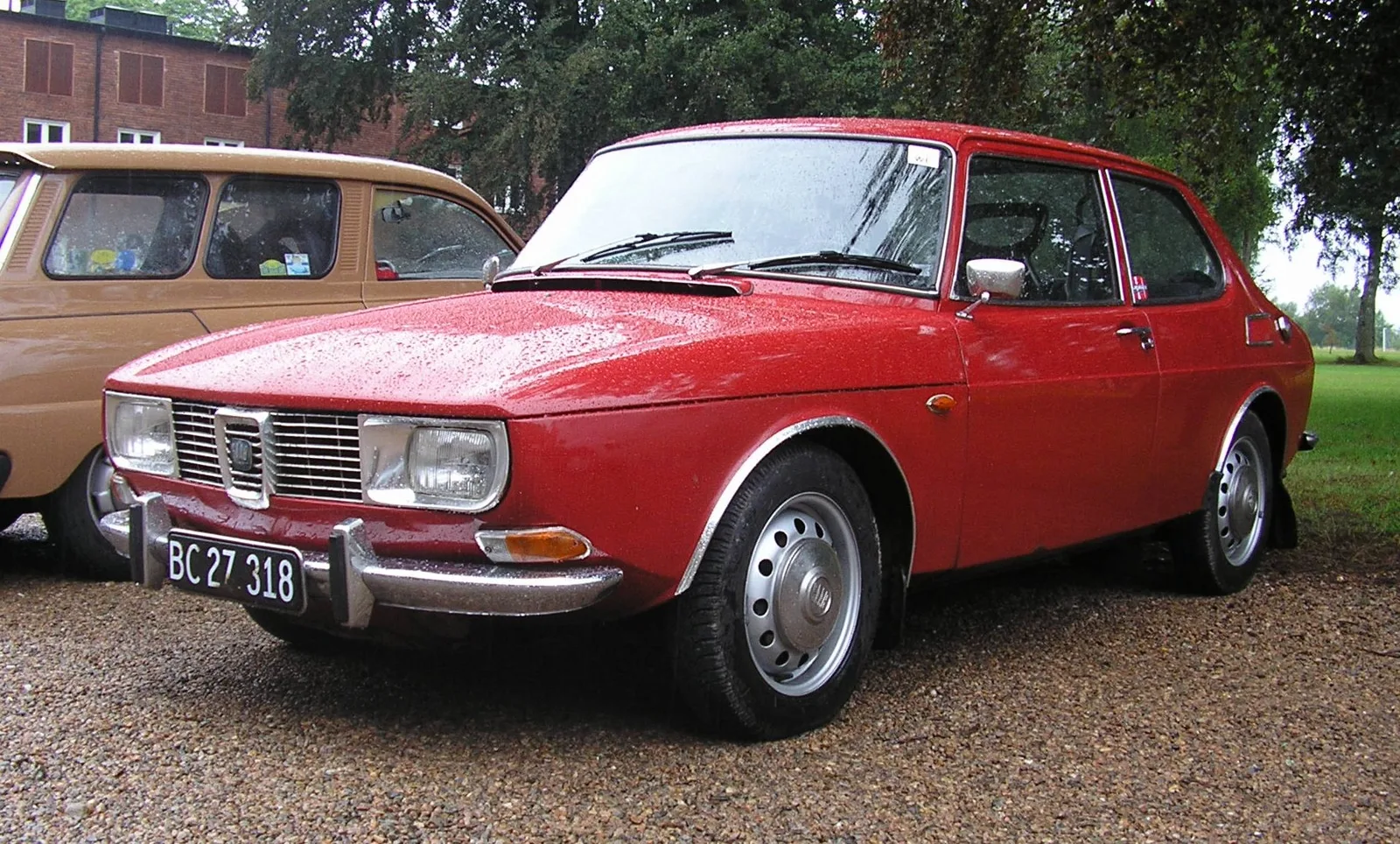
The Saab 99 was a Swedish front-wheel-drive family car built from 1968 to 1984. It began with a 1709 cc Triumph-sourced four-cylinder engine, and the turbocharged 1978 Turbo, with 145 PS, became the model that repositioned Saab. It remains a reference point for Saab enthusiasts.
Saab's 99 arrived in 1968 as the company's first step beyond the 96 and remained in showrooms until 1984. Its early engine came from Triumph, and the turbocharged version of 1978 became a landmark in the history of family cars.
Where did the Saab 99 come from?
The 99 was created because Saab wanted a car above the market served by the smaller Saab 96. The company's board began Project Gudmund on 2 April 1964, and the design, by Sixten Sason, was unveiled in Stockholm on 22 November 1967.
Early work relied on disguises. Engineers cut a Saab 96 lengthwise and widened it by 20 centimetres (7.9 in), creating a test mule nicknamed the Paddan, which translates as the toad. The first body shell carried a Daihatsu badge to keep the project quiet.
Born from a Triumph engine and a lengthwise-cut Saab 96, the 99 grew into a turbocharged icon.
Why did Saab choose a Triumph engine?
Saab engineers liked the company's two-stroke engine, but Saab decided it needed a four-stroke design. The choice was a 1.7 litre unit from Triumph, the slant-four also used in the Triumph Dolomite, fitted with a Zenith-Stromberg carburettor made for Saab. The engine later grew to 1.85 litres.
Reliability was the weak point. Saab found the Triumph engines troublesome, so it brought development in-house, and the 1985 cc Saab B engine took over from September 1972. Fuel injection later appeared on some versions as the engine family evolved.
How was the 99 engineered?
The 99 was a front-wheel-drive car whose engine sat in a reverse longitudinal position behind the gearbox, which kept weight off the nose. Drive reached the gearbox by triplex chain. The chassis also had deformation zones at both ends to absorb a crash.
The bonnet hinged at the front and extended over the front wheel arches, and the windscreen wrapped deeply around the cabin. A steep A-pillar gave the driver a clear view ahead. Its drag coefficient of 0.37 compared with 0.4 to 0.5 for many rivals of the period.
Small details also mattered. The handbrake worked on the front wheels, and the freewheel carried over from the Saab 96 was dropped once the 1.85 L engine arrived. A heating duct ran to the rear window, and an electric cooling fan helped the engine, which was unusual at the time.
What were the Saab 99 specifications?
Figures depend on the version, so the table below separates them. The earliest 1.7 litre car produced 87 PS (64 kW; 86 hp) at 5500 rpm, while the 1978 Turbo delivered 145 PS (107 kW; 143 hp) and reached 0-100 km/h in 9.2 seconds.
| Model | Output | 0-100 km/h | Top speed |
|---|---|---|---|
| 99E (1.85 L) | 95 PS (70 kW; 94 hp), DIN | 14.6 seconds | 161.5 km/h |
| 99 EMS | 118 PS (87 kW; 116 hp), DIN | 11.6 seconds | 175.6 km/h |
| 99 Turbo | 145 PS (107 kW; 143 hp), DIN | 9.2 seconds | 196.7 km/h |
| 99 Petro | 85 PS (63 kW; 84 hp), DIN | 16.5 seconds | 155 km/h (96 mph) |
The EMS needed 41.0 seconds to reach 160 km/h, and the Petro was the slowest of the group. At a steady 105-110 km/h (65-70 mph), the 99E was rated at 7.8 L/100 km (33 mpg), a figure quoted for cruising.
How did the 99 Turbo change Saab?
The 99 Turbo arrived in 1978 with a turbocharged version of the 2.0 litre engine that produced 145 PS (107 kW; 143 hp). It repositioned Saab in the car market, and by early 1979 more than 10,000 turbo-engined Saabs had been built, which showed a new segment had opened.
Garrett AiResearch designed and built the turbochargers. Saab's Turbo ranked among the first family cars to carry a turbo, which set it apart from specialist turbocharged machines that were hard to drive. Popular Mechanics later placed the car second on its list of the greatest turbocharged cars.
Styling was distinctive but restrained. Alloy wheels and front and rear spoilers marked the Turbo out. Before the launch, a test fleet called the One Hundred series was distributed to users around the world in 1977, mostly built from three-door and two-door EMS models.
Which Saab 99 models were sold?
Saab sold the 99 in a long list of trims, from the basic L and the stripped X7 to the fuel-injected EMS, GLE and Turbo. The letters carried meaning, and the E in GLE stood for injection. The range shifted each year with new engines, trim and bodies.
- 99E: introduced for 1970, sold to order rather than from dealer stock, with fuel injection and a four-speed manual
- EMS: launched in January 1972 as a sportier model with stiffer suspension, and Bosch K-Jetronic injection from 1975
- SSE: a United States model with a vinyl roof and a BorgWarner automatic
- X7: a very basic model from 1973, sold only in Sweden and Denmark
- L: a budget model from 1973 with the 1.85 L engine
- GLE: the 1976 top model, with fuel injection, power steering and an automatic transmission
- GLs: a model with two carburettors and 108 PS (79 kW; 107 hp)
- Turbo: introduced in 1978 as a combi coupe, then a two-door saloon from 1979
What was the Finlandia?
The Finlandia was a long-wheelbase limousine built by Valmet in Finland from 1977, based on the GLE combi coupe. Saab's Swedish head office never gave it an official designation, so it was sold only by local dealers in Finland under its own name.
The idea came from a gift. In the mid-1970s the industrialist Marcus Wallenberg Jr. heard President Urho Kekkonen complain that his large Cadillac state car was too conspicuous and set him apart from ordinary people. Wallenberg then ordered a pine-green 99, had it stretched by 20 centimetres (7.9 in) at a Malmo coachbuilder, and gave it to the president.
The president loved the car, and newspaper coverage made the stretched model fashionable with Finland's political and business elite. Saab-Valmet then built its own version, and the tradition carried on with the Saab 900 Finlandia in 1979. Later 900s became the 900 CD, mostly four-door sedans, and one long-wheelbase five-door was delivered to Metsa Group in 1983.
A museum at Uusikaupunki, which also covers Saab and other makes, displays the original Wallenberg Special 99. The first Finlandias were 25 centimetres (9.8 in) longer than standard, and in 1978 the wheelbase was trimmed to 20 centimetres (7.9 in) longer. Three late cars received turbocharged engines with manual transmissions.
What was the Petro engine?
The Petro-Multifuel engine ran on either gasoline or kerosene, and it was built at Uusikaupunki from 1979 to 1981 for sale only in Finland. It was developed as fuel prices rose, and it was an alternative to a diesel engine, which Saab's model line did not offer.
Kerosene was unsuitable for long-term reliability, and the cost savings disappeared when fuel pricing changed. Most Petros were eventually converted to run only on gasoline.
How did critics rate the 99?
Critics generally praised the 99 for comfort, build quality and driving satisfaction. The UK's Mass Motorist magazine said in 1968 that the 99 could become a class leader, and Australia's Wheels magazine praised the Turbo's midrange pace in a July 1978 road test.
Modern Motor was struck by what it called an apparently endless surge of acceleration from a two-litre engine in a heavy car. Popular Science likened the four-cylinder engine's agility to a V8 and claimed that no American engine since 1968 could match its driveability.
How long was the Saab 99 in production?
Saab built the 99 from 1968 to 1984. The first production cars appeared in autumn 1968, with 4190 built that year, and the total reached 588,643. Including Saab 90 output, the figure rose to 614,003 cars. The 900 and the Saab 90 succeeded it.
Production climbed in 1969 and again in 1970. Plastic bumpers added in 1972 were built to survive knocks of up to 8 km/h (5 mph) without losing their shape. The three-door combi coupe from 1974 was 11 centimetres (4.3 in) longer than the saloon. In 1982 the H engine, built by Scania at Sodertalje, let every car run on 93 octane petrol.
Which Turbo versions stood apart?
Two special Turbos stood apart from the standard car. The Turbo S added factory-mounted water injection for an extra 15-20 PS, while a limited run of just over 100 five-door Turbos in Cardinal red appeared in 1978. Both were rare, and each had its own place in the Turbo story.
The Turbo S gained its extra output from the water injection system alone, since the engine was otherwise the same turbocharged two-litre unit. The five-door run was small, and only Cardinal red was offered for it.
The two-door saloon of 1979-80 was a limited homologation exercise, built so that a rally version could be produced. Saab had already used the 99 for its final factory rally entries, first as the EMS and later as the Turbo, so the two-door saloon carried that racing thread forward.
Why did US models have four headlights?
American rules at the time required sealed beam headlamps, so US-market 99s used a special front with four round lights instead of the two rectangular units fitted elsewhere. The arrangement became a favourite for European customisers, who swapped the American nose onto their own cars.
Police versions were also built, and the bonnet posed a problem for the livery team. Because the front wraps around the wheel arches, the paint had to continue up onto the bonnet rather than stopping at the fenders as it did on most cars. The same wraparound shape later applied to the 900.
How did the 99 compare with its rivals?
The 99 was pitched against the BMW 2002 and the Alfa Romeo Giulia, and the UK's Mass Motorist judged it the stronger car. In Australia's test of the Turbo, Wheels measured the Turbo from 60 km/h (37 mph) to 160 km/h (99 mph) in 4th gear and compared it with any five-seater in the world.
Popular Science placed the car in the Peugeot and Volvo price class, but in the Colt and Dasher class for fuel economy. That mix of price and running costs was an unusual combination for a car of its size.