Three generations of American Motors' compact, from the 1958 two-door to the 1969 SC/Rambler, with economy records, racing, exports and a second life as a collectible.
The Rambler American was an AMC compact built from 1958 to 1969 in three generations. It began as a two-door with a 90 hp six, grew into a V8 car by 1967, and finished with the 1969 SC/Rambler, which was built for drag racing.
The Rambler American was a compact car that American Motors built from 1958 to 1969. It was the second incarnation of the Rambler compact line, which began with Nash Motors in 1950, and it was sold cheaply on the strength of its economy. By the late 1960s it had grown into a muscle-style V8 car, before the Hornet took over its role.
Where did the Rambler American come from?
The Rambler American was a second take on the Rambler compact. It reused a modified version of the 1955 Nash Rambler, with a 100-inch wheelbase, and it went on sale in January 1958 as a two-door sedan. AMC could not afford an all-new model, so the old tooling was put to work again.
George Mason believed in small cars and introduced the Austin-built Metropolitan in 1954. The Rambler line grew to a 108-inch wheelbase in 1956, and the new president, George W. Romney, wanted a third car line to challenge the Big Three. The small Rambler suited a nation that entered recession in 1958.
The Metropolitan's 85-inch wheelbase was too short for a practical four-passenger car, and its overseas-built costs were hard to control. The 1955 car's 100-inch wheelbase fitted between the larger Ramblers and the import, so a modified version of that car became the American.
From a 1958 two-door that sold on price to a 1969 V8 that ran the Baja 500, the Rambler American kept changing.
What did the 1958 Rambler American offer?
The 1958 car was sold only as a two-door sedan, with a flathead six of 195.6 cu in (3.2 L) that made 90 hp (67 kW; 91 PS). It came in a Deluxe at US$1,789 and a Super at $1,874, and AMC claimed it was the lowest-priced car made in America.
Tom McCahill, writing in Mechanix Illustrated, judged it an ideal-size small family car that could outperform imports at its price. Owners praised its economy and handling. The American found 30,640 buyers in the abbreviated 1958 model year, and it helped Rambler become the only domestic make to post a sales increase that year.
How did the Rambler American grow in the late 1950s?
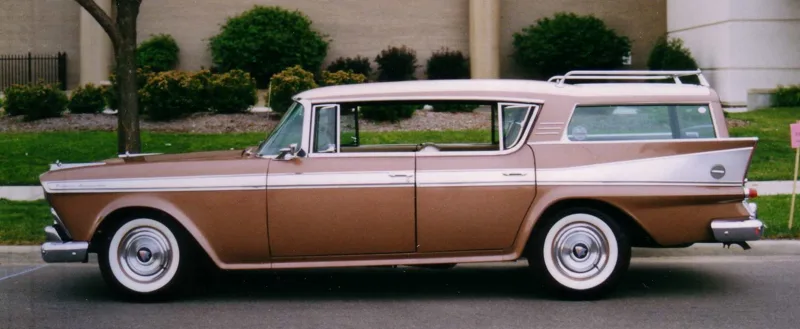
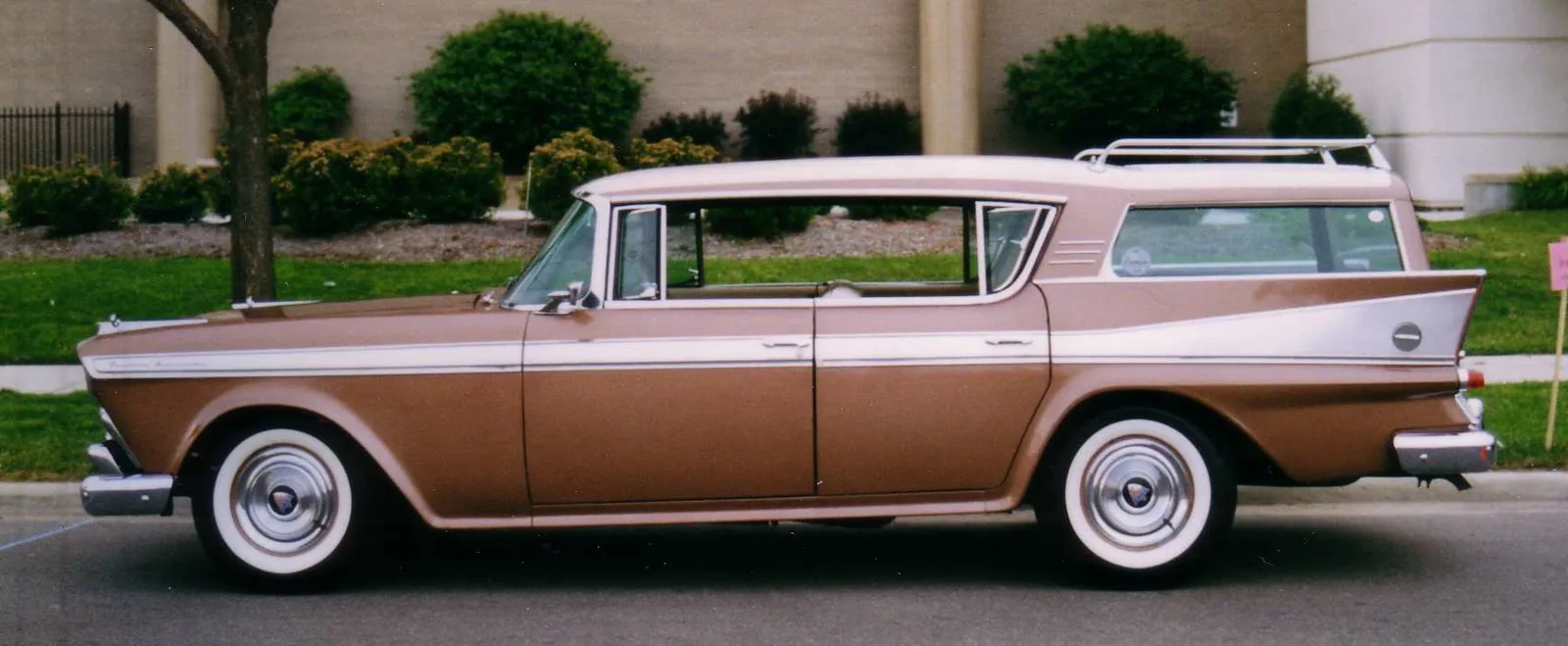
A two-door station wagon arrived in 1959, and production tripled to 91,491 Americans that year. AMC struggled to keep up with demand, and the wagon made up almost 36% of output with 32,639 cars. The Deluxe wagon cost $2,060, while the Super version, with a cargo mat and roof rack, cost $2,145.
The 1960 model year added a four-door sedan and a top-of-the-line Custom trim. The new four-door shared the 100-inch wheelbase, and it was meant to battle the Ford Falcon, Chevrolet Corvair and Plymouth Valiant. The Custom came with a new 195.6 cu in overhead-valve six rated at 125 hp (93 kW; 127 PS).
Sales reached 120,603 units in 1960, split between 44,817 two-door sedans, 46,973 four-door sedans and 28,813 wagons. Rambler's total sales of 485,745 gave AMC 7.5% of the US market and third place among domestic brands.
What changed with the second generation in 1961?
The second generation was a heavy restyle under AMC styling vice president Edmund E. Anderson. The mechanics stayed the same, but the car was three inches (76 mm) narrower and shorter, with an overall length of 173.1 in (4,397 mm), and its cargo space grew. The square, breadbox look replaced the rounder shape of the earlier car.
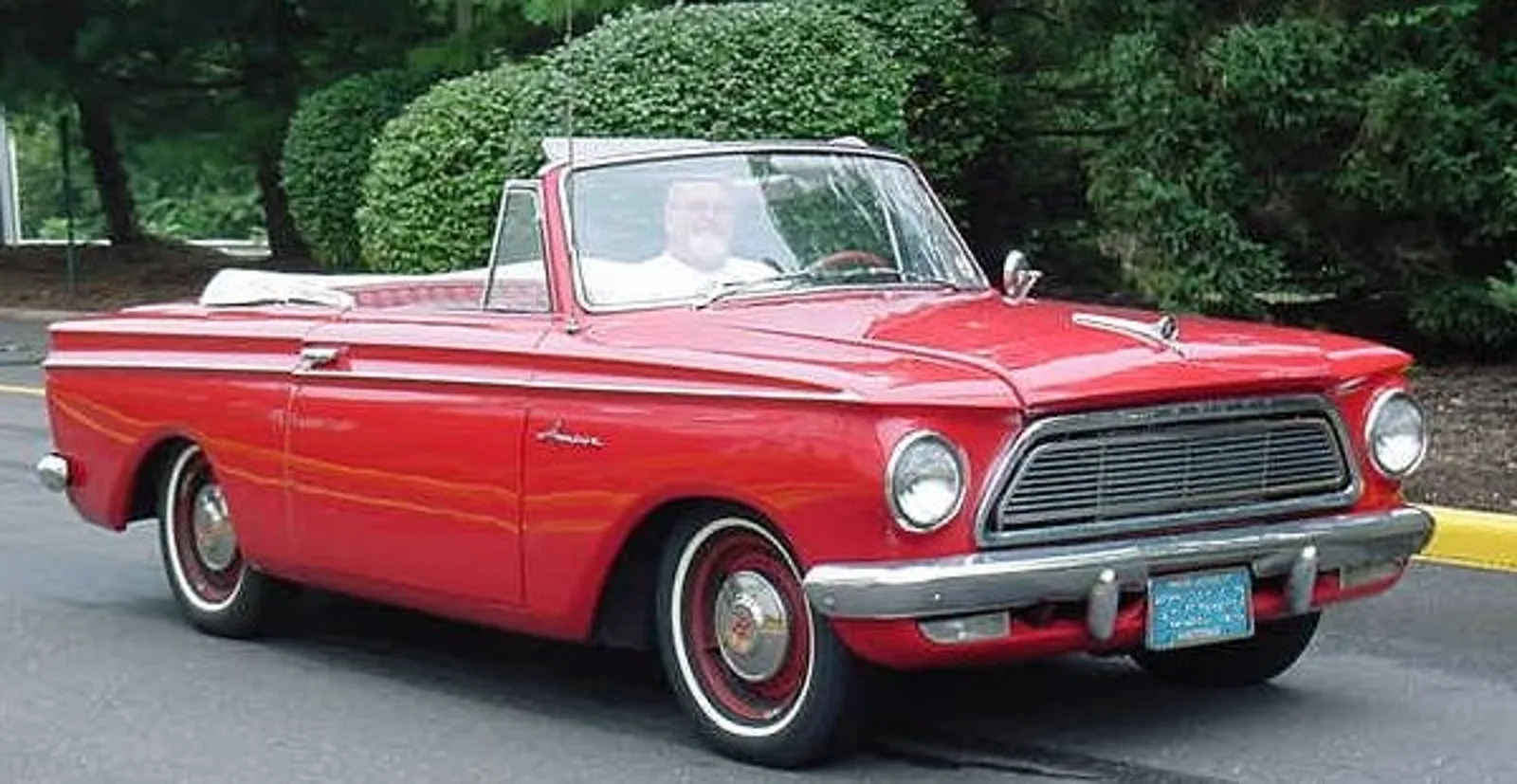
In 1961 the American range gained a four-door wagon and a two-door convertible, the first American convertible since 1954. The convertible had a power-operated folding top, and the Brampton plant in Ontario was built to make Rambler Americans and Classics.
How did the 1962 and 1963 models differ?
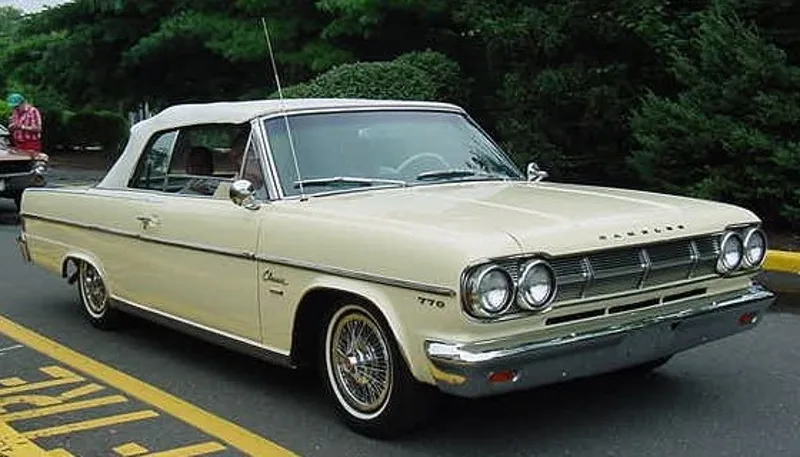
The 1962 cars introduced Double-Safety brakes, with a tandem master cylinder and separate circuits for the front and rear. An E-stick option combined a manual three-speed with an automatic clutch for $59.50. Production reached 125,678 Rambler Americans that year, and almost 13,500 of them were convertibles.
The 1962 models carried many maintenance improvements. Oil changes went from every 2,000 miles to every 5,000 miles (3,219 to 8,047 km), coolant was guaranteed for two years or 24,000 miles (38,624 km), and the car had deep-dip rustproofing. The Popular Science test of a 10,000-mile car called it sturdy, solid and dependable.
In February 1962 George W. Romney resigned to enter politics, and Roy Abernethy took over as president. He moved AMC away from Romney's economy focus and set out to meet the Big Three head on. For 1963 the 400 was renamed the 440, and a hardtop coupe with a faux convertible roof appeared.
The 1963 440-H added a sports-type interior and a 138 hp (103 kW; 140 PS) six, and an optional Twin-Stick overdrive transmission allowed five-speed shifting. The AMC line as a whole earned Motor Trend's Car of the Year award for 1963.
What did the third generation look like?
The third generation, from 1964, was the only all-new design of the car. Its wheelbase grew six inches (152 mm) to 106 in (2,692 mm), and the interiors were made more spacious. The new body was a shorter, narrower version of the Rambler Classic of that year.
Dick Teague designed the car, and he later designed the Javelin and AMX. The station wagons in the 1964 series had four doors and gained 17% more cargo space, with a roll-down rear window for the tailgate. Full coil front springs and soft rear leaf springs gave an unusually smooth ride.
Sales rose to a record of more than 160,000 in 1964. AMC's advertising focused on economy, with testimonials from ordinary owners in its Love Letters to Rambler series, a strategy that Datsun copied a decade later.
How did the 1965 and 1966 models change?
The 1965 Americans were advertised under the slogan The Sensible Spectaculars. A new 232 cu in (3.8 L) six with 155 hp (116 kW; 157 PS) appeared, and 1965 was the last year for the old flathead six, which was the last flathead engine used in a domestic US car.
The 1965 440 convertible was the most affordable American-built open car, from US$2,418. It was one of the best convertibles on the market, but it lacked a V8, which buyers wanted. Roy Abernethy looked to the Classic and Ambassador for growth rather than to the American.
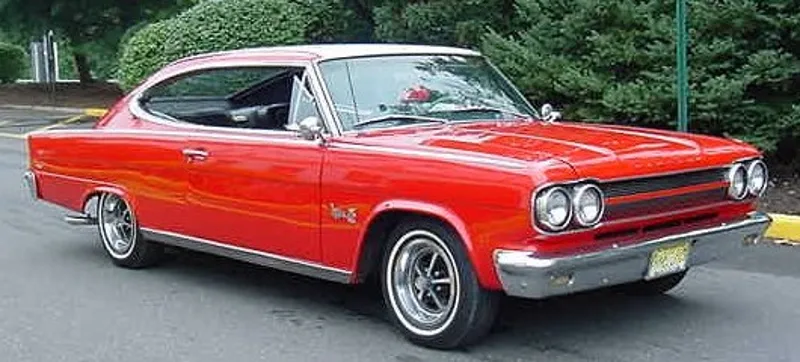
For 1966 the American was facelifted with squarer front and rear styling, and the front was extended three inches (76 mm) to fit optional air conditioning. The mid-trim 330 was dropped, and the top 440-H became the Rogue, a two-door hardtop.
A new 290 cu in (4.8 L) Typhoon V8 arrived in the mid-1966 Rogue. It came with a 200 hp (149 kW; 203 PS) two-barrel or 225 hp (168 kW; 228 PS) four-barrel. Weighing only 540 pounds (245 kg), the engine was used across AMC's cars and later in Jeeps, and it was assembled until 1991.
What made the 1967 Rambler American more powerful?
The 1967 model year brought AMC's new 343 cu in (5.6 L) V8, with a 10.2:1 compression ratio and a four-barrel carburettor. It produced 280 hp (209 kW; 284 PS) and 365 lbf ft (495 N m) of torque at 3,000 rpm, but it was not widely advertised. Only 58 Rogues and 55 440s received it at the factory.
The 1967 car was offered in nine models, and it was the only US compact available in every body style, including a convertible. Total production was 69,912, and 921 of those were Rogue convertibles. New safety rules brought lap belts for every seat, a collapsible steering column, energy-absorbing padding and four-way hazard flashers.
The instrument cluster changed to round gauges, with the speedometer in the centre. AMC's warranty, at two years or 25,000 miles (40,000 km) on the whole car and five years or 50,000 miles (80,000 km) on the engine and powertrain, was the strongest of its time.
Roy D. Chapin Jr., newly installed as chairman and chief executive, cut the base two-door sedan's price to US$1,839, against the $2,117 Plymouth Valiant. That left the American only $200 above the Volkswagen Beetle, but with more car for the money.
Why did the 1966 design last until 1969?
AMC announced that it would skip the annual styling changes that rivals expected, saving retooling costs and passing the savings on to buyers. It promised future changes would focus on safety and reliability, and it backed the plan with a $300,000 advertising campaign.
The American's 1966 design continued largely unchanged through the 1969 model year. For 1968 the line was cut from nine models to five, and the Rogue became the only two-door hardtop in the range, alongside the Chrysler A-platform cars and the Corvair.
One of the campaign's lines suggested that rivals were charging too much for their cars. The approach broke the usual rule against attacking competitors, but it brought the company's economy image back to its customers. Sales and showroom traffic rose as a result.
What was the final model year like in 1969?
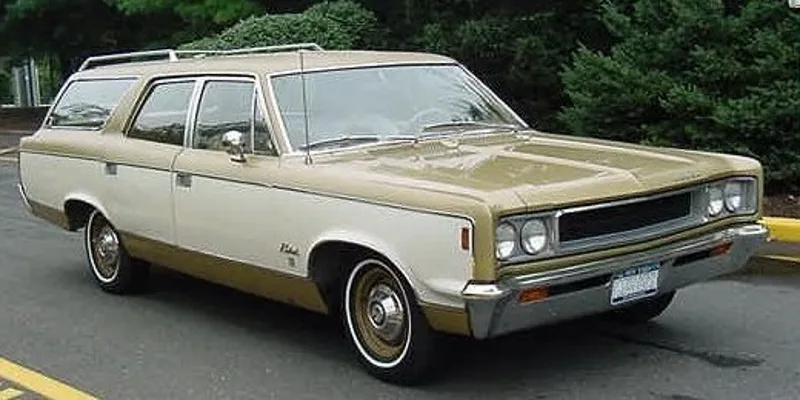
In 1969 the American name was dropped, and the car became the American Motors Rambler. The new suspended accelerator pedal and cable linkage were the main mechanical changes, and front shoulder belts and headrests were added to the front seats.
Total production for 1969 was 96,029 cars. The last US-made Rambler was assembled at Kenosha, Wisconsin, on 30 June, which brought the production total to 4,204,925 units. The Rambler station wagon, on a 106 in (2,692 mm) wheelbase, offered 66 cubic feet (1,869 L) of cargo space.
The redesigned AMC Hornet took over from the American once the 1969 model year ended. The name was kept in Mexico, where the Hornet did not carry the same connotations.
What was the SC/Rambler?
The SC/Rambler was a 1969 muscle car built with Hurst Performance, powered by the 315 hp (235 kW; 319 PS) 390 cu in V8 from the AMX. It was priced at $2,998 with no factory options, and 1,512 were built. Its purpose was the NHRA F-stock class.
The SC/Rambler had a 10.5-inch (267 mm) clutch, a four-speed BorgWarner T-10 and a Hurst shifter with a large T handle. Its rear end was an AMC 3.54:1 Twin-Grip limited-slip differential. Front disc brakes, staggered rear shocks and a stronger driveline distinguished it from the regular Rambler, along with rolled-back wheel openings for bigger tyres.
Quarter-mile times in the low 14-second range were achievable from the showroom. Owners who ran it in full street trim managed 12.07 seconds at 114 mph (183 km/h) on street tyres. A Road Test magazine run recorded 14.4 seconds at 100.44 mph, with 109 mph (175 km/h) reached without topping out.
Charles Rauch set a D/S class quarter-mile mark of 12.54 seconds at Detroit Dragway in a factory-supported SC/Rambler. AMC painted the cars in two red, white and blue schemes, A and B, and about 1,215 were painted in the A scheme by Paul Hatton, which suggests about 297 were B.
How did the Rambler American perform in economy trials?
The Rambler American won the yearly fuel economy prize in the Mobil Economy Run and the Pure Oil Company trials, even in years when efficiency was not a major sales factor. In the 1959 Mobilgas run over 1,898 miles (3,055 km), a Deluxe averaged 25.2878 miles per US gallon.
The 1959 Pure Oil trials ran from Los Angeles to Miami over 2,837 miles (4,566 km), and an overdrive Rambler set a NASCAR-supervised coast-to-coast average of 35.4 miles per US gallon. In 1960 an overdrive car averaged 38.9 miles per US gallon coast to coast, and a Pure Oil run returned 51.281 miles per US gallon.
The 1960 Mobilgas run gave a Custom two-door sedan 28.35 miles per US gallon over 2,000 miles (3,200 km), and it finished first in the compact class. In 1964 a six-cylinder 440 sedan averaged 27.8336 miles per US gallon, the best of all the cars that year.
AMC used those results in its advertising, and its handbooks showed how the automatic could be used to favour economy. Leaving the selector in D-2 blocked low gear when starting from a stop, which gave an initial final drive ratio that cut crankshaft revolutions.
Did the Rambler American race?
For much of the early 1960s AMC stayed out of racing, as it had signed up to the industry's 1957 ban on sponsorship. Independent dealers did not, and Preston Honea became famous in the 1964 Bill Kraft Rambler, a car from Norwalk, California, with a 418 cu in (6.8 L) V8 and four carburettors.
The Bill Kraft car ran 112 mph (180 km/h) at Fontana with an 8,200 rpm redline. The Ambassador's V8 added only 80 pounds (36.3 kg) over the small six. After Roy Abernethy left, AMC embraced motorsport and used the car's performance image to sell it.
Spencer Murray and Ralph Poole drove a Rambler American in the passenger-car class of the July 1967 Baja 500, setting a record 31 hours. The American International Racers team, led by James Garner, later prepared ten 1969 SC/Ramblers for the Baja 500.
The 1969 Baja cars had 44 US gal (167 L; 37 imp gal) fuel tanks, roll cages and 410 hp (306 kW; 416 PS) from blueprinted 390 V8s. They could run at 140 mph (225 km/h) on straights and weighed 3,140 pounds (1,424 kg). Seven of the Ramblers finished, taking three of the top five places in the passenger-car class.
Rambler Americans also competed in the Shell 4000 Rally in Canada. In 1968 the 4,000-mile (6,437 km) rally ran from 31 May to 8 June from Calgary to Halifax, and the AMC team finished second, third and fifth, which won the manufacturers' award.
What electric experiments did AMC try?
AMC and Gulton Industries built an electric prototype from a 1969 Rambler American station wagon, which had a 290 cu in V8 removed and nickel-cadmium batteries installed. It used 160 cells rated at 75 ampere hours each. The car gave good acceleration, but range remained a problem.
In 1967 AMC and Gulton had built the Amitron, a purpose-built electric vehicle rather than a conversion, and later the similar Electron concept city car.
How did the Rambler American sell overseas?
The car was built in many countries. Industrias Kaiser Argentina produced a version as the Torino from 1966 to 1982, Australian Motor Industries built it from 1964 to 1967, and Iran's Pars Khodro assembled the Aria and Shahin from 1967. South Africa's assembly produced 3,664 sedans, 736 wagons and 288 hardtops.
The Argentine Torino used a Pininfarina-styled body on a 1963-1964 Classic passenger compartment, and its Tornado Interceptor 230 cu in overhead-cam six was unique to the country. A Torino finished fourth on penalties in the 84 hours of Nurburgring in 1969 after completing the most laps.
In Australia the local content rose to 53% by 1967, and the cars were considered reliable. In Mexico the American was introduced in 1958, and Willys Mexicana began local assembly in 1960. The Mexican cars became Vehiculos Automotores Mexicanos (VAM) products, and the 1963 hardtop was a limited edition of 90 units.
Norway imported 260 Americans from 1963 to 1969, peaking in 1965. In the Philippines the car was assembled locally and became a favourite of the Manila Police Department. Right-hand-drive cars sold in the UK did not have V8s, overdrive, power steering or air conditioning.
Why is the Rambler American a collectible today?
Television helped. A 1962 Rambler American convertible appeared on the NBC sitcom 3rd Rock from the Sun, and examples commanded upward of $14,000 from collectors. The series' composer, the musician Ben Vaughn, had also released an album recorded inside his 1965 Rambler American in 1997.
The SC/Rambler has a strong collector following, with clubs, websites and a registry. Its replica appeal comes from the ease of fitting an AMC V8 into the inexpensive 1966 to 1969 Rambler Americans. A No. 1 condition example was valued at mid-five figures, according to Old Cars Weekly.