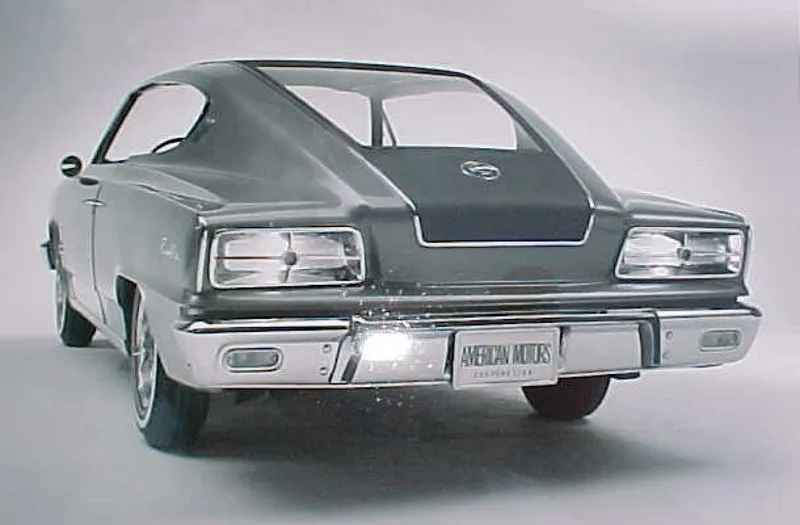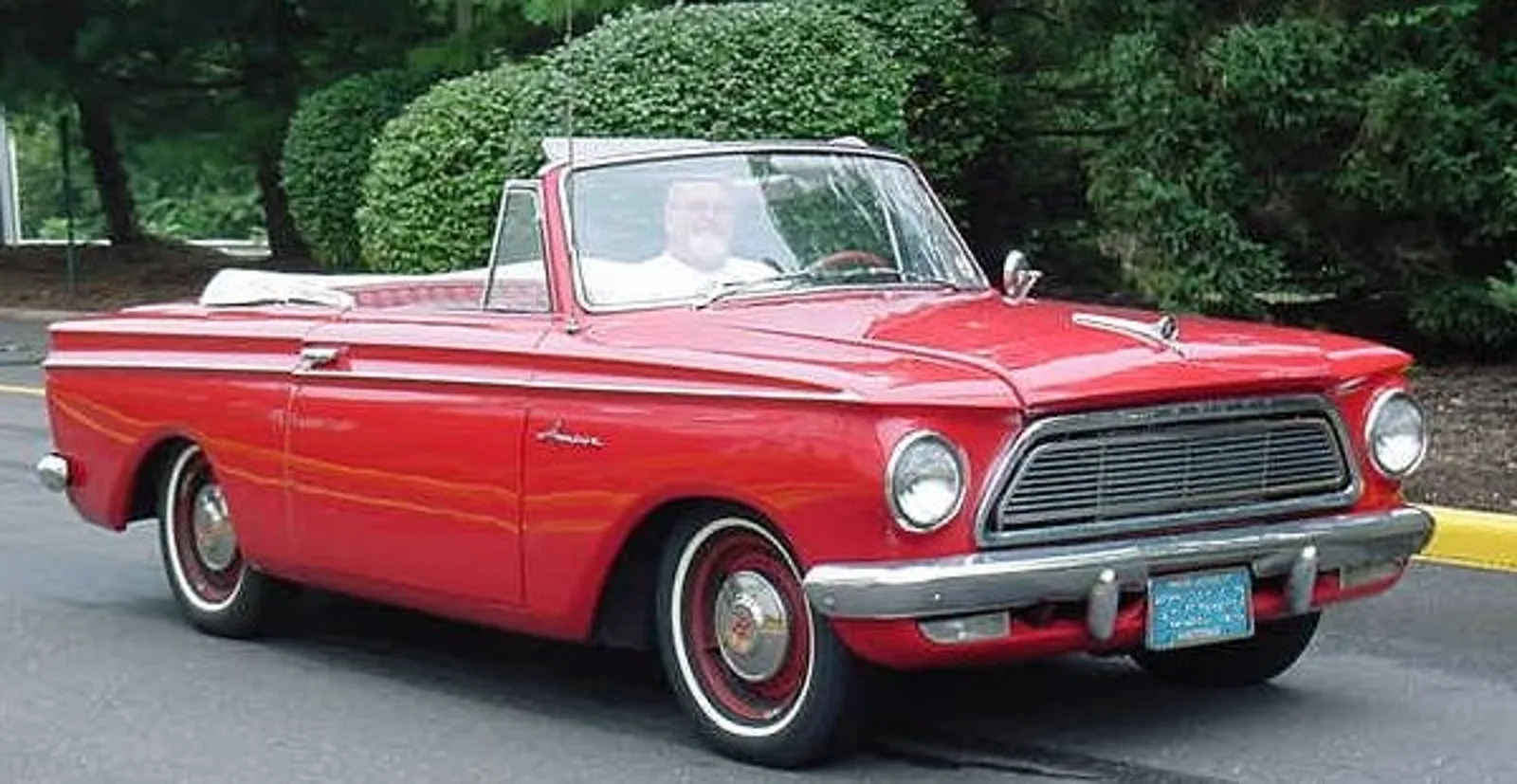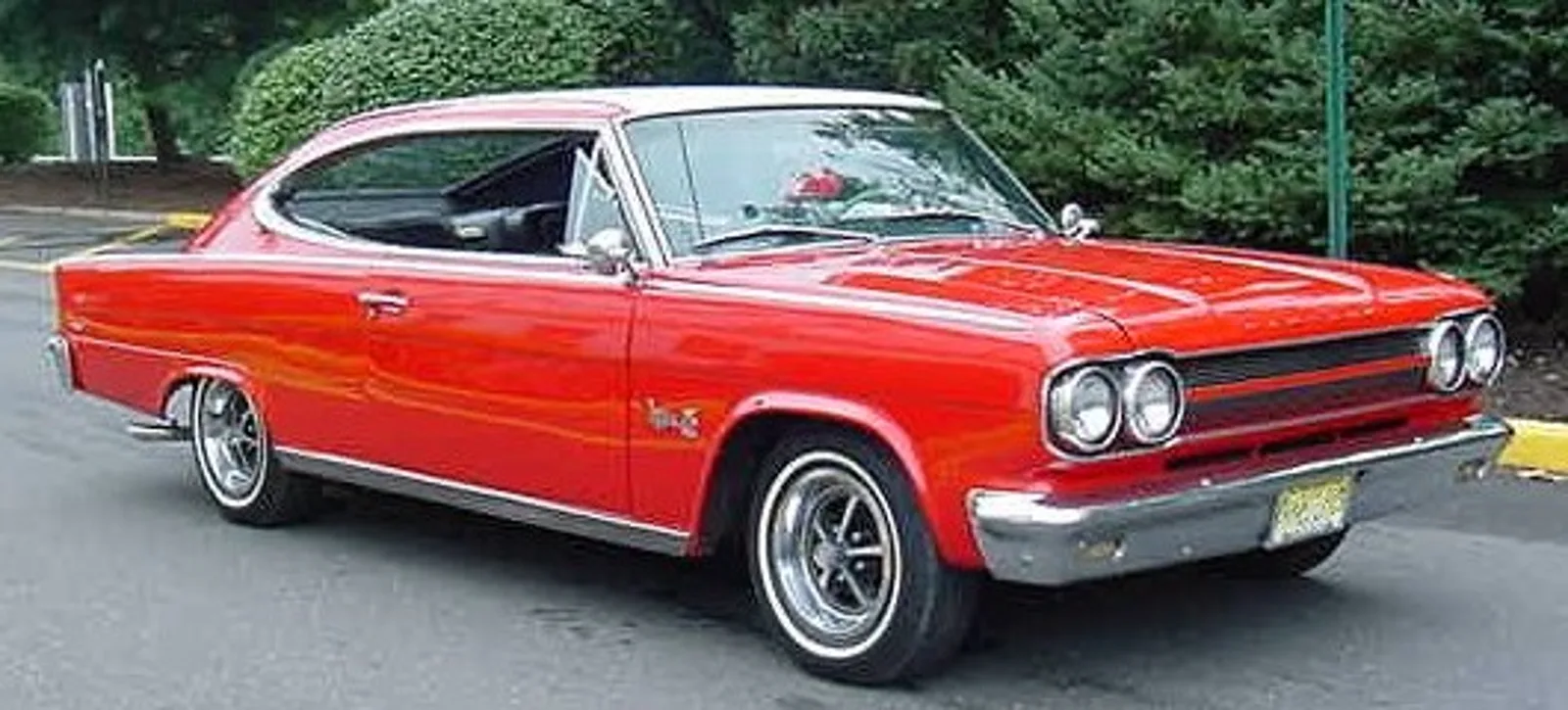
A 1965 personal luxury fastback built on the Rambler Classic, redesigned for 1967 on the Ambassador chassis and remembered for its boat-tail rear end.
Built by American Motors from 1965 to 1967, this two-door fastback was sold as a personal luxury car. It began on the Rambler Classic platform and moved to the Ambassador chassis for its final year. Sales were modest, though the car helped pave the way for the Javelin.
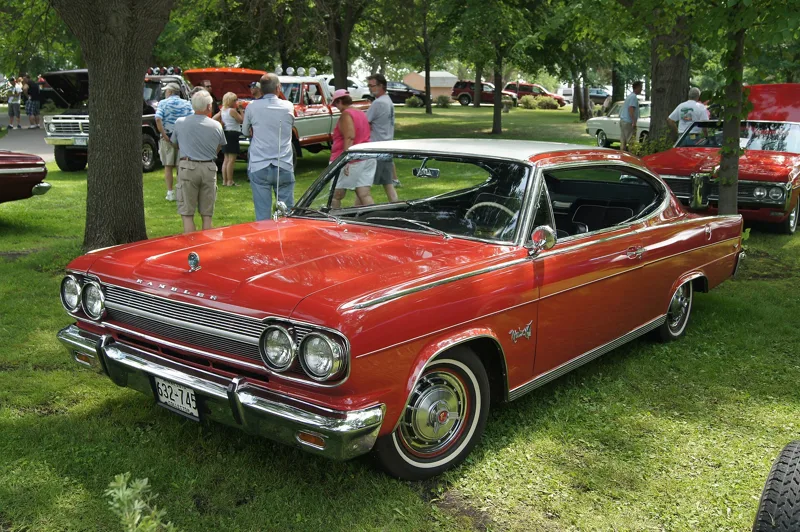
The AMC Rambler Marlin was a two-door fastback that American Motors built from 1965 to 1967 as a halo car. It was sold as a personal luxury car, and it was first based on the Rambler Classic before a 1967 redesign moved it onto the larger Ambassador chassis. Its roof and its rear end became its most recognisable features.
What was the AMC Rambler Marlin?
The Marlin was a fastback coupe designed to show what American Motors could do beyond compact, economical cars. It was announced as part of the company's Sensible Spectaculars line, and it was marketed as a personal luxury car with a long list of standard equipment. Its name changed from Rambler Marlin to AMC Marlin for 1966, when the company dropped the Rambler badge from its larger cars.
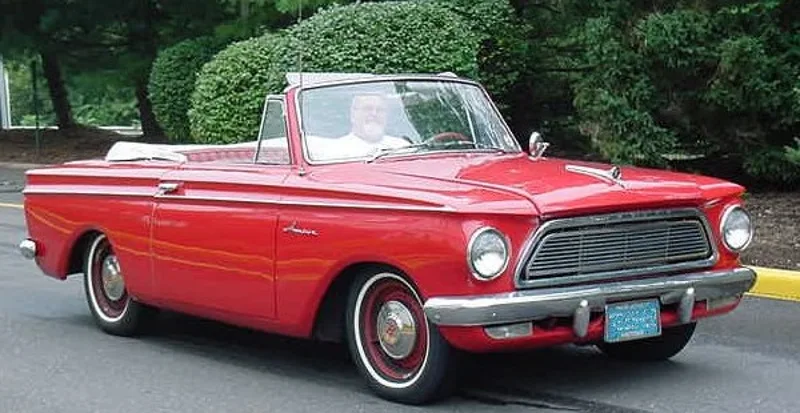
Its fastback roof was previewed on the 1964 Rambler Tarpon show car, a compact four-seat concept. The production Marlin, however, was built on the intermediate Rambler Classic platform, which gave it more room and a more luxurious character.
A fastback built to be roomier and more comfortable than a pony car, and remembered most for its rear end.
Why did American Motors build the Marlin?
American Motors had made its name with compact, economical cars under George W. Romney. His successor as chief executive, Roy Abernethy, wanted to compete with the Big Three by entering new market segments. The Marlin was meant to be a distinctive, low-volume model that symbolised a new Rambler look and led a wider product line.
The Tarpon concept had been built on the compact Rambler American, but the company's GEN-I V8 would not fit that small chassis. The new GEN-II V8 designs were still in development, and research showed that a six-cylinder engine alone would not satisfy potential buyers. The Marlin was a response to Ford's Mustang, but it was built to be roomier and more comfortable rather than purely sporty.
The fastback look itself had a precedent. Sedans of the 1940s, such as the Nash Ambassador, had used a similar silhouette, and AMC's team revived it for the 1960s market.
How was the Marlin designed?
The design team was led by Dick Teague, and it had far smaller budgets than the Big Three's studios. The team built a large, roomy and luxurious fastback that carried over several features from the Tarpon. The roofline ran from the windshield in an unbroken sweep, with a skylight that carried the fastback line through.
Roy Abernethy stood six-foot-four (193 cm) tall and insisted on being able to sit in the back seat of the design studies. The roof was raised over the rear passenger area to make that possible. Teague had worked as a stylist for Chrysler in the mid-1950s, and critics later noted similarities between the Marlin and the 1956 Chrysler Norseman concept.
Standard equipment focused on comfort. Buyers got individually reclining front seats, centre armrests on bucket-seat cars, and interiors borrowed from the two-door Ambassador, including its dashboard and instrument panel. The dashboard was trimmed with engine-turned aluminium, and the door panels had carpeting and stainless steel trim where many rivals used stamped vinyl.
When did the Marlin go on sale?
American Motors announced the Marlin on 10 February 1965 and unveiled it in Rambler dealer showrooms on 19 March. The car was advertised in 2,400 newspapers on its launch day, and the company's releases aimed it at buyers who wanted a sporty fastback that was also roomy and comfortable.
The Marlin was positioned against the smaller Barracuda and Mustang fastbacks that had arrived a year earlier. AMC's own sales chief later said that the basic reason for building the car was to attract attention to American Motors, and dealers received one or two units each to help showroom traffic.
How much did the Marlin cost?
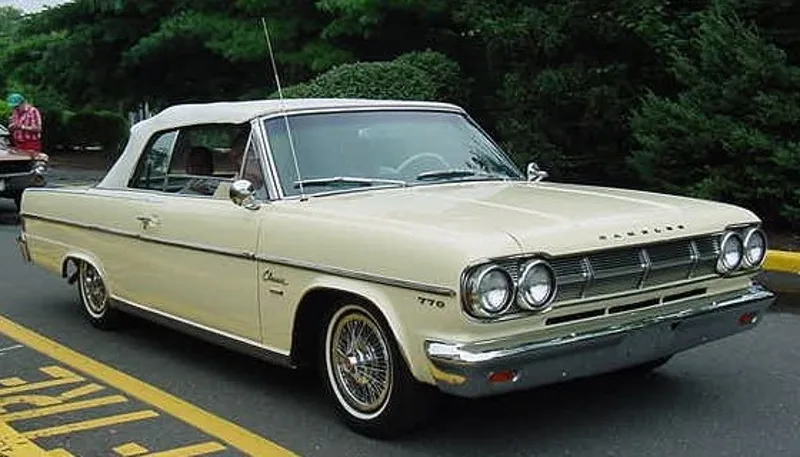
The launch MSRP was US$3,100, which equated to US$31,671 in 2025 dollars. A bench-seat six-passenger Rambler Classic 770 two-door hardtop cost US$3,063, so the Marlin was only slightly more expensive while offering far more equipment and an interior that the Classic lacked.
The 1966 base price was lowered to US$2,601, which was US$25,810 in 2025 dollars. AMC also offered more options to widen the car's appeal, and the price cut came as competition from fastbacks grew.
How many Marlins sold in the first year?
In the abbreviated first year of production, 10,327 Marlins were sold. The car was built with several powertrains, and the buyers' choices defined the mix. Most cars had the 327 V8, and the six-cylinder was the least popular option in the line-up.
Production of 2,005 cars with the six, the smallest engine, was followed by the 327 V8, which accounted for 42 percent of total output. Less than 6 percent of cars had the Twin-Stick manual, which used a second, shorter lever for overdrive.
What engines did the 1965 Marlin use?
The standard engine was a 145 hp (108 kW; 147 PS) 232 cu in six. The AMC-designed 270 hp (201 kW; 274 PS) 327 cu in V8 was the performance option, normally paired with an automatic transmission with a floor-console shifter.
The Twin-Stick, a manual with overdrive, was offered with the regular gears on one stick and the overdrive on a shorter lever. Buyers could add a Twin-Grip limited-slip differential, a heavy-duty suspension, power steering and air conditioning, and most cars had tinted Solex glass.
Radios were fitted to about half of the production, and only 221 Marlins were built without one. A Duo Costic rear speaker and a Vibra Tone system were offered to simulate stereo sound, which was not yet widely broadcast in the United States.
How fast was the Marlin?
Popular Mechanics recorded 0 to 60 mph in 10.8 seconds with the automatic shifted by hand, and the car returned 18.14 mpg-US (12.97 L/100 km; 21.79 mpg-imp) when held at 60 mph.
Tom McCahill, testing for Mechanics Illustrated, timed 0 to 60 mph at 9.7 seconds with the 327. Hot Rod ran the quarter-mile in 17.43 seconds at 79 mph with the 327 and Flash-O-Matic transmission. The San Francisco Chronicle noted effortless cruising at 80 mph.
What did critics make of the Marlin?
The press was mixed. Motor Trend found the Marlin well balanced and said it added something to the market for personal performance cars. Automobile Quarterly, however, thought the car very ugly, and it disliked the rear-view window, the positions of the steering wheel and the stoplights, and the soft front seats.
Designer Vincent Geraci, who later became chief of product design at Chrysler after AMC was bought out, saw the Marlin as an exciting programme that turned a 1965 body into a sportier car. He felt that enlarging the car from the Tarpon concept and raising the roof had hurt its overall appearance.
Carl Cameron, who designed the original Dodge Charger, named the Marlin as the only competitor for his 1966 car. He said the Marlin lacked some of the Charger's features and was very different, and he credited the roof treatment as the main difference.
What changed for the 1966 model year?
In 1966 the car lost the Rambler name as part of Roy Abernethy's remake of AMC's identity. The Marlin became the AMC Marlin, and all references to Rambler were removed from the car and its promotional material. The changes were minor, including a slightly modified grille, a front sway bar on six-cylinder models and an optional black vinyl roof cover.
Despite the price cut and more options, Marlin production fell to 4,547 in 1966. The Dodge Charger arrived mid-season that year as a fastback in direct response to the Marlin, and the press often paired the two cars together.
Popular Science tested the 1966 Marlin against a Ford Mustang and a Plymouth Valiant. It praised the quiet interior, the upholstery and the adjustable seats, and it said the Marlin had the best-balanced ride on good roads and bad. Its drum brakes were criticised, and the authors recommended the optional disc brakes.
Why was the Marlin redesigned for 1967?
For 1967 the Marlin moved onto AMC's redesigned 118 in (2,997 mm) senior platform, which was the Ambassador chassis. The retooling for the 1967 changes cost US$35 million, and the car's overall length grew by 6.5 inches (165 mm). Interior room increased by 2.2 inches (56 mm), but the car gained 350 pounds (159 kg).
The larger size was partly in anticipation of the 1968 Javelin, which would use the compact platform. A longer, wider Marlin also helped AMC separate its model lines. Motor Trend compared the 1967 Marlin with the Dodge Charger and concluded that both were caught in the middle between sporty and posh cars.
The Ambassador chassis allowed a longer hood that suited the fastback rear end, and the body had a less angular look. The front end shared the Ambassador's vertically stacked headlights, and the hood ornament was a small chrome marlin fish set in clear plastic. Teague said the 1967 car was the best-looking Marlin the company built.
What engines did the 1967 Marlin offer?
An entirely new family of V8s was offered for 1967. The base engine was a 290 cu in (4.8 L) unit with a two-barrel carburettor, and a 343 cu in (5.6 L) V8 was optional. The high-compression 10.2:1 version used premium fuel and a four-barrel carburettor with dual exhaust, producing 280 hp (209 kW; 284 PS) at 4800 rpm, with torque of 365 pound-feet (495 N-m) at 3000 rpm.
The six was still available but rarely ordered, with only 355 built. The new car also had a four-link, trailing-arm rear suspension that replaced the earlier torque tube design.
How did the 1967 Marlin perform?
Motor Trend's road test of the 343-engined Marlin recorded 0 to 60 mph in 9.6 seconds and a 17.6-second quarter-mile at 82 mph with two people aboard. That was comparable to a Dodge Charger with a 383 cu in (6.3 L) engine.
With the 280 hp V8 the city figure was 15.3 mpg-US (15.4 L/100 km; 18.4 mpg-imp), and the highway figure was 17.6 mpg-US (13.4 L/100 km; 21.1 mpg-imp). The six averaged 17.3 mpg-US city and 20.4 mpg-US highway. Motor Trend said the car handled well and that its reclining seats were worth the extra cost to anyone travelling long distances.
Why did Marlin sales fall?
Sales of the redesigned Marlin fell to 2,545. Part of the reason was a loss of confidence in the company's financial health under Abernethy, and part was AMC's move from its economy customers into segments dominated by the Big Three. The Javelin also drew some buyers away from the Marlin.
The Dodge Charger saw its 1967 sales fall by half compared with its 1966 introductory year, and the Marlin and Charger both struggled as buyers turned to compact pony cars. Production ended with the 1967 model year.
Did the Marlin race?
AMC ran no factory racing programme for the Marlin, and Roy Abernethy had banned corporate sponsorship of activities that glamorised speed. Some dealers and private teams took matters into their own hands. AMC's advertising at the time made the case with the line that the only race Rambler cared about was the human race.
Preston Honea gained drag racing fame with the Bill Kraft Rambler. For 1965 Kraft built a fastback Marlin Funny Car running alcohol fuel and nitrous injection, and after the AMC engine was replaced by a Plymouth Hemi, it ran a 10.31-second quarter-mile at 138 mph (222 km/h) on its first outing.
On the oval, Roy Haslam raced an AMC Marlin Super Stock in Canada and the United States, winning the July Cup and finishing third in the season championships. Brothers Larry and Don Hess raced a Marlin at the 1966 24 Hours of Daytona, sponsored by Queen City Rambler in Charlotte. The car retired after 80 laps with overheating and steering problems.
What were the Marlin show cars and special versions?
American Motors built two working show cars, the Black Marlin and the Tahiti Marlin, on the first-generation platform to promote the company's new emphasis on luxury. The Black Marlin toured the 1965 shows in black with a silver interior and a chrome roof. It was then refitted as the Tahiti for 1966, in brilliant fireflake blue with floral upholstery and rhinestones.
The Marlin II was a design experiment that mated a first-generation Marlin with the Ambassador's front end, and it foretold the longer platform used for 1967. A handmade prototype showed the 1967 model on the 118-inch platform, with plaster armrests and a four-speed manual with cruise control. George Barris also customised a 1966 Marlin for the Rader wheel company, painting it Candy Red.
What is the Marlin's legacy?
The Marlin did not become a big hit, but it generated publicity and brought potential customers into AMC showrooms. The car's first-year sales helped AMC reach a US$5.2 million profit in fiscal 1965, although a strike by the United Auto Workers lasted three weeks. Consumer Reports said the intermediate fastbacks defied the usual rules on size and price.
The Marlin paved the way for the 1968 AMC Javelin, a true pony car that replaced it. The Marlin's rear styling was also recalled in 2004, when the Chrysler Crossfire arrived with a fastback roof and a boat-tail rear.
What are the AMC Rambler Marlin specifications?
| Specification | Detail |
|---|---|
| Production years | 1965 to 1967 |
| Launch MSRP | US$3,100 (US$31,671 in 2025 dollars) |
| 1965 six | 145 hp (108 kW; 147 PS) 232 cu in |
| 1965 top V8 | 270 hp (201 kW; 274 PS) 327 cu in (5.4 L) |
| 1967 base V8 | 290 cu in (4.8 L), two-barrel |
| 1967 top V8 | 343 cu in (5.6 L), 280 hp (209 kW; 284 PS) at 4800 rpm |
| 1967 wheelbase | 118 in (2,997 mm) |
| 1967 length gain | 6.5 inches (165 mm) |
| 1966 base price | US$2,601 (US$25,810 in 2025 dollars) |
| First-year sales | 10,327 |
| 1966 production | 4,547 |
| 1967 sales | 2,545 |