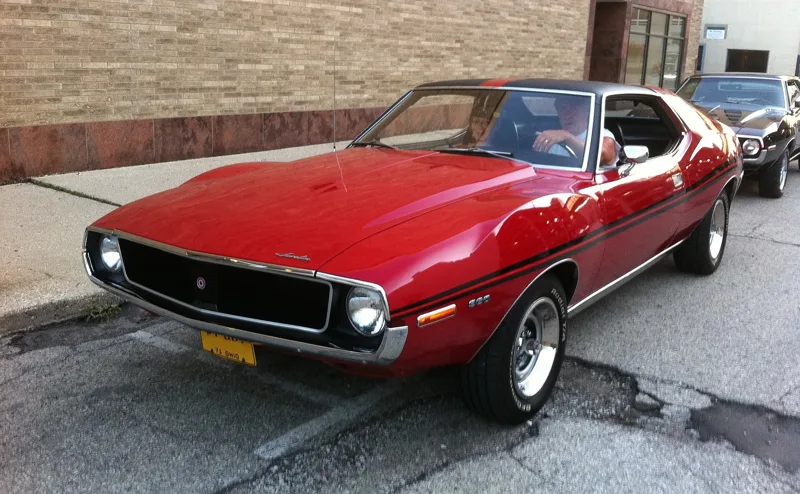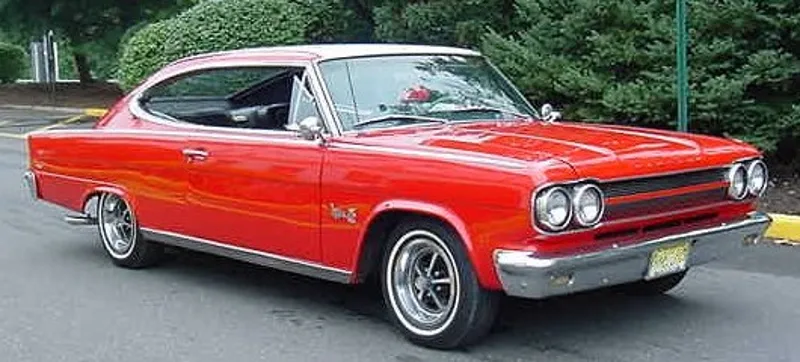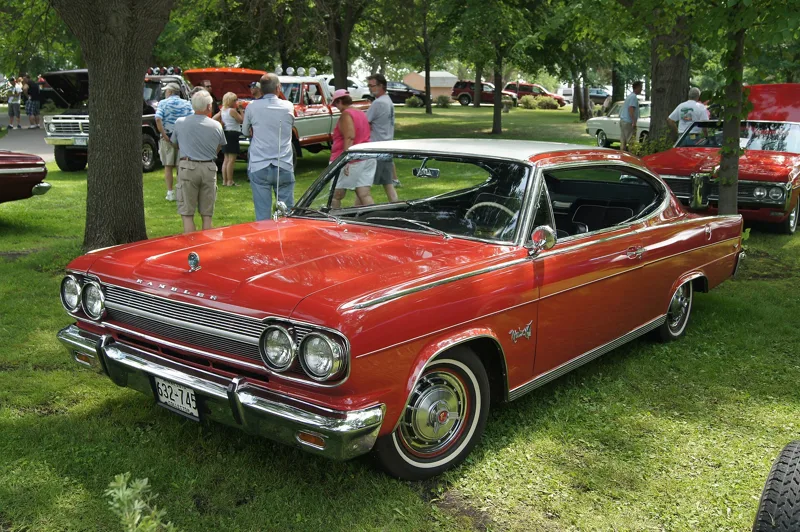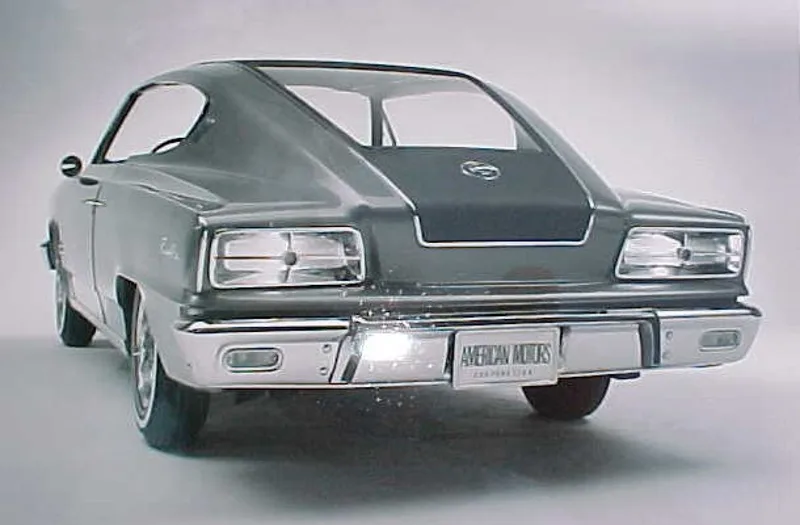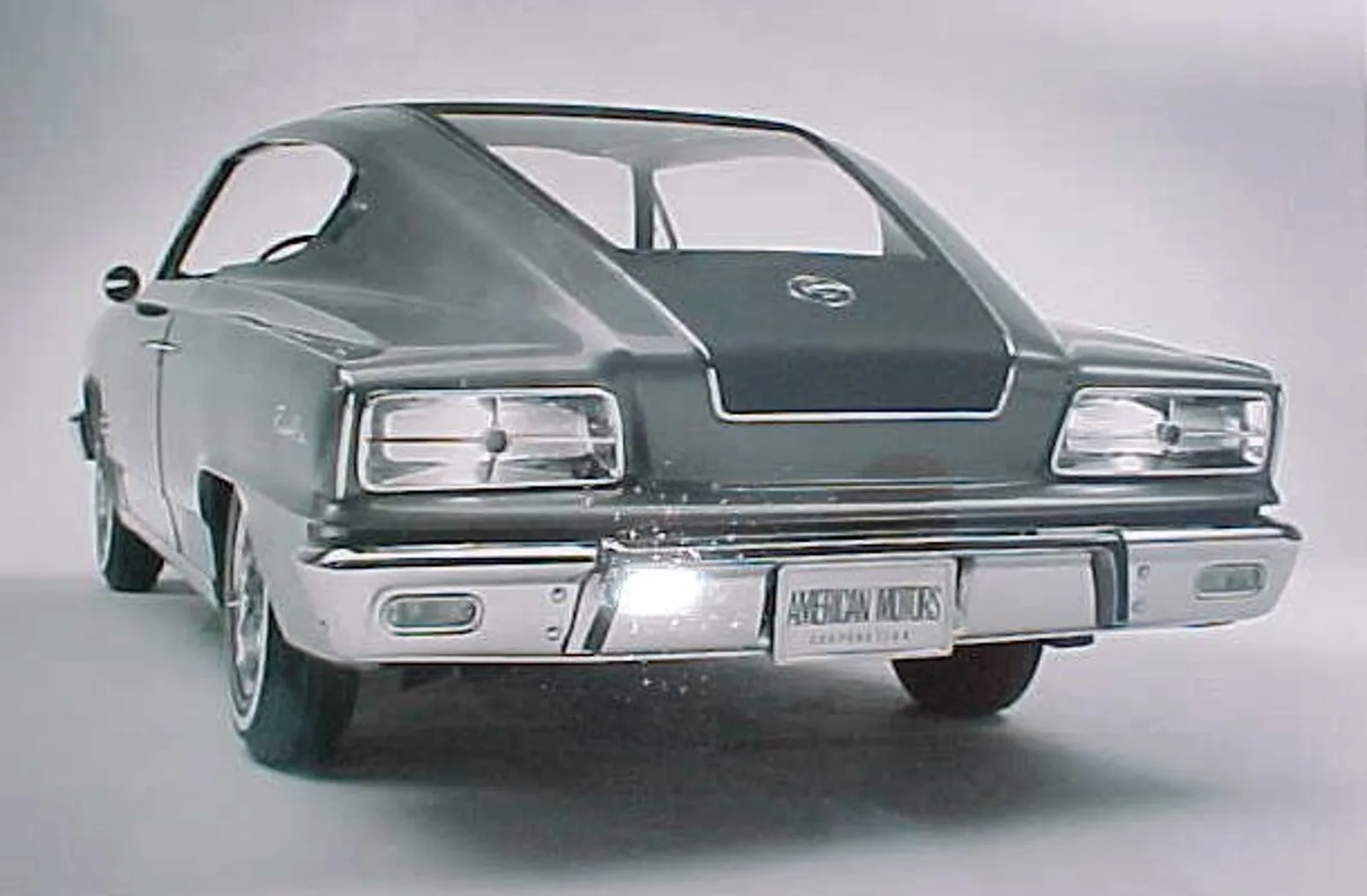
A 1964 show car with a sloping fastback roof, built on the compact Rambler American and never put into production.
The AMC Rambler Tarpon was a 1964 fastback concept from American Motors, built on the compact Rambler American platform. It never reached production, but its sloping roofline and sporty image shaped the Rambler Marlin that followed in 1965, and its styling later reappeared on the Chrysler Crossfire.
The AMC Rambler Tarpon was a 1963 concept car from American Motors' Rambler Division, a small fastback coupe with room for four and a sporty image. It was first shown to the public at the 1964 Chicago Auto Show and never went on sale, yet its roofline shaped the Rambler Marlin that arrived in 1965.
Where did the Tarpon come from?
American Motors wanted to lose its image as a maker of plain, economical compacts at the start of the decade. Dick Teague's styling team was asked for something with flair, and it proposed a fastback coupe built on the Rambler American platform for the 1964 model year. Show visitors reacted so warmly that dealers began asking about production plans.
Development started in early 1963, when management asked for a new car with sports flair. Teague's team had far less money than Detroit's Big Three, so it could not justify all-new tooling and instead reused what the company already had. Ford had built a handmade fastback roofline for its compact Falcon, a sign that the idea was in the air.
Teague had a long admiration for pre-war automobiles and liked to take old styling ideas and make them new again. The Tarpon was the result, a design that looked back to older fastbacks while sitting firmly in the compact class.
A small fastback with real sports flair that never reached showrooms, yet its roofline lived on in the Marlin.
What did the Tarpon look like?
The Tarpon was a two-door fastback whose sloping roof narrowed as it met the rear bumper. Its body was bright red, with a black vinyl roof that ran from the windshield to almost the back, and two large, deep taillights flowed from the rear fender shoulders.
Extended rear quarter windows kept the back seat from feeling closed in. The nearly horizontal rear window left the roofline unbroken, and the swept-back windshield was double-compound curved, which made the whole car look lower. The top section of the roof was reinforced plastic.
A small upward line at the base of the rear quarter windows drew comment, and the show car had no trunk lid or outside hatch. That gap was to be addressed before any production run, although the car never reached that stage.
Richard M. Langworth, writing in a 1991 book about collectible cars, praised the proportions and said the fastback suited the showroom. The praise was aimed at the car's balance, even though the upward line at the rear windows was a clear oddity.
Inside, a full set of dial gauges sat under a padded dash, with a deep-dish aluminum wheel finished in walnut, plus custom bucket seats. Outside, the show car used polished 13-inch aluminum wheels, smaller than the 14-inch wheels on production Rambler Americans, and its roof was lowered two inches.
What are the Rambler Tarpon specifications?
The concept sat on a 106 in (2,692 mm) wheelbase and measured 180 in (4,572 mm) long, a little longer than the production Rambler American at 177.25 in (4,502 mm). Its roof stood 52.5 in (1,334 mm) high, and the show car ran 13-inch wheels. The table below sets out the key figures.
| Specification | Detail |
|---|---|
| Type | Two-door 2+2 hardtop fastback concept |
| Debut | 1964 Chicago Auto Show |
| Wheelbase | 106 in (2,692 mm) |
| Length | 180 in (4,572 mm) |
| Height | 52.5 in (1,334 mm) |
| Wheels | 13-inch polished aluminum |
| Production Rambler American length | 177.25 in (4,502 mm) |
| Tribute replica engine | 343 cu in (5.6 L) GEN-2 V8 |
| Tribute replica gearbox | Manual four-speed |
| Production status | None |
Nothing in this table describes a car anyone could buy. The tribute replica is a later reconstruction with its own engine and gearbox, so its figures should not be read as the specification of the 1964 show car.
How did the public react to the Tarpon?
The concept toured the auto show circuit from early 1964 and generated excitement at the Society of Automotive Engineers convention that year. It was also on display at the New York International Auto Show, alongside a Ford Mustang II concept shown in the same period.
Visitors were asked about their interest, and the result was striking. Over 60% said they would be happy to own a car styled like the Tarpon. Some attendees wanted to place orders, and AMC dealers asked about production plans.
Both the Tarpon and the Mustang II were aimed at the growing interest in small, sporty cars and at the spending power of younger buyers. The Tarpon showed that AMC had a clear opening in that market if it chose to take it.
Why was the Tarpon never built?
The Tarpon never reached production because AMC did not yet have a V8 for a small car. Its GEN-2 lightweight V8 was still being developed, and market research suggested buyers would not accept a car with only a six-cylinder engine. AMC chose a larger platform for its fastback instead, and that car became the Marlin.
Roy Abernethy, the company's president, did not like little cars and wanted AMC to shed its image as a maker of small, economical, conservative automobiles. He asked for a 3+3 car on the Classic platform, and Teague later said the missing V8 was what killed the Tarpon.
Abernethy saw the company's core problem as image lag, the sense that too many people still thought of AMC as a builder of plain compacts. Under his leadership the firm moved toward bigger cars with more options, luxury and prestige, including convertibles and the upscale Ambassador.
Some observers believed the Tarpon anticipated the small sporty car market that later took the pony car name. Not until the 1968 model year did AMC bring out a small fastback, the Javelin, aimed squarely at the Mustang market.
How did the Tarpon shape the Marlin?
The Rambler Marlin arrived in the 1965 model year on the larger Classic platform, and it kept many design features from the Tarpon show car. It was the direct fastback successor to the concept, but it seated six passengers and was far larger, which kept it out of the pony car class.
The Marlin had more pronounced shoulders behind the rear wheels than the Tarpon, because the larger car needed the extra width. It was built from 1965 through 1967, and its roofline carried the concept's fastback idea onto a bigger chassis with AMC's existing V8 engines.
Who designed the Tarpon?
Dick Teague led AMC's design team and selected the names for both the Tarpon and the production Marlin. Stuart Vance managed engineering, including body development and the prototype shop, and Jim Alexander designed the interior. Fred Hudson, Teague's right-hand man, later contributed to the Javelin.
Teague spent 26 years at AMC, and his career included some of the company's most admired designs as well as some of its disappointments. He was responsible for the compact Javelin, which carried the fastback idea the Tarpon had introduced, and for the two-seat AMX.
Vince Geraci helped shape how the Marlin finally looked. Teague's own view, given after his retirement, was that the Tarpon should have been produced.
Did the Tarpon influence later cars?
Yes. Its rear styling returned in 2004 on the Chrysler Crossfire, a two-seat fastback whose rear lines reminded several writers of the 1965 Rambler Marlin. The first show car no longer exists, and a tribute replica was built later to recreate it.
Rob Rothwell said his first look at the Crossfire's rear end called the 1965 Marlin to mind at once. Other automotive journalists noted the same resemblance between the two cars.
The replica was built from a Rambler American convertible fitted with the roof from a 1965 Marlin. It is based on a 1966 car, which has a larger engine compartment than the 1964 version, and it runs a 343 cu in (5.6 L) GEN-2 V8 with a manual four-speed transmission.