Founded in 1962 by Jim Hall and Hap Sharp, the American team pioneered wings, ground effect and fan-assisted cars, then won the 1978 Indy 500 and the 1980 race with Johnny Rutherford.
Chaparral Cars was an American team founded in 1962 by Jim Hall and Hap Sharp. It built innovative sportscars and Can-Am racers in the 1960s, then won the 1978 and 1980 Indianapolis 500s with Al Unser and Johnny Rutherford.
Chaparral Cars was an American racing team and race car developer that built and raced its own cars from 1963 through 1970. It was founded in 1962 by the Formula One racers Hap Sharp and Jim Hall, and it was named after the roadrunner, a fast-running ground cuckoo.
What was Chaparral Cars?
The outfit was a US racing team that also developed its own race cars, building and running them across the 1960s and early 1970s. Its name came from the roadrunner, which also gave the team its emblem. The team's most influential period was its Can-Am work, where its cars pushed aerodynamics further than any rival.
The team later returned to Indy cars and took major results in the 1970s and 1980s. Chaparral cars also featured in the SCCA and CASC Can-Am series and in endurance racing, and the team left motor racing in 1982.
A team that turned aerodynamics from an art into applied physics and sent its cars to Sebring, Brands Hatch and Indianapolis.
How did Chaparral begin with Jim Hall?
Dick Troutman and Tom Barnes built the original Chaparral race cars, later known as the Chaparral 1. Jim Hall raced those front-engined cars from 1957 through 1962 and bought two of them. When Hall and Sharp started building their own cars, they asked Troutman and Barnes for permission to keep the Chaparral name.
That is why Hall and Sharp's cars are called Chaparral 2s, in models from 2A to 2J for sportscar and Can-Am use, plus the 2K for Indy cars. Hall had trained as an engineer, and his methodical approach shaped every model. He had access to engineers at Chevrolet and Firestone, and the data systems developed by the GM research group also helped.
How did the first Chaparral 2 cars perform?
The first Chaparral 2 was designed to compete in the United States Road Racing Championship and the West Coast Pro Series. Hall had significant unofficial help from GM, including engineering and technical support for the car and its automatic transmission. First raced in late 1963, the car became highly competitive in Can-Am racing in 1966 and 1967.
In 1965 a Chaparral 2 stunned rivals by taking the 12 Hours of Sebring through heavy rain on a notoriously harsh track. The car's fiberglass chassis was a notable feature, while the 2C used a conventional aluminium chassis.
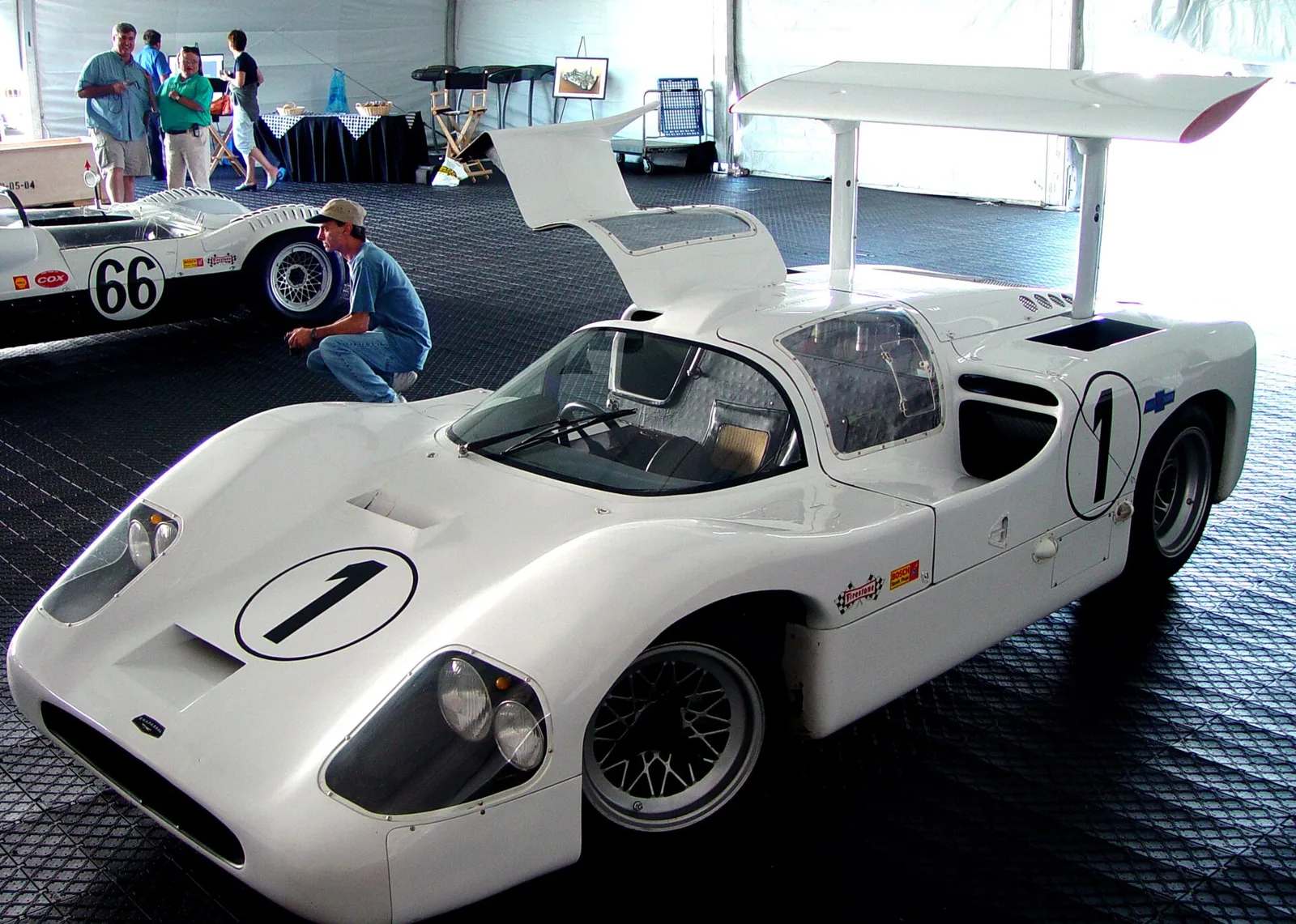
Hall's aerodynamic work started early. The 2A had a sharp edge to cut through the air and a concave tail, and its first aerodynamic appendages appeared almost at once to cure a light front end at speed. The 2C was the first Chaparral with an in-car adjustable rear wing, which lay flat on straights and tipped up under braking.
Hap Sharp nicknamed the 2C the EBJ, or eyeball jiggler, because of its lack of damping from the fiberglass chassis. Hall also owned Rattlesnake Raceway next to his race shop, which let him take part in much of Firestone's race tyre development.
What made the 2E a turning point?
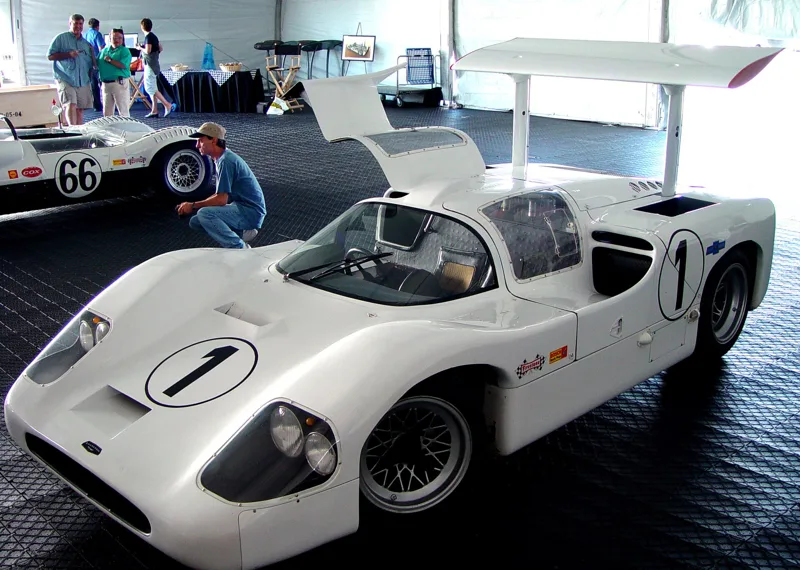
The 2E was based on the aluminium 2C chassis and presented Hall's most advanced aerodynamic theories in 1966. Its radiators moved from the nose to two ducted pods beside the cockpit, and a large variable-incidence wing sat on struts above the rear of the car. The wing generated downforce rather than lift and was attached to the rear suspension uprights.
A floor pedal, positioned where a clutch would sit in other cars, let Hall flatten the wing on straights to cut drag. Releasing it returned the wing and nose ducts to full downforce.
The 2E scored only one win, at the 1966 Laguna Seca Can-Am with Hill driving. It used an aluminium 5.3-litre Chevrolet engine, while rivals ran 6 to 7 litre iron engines, trading weight for power. The 2E was a crowd favourite and remains Hall's favourite car.
How did the 2D and 2F reach Le Mans and Brands Hatch?
The 2D was the first closed-cockpit car in the 2-series, designed for endurance racing in 1966. It won the 1000 km at the Nurburgring that year with Phil Hill and Joakim Bonnier at the wheel. It also raced at Le Mans in 1966 and withdrew after 111 laps. The car weighed only 924 kg.
For 1967 the 2F applied the 2E's aerodynamics to the older fiberglass 2D chassis. It used a big-block 7-litre Chevrolet, which was too much for the automatic transmission. After fixing the transmission problems, the 2F won on 30 July 1967 at the BOAC 500 at Brands Hatch with Hill and Mike Spence driving.
That win prompted the FIA to change its rules. The 2F was outlawed, along with the Ford GT40 Mk.IV and Ferrari's 330 P3 and 365 P4 cars. The 2F, like the 2D, had raced with Texas licence plates.
What was the story of the 2G and 2H?
The 1967 2G was a development of the 2E, with wider tyres and a 427 cubic-inch aluminium Chevrolet V8. The stretched 2C chassis was pushed to its limit, and Hall's driving skill kept the car competitive. Larger tyres followed for the 1968 Can-Am series.
Hall's racing career was effectively ended by a severe crash at the Stardust Grand Prix Can-Am race, when he ran into the slow-moving McLaren of Lothar Motschenbacher. He returned in the 1970 Trans-American Sedan Championship with a team of Chevrolet Camaros.
Hall noted that increasing downforce created enormous drag. The highly advanced 2H was built in 1968 to cut drag, and it was extremely slippery and narrow. Development problems kept it out of Can-Am that year, and John Surtees struggled with it in 1969.
Surtees complained he could not see out of the car and demanded a redesign that ruined the aerodynamics. By 1969 the power of the big-block Chevrolet engines made downforce more important than low drag, so the 2H's advantage was lost.
How did the fan-powered 2J change the rules?
The most unusual Chaparral was the 2J, with articulated Lexan skirts along the sides that sealed against the ground. Two fans adapted from a military tank engine sat at the rear, driven by a single two-stroke twin-cylinder engine. The fans created a vacuum that produced downforce of 1.25 to 1.50 g when the car was fully loaded.
The 2J was at least two seconds a lap quicker than the next fastest car in qualifying, but mechanical trouble held it back. It ran only in 1970, and the SCCA later outlawed it after pressure from rival teams who called the fans movable aerodynamic devices. McLaren argued that the 2J would ruin the series, since McLaren had been dominant since 1967.
How did Chaparral win at Indianapolis?
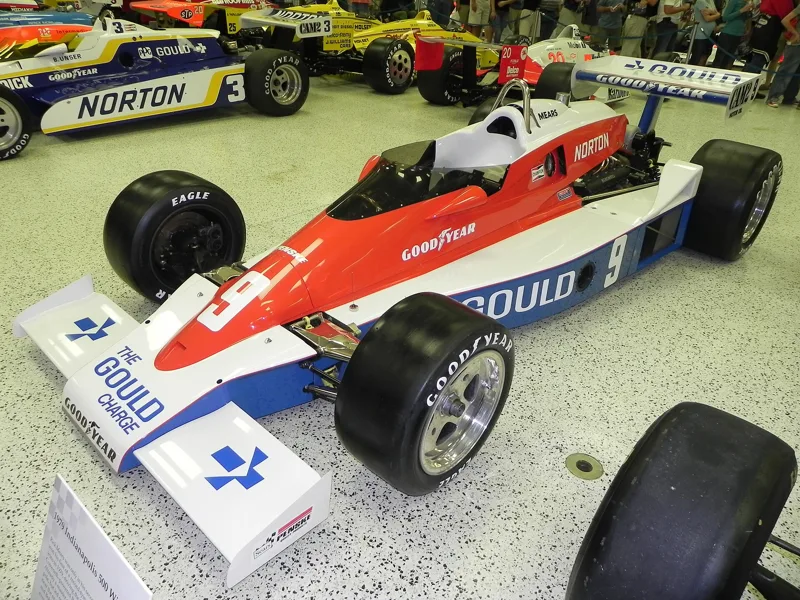
Chaparral entered Indy cars in 1978 with Al Unser driving a Lola T500 with a Cosworth DFX engine. Unser won the 1978 Indianapolis 500, and he later added the California 500 at Ontario and the Schaefer 500 at Pocono, a feat that remains the only Triple Crown win by a driver. He still lost the championship to Tom Sneva.
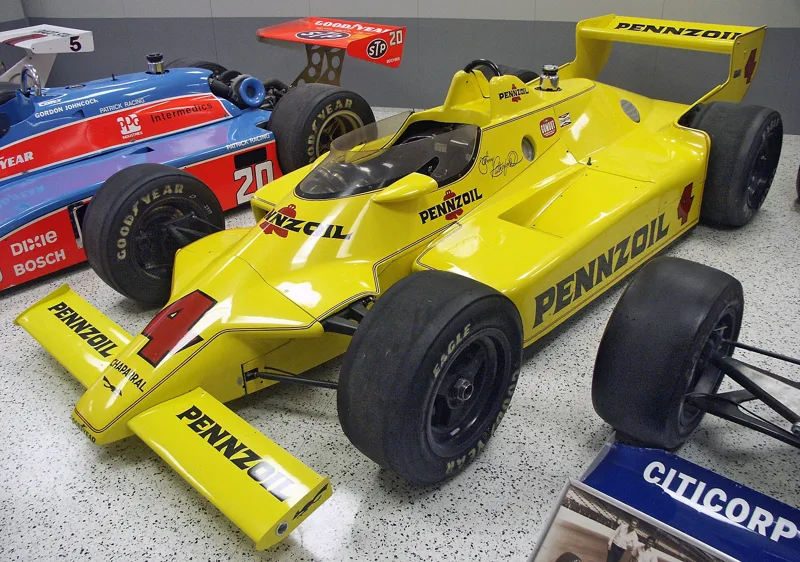
The 2K was a ground-effect Indy car designed by John Barnard, and it debuted in 1979 with Unser. It won six races in 27 starts over three seasons. Unser led 89 of the 200 laps at the 1979 Indy 500 before an engine fire ended his race.
By 1980 Johnny Rutherford had replaced Unser. He won five races that season, including the Indy 500, and he also took the 1980 CART championship. Rutherford's season was a high point for the team, and the 2K's number changed to four.
The 2K became outdated by 1982, and the team used a March 82C from Bob Fletcher Racing after the Michigan race. Rutherford finished third at the AirCal 500K and was 12th in the points that year, before the team left motor racing in 1982.
What happened to Hall's Indy team in the 1990s?
Hall returned to Indy cars in 1991 with VDS Racing as Hall-VDS Racing, with John Andretti driving. The team won on debut in the Gold Coast Grand Prix at Surfers Paradise, and Andretti was fifth at the Indy 500. He finished eighth in the points that year and again in 1992.
Teo Fabi drove for the team in 1993 and 1994, with a best finish of fourth at Long Beach and two fourth places in 1994. VDS then dropped out, and the team became Hall Racing with Gil de Ferran in 1995. He was in the top ten in four of the first six races, and took a pole and a Laguna Seca win that season.
De Ferran won the Jim Trueman PPG IndyCar World Series Rookie of the Year award. In 1996 he took pole at Long Beach, won at Cleveland and finished sixth. Hall then closed the Indy car team for good, and in total Hall won 13 races and two championships.
How is Chaparral remembered today?
Chaparral is remembered in a museum display. Since 2005 a museum wing in Midland, Texas, has displayed the surviving cars alongside the story of their development. The cars are still driven from time to time to keep them running.
The 2005 Monterey Historic Automobile Races honoured Chaparral as its featured marque, and Hall's 2A had won the 1964 Monterey Sports Car Championships at Laguna Seca. In 2009 de Ferran painted his Acura ARX-02a in Chaparral style as a tribute to Hall.
What are the key results?
| Series or race | Result | Year |
|---|---|---|
| 12 Hours of Sebring | Win in a rainstorm, Chaparral 2 | 1965 |
| 1000 km Nurburgring | Win, 2D with Phil Hill and Joakim Bonnier | 1966 |
| Can-Am, Laguna Seca | Win, 2E with Hill driving | 1966 |
| BOAC 500, Brands Hatch | Win, 2F with Hill and Mike Spence | 1967 |
| Indianapolis 500 | Win, Al Unser | 1978 |
| CART | Triple Crown wins by Al Unser | 1978 |
| Indianapolis 500 | Win, Johnny Rutherford | 1980 |
| CART | Championship, Johnny Rutherford | 1980 |
| Gold Coast Grand Prix | Win on debut, John Andretti | 1991 |
| CART | Rookie of the Year, Gil de Ferran | 1995 |
What is the legacy of Chaparral Cars?
Chaparral's legacy is a set of ideas that shaped modern racing: the adjustable wing, the wing on struts, and the ground-effect fan car. Hall's methodical approach to engineering made aerodynamics a matter of data rather than art.
The team's Indy successes, including the 1978 and 1980 Indianapolis 500 wins, show that its ideas could also work on the oval. Its museum display and its cars still running today keep that history in view.