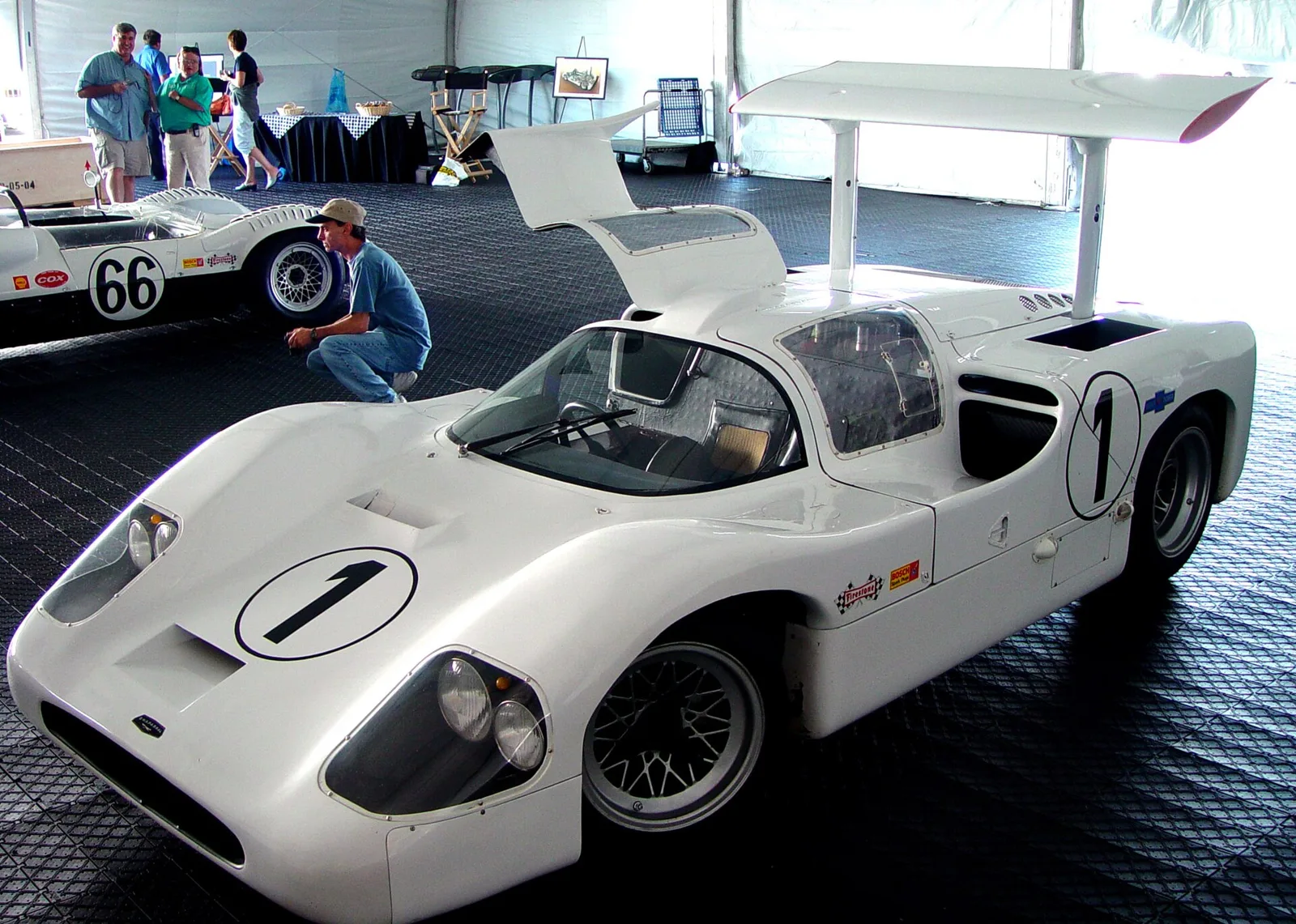
Jim Hall and Hap Sharp's 1967 sports prototype carried a rear wing that shaped Formula One design, and it won the BOAC 500 with Phil Hill and Mike Spence.
Raced in 1967, the Chaparral 2F was a sports prototype whose rear wing helped shape aerodynamic design in Formula One. Driven by Phil Hill and Mike Spence, it won the BOAC 500, its best result in the World Sportscar Championship.
The Chaparral 2F was a Group 6 prototype built by Jim Hall and Hap Sharp under their Chaparral Cars banner, and it raced in the 1967 World Sportscar Championship. Its finest hour came when Phil Hill and Mike Spence won the BOAC 500 in it. The car and its Can-Am sibling, the 2E, pushed Formula One designers toward wings and aerodynamic efficiency in the late 1960s.
What was the Chaparral 2F?
The 2F was built to compete in the World Sportscar Championship, and it made its name with a rear wing that generated downforce. Its mechanical grip was pushed close to its limits, so the team looked to the air to find extra speed. That search made the car one of the most talked-about prototypes of its era.
Several strands of the 2F's story came together at once. Hall and Sharp had developed a new aerodynamic approach through their 2-series cars, and the 2F carried that approach into the sportscar world. The result was a car that was fast in a straight line and capable of winning a major race.
A rear wing on a sports prototype helped set the course of Formula One aerodynamics for a decade.
Where did the wing idea come from?
Jim Hall first discovered the value of reversed lift in the winter of 1963, when his first race car, the Chaparral 2, suffered lift at the front. Experimenting with the bodywork, he found that generating downforce could sharply improve lap times. A private racetrack nearby let him test those ideas far faster than rival teams could.
The idea had earlier roots. Privateer Michael Mayer fitted a wing to his Porsche 550 at the 1956 Nurburgring 1000 km race, mounting a wing just above the driving position before scrutineers made him remove it. Hall, who held a degree in mechanical engineering from the California Institute of Technology, took the principle much further.
In 1965 Hall and colleagues at General Motors tested rear aerodynamic structures, which led to a small adjustable rear wickerbill on the 2C. The part was tried in the 1965 United States Road Racing series. The wickerbill could be set by a third pedal in the cockpit, so the 2C became the first racing car to feature active aerodynamics.
How did the 2E pave the way for the 2F?
The 2E took the 2C's idea further, with a full rear wing mounted high above the chassis. It also moved the radiators from the nose to the sides, which freed the front of the car and let the nose act as a miniature Venturi tunnel. That was an early example of ground effect in racing, and it gave the car a sensible split of downforce between the axles.
The 2E came close to the first Can-Am title in 1966, but John Surtees beat it in a Lola T70. Hall and Sharp were encouraged by its results, including a 1-2 finish at Laguna Seca. The success prompted Hall to put the rear wing concept into a successor to the 2D.
The 2D had been a shut-top variant of the Chaparral 2, which was Chaparral's main race car from 1963 to 1965. Introduced for the 1966 World Sportscar season, it suffered many mechanical problems and won only once, at the 1966 1000 km of Nurburgring. One original 2 chassis became a 2F, and the other 2D was rebuilt into a 2F later on.
How did General Motors fit into the story?
Hall's ties with Chevrolet started in 1962 when the Corvair Monza GT was unveiled at Elkhart Lake in Wisconsin. The concept's semi-monocoque body caught his attention, and he developed a relationship with its designer, Frank Winchell. Winchell was also working on a mid-engined Corvette with an automatic transaxle, and the two projects overlapped.
GM's research team later asked to use Hall's Rattlesnake Raceway for testing, which deepened the ties. The timing mattered, because Ralph Nader's book Unsafe at Any Speed had been published in 1965 and had put the car industry's safety record under scrutiny. The relationship never grew into a full factory effort.
GM engineer Jim Musser later said the company stayed in the background and never sponsored the programme with cash. It did provide parts, and it carried out much of the testing, from which both sides benefited. The 2F's Chevrolet automatic transaxle replaced the Cooper and Colotti manual gearboxes the team had used before, but speculation about GM's role persisted within the racing community.
What made the 2F's design different?
The 2F did not use the aluminium tube frame of the 2E. Hall and Sharp kept the fibreglass semi-monocoque instead, and General Motors supplied the Chevrolet Porcupine 427 big-block V8. The car's specifications set it apart from the production 427s of the time.
The large rear wing struts attached to the suspension uprights, so that downforce acted directly on the tyres and shifted weight rearwards. The side radiators also removed the need for a roof-mounted intake, because cold air flowed straight to the engine. Centrelock wheels replaced the 2D's bolt-on wheels for the longer endurance races.
| Specification | Detail |
|---|---|
| Engine | Chevrolet Porcupine 427 big-block V8, aluminium block |
| Carburation | Weber 58IDM carburettors |
| Output | 392 kW (533 PS; 526 hp), peaking at 6,000 rpm |
| Transmission | 3-speed automatic transaxle |
| Chassis | Fibreglass semi-monocoque |
| Wheels | Centrelock |
| Rear wing | Hydraulic, third pedal, high-downforce and low-drag modes |
| Luggage | Small compartment at the front, required by Group 6 rules |
The rear wing was operated hydraulically by a third pedal, just as on earlier cars, switching between a high-downforce setting and a low-drag setting. The front luggage compartment was a Group 6 requirement, so even this detail was dictated by the regulations.
How did the 2F start its racing career?
The 2F's first race was the 24 Hours of Daytona, which opened the 1967 sportscar season. It qualified second, 1:55.36 off the pace of Dan Gurney's pole-sitting Ford GT40 Mk II, and ahead of numerous Ferraris, including several factory-backed entries.
Phil Hill led the early stages, with the car's downforce and power working well on Daytona's steep banks. Hill later swapped seats with Mike Spence, and the car eventually returned to Hill. Hill then ran over debris where the track had broken up at turn six. He lost grip and hit the high barrier on the infield banks two times, bending suspension parts. The 2F retired four hours into the race, and Hill took partial blame, although he said Spence had not warned him about the conditions. Hill did set the fastest lap, 1:55.69, before the retirement.
At Sebring Hill was admitted to hospital with appendicitis after practice, and Jim Hall stepped in. The 2F had mechanical problems in practice, but in the race it lowered the lap record several times and traded the lead with the Fords. Hall handed over to Spence, but the gearbox was running hot, and Spence was out after a few laps with a differential failure.
What happened in Monza and at the Spa 1000 km?
The team moved to Europe and based itself at General Motors' factory in Ruesselsheim am Main. At the 1967 1000 km of Monza Spence took pole, and the 2F set the fastest practice time, 2:53.8, three-tenths quicker than Lorenzo Bandini's works P4. Spence pitted with vibrations at the rear, first blamed on a tyre, but the real cause was a broken universal joint within the drive shaft coupling.
At Spa-Francorchamps Hill took pole and Jacky Ickx started alongside him on the front row. Rain fell on race day, and Ickx's wet-weather skill was clear as he took the lead at the start. Hall had told the drivers not to use the adjustable wing because of their limited wet-weather experience, and Spence could not match the 2F's pace on the drying track.
The team struggled with a battery system failure, and Hill rejoined two laps down. Spence later set the fastest lap of the race with 4:03.5 as the rain eased, but then he came in with another transmission failure. The race ended there.
Why did the Targa Florio and Nurburgring races end early?
Hap Sharp stood in for Spence at the 51st Targa Florio, where the 2F ran fourth for a time despite its unsuitability for a road course. Hill and Sharp had to be careful, because Le Mans was approaching and the team could not afford to wreck a chassis. A slow puncture at the rear began on the ninth lap and ended their race. The spare was for the front tyres only.
At the 1967 1000 km of Nurburgring Hill took pole, and he set the lap record at 8:42.1 during a hectic opening. Hill took the lead on lap nine, after wrongly believing he had been leading earlier, but on the eleventh lap he pitted unexpectedly. Transmission trouble struck once again, and the team recorded its fifth retirement of the season.
What went wrong at Le Mans?
Both 2F chassis were entered for the Le Mans 24 Hours that year. The No. 7 was driven by Hill and Spence, while the No. 8 was driven by Bob Johnson and Bruce Jennings. The 2F topped the timing charts early in qualifying, but Bruce McLaren took pole with a time of 3:24.4 as qualifying closed.
The No. 8 retired shortly before 11 p.m., after its battery and starter motor failed. Its wing also became stuck in the high-downforce position, which crippled its straight-line speed. The remaining 2F stayed near the podium in the early hours, but it pitted shortly after 5 a.m. with a broken transmission seal.
Hall chose to repair the car rather than retire it. The regulations allowed only two people to work on a car in the pits, and he estimated the full transmission replacement would take two to three hours. The 2F re-emerged 17th after almost three hours, to an ovation from the crowd, but its gearbox failed for good an hour later.
How did the 2F win the BOAC 500?
At the final round, the BOAC 500, the gearbox problems had finally been resolved. Strengthened drive shafts, seals and bearings had arrived, and the 2F was almost a second slower than the Lola T70 Mk III that Jack Brabham and Denny Hulme had put on pole.
Spence was in front by the end of the first hour. He pitted half an hour later, handing the car to Hill with fuel added. Pedro Rodriguez briefly led in his Mirage M1 before pitting, and Jo Siffert took over in his Porsche 910. Hill closed on the Swiss driver, but a rear puncture in the third hour slowed his charge. A quick pit stop got him back into second, and he inherited the lead when Chris Amon pitted.
Spence took over shortly before the halfway mark, dropping Hill to third. He passed McLaren's Porsche but could not close the gap to Jackie Stewart's Ferrari 330 P4. Paul Hawkins then spun at the fourth hour and damaged the rear bodywork, and Ferrari's crew could service only one car at a time, so Amon lost time and the lead to Spence.
Near the five-hour mark Spence made his final stop, swapping seats with Hill, and he emerged almost twenty seconds ahead of Amon. Amon pitted near the end to switch with Stewart, and Hill took the chequered flag. It was the last victory for Hill and Spence, and Spence was fatally injured in practice for the 1968 Indianapolis 500.
Why did the 2F leave the World Sportscar Championship?
The FIA moved to outlaw cars with engines of 7 L (427 cu in) from 1968, which made the 2F ineligible for the World Sportscar Championship. Chaparral turned its attention to the Can-Am series instead. Hall later broke both legs in a crash in a Chaparral 2G at the final 1968 Can-Am round, and although he did not race again, he kept building race cars for customers.
How did the 2F influence Formula One?
The rear airfoils of the 2F and 2E came before those seen in Formula One, and they supplied much of the inspiration for them. Drivers who raced the 2F in 1967 saw its speed despite its mechanical troubles, and interest in aerodynamic aids grew as Formula One engines became more powerful than the tyres could cope with.
Colin Chapman, who is credited with bringing wings into Formula One, trialled winglets at the 1968 Monaco Grand Prix. Wings spread through the grid from the 1968 Belgian Grand Prix, and the adjustable nature of Hall and Sharp's wings resembles the drag reduction system used in Formula One today.
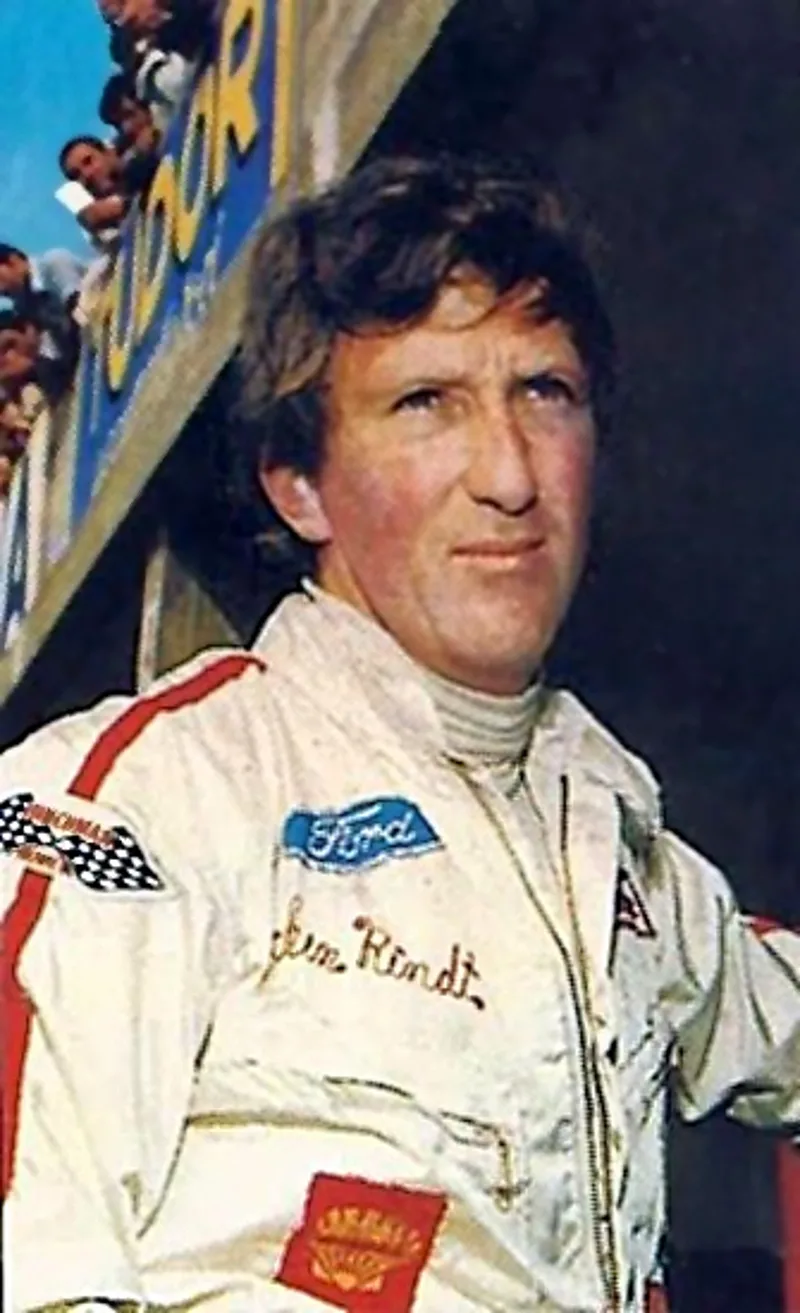
The spread of wings brought problems of its own. Jochen Rindt opposed them on safety grounds, and he suffered a heavy crash at the 1969 Spanish Grand Prix when his high rear wing failed. Rindt later raced a car with no wings at the 1970 Italian Grand Prix, where he died in a crash during practice in his Lotus 72.