Sebastian Vettel led from start to finish at the Marina Bay Street Circuit, with Button second and Webber third, as the championship swung decisively his way.
Sebastian Vettel won the 2011 Singapore Grand Prix from pole, leading from start to finish ahead of Jenson Button and Mark Webber. The 61-lap race stretched Vettel's championship lead to 124 points. It was his third straight victory, and Button was the only rival left in a position to challenge him.
Sebastian Vettel took the 2011 Singapore Grand Prix from pole and held the lead for the entire 61-lap distance. Jenson Button finished second and Mark Webber third, a result that left Vettel 124 points clear in the championship. The race effectively settled the title contest in his favour.
What was the 2011 Singapore Grand Prix?
The event took place on 25 September 2011 on the Marina Bay Street Circuit and counted as the fourteenth round of the season. It was the twelfth time the city had staged the race. Vettel's victory was his third in succession, which put him in a commanding position as the season entered its final stretch.
Button's second place moved him up to second in the standings, but he remained far behind the leader. Alonso and Webber, who had been third and fourth in the championship, were both knocked out of the title fight by the outcome.
In the constructors' battle, Red Bull stretched its advantage over McLaren to 138 points. Ferrari, another 85 points adrift, was third and no longer able to challenge for the title.
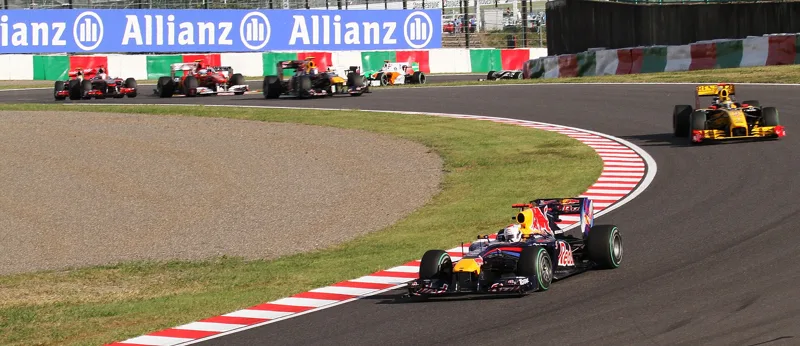
Vettel led from start to finish under the Singapore lights, and a 124-point cushion made the title race look settled.
What controversies came before the race?
The build-up was dominated by claims that Red Bull Racing had broken the Resource Restriction Agreement during 2010. The team rejected the allegations. The agreement is a cost-cutting arrangement among members of the Formula One Teams Association, and it fixes projected budgets, including how much wind tunnel time a team may use.
An outside audit by a Dutch consultancy reportedly concluded that Red Bull had gone beyond the agreed limits. The issue lingered through the weekend even though the team maintained its innocence.
Vitantonio Liuzzi was also penalised before the race. He was given a five-place grid drop for causing a first-lap accident at the Italian Grand Prix. HRT honoured Christian Bakkerud on its cars; the driver had competed twice at Le Mans for Colin Kolles' outfit before a fatal road accident in September.
Why did the night timetable cause trouble?
Toro Rosso broke a curfew when Franz Tost came to the circuit ahead of the permitted time. Night racing in Singapore means a 10pm local start, whereas the European rounds begin at 2pm, so the whole weekend runs on a different clock from the usual one.
Under the curfew rules the nine hours before first practice are restricted, and in Singapore that stretch falls in daylight rather than in the early hours. Toro Rosso was judged to have used one of the four waivers that every team received for 2011. Red Bull Racing, Mercedes and Virgin also ran into the same timetable problem on Saturday morning, although all three later had their exemptions restored once it was clear that the staff who broke the curfew had no role on their cars.
The tyres were another change. Pirelli supplied a yellow-banded soft as the harder prime and a red-banded super-soft as the option, while the year before Bridgestone had used a medium compound for the prime.
Only one DRS zone was in use. Its detection point sat at turn 4, and the activation point was 35m beyond the turn 5 apex, which opened up plenty of passing opportunities into the turn 7 braking area.
Two drivers reached career landmarks. Buemi reached his fiftieth start, having first raced at the 2009 Australian Grand Prix. For Vettel the race was also his fiftieth start for Red Bull Racing.
How did the first practice session go?
The opening session began half an hour late because the circuit needed repairs. Support-race cars from the Porsche Carrera Cup Asia series had dislodged plastic kerbs on Republic Boulevard and Esplanade Drive, and teams had to make the most of the reduced running time.
Hamilton was quickest, four hundredths of a second in front of Vettel, who was himself a second faster than Webber. Webber's session was over early after an incident with Timo Glock that tore off his front wing and punctured Glock's tyre. Kovalainen's Lotus T128 then caught fire at almost the same point where it had burned in 2010, and the running was halted twice.
Massa struck a kerb that moved and exposed the bolt meant to hold it down, and the session resumed with only three minutes remaining. Alonso ended up fourth, with Button and Massa behind him. Karthikeyan, returning to the HRT cockpit for the first time since Valencia, ended the session 24th and last.
What did the second practice session reveal?
Repairs were finished before the second session, with the kerbing at Turn 13 taken out. Button locked a brake and stopped just short of the wall at Turn 14, and he could not restart, although his time was good enough for tenth. Buemi hit the barriers at Turn 21 and damaged his suspension.
Alguersuari's running ended early with a mechanical fault, and di Resta managed only eight laps because of a hydraulic brake problem. Petrov had planned to test upgraded bodywork on his Renault R31, but the car overheated and the parts were held back until Suzuka.
Vettel was quickest, two tenths ahead of Alonso. Hamilton, Massa, Webber and Schumacher rounded out the top six.
How were the kerbs changed overnight?
Overnight the Turn 3 and Turn 7 kerbs disappeared altogether, replaced by painted markings. The work was carried out overnight so that the weekend would not be disrupted any further. Turn 14 lost its entry kerb too, and no replacement was planned.
The FIA would not commit to a fixed plan, and the changes were made in a rush. It decided to review matters after the initial work and again once the third practice session was done. Most drivers shrugged off the changes, and Massa said the difference between having the kerbs and not having them was minor, while arguing that the kerbs at Turn 5 deserved attention.
How did qualifying unfold?
Qualifying revealed a clear divide, with several teams lining up close to each other and apart from the rest. In the first period Vettel was fastest, half a second up on Button. Petrov was 18th for much of the session, until Senna beat him on the last lap, having lost a tenth of a second through a small slide.
Senna said Alguersuari had blocked him on his flying lap, but no investigation followed. Ricciardo again outqualified Liuzzi, which made it two sessions running, and Liuzzi was 24th. The earlier penalty made no difference to where he started.
The second session was red-flagged after Kobayashi crashed at the Turn 10 chicane, where the kerb launched his Sauber into the barriers. He never set a time, so he began from 17th. Hamilton then picked up a puncture on his second flying lap and had to pit.
Perez was briefly in the top ten but lost his place to di Resta at the death and qualified 11th. Buemi and Alguersuari of Toro Rosso were 14th and 16th. Both Force Indias reached the final session, something not seen since the 2010 Canadian Grand Prix.
How did the final session set the grid?
The final session opened with four cars queuing at the pit exit, which is a rare sight. Button led Alonso, Massa and Hamilton out, and Hamilton drew criticism for an aggressive move on Massa at Turn 19 during his out-lap. Massa backed off to let him past, sacrificing his own quick lap.
Vettel waited for the traffic to thin and then moved to the top. Button held second until Hamilton and Webber went ahead, and then took third from Hamilton on his second flying lap. Hamilton had to stop with a fuel issue and finished fourth on the grid, with Alonso and Massa fifth and sixth.
Vettel's time stood up, giving him his eleventh pole of the season. Red Bull took the front row, McLaren the second, the Ferraris the third, Mercedes the fourth and Force India the fifth.
How did the race start and develop?
Vettel held the lead through the first corner, but Webber slipped back to fourth at the start. Hamilton had a good launch but then lost places and fell to seventh. Button and Alonso took second and third, and Massa and Rosberg made contact at Turn 1, which sent Rosberg across the track before he handed the place back.
Hamilton caught Schumacher on lap 4, passed him on the run to Turn 7 and went by Rosberg for sixth the following lap. Glock came to grief at the final turn on lap 10, and rear suspension damage brought his afternoon to an end. On the same lap Webber went round the outside of Alonso into Turn 14 and then regained the place with a bold move at Turn 16.
Alonso pitted the next lap to switch from the option to the prime tyre. Hamilton and Massa stopped on lap 12, and Ferrari won the stop battle, keeping Massa in fifth. Alonso re-emerged just ahead of them at Turn 1, despite being held up by Barrichello, and moved back in front of Webber when Webber made his own stop.
What happened at Turn 7 and under the safety car?
Hamilton went after Massa straight away on the out-lap and made contact at Turn 7. His front wing caught Massa's rear tyre, leaving Massa with a right-rear puncture that dropped him to nineteenth. Hamilton had to pit for a fresh front wing, and he later served a drive-through penalty for a collision he could have avoided.
Di Resta had been running third on a different strategy from most rivals. He kept the position until lap 19, when Alonso took it at Turn 7. After his stop di Resta fell to eighth behind Sutil. Webber was half a second behind Alonso by lap 25, just before Alonso's second stop.
On lap 29 Rosberg ran wide at the final corner, which let Perez and Schumacher close in. Perez defended the line into Turn 7, and Schumacher hit the rear of his car, strewing debris across the circuit. Schumacher later called it a racing incident and said he had not expected Perez to brake so early. He retired, while Perez carried on.
The safety car was sent out while the debris was cleared, and many drivers chose to pit under it. Vettel's lead, which had been more than 20 seconds, disappeared in the process.
How did the closing laps play out?
At the restart Vettel built a 4-second gap over Button, who was trapped behind a group of backmarkers led by Jarno Trulli. Webber went down the inside of Alonso into the Singapore Sling chicane, and Hamilton started to recover from his penalty, reaching sixth and passing di Resta the next time round.
Kobayashi picked up a drive-through for disregarding blue flags that had been shown while Button was held up behind him. Trulli's race ended on lap 46 when his gearbox gave out. Button stopped the lap after, Vettel covered him, and Alonso pitted on the same lap as Vettel.
Seven laps from the flag, Hamilton overtook di Resta for fifth, while Button recorded the fastest lap. Massa climbed back into the points by passing Barrichello and Perez. Alguersuari went off at turn 18 late in the race, yet he was classified 21st because he had covered more than 90 percent of the distance.
On the final lap Vettel was held up in the Massa and Perez battle, and Button gave up his attack on the win. Massa then had to let Vettel through, which cost him the chance of eighth from Sutil. Vettel took his third successive victory, the first time he had led from start to finish since the 2010 European Grand Prix. Button crossed the line 1.7 seconds behind, and Webber completed the podium ahead of Alonso and Hamilton.
Di Resta took sixth, the best Formula One finish of his career. Rosberg, Sutil, Massa and Perez rounded out the points.
Who finished where in Singapore?
| Position | Driver | Team | Note |
|---|---|---|---|
| First | Sebastian Vettel | Red Bull Racing | Pole and third successive win; led from lights to flag |
| Second | Jenson Button | McLaren | 1.7 seconds behind; fourth podium in a row |
| Third | Mark Webber | Red Bull Racing | Passed Alonso in the Singapore Sling chicane |
| Fifth | Lewis Hamilton | McLaren | Recovered from a drive through penalty |
| Sixth | Paul di Resta | Force India | Best Formula One finish of his career |
What did the result mean for the title?
Vettel was still short of a second title, but Hamilton, Alonso and Webber were all out of contention. Button became the only driver who could stop him, moving up to second in the standings while remaining 124 points adrift. For the others, the points gap had become almost impossible to recover from.
With 125 points still on offer, Button could not catch Vettel even by winning every remaining race. Vettel needed only a tenth-place finish to secure the title. His advantage was now too large for any rival to close without a run of retirements. Red Bull also had a chance to take the constructors' title in Japan by finishing 34 points ahead of McLaren.
How did Massa react to Hamilton after the race?
Massa openly criticised Hamilton once the race was over. He had been irritated already by an incident in qualifying, when Hamilton dived down the inside of him while attempting a pass on an out-lap, and the frustration carried into the post-race period.
Afterwards Massa walked up to Hamilton in the interview area while Hamilton was about to speak to RTL Television. He patted his shoulder and offered a sarcastic remark about a good job.