Hamilton took pole, pushed his McLaren on the cool-down lap, then won in Montreal with Button second and Alonso third.
Hamilton's pole-to-win at Montreal on 13 June 2010 moved him ahead of Button and Webber in the title race. Button took second and Alonso third, and McLaren gained the constructors' lead from Red Bull. It was McLaren's second one-two in a row.
Lewis Hamilton won the 2010 Canadian Grand Prix in Montreal, his second win at the circuit, with Jenson Button second and Fernando Alonso third. It was McLaren's second consecutive one-two, and Hamilton had earlier been forced to get out and push his car on the cool-down lap after taking pole.
Why did this Montreal race matter for the title?
The eighth round of the 2010 season went to Hamilton from pole at Circuit Gilles Villeneuve on 13 June. Button was second and Alonso third, and the result put Hamilton ahead of both Button and Webber in the drivers' standings, with six points covering the top three.
McLaren also took the lead of the constructors' championship from Red Bull in Turkey, and their maximum score in Montreal put them a further twenty-two points clear of the Austrian team.
Montreal was the first Grand Prix on North American soil since 2008. A podium of three former champions had not been seen since the 1991 United States race.
Hamilton pushed his McLaren on the cool-down lap, then won the race his pole had earned.
How did the Turkish crash shape the Montreal weekend?
Red Bull had dominated the three races before Montreal, but the crash between Vettel and Webber in the lead of the Turkish Grand Prix dominated the build-up. Neither driver accepted full responsibility, but both said they wanted to move on.
None of the teams planned major updates, although several brought customised packages for the high-speed, low-downforce circuit. Teams that had tried an F-duct system at the previous race kept it in trial form.
The weekend was also Ferrari's 800th start in a World Championship event as a team,.
What happened in the Friday practice sessions?
Friday passed without serious incident beyond minor off-track moves and a spin by de la Rosa at l'Epingle. Di Grassi alone failed to set a time in the first session, after stopping on the circuit.
Jenson Button set the fastest time of the first session, while Hispania improved dramatically to beat both Virgins. Karun Chandhok also beat the Lotus of Jarno Trulli, and Heikki Kovalainen finished just over a second behind Jaime Alguersuari.
The biggest story of the day was extreme tyre degradation on the super-soft compound. Resurfaced stretches of the track, laid since the last visit in 2008, offered far less grip than the rest of the circuit.
Hirohide Hamashima, Bridgestone's director of motorsport tyre development, said the tyres could not reach their optimum operating temperature. With rain expected at some point over the weekend, that made set-up work exceptionally difficult.
Vettel was fastest in the second session, narrowly ahead of Alonso and Nico Rosberg. Back in the first session, the McLarens had struggled despite the fastest times, with Hamilton seventh and Button eleventh.
The McLarens recovered in the third session, when Hamilton set the fastest time of the session and the weekend, ahead of Webber, Alonso and Schumacher. Hamilton and Massa both clipped the concrete walls without damage, while Chandhok's Hispania stopped early on the circuit.
Rosberg was sidelined by a clutch problem for most of the third session. The only other incident was di Grassi losing control under braking at l'Epingle, which left him in the gravel shortly after he had recorded the fastest speed of the session, 324 km/h (201 mph), through the speed trap.
How did overnight rain change qualifying?
Overnight rain washed away the rubber laid down on Friday, which reduced grip further. Bridgestone projected that a one-stop race would be impossible, because the harder prime lost up to seven seconds over half race distance and the super-soft option lost over sixteen seconds in the same window.
Qualifying began without rain on the track. The drivers had to start the race on the tyres on which they had set their best time, so tyre selection in qualifying was crucial.
In the first session, both drivers from HRT, Virgin and Lotus failed to make the cut, and they were joined by Kamui Kobayashi of BMW Sauber. Schumacher was the only surprise elimination in the second session, starting from 13th.
Barrichello was the fastest of the group that went through to the third session, followed by Hulkenberg, Schumacher, Petrov, Buemi, Alguersuari and de la Rosa.
Hamilton's pole and the cool-down lap
In the final session, Webber grabbed the early lead, but Hamilton took pole on the last lap. That ended Red Bull's run of pole positions after seven races, and Webber was set to start second in front of his team-mate Vettel.
Alonso was fourth, Button fifth, and Liuzzi qualified at a career-best sixth. Massa, Kubica, Sutil and Rosberg completed the top ten.
On the cool-down lap Hamilton was told to slow and stop, because the team realised he had too little fuel left for an FIA sample. He turned the car off and let it roll down the back straight before getting out and pushing it.
Marshals came to his aid, and the course car collected him for the trip to the press conference. The FIA reprimanded Hamilton and fined McLaren $10,000 for missing the time limit on the cool-down lap, but his pole stood.
How did Webber's grid penalty come about?
Webber was demoted from second to seventh after Red Bull found iron filings in a gearbox oil sample taken during qualifying. The finding suggested damage to the gearbox internals, and it forced a gearbox change under parc ferme conditions and a five-place grid penalty.
How did the race start in Montreal?
It was the first race of the season in which all twenty-four cars started on the grid. Before Montreal, at least one car, usually from Virgin, Lotus or Hispania, had been forced to start from the pit lane with a mechanical problem.
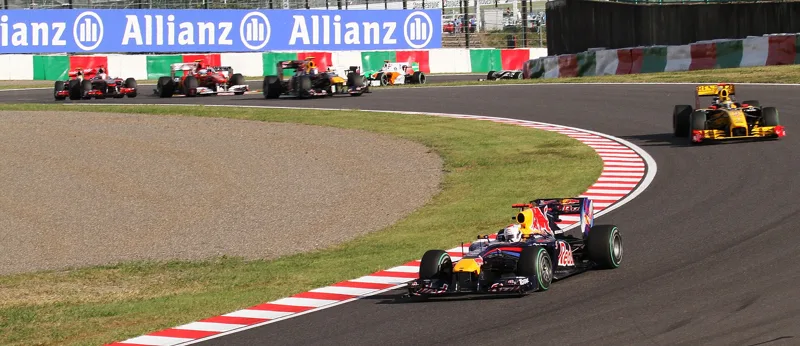
Hamilton won the drag race to the first corner, while Vitaly Petrov jumped the start and was forced onto the grass as he tried to go around the outside. He spun and earned two drive-through penalties in the space of one hundred metres.
Felipe Massa and Vitantonio Liuzzi made contact three times at one corner, and Liuzzi was spun round and slid down the order. Kamui Kobayashi and Nico Hulkenberg tangled on the run into the final corners, and Kobayashi retired a lap later with accident damage.
Kobayashi's Sauber team-mate Pedro de la Rosa also retired soon afterwards, which gave Sauber the unenviable record of eleven retirements from sixteen starts.
How did the strategies split the leading group?
Red Bull ran their drivers on separate strategies. Webber used the harder primes first and finished on the softer options, while Vettel used options in his middle stint and primes for the run home.
Every driver except Robert Kubica had started on the softer options. Toro Rosso's Sebastien Buemi briefly inherited the lead before his stop, the only lap he ever led in his career.
Hulkenberg over-extended himself under braking at l'Epingle while attempting to pass Rosberg, and he damaged his front wing. He was then flagged for speeding in the pit lane, and he had to serve a drive-through penalty.
Schumacher and Kubica came close to a collision after Schumacher's first stop, when Schumacher refused to yield on the way to the fourth corner and the two took a short trip across the grass. The altercation damaged Kubica's undertray, and the stewards investigated it.
How did Hamilton and Button break away?
Webber's tyres began to deteriorate rapidly. Hamilton, running second, quickly cut the gap and caught him with twenty laps to go, dragging Alonso through in the process. Webber pitted and emerged behind Vettel, who was struggling with a serious gearbox problem that he had to nurse to the finish.
As Hamilton settled into the lead, Button took Alonso by surprise around the back half of the circuit and secured second. He briefly pressed his team-mate, closing to two seconds with ten laps to go, but Hamilton answered with a fast lap that ended the chase.
The top five stayed in place until the end. Vettel stopped on the circuit just after he crossed the line, and Nico Rosberg held off a late surge from Kubica to take sixth.
Buemi finished eighth and a lap down, while Liuzzi and Sutil passed Schumacher on the final lap. Schumacher finished without a point, and Martin Brundle described it as the worst weekend of his career.
How many drivers finished, and who retired?
The race was notably short of retirements compared with other Montreal races, and nineteen drivers were classified, the most finishers of the season so far. Bruno Senna was once again troubled by a gearbox problem, and Trulli pulled into the pit entry on lap forty-seven with terminal brake trouble.
Timo Glock retired on lap fifty-five with a steering rack leak. Chandhok and di Grassi were the last cars home, four and five laps down.
The top five finishers and their grid positions
| Finish | Driver | Team | Grid |
|---|---|---|---|
| First | Lewis Hamilton | McLaren | Pole |
| Second | Jenson Button | McLaren | Fifth |
| Third | Fernando Alonso | Ferrari | Fourth |
| Fourth | Sebastian Vettel | Red Bull Racing | Third |
| Fifth | Mark Webber | Red Bull Racing | Seventh |
Hamilton's win was his second Canadian Grand Prix victory, and Button's second place kept the McLaren pair at the head of the championship. Vettel's fourth place and Webber's fifth left Red Bull with ground to make up in both tables.