A BMW-based V8 Le Mans Prototype 2 car built by ADESS and Kodewa, with a seized-car legal fight and one podium in its only season.
The T128 was an LMP2 sports prototype that Kodewa ran under the Lotus name in 2013. The car was designed by James Key. Its 3,600 cc V8, based on the BMW S65, produced 450 hp, and the CLM P1/01 replaced it after the season.
The Lotus T128 was a Le Mans Prototype 2 (LMP2) car built for the 2013 FIA World Endurance Championship. James Key, the former Sauber technical director, designed it, and ADESS and Kodewa built it under the Lotus name.
The car is remembered for a legal dispute that saw it seized by bailiffs during the 24 Hours of Le Mans, and for a single podium at the Circuit of the Americas. After the season Lotus moved into LMP1 with a new car.
Where did the Lotus T128 come from?
The T128 grew out of a 2011 proposal by Stephane Chosse, founder of ADESS. German team Kodewa ordered two chassis a year later, and the car was developed in Munich's high-technology park before construction began in February 2013. The programme was announced during the 2012 24 Hours of Le Mans weekend.
Romulus Kolles oversaw the project alongside Patrick Louis, the Lotus F1 Team manager, Antonin Charouz of Gravity Charouz Racing, and Petr Ptacek, owner of the Czech manufacturer Praga. Former Sauber technical director James Key assisted them with the design.
Lotus became the title sponsor, so the Kodewa team adopted the Lotus name. Kodewa also hoped to sell the T128 to customer teams running in other series, and the car was designed to meet the 2014 LMP1 regulations as well.
A Le Mans Prototype 2 car that ran one season for Lotus and left a podium and a legal dispute behind.
How was the T128 designed?
Aerodynamics were the main priority. Altair Engineering software was used for the aerodynamic study, with HyperMesh finite element simulations and Radioss crash simulations, and Chosse took a similar approach to the one he had used in Formula One.
Crash simulations influenced the shape of the monohull's front nose. The rollover protection structure was built into the carbon fibre reinforced polymer chassis, and the monocoque began production in February 2013 and was homologated a month later.
A scale model went through a wind tunnel at Mercedes-Benz's F1 base in Brackley to refine the aerodynamics. Those tests sat alongside the computer work and shaped the car's body.
The suspension was a double wishbone layout with a pushrod-actuated torsion bar at each end, and the dampers were housed inside the monocoque. A single intake mounted on the roof fed air into the engine.
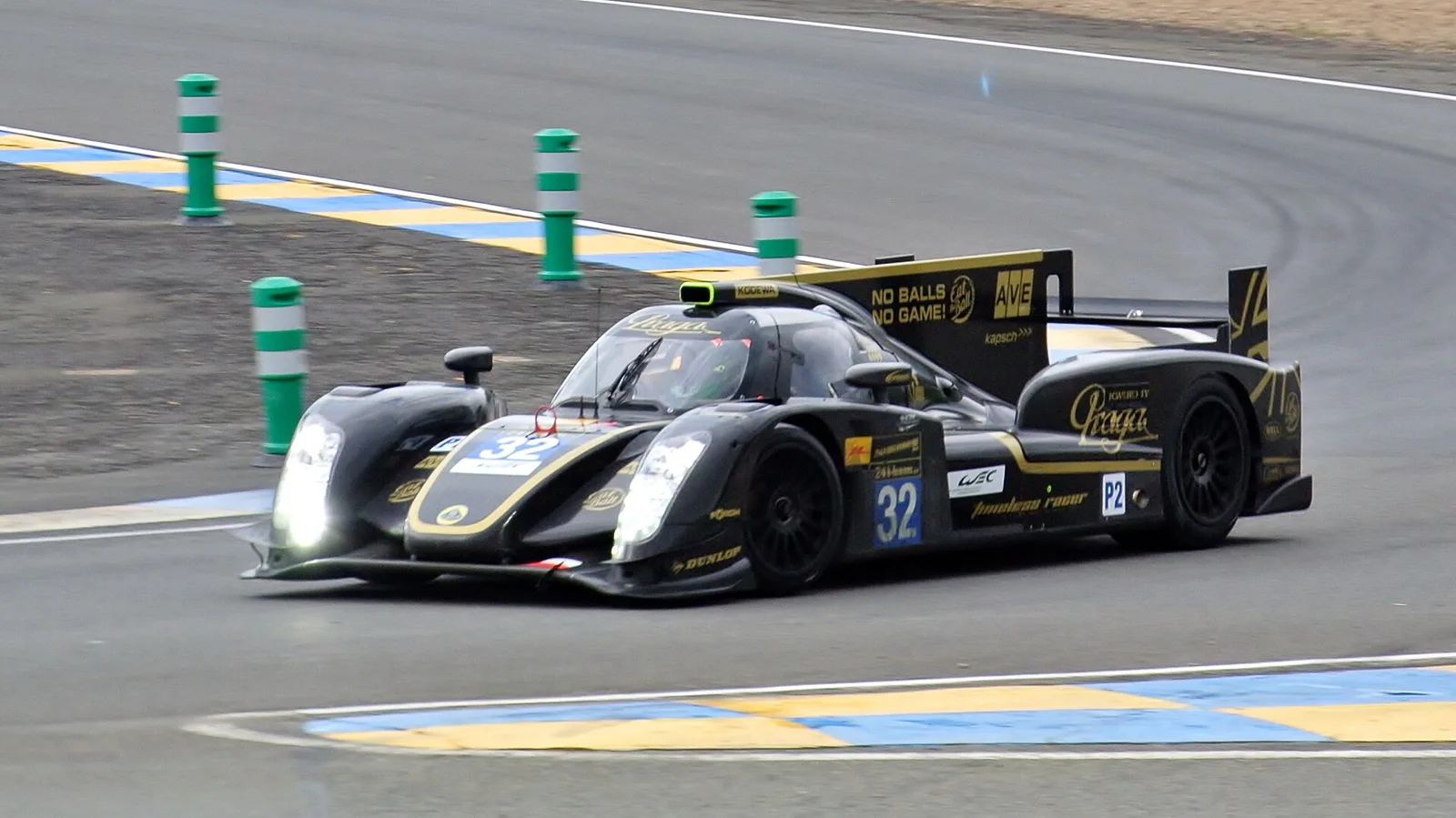
Automotive futurist Daniel Simon designed the black and gold livery. After the car's launch, Igor Zamorano of Motorpasion wrote that its front resembled the Audi R18.
What engine and gearbox did the T128 use?
The engine was a V8 built on the BMW S65 block family, the unit that also powered the M3. Its capacity was trimmed to 3,600 cc, and output stood at 450 hp (340 kW) with the unit able to be revved to 9,500 rpm.
Engineers used the S65 production block for the best efficiency rate, and the engine was angled at 90 degrees and rebadged by Praga. Hewland custom-designed a six-speed sequential gearbox for the car.
Peak torque of 405 Nm arrived at 7,000 rpm. Braking came from carbon ceramic Brembo discs, and the steering was power-assisted.
How did the T128 perform in its first season?
The T128 raced in the 2013 World Endurance Championship, with both cars failing to finish the season-opening 6 Hours of Silverstone. They did finish in the top six at Spa-Francorchamps, but the team's results suffered from a run of mechanical problems across the calendar.
Only one car ran at the pre-season test at Circuit Paul Ricard on 28 March, and a ruptured oil tank limited its running for several hours. The team had planned a first test in December 2012, but late part fitting moved it back.
At Silverstone, Weeda, Bouchut and Liuzzi drove the No. 31 car, while Holzer, Kraihamer and Charouz drove the No. 32 car. Rossiter returned for Spa and replaced Bouchut in the No. 32 car.
At Le Mans, Bouchut placed 15th in class for the No. 31 car in qualifying. Holzer took 16th for the No. 32 car, which was then relegated to the back of the LMP2 grid after failing the 110% qualifying rule.
In the race, Weeda spun at the second Mulsanne Chicane and beached the No. 31 car, which retired after 17 laps with electrical problems. The No. 32 car suffered a bell housing failure in the 17th hour, and that ended the team's race.
Why was the car seized by bailiffs?
The dispute centred on unpaid invoices and came up while the car was at the 24 Hours of Le Mans.Lotus sued Chosse, ADESS and SCE Solutions on June 17, and Chosse claimed a seven-figure sum was owed. A bailiff then seized both T128s on June 18, before the Le Mans court ruled in Lotus's favour.
Lotus presented invoices that the court found to be fictitious. The Le Mans court decided the matter on June 19 and ordered both cars returned to the team. The wider dispute was still ongoing as of 2018.
Did the T128 score a podium?
Yes, once. Lotus took its only podium of the season at the 6 Hours of Circuit of the Americas, where the No. 32 car of Kraihamer, Charouz and Holzer finished third. The No. 31 car had changed engines after practice, which brought a three-minute stop-and-go penalty.
The race was not kind to the No. 31 car. Rossiter collided at the first turn and withdrew, and Charouz had earlier hit Sarrazin's car as the field approached the opening corner, sending it into a spin.
In Sao Paulo, Kraihamer's No. 32 car slid out of control at the rear and collided with the flank of Sarrazin's Toyota, ending the Lotus's race early. The No. 31 car suffered gearbox trouble from the start and was not classified in the final results.
How did the 2013 season end?
The T128s finished the season in Asia and Bahrain. At the 6 Hours of Fuji, Typhoon Wipha brought heavy rain that stopped competitive running, and the cars finished eighth and tenth. Bahrain ended with heavy damage to one car, which was declared a non-finisher.
At the 6 Hours of Shanghai, the No. 32 car was damaged when it collided with an AF Corse Ferrari 458 Italia and then retired with engine failure. The No. 31 car recovered to finish seventh in class.
The season closed at the 6 Hours of Bahrain, where Lucas Auer, a Formula Three European Championship fourth-place finisher and nephew of Gerhard Berger, made his sports car endurance debut in the No. 31 car. Liuzzi collided with a rival early on, and Kraihamer later made contact with a Porsche 911 RSR.
What replaced the T128?
When the season ended, Lotus moved up to LMP1, with the CLM P1/01 taking the T128's place. That step took the team out of LMP2. Across the season the two cars scored 37 and 11 points, placing them seventh and eighth among LMP2 teams.
What were the Lotus T128 specifications?
Engine, transmission, braking and class details for the T128 are gathered in the table below. The figures describe the car itself, while the final line records how the team finished in the LMP2 standings. Where the car raced, the table reflects the 2013 season only.
| Specification | Detail |
|---|---|
| Category | LMP2 sports prototype |
| Designer | James Key, ex-Sauber |
| Builders | ADESS and Kodewa |
| Engine layout | V8, 3,600 cc, normally aspirated, BMW S65 derived |
| Power | 450 hp / 340 kW, peaking at 9,500 rpm |
| Torque | 405 Nm, reached at 7,000 rpm |
| Transmission | Hewland-built, six speeds, sequential |
| Braking and steering | Brembo carbon ceramic discs; power-assisted steering |
| Debut season | 2013 FIA WEC, entered as a Lotus |
| Season standing | Seventh and eighth, FIA Endurance Trophy for LMP2 Teams |
Who designed the Lotus T128?
The car was designed by James Key, who had been Sauber's technical director. Stephane Chosse of ADESS first proposed a Le Mans prototype in March 2011, and the car was later built by ADESS and Kodewa.
How much power did the T128 make?
The car produced 450 hp (340 kW) from its 3,600 cc naturally aspirated V8. The engine peaked at 9,500 rpm and produced 405 Nm of torque at 7,000 rpm.
Did Lucas Auer race the T128?
Yes. Auer made his sports car endurance debut at the 6 Hours of Bahrain in the No. 31 car, filling the seat that Rossiter could not fill.
How did the T128s finish the 2013 LMP2 Teams standings?
The two cars finished seventh and eighth in the FIA Endurance Trophy for LMP2 Teams, scoring 37 and 11 points across the season.