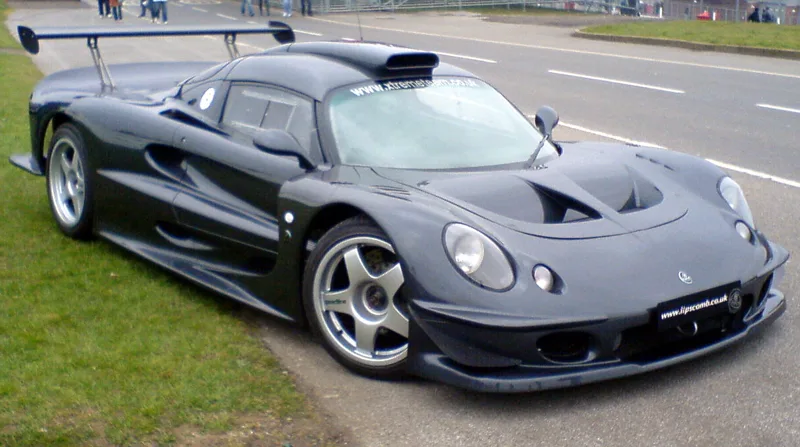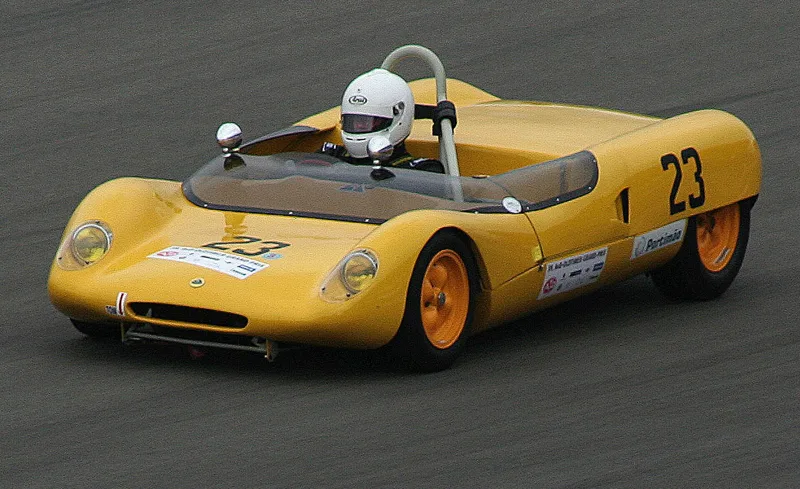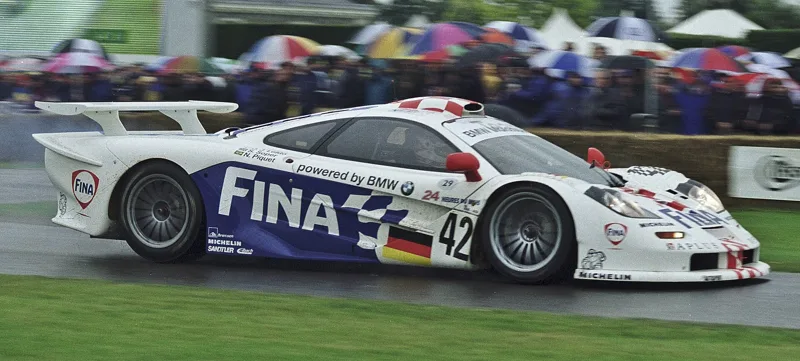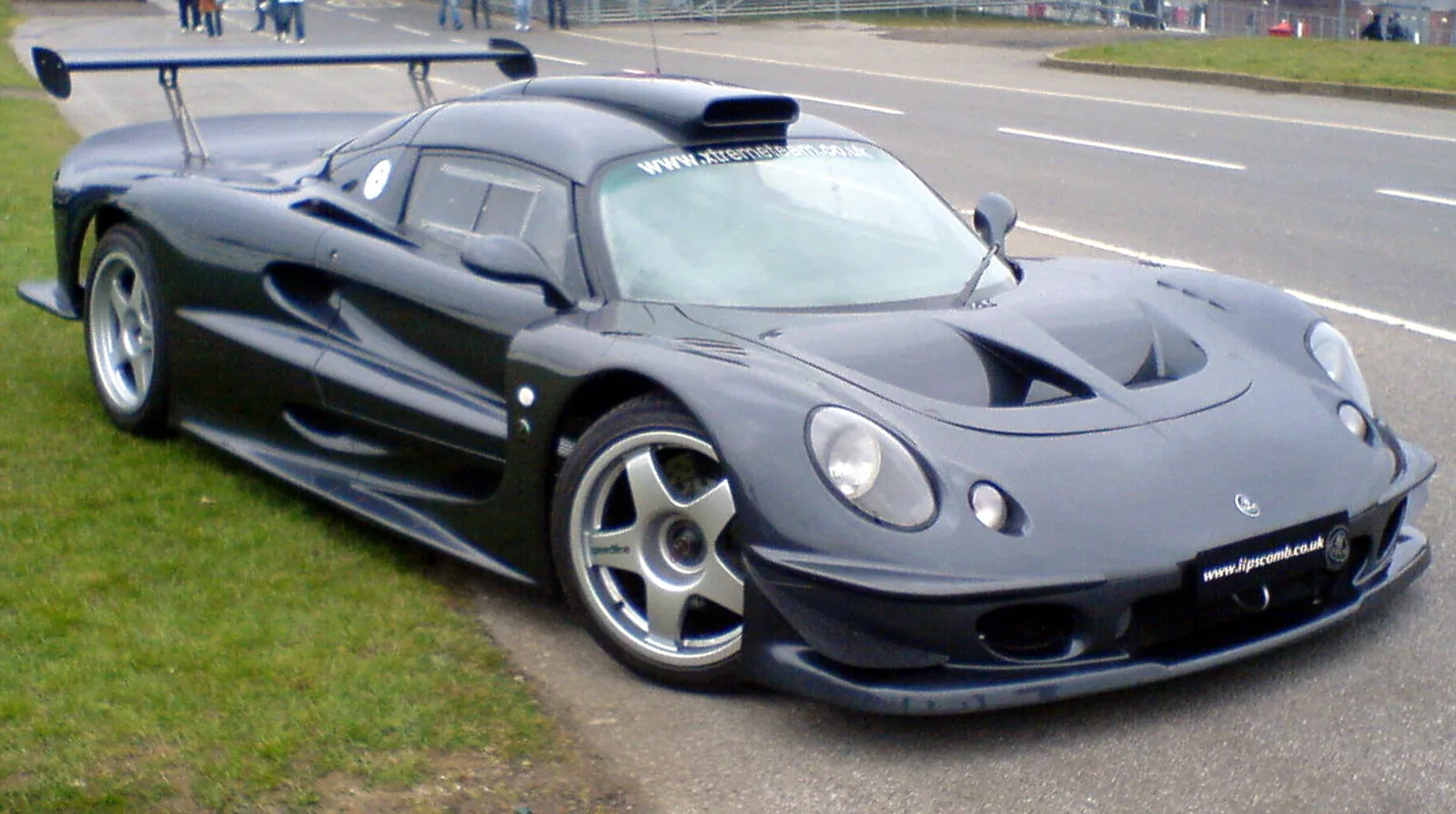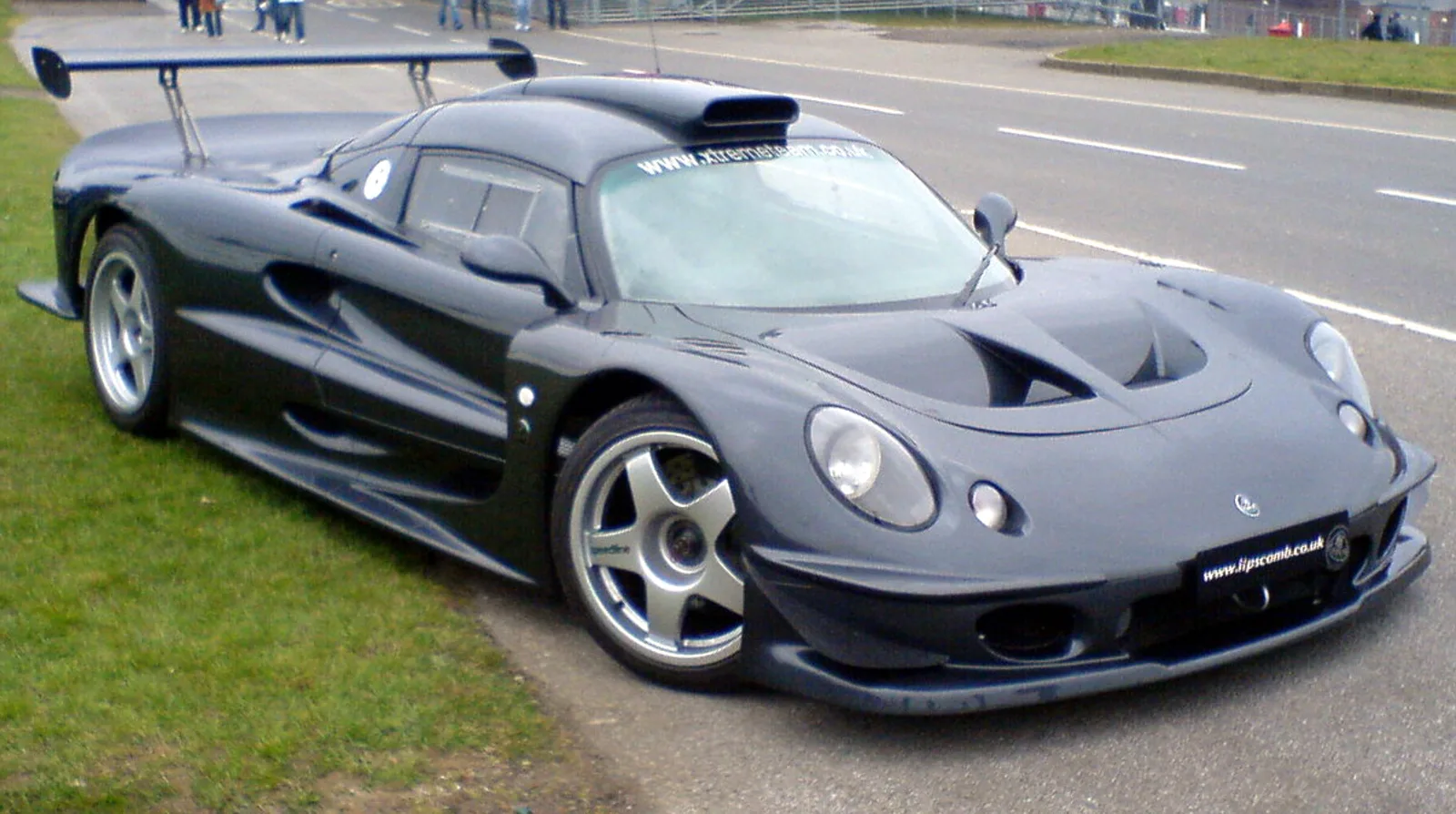
A 1997 GT1 racer based on the Elise, the single road-going homologation car behind it and the Bitter GT1 spin-off that followed.
The Lotus Elise GT1 was a 1997 grand tourer-style race car based on the Elise, built to compete in the FIA GT1 class. The race cars used a 5.7-litre Chevrolet V8, while the single road-going homologation car used a 3.5-litre twin-turbo V8 producing 550 PS.
The Lotus Elise GT1 was a race car built for grand tourer-style sports car racing from 1997, based on the new Elise rather than the ageing Esprit. Lotus also built a single road-going version to meet homologation rules, a costly gamble that reflected how little money the company could spend against Porsche and Mercedes-Benz.
What was the Lotus Elise GT1?
The Elise GT1 was a race car built to compete in the GT1 class of the FIA GT Championship, which took that name in 1997. Seven racing chassis were constructed, and one road-going homologation car was built alongside them. Its racing record was poor, but the programme is one of the most unusual efforts in Lotus history.
Lotus had campaigned an Esprit-based GT1 racer in the BPR Global GT Series from 1994 onward. That series counted the McLaren F1 GTR, the Venturi 600LM and the Ferrari F40 GTE among its rivals, and Lotus wanted to remain competitive in the top GT1 class.
Porsche had introduced its purpose-built 911 GT1 in 1996, and Mercedes-Benz announced its CLK GTR for 1997. Lotus judged that it had to follow the same blueprint, but it lacked the resources to build both a race car and a street-legal version.
The GT1 class was the front rank of the series, so any car that wanted a place in it needed both outright speed and the durability to finish long races. Lotus was not short of ambition, but its budget could not keep pace with the works teams.
Lotus built a race car on the Elise's chassis, then a single road car, and watched the GT1 programme fold after one season.
Why did Lotus build a race car from the Elise?
Lotus needed a competitive GT1 car but could not match the resources Porsche and Mercedes-Benz had for building race cars and street-legal variants. Using the new Elise sports car as the base gave Lotus a modern chassis in place of the outdated Esprit, and the company accepted a guaranteed financial loss on the single road version.
The Elise's four-cylinder engine was never going to be competitive in this class, so the powerplant became the central engineering problem of the programme. Lotus had to decide how to make the car fast enough to be worth racing against the factory teams of its rivals.
What engine did the Elise GT1 use?
The road car used a 3.5-litre twin-turbo V8 called the Type 918, rated at 550 PS, 540 hp or 400 kW. The factory race cars used a modified 5.7-litre Chevrolet V8 peaking at around 600 PS, and both engines covered 0-60 mph in 3.8 seconds.
The first plan used the Esprit's 3.5-litre V8, but testing showed that unit was not as reliable as hoped. Lotus then had to choose between its own V8 and a 5.7-litre LT5 V8 it had co-developed while under General Motors ownership. The Chevrolet engine gained a carbon intake and a dry sump system, and early examples had an aluminium block that proved problematic.
Peak power came at 6,500 rpm for the road engine and at 7,200 rpm for the race unit. Late in the programme, the factory team switched to a cast-iron NASCAR engine block with two valves, which gave more power and proved far more reliable.
In the final pair of rounds, at Sebring and Laguna Seca, the team used restrictors of 2 x 36.8 mm, and the Hewland 6-speed sequential gearbox was the original choice for the race cars.
How did the factory cars perform in 1997?
The factory Elise GT1s struggled from the first round, with alternator and gearbox failures. Their best finish was 8th at Spa-Francorchamps, and the works squad finished the season with no points. The privateer GBF team earned points with 5th place at Helsinki and finished 8th in the championship.
The season opened at Hockenheim on 13 April, where the three factory cars and the privateer GBF car all retired with alternator trouble. At Silverstone the factory cars failed again, this time with gearbox difficulties. Helsinki's smaller field had 23 cars, and GBF took 5th place there.
At Le Mans only a lone GT1 was entered, and its engine block failed after 121 laps. Later in the season the full team of five cars managed 11th at the Nurburgring and 8th at Spa-Francorchamps, but all five retired at Zeltweg. The two final US rounds brought only the factory team, using 5.7-litre NASCAR Chevrolet engines, which finished 9th and 13th.
Those results left the factory team without points, while the cars remained expensive to build and run. That combination made the programme hard to justify, however much Lotus wanted a place among the leading GT1 teams.
Why was the GT1 project cancelled?
Lotus and its parent company Proton concluded after 1997 that the GT1 was too slow next to Porsche, Mercedes-Benz and McLaren, and too expensive to run. The Chevrolet engine was not a custom race unit, the Lotus turbo V8 fared worse, and the chassis looked too much like a production car.
The programme was dropped and the works team disbanded. Toine Hezemans, who ran G.T.I., took the whole inventory, including the two factory cars, to the Netherlands, where his family still keeps them. The privateer teams either folded or bought more capable machinery.
Was there a 2004 comeback attempt?
Team Elite, a British squad, announced in 2003 that it would buy chassis #05 and run it as a closed-cockpit Le Mans prototype in 2004. The plan ended after seven laps at the 12 Hours of Sebring when the transmission failed, and the project was cancelled soon afterwards.
The team planned changes to bring the car, then seven years old, up to modern regulations. Panoz and the French squad Larbre Competition had a similar idea with a Panoz Esperante GTR-1, which had originally competed in FIA GT in 1997 alongside the Elise GT1.
Was a road-going Elise GT1 built?
Yes. GT regulations required a road version for homologation, so Lotus built one car on a heavily modified Elise S1 aluminium chassis. It used the Type 918 twin-turbo V8 and a Renault five-speed manual gearbox, and was homologated from 1 April 1997 until 31 December 2004.
The carbon fibre and Kevlar body was much longer and wider than the Elise, at 4510 mm long and 2070 mm wide, with a wheelbase of approximately 2675 mm. Both axles measured 2000 mm. The car weighed around 1050 kg, slightly more than the track-focused Elise models, and an aluminium roll cage was also fitted.
Because the road car existed to satisfy the rules, it was never a model in its own right. It was a single example, and it sat at the centre of a programme that Lotus expected to lose money on from the start.
Its whereabouts are uncertain. Reports say it was last seen in public almost ten years before 2017, at Le Mans Classic. One account has the car still with Lotus, held in a warehouse in England, while another suggests a private collector in the Netherlands holds it.
What became of the Bitter GT1?
Mike Hezemans, a former Dutch factory driver, persuaded his father Toine to fund a revival of the Elise GT1. Erich Bitter of Bitter Automobile lent his firm's name so the cars could meet FIA regulations, and the revived cars were called Bitter GT1s. They were built to compete in the 1998 FIA GT season.
Toine owned two former Elise GT1 chassis, and his small team with chief mechanic Hans Willemsen reworked them in a Dutch workshop. The front end was lengthened to add downforce, and a Chrysler eight-litre V10 from the GT2 Vipers was fitted by extending the chassis. The engine delivered 626 PS, 460 kW and 617 hp, and torque reached 800 N m (590 lb ft). The Hewland gearbox was kept because the team had a small budget.
Both Bitters failed to finish at the 1998 British Empire Trophy at Silverstone, because the torque overwhelmed the gearbox. A Gemini Transmission unit was planned as a replacement, but the project ended when the car failed to get past initial practice at Hockenheim.
One Bitter survives in the Hezemans family. Hendriks Motorsport restored it to its 1998 specification, and Loris Hezemans shook it down at TT Circuit Assen in January 2021. The second car was rebuilt as a Lotus Elise GT1, so the hardware of the programme survives in two forms.
Lotus Elise GT1 specifications
| Specification | Detail |
|---|---|
| Type | Race car for the FIA GT1 class, with a road-going homologation version |
| Chassis | Lotus Elise S1 aluminium chassis, heavily modified for the road car |
| Road car engine | 3.5-litre Type 918 twin-turbo V8 |
| Road car output | 550 PS, 540 hp, 400 kW, reached at 6,500 rpm |
| Race engine | 5.7-litre Chevrolet V8, modified |
| Race output | Around 600 PS (590 hp; 440 kW), peaking at 7,200 rpm |
| 0-60 mph | 3.8 seconds |
| Top speed | In excess of 200 mph |
| Length and width | 4510 mm by 2070 mm |
| Wheelbase | Approximately 2675 mm |
| Weight | Around 1050 kg (road car) |
| Road gearbox | Renault 5-speed manual |
| Race gearbox | Hewland 6-speed sequential, initially |
| Restrictor | 2 x 36.8 mm, on the final races with the NASCAR engine |
| Homologation | 1 April 1997 to 31 December 2004 |
| Racing chassis built | 7 |
| Bitter GT1 engine | eight-litre Chrysler V10, 626 PS (460 kW; 617 hp), 800 N m (590 lb ft) |