From a jet fighter's pinched fuselage to a window borrowed from horse-drawn carriages, what four car design terms mean and which vehicles wore them.
Coke bottle styling is a narrow-waisted body shape taken from fighter jets. Cab-forward moves the cabin to the front, as on the AMC Pacer and Chrysler LH cars. An opera window is a small fixed C-pillar window. Cab-over places the cab above or ahead of a truck's front axle.
The pinched waist on a 1962 Studebaker Avanti came from supersonic fighter jets, where that shape cuts drag at speeds above 575 mph (925 km/h). On a road car it brings visual appeal and a negligible performance gain. It is one of four design terms, with cab-forward, opera window and cab-over, that tell you where a vehicle came from and whether it was shaped by fashion, by rules or by a bit of both.
Coke bottle styling: a fighter jet shape on a road car
Coke bottle styling is a body design with a narrow centre between flaring fenders, loosely resembling the classic Coca-Cola glass bottle and inspired by the tapering middle of a fighter jet's fuselage. Raymond Loewy, who had redrawn the real Coke bottle in 1955, brought it to cars on the radical 1962 Studebaker Avanti.
The jet connection is real engineering. Aircraft designers found that pinching the middle of a fuselage sharply reduces the rise in drag as an aircraft approaches and passes the speed of sound. America's National Advisory Committee for Aeronautics gave the principle the name area rule, and the pinched fuselage was variously called a Coke bottle, a wasp waist or an hourglass. It works best between Mach 0.75 and 1.2. A road car never gets there, which is why the shape did little on a car beyond looking good.
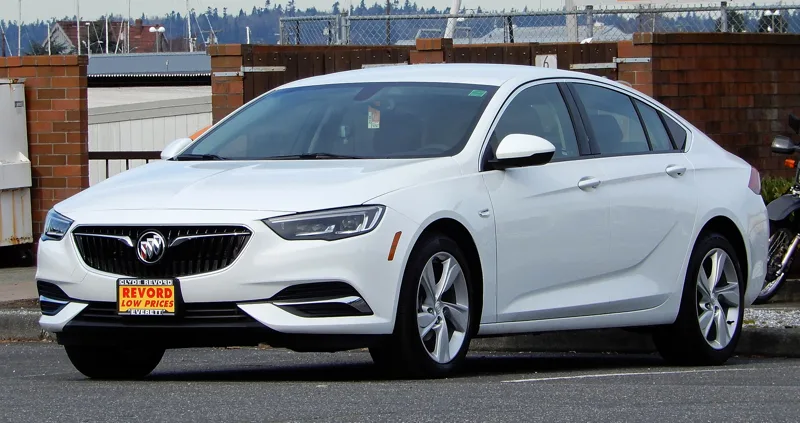
Stylists were hooked on aviation anyway. Tailfins arrived in the mid-1950s and were on their way out by the early 1960s, and the wasp-waisted fighters of the day, the Northrop F-5 among them, supplied the next idea. The Avanti and the 1963 Buick Riviera, a pioneering personal luxury car, carried rounded panels with arcs over the wheelwells, so that they looked like bottles of Coke laid on their sides. The 1962 Pontiacs had a subtle crease along the body and a slight constriction at the doors that swelled again at the rear quarters. The first Chevrolet to use it was the 1963 Corvette Sting Ray, shaped under Bill Mitchell. The 1962 to 1968 versions, with a long bonnet and powerful wheel arches, have been likened to a bottle of Coke on wheels.
By 1966 General Motors' A-body sedans had a pinched mid-riff and raised fenders. The 1968 to 1970 Dodge Charger and Ford Torino followed, as did small cars like the Ford Maverick and Plymouth Duster, and GM styled its B-body full-size cars of 1965 to 1968 the same way, most obviously on the fastback two-door hardtops. Muscle cars of the era wore it too, including the Pontiac GTO, Camaro and Charger.
The look spread so widely that critics noticed. American Motors' all-new 1967 Rebel was accused of being hard to tell from its General Motors, Ford and Chrysler rivals unless you were a car buff. AMC's own finding was more practical: rounded panels were easier to make than slab sides with deep ridges, and the dies lasted longer, which mattered for cost.
Abroad, Japanese, European and Australian makers adopted it in the late 1960s and into the 1970s. Toyota's limited-production 2000GT of 1967 had a flowing, Coke bottle shape, and the Corona Mark II of 1972 to 1976 and the Celica followed. Nissan applied it to the 1970s Cedric, Gloria, Laurel, Bluebird and Violet, and Mitsubishi to the 1973 to 1980 Galant and 1973 to 1979 Lancer. The smallest car with the look is usually taken to be the 1967 Suzuki Fronte 360, under 3 m (10 ft) long, while the Subaru 360 shared its curvaceous belt line.
The fashion ended in the late 1970s and early 1980s, when the Ford Fairmont and Chrysler's K-cars turned to straight lines. The Audi 100 of the C3 generation and the Ford Taurus then led towards functional, aerodynamic shapes.
A shape built to cut drag at 575 mph ended up on cars that never came close.
Cab forward design: moving the cabin to the front of the car
Cab-forward describes a vehicle whose driver's compartment sits well ahead of where it normally would. In a car it means more passenger space for a given size. AMC's Pacer of 1975 was the first modern mass-produced American car with the layout, and Chrysler built a range around it from 1993.
AMC did not call the Pacer cab-forward, but the passenger compartment sat farther forward than usual, with the A-pillars moved up and the windshield running over part of the engine bay. Chrysler adopted the term in 1992, for the first time on a full-size car. Its cars pushed the cabin forward so that the front wheel arch met the front edge of the doors, and the windscreen extended over the engine. The rear wheels went to the back corners. Moving the wheels outwards gave designers a bigger interior along with a better ride and cornering.
Chrysler marketed the LH cars, the JA and JR cloud cars and the PL-platform Neon as cab-forward, all built between 1993 and 2004. On the Dodge Stratus and Chrysler Cirrus the bonnet measures wider than its length, the result of an engineering target to pack the engine and all else ahead of the cabin into a much smaller space. Designers then shaped the body to give more interior room than rivals in the class.
The idea has a second life in trucks. Telo Trucks showed the Telo MT1 in 2023, an electric pickup. Its compact cab-forward layout, unlike some big commercial vehicles and Japanese kei trucks, does not sit the cab over the axle, which frees up cabin space.
The phrase is older than the car, though. On railways, a cab-forward locomotive puts the crew at the front, ahead of the boiler. Southern Pacific ran 256 oil-burning Mallet-type cab-forwards because its route over the Sierra Nevada passed through 39 long tunnels and nearly 40 miles (64 km) of snow sheds, where a conventional locomotive's exhaust blew back onto the crew. When crews came close to suffocating they ran engines backwards, tender first, which blocked the view ahead. The cab-forward cured both problems, and the view from the cab was superb. The only cab-forward not scrapped, number 4294, was built in 1944 as Southern Pacific's last new steam locomotive and is kept at Sacramento's California State Railroad Museum.
Cab over design: when the driver sits on top of the engine
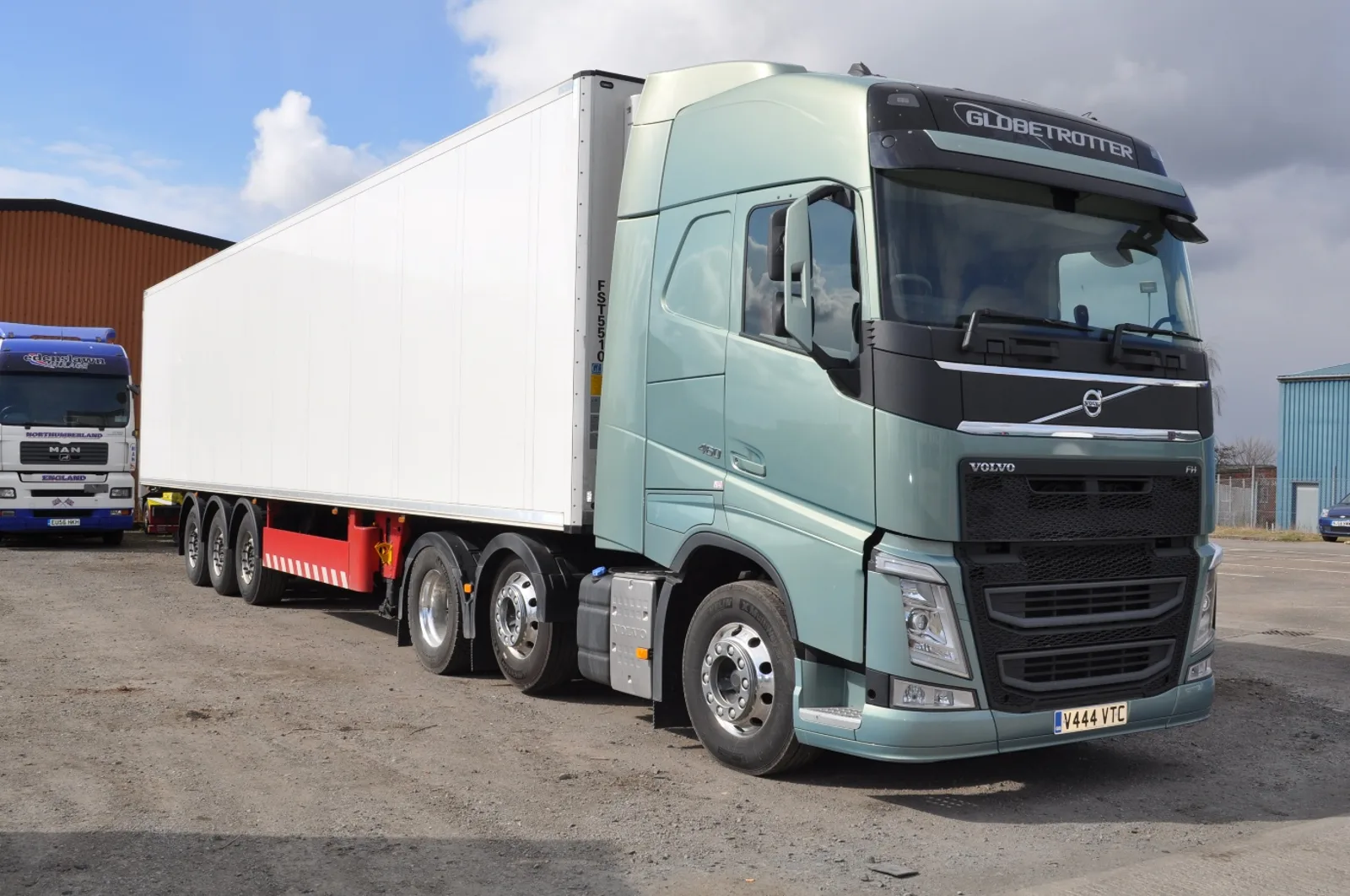
Cab-over, also called cab over engine or COE, flat face in America, flat nose in Canada and forward control in Britain, is a body style with a vertical front and the cab above or ahead of the front axle. A conventional truck, by comparison, puts the engine ahead of the driver. Jeep's Forward Control used the idea to set a record for pickup box length on a short wheelbase.
Regulation shaped it. European length rules allow a cab of 2.35 m alongside the longest permitted load area, and the layout is common among European and Asian truck makers. Scania, the last European maker of conventional trucks, stopped building them in 2005 after sales fell to under 1000 units worldwide. In the United States cab-overs boomed in the 1970s because many states had strict length laws, and faded when those laws were repealed. The Federal Bridge Formula also pushed against them, because it rewards spreading axles apart, and for a truck at maximum weight that meant an axle right behind the bumper. Drivers had to climb in behind the front wheel and then move forward to the seat. Even so, cab-overs remain common in American refuse collection and terminal tractors, where a tight turning radius matters, and in light and medium-duty work, where Hino, Isuzu and Mitsubishi Fuso are familiar sights. Paccar, which owns Kenworth and Peterbilt, builds them for Australia and South Africa, where length limits still favour them.
The history goes back to the earliest trucks. A Daimler delivered to London in 1896, Order No. 81, is considered the world's oldest truck and has what is basically a cabin over the engine, though it had no roof, doors or windscreen. Autocar built the first American truck in 1899 with the engine under the seat. Credit for the first modern American cab-over goes to industrial designer Viktor Schreckengost and engineer Ray Spiller, who designed one for the White Motor Company in 1932. Highway length was limited to 42 feet (12.8 m) at the time. Putting the cab over the engine and axle saved several feet that could go to the trailer, and Schreckengost patented the design in 1934. Raymond Loewy later designed the Metro vans and trucks for International Harvester. White-Freightliner introduced a tilting cab-over in 1958 so that the whole cab could swing forward for engine access.
The benefits are practical. A shorter wheelbase means a shorter truck and a longer trailer, and with no bonnet the driver sees more and turns tighter. Cab-overs are generally lighter, so they can often haul more at the same weight rating. The costs are a rougher ride, because the seat is above the front axle, and noise. In the 1970s a cab-over's interior noise ran between 80 and 90 dB(A), an unhealthy level. Early cab-overs also had worse aerodynamics than conventional trucks, and modern ones often still have higher drag. A tilting cab sends loose items in the cab sliding onto the windscreen, and a fixed cab needs floor panels to reach the engine. Mercedes-Benz was the last European maker to use floor panels, producing such cabs well into 1983.
Safety evidence is mixed in a useful way. Rollover is the leading cause of casualties among truck occupants, and engine position does not change the result much. Volvo performed the first mechanised truck cab crash test in 1959, adopted in 1974 as ECE R-29, and by the early 1980s a European truck, usually a cab-over, was the safest place for a driver. In military use, though, a cab-over raises the risk of injury if the vehicle runs over a landmine, because the tyre that sets off the mine is right below or beside the driver.
Opera window car: the small window with a carriage past
An opera window is a small, fixed pane set behind a car's rear side window, usually in the C-pillar within a padded vinyl section of roof. The detail comes from small windows in the folding fabric tops of horse-drawn carriages, and it was popular on American cars, and some Japanese ones, in the 1970s and early 1980s.
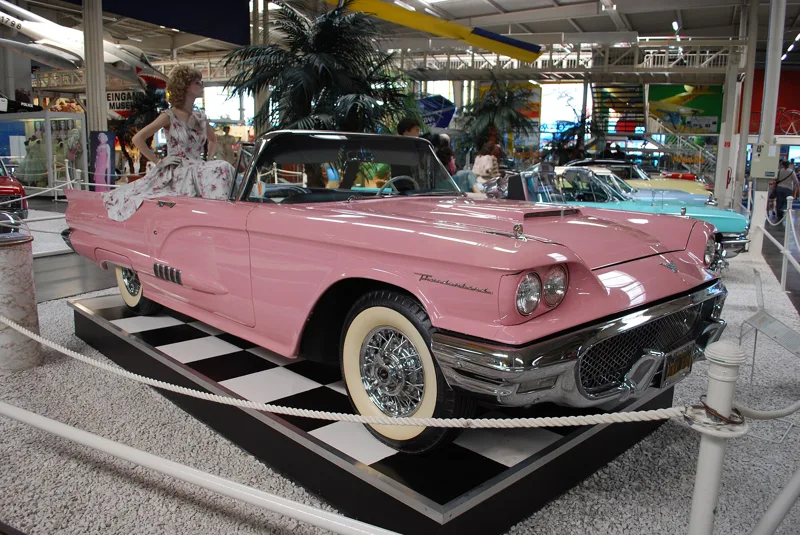
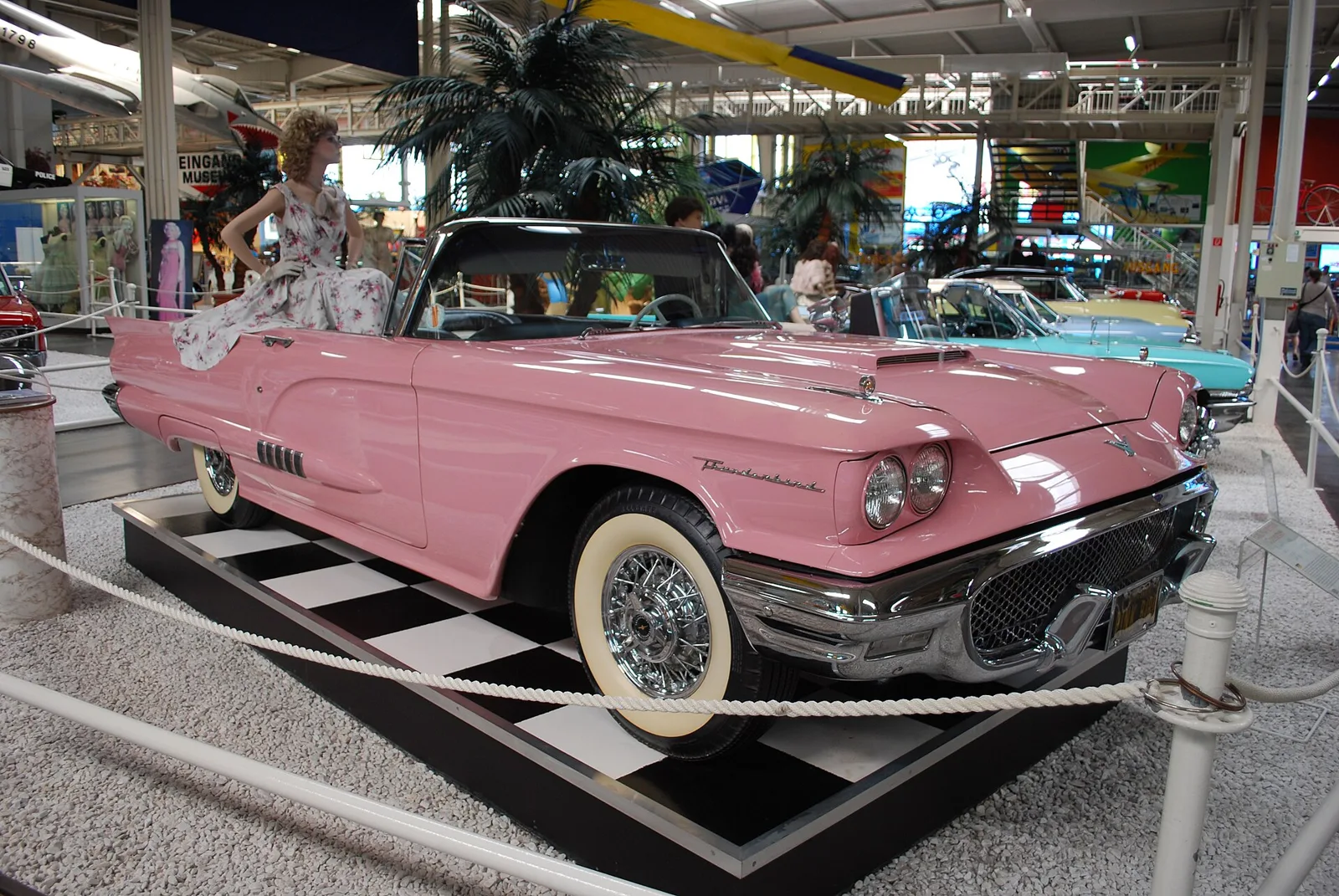
The name comes from "opera" vehicles of around 1915 that had occasional collapsible seats for extra passengers. Limousines and formal-roof models also had higher roofs so that passengers in top hats could sit comfortably. The Elcar of 1924 had a fabric top with oval opera windows, but the idea disappeared in the 1930s. The most famous return was the porthole on the 1956 and 1957 Ford Thunderbird, an option meant to help drivers see out of the rear quarter when the hardtop was fitted.
In the early 1970s the opera window came back, on the 1972 Continental Mark IV. Almost every personal luxury car took it up, usually framed by a vinyl roof, and it spread from economy compacts to flagship coupes, where it served as a recognition element and a vintage touch. General Motors' mid-size Colonnade models of 1973 had a fixed triangular rear quarter window on all coupes, and a rectangular upright opera window on higher trim levels. Some cars added an opera light on the B-pillar or C-pillar that lit up with the exterior lamps.
The windows helped a little. They offset the blind spots from the wide C-pillars of American cars, and on two-door cars whose rear side windows no longer opened, they may have made rear passengers feel less boxed in. They were normally non-functional. The unusual exception came in NASCAR: roll-down quarter windows on the AMC Matador coupe caused aerodynamic drag, so Penske Racing asked AMC for a small porthole to calm the airflow. NASCAR needed 500 units available to the public to qualify it as a stock item. The window first appeared as part of the D/L Formal Window Package on Brougham models and later as standard equipment on the Barcelona II trim.
- American luxury cars: Continental Mark IV, V and VI (1972 to 1983), Cadillac Eldorado (1971 to 1978), Chrysler Cordoba (1975 to 1983), Lincoln Town Car (1981 to 1997).
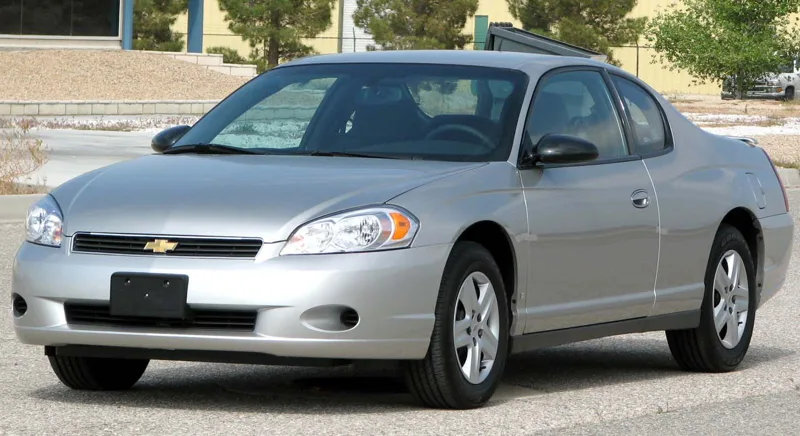
- Everyday coupes: Chevrolet Monte Carlo (1973 to 1977 and 1981 to 1988), Ford Thunderbird (1956 to 1957, 1973 to 1982 and 2002 to 2005), AMC Concord and AMC Eagle.
- Japanese examples: Daihatsu Charade Runabout (1978 to 1983), Mazda Cosmo (1975 to 1980), Nissan Silvia S110 (1979 to 1983), Toyota Crown coupe (1979 to 1983).
The four car design terms side by side
| Term | What it describes | Where it started | Best-known period | Examples |
|---|---|---|---|---|
| Coke bottle | Narrow centre between flaring fenders | Fighter jet fuselages; 1962 Studebaker Avanti | 1960s into the 1970s | Buick Riviera, Corvette Sting Ray, Camaro, Charger |
| Cab-forward | Cabin placed well forward of normal | Locomotives; AMC Pacer in 1975 | Chrysler cars of 1993 to 2004 | Dodge Stratus, Chrysler Cirrus, Neon, Telo MT1 |
| Opera window | Small fixed window in the C-pillar | Horse-drawn carriages; around 1915 | 1970s and early 1980s | Continental Mark IV, Cordoba, Monte Carlo, Thunderbird |
| Cab-over | Cab above or ahead of the front axle | Daimler truck of 1896 | 1970s in the United States | Autocar, Hino, Isuzu, Mitsubishi Fuso |
What does each term tell you about a vehicle?
Coke bottle styling tells you the car is from roughly the 1960s or 1970s and that its shape is for show rather than speed. An opera window points to an American personal luxury car, and it is usually a fixed pane with no function beyond light and a little visibility. Cab-forward on a Chrysler of the 1990s means more interior room for the car's size.
For a truck, a cab-over is a trade. It gives a tight turning circle and good visibility, but a rougher ride and more cab noise than a conventional layout.
Where these styling ideas stand today
Coke bottle styling gave way to straight lines in the late 1970s and early 1980s. Opera windows lasted longer than the fashion, with the Lincoln Town Car carrying them until 1997 and the Ford Thunderbird listed with them again from 2002 to 2005. Cab-forward is still being explored, as the Telo MT1 shows in 2023, and the cab-over layout remains common among European and Asian truck makers.