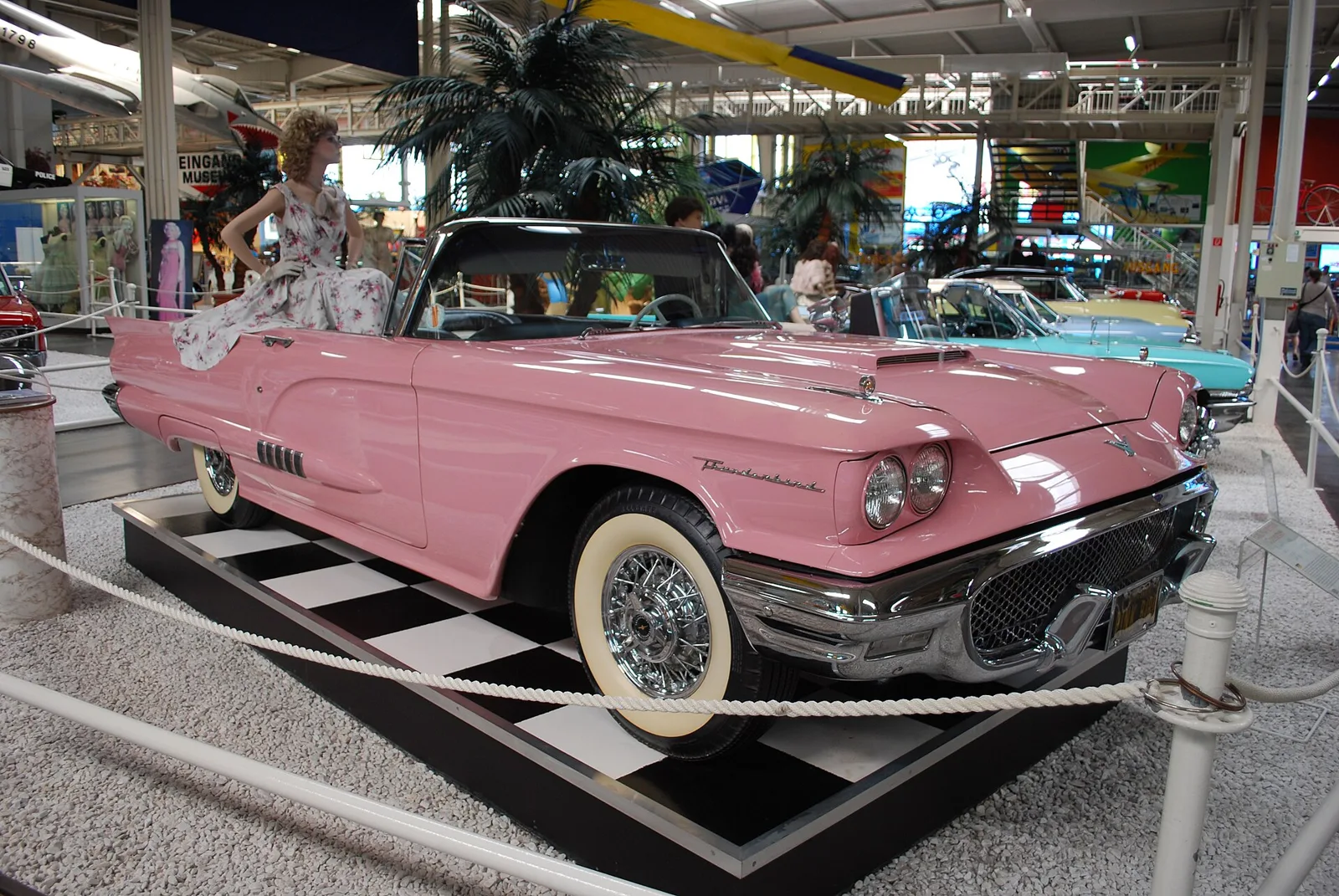
A Thunderbird with a back seat set the formula; a knife-edged 1963 Riviera and a front-wheel-drive 1966 Toronado gave General Motors its answer.
A personal luxury car is a North American mass-market coupe that put comfort ahead of performance. The segment is generally dated to the four-seat 1958 Ford Thunderbird. General Motors answered with the 1963 Buick Riviera and the front-wheel-drive 1966 Oldsmobile Toronado.
In 1958 Ford took the two-seat Thunderbird, added a back seat, nudged it from sport towards comfort, and sold approximately four times as many over the next three years as the two-seater had managed. Detroit had found a formula, and it spent the next two decades rewriting it.
General Motors answered the Thunderbird in 1963 with the Buick Riviera, a rear-drive coupe styled from the ground up. Three years later Oldsmobile launched the Toronado, the first American front-wheel-drive car since the 1930s. Between them, those two cars show what a personal luxury car was supposed to be and how far makers were willing to go to build one.
What is a personal luxury car?
Personal luxury car is a North American classification for somewhat sporty, sophisticated mass-market coupes that emphasised comfort over performance. Typical cars were two-door coupes or convertibles with a small rear seat not meant for adults on regular trips, and they carried more interior equipment than other models, sometimes features that were not available elsewhere.
Where the European grand tourer put high-speed performance first, the American version usually blunted it, pairing large engines with heavy bodies. The cars were mass-produced and often borrowed major mechanical components from other models to hold costs down. Makers combined engineering, design and marketing to turn these shared platforms into distinctive and highly profitable cars.
Buick limited the first Riviera to 40,000 cars a year on purpose, in a year it sold 440,000 Buicks.
Before the label: quasi-custom luxury in the 1950s
Luxury coupes had been built in North America for decades, but the 1950s versions were expensive, low-volume and niche. Marketers called them "quasi-custom" and sold them as sports cars, a label stretched to cover any car with a folding roof, plenty of speed, a few unusual styling touches and the highest price in the range. The group took in the Cadillac Eldorado, the Buick Skylark, the Oldsmobile Fiesta, the Chrysler 300 and the Packard Caribbean, among others. All were two-door convertibles or hardtops on platforms shared with far cheaper cars, and their styling has been described as "baroque excess".
Numbers were tiny. In 1953 the Eldorado made up 0.5 percent of Cadillac's sales, and buyers took 1,690 Buick Skylarks, 458 Oldsmobile 98 Fiestas and 750 Packard Caribbeans.
The Continental Mark II of 1956 took the idea to its extreme. At roughly US$10,000 (US$118,421 in 2025 money) it cost about as much as a Rolls-Royce Silver Cloud, and 3,012 were sold from 1955 until 1957. Standard equipment included power steering, brakes, windows, seats and vent windows, leather trim and a tachometer. Only one option existed, air conditioning at US$595.
The Ford Thunderbird writes the formula
Ford and General Motors both set out in the early 1950s to answer the rising popularity of European sports cars. The results were the Ford Thunderbird, the Studebaker Speedster and the Chevrolet Corvette. The Thunderbird of 1955 was a two-seat V8 with a suspension tuned for comfort rather than handling, sold as a convertible or a roadster with a removable hardtop. Its top speed of 200 km/h (124 mph) was comparable to many European grand tourers.
Buyers preferred the Thunderbird's sporty luxury to the spartan Corvette. In 1955 Ford sold 16,155 Thunderbirds against 674 Corvettes, 809 Chrysler 300Ds and 2,200 Studebaker Speedsters. For 1958, after market research found the two-seat layout was limiting sales, Ford redesigned it with a rear seat and a choice of fixed hardtop or convertible. It became the first volume personal luxury car, sold 198,191 over three model years and took Motor Trend's 1958 Car of the Year title.
Buick Riviera 1963: General Motors answers
By the late 1950s General Motors had nothing to rival the Thunderbird or the Chrysler 300C. Cadillac built an experimental car, the XP-715, which took the nickname "LaSalle" from an old GM luxury marque. Reportedly, its angular look came from GM styling chief Bill Mitchell's trip to London, where he was struck by a custom-bodied Rolls-Royce, and he asked for "knife-edged" styling on a lower body. Ned Nickles drew it.
Cadillac passed on the project in 1960 and GM threw it open to the other divisions. Buick, desperate to revive flagging sales, won by hiring the McCann-Erickson advertising agency to build its presentation. The finished design was fitted to a shortened version of Buick's cruciform frame.
The Riviera name already had a history at Buick. Italian for coastline, it was chosen in 1949 to evoke the allure of the French Riviera, first for a two-door pillarless hardtop described as "stunningly smart". In the 1950s it was applied to long-wheelbase sedans and to hardtop body styles, and it served as a trim level until 1963, the year the model we know arrived.
Buick Riviera 1963: design and engineering
The production car was introduced on 4 October 1962 as a 1963 model, with a bodyshell unique to Buick, which was unusual for a GM product. Its hidden headlights were less expensive than the original design, and it borrowed the tapered midsection and flared fenders of the "Coke bottle look" seen the year before on the Studebaker Avanti.
It rode on a cruciform frame similar to Buick's standard chassis, but shorter and narrower. The wheelbase of 2,970 mm (117.0 in) and overall length of 5,280 mm (208.0 in) were slightly longer than a contemporary Thunderbird. At 1,813 kg (3,998 lb) it was about 180 kg (390 lb) lighter than either that car or the Buick LeSabre. Power brakes with huge finned aluminium drums of 300 mm (12.0 in) were standard, as was power steering at a ratio of 20.5:1, or 3.5 turns lock to lock.
The 401 cu in (6.6 L) "Nailhead" V8 produced 325 hp (242 kW) and was the only engine at first, paired with a twin-turbine automatic of continuously variable design. Buick announced an optional 340 hp (254 kW) 425 cu in (7.0 L) version in December 1962. Base price was US$4,333 (US$46,119 in 2025 dollars), and typical options took it above US$5,000.
Buick deliberately limited production to 40,000 cars, in a year when it sold 440,000 Buicks overall, to emphasise exclusivity and push up demand. Only 2,601 cars got the larger engine in 1963.
On the road, Motor Trend recorded 0-60 mph (97 km/h) in 8 seconds or less, the standing quarter mile in about 16 seconds and a top speed of 115 mph (185 km/h), with fuel consumption of 13.2 mpg-US (17.8 L/100 km). Contemporary testers rated it among the most driveable American cars, balancing comfort and agility well, though it still leaned towards understeer. Inside was a four-place cabin with bucket seats front and rear and a console, while options included a tilt wheel, power windows, a power driver's seat and air conditioning.
Buick changed little for 1964 beyond a raised stylised "R" hood emblem, the arrival of a Super Turbine 400 three-speed gearbox, and a 340 hp 425 as the standard engine, plus a 360 hp (268 kW) "Super Wildcat" option with two four-barrel carburettors. For 1965 the 401 returned as the base engine and the Gran Sport made its debut with the Super Wildcat, a tighter axle ratio and larger exhausts. The headlamps were now hidden behind clamshell doors, the taillights moved into the rear bumper, and a tilt steering wheel became standard.
How the 1963 Riviera was received
The first-generation Riviera sold 112,244 units from 1963 to 1965, made up of 40,000 for 1963, 37,658 for 1964 and 34,586 for 1965. The motoring press treated it as a great success, and it became the first serious challenger to the Thunderbird at the top of the class.
Sir William Lyons, the founder of Jaguar, said Mitchell had done a "very wonderful job", and Sergio Pininfarina called it one of the most beautiful American cars ever built. Raymond Loewy said it was the most handsome American production car at its Paris debut, apart from his own Avanti. The Milestone Car Society has since given it Milestone status, and the car is regarded as a styling landmark and a collectible.
Studebaker Avanti and the other 1960s rivals
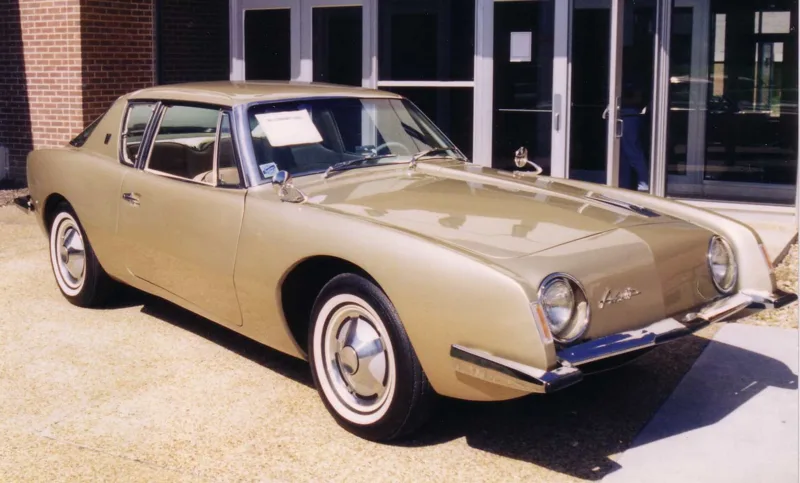
Two rivals shown at the Paris Motor Show in October 1962 followed the Thunderbird's formula of a close-coupled four-seat coupe with a powerful engine. The Studebaker Avanti had a fibreglass body, an optional supercharged engine and front disc brakes, and was sold as "America's only four-passenger high-performance personal car". Studebaker built 4,647 before ending production for 1964. The other was the Riviera.
Others joined. American Motors' first personal luxury car was the intermediate 1965 Rambler Marlin, with a fastback roofline running down to the rear bumper. The Dodge Charger of 1966 was still classed as a "specialty car", not a muscle car, but it had premium trim. Up to 1967, personal luxury cars shared that specialty label with muscle cars and pony cars, each aimed at narrow market niches with long lists of options.
Oldsmobile Toronado 1966: front-wheel drive returns
The Toronado started in 1962 as a painting by the Oldsmobile stylist David North, a compact sports and personal car called the "Flame Red Car" that was never meant for production. A few weeks after he finished it, Oldsmobile learned it would be allowed to build a personal car in the Riviera and Thunderbird class for 1966, and North's design was chosen.
For production economy the car had to share the E-body shell with the redesigned 1966 Riviera, which was substantially larger than North had pictured. Oldsmobile and Bill Mitchell tried to put it on the smaller A-body used by the Cutlass but were overruled on cost grounds. The name "Toronado" had no prior meaning and had first been picked for a 1963 Chevrolet show car.
The Unitized Power Package
The Toronado's real headline was under the skin. Oldsmobile had worked on front-wheel drive since 1958, a project led by engineer John Beltz. The result was a Unitized Power Package, which placed a Rocket V8 and its transmission in an engine bay no bigger than that of a conventional rear-drive car. Its seven-year development included more than 1.5 million test miles, and it proved so strong that it was used essentially unchanged in the 1970s GMC motorhome.
In the automatic, which was called the TH425 in its front-drive form, the torque converter sat apart from the planetary gearset and drove it through a 2 in (51 mm) wide silent chain called Hy-Vo. Oldsmobile saw no need for a manual: performance was adequate with the automatic, and virtually every American luxury car of the period came with one.
Power came from a tuned 425 cu in (7 L) Super Rocket V8, good for 385 hp (287 kW) and 644 Nm (475 lb ft). Firestone designed a special tyre, the TFD, with a stiffer sidewall and a thin white pin-stripe. At the front, torsion bars were the first use of that type of spring on a GM passenger car in the US, and a subframe carried the powertrain, front suspension and floorpan, isolating road and engine harshness.
Published test data shows the Toronado reaching 0-60 mph (97 km/h) in 7.5 seconds, the quarter mile in 16.4 seconds at 150 km/h (93 mph) and a maximum of 217 km/h (135 mph), despite an average weight of 2,041 kg (4,500 lb). Testers found notable understeer from the front weight bias but felt the car was more poised and responsive than other big American cars, and essentially incapable of terminal oversteer.
The weak link was the 279 mm (11 in) drum brakes, which overheated and faded after several panic stops. Vented front discs, added as an option for 1967, improved matters considerably. The front-drive layout gave a completely flat floor, though fastback styling cut rear headroom. Long doors, with extra latch handles at the back so rear passengers could open them, eased entry, and the speedometer was an unusual "slot-machine" design with a stationary needle and a rotating drum.
How the Toronado was received
The 1966 Toronado was widely recognised as a step forward in design. Awards followed: Motor Trend named it Car of the Year, Car Life honoured its engineering, and it came third in the 1966 European Car of the Year voting. Oldsmobile built 40,963 for 1966, using former NASA public affairs officer John "Shorty" Powers and racing driver Bobby Unser in commercials.
Sales fell by nearly half to 22,062 for 1967, a year that brought a slight facelift, optional disc brakes and a softer ride, and the first-year volume was not matched until 1971. Cadillac meanwhile adopted its own version of the power package for the 1967 Eldorado. The three E-body cars looked entirely different, and the Riviera kept rear-wheel drive until the platform was downsized in 1979.
From 1968 a 455 cu in (7.5 L) V8 replaced the 425, rated at 375 hp (280 kW) or 400 hp (298 kW) with the W-34 option. W-34 added cold-air induction, a performance camshaft and a quick-shifting "GT" transmission, and could reach 60 mph in 7.5 seconds. Hidden headlights disappeared for 1970. The second generation of 1971 moved the Toronado from a GT-style car towards a traditional luxury car, closer to the Eldorado, and sales increased dramatically. It grew a longer 122 in wheelbase, switched to body-on-frame construction and coil springs at the rear, and gained two high-mounted taillights.
Riviera and Toronado compared
| Model | Drive | Engine | Power |
|---|---|---|---|
| Buick Riviera 1963 | Rear-wheel | 401 cu in (6.6 L) Nailhead V8 | 325 hp (242 kW) |
| Buick Riviera Gran Sport 1965 | Rear-wheel | Super Wildcat V8 | 360 hp (268 kW) |
| Oldsmobile Toronado 1966 | Front-wheel | 425 cu in (7 L) Super Rocket V8 | 385 hp (287 kW) |
| Buick Riviera 1967 | Rear-wheel | 430 cu in (7.0 L) V8 | 360 hp (268 kW) |
| Oldsmobile Toronado W-34 1968 | Front-wheel | 455 cu in (7.5 L) V8 | 400 hp (298 kW) |
The personal luxury car in the 1970s
When insurance costs and emissions rules hit muscle cars in the early 1970s, buyers shifted from performance to comfort, and the personal luxury segment surged. The 1973 and 1979 oil crises then undercut demand for cars with poor fuel economy. Pontiac's Grand Prix, downsized for 1969, had sold more than 112,000 cars against 32,000 for the full-size 1968 model, and other GM divisions followed in 1970 with the Chevrolet Monte Carlo and the Oldsmobile Cutlass Supreme coupe. Their arrival cut the Grand Prix's sales by 40 percent, and commentators say Chevrolet and Pontiac brought the class to a mass audience.
Ford fought on with the Continental Mark III, which sold 30,858 cars in the extended 1969 model year against 23,333 for the Eldorado, and with a bigger Thunderbird in 1972. Mercedes-Benz found a North American audience with the 450SL and SLC, building 237,287 and 62,888, with about two-thirds officially sold there. Chrysler entered with the mid-size Cordoba in 1975, and the Monte Carlo and the Cordoba were that year's two best-selling personal luxury cars. By 1978 even Plymouth's rebadged Mitsubishi Sapporo was marketed in the class.
What happened to the Riviera, Toronado and the class?
The late 1970s brought downsizing. Many personal luxury cars were now mid-size, with six-cylinder engines and front-wheel drive, and by the 2000s the segment had faded as consumers moved to other types of vehicle. The Thunderbird ran for eleven generations until the 2005 model year, and the Eldorado had a 50-year run from 1953.
The Oldsmobile Toronado was built from 1966 to 1992, over four generations. The Buick Riviera ran from 1963 to 1999, except for the 1994 model year, with 1,127,261 built in all and front-wheel drive from the 1979 model year. Buick revived the Riviera name for two concept cars, shown in 2007 and 2013.