The 1953 Corvette was nearly shelved after two weak years. A V8, an engineer from Brussels and a rival's two-seater changed the story.
The Chevrolet Corvette began in 1953 as a fibreglass-bodied six-cylinder roadster and was nearly cancelled before the 1955 V8 and engineer Zora Arkus-Duntov rescued it. It stayed front mid-engined for seven generations, C1 to C7, and became rear mid-engined with the C8, which went into production in February 2020.
The first Chevrolet Corvette took 11.5 seconds to reach 60 mph (97 km/h), had no manual gearbox and no roll-up windows, and General Motors came close to killing it. It survived and ended up as a rear mid-engined machine that GM unveiled in 2019.
Where did the Corvette come from?
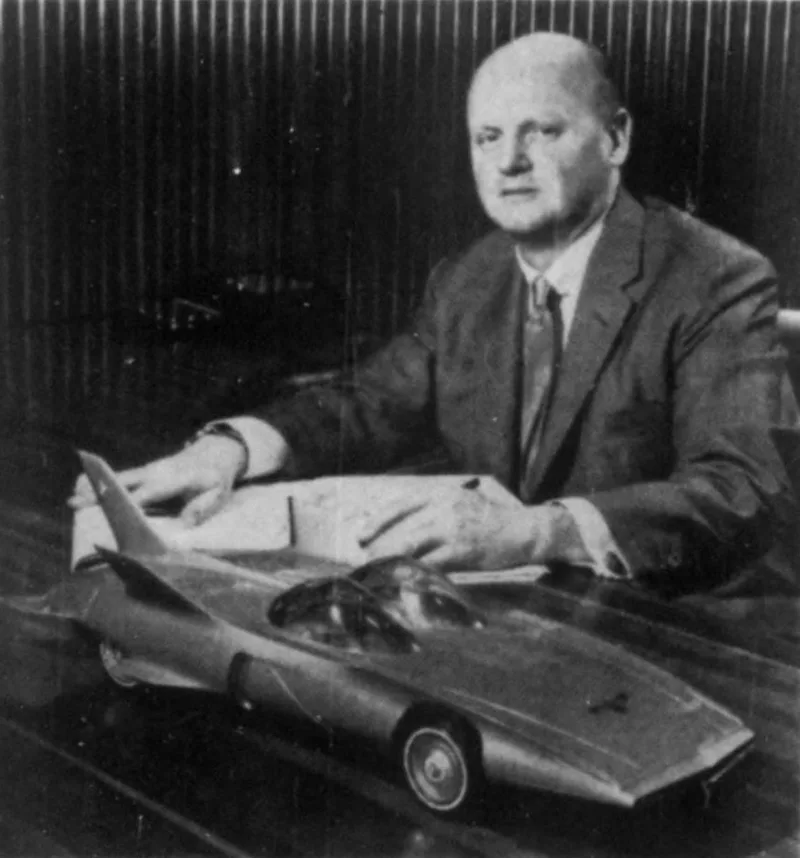
From the enthusiasm of one stylist. Harley Earl, head of GM's Styling Section, noticed that ex-servicemen coming back from overseas had started importing MGs, Jaguars and Alfa Romeos, and that hardly any moderately priced two-seaters existed to compete. He convinced GM to build an all-American one and began work with his Special Projects crew in late 1951.
The effort was secret and code-named Project Opel. It produced a hand-built prototype, the EX-122, shown at the General Motors Motorama at New York's Waldorf-Astoria on 17 January 1953. Thomas H. Keating, the Chevrolet general manager, judged it six months to a year short of production readiness, but public interest was strong enough that mass production began on 30 June 1953. The car had grown costlier on the way: it sold for US$3,513 against the US$2,000 roadster that Earl had first imagined.
Myron Scott, assistant director of Public Relations, proposed the name. He suggested the corvette, a small and nimble warship, and the executives agreed.
Why fibreglass?
The body was made of glass-fibre reinforced plastic, with the reinforcement placed by hand. Steel shortages are sometimes blamed, but Chevrolet had built nearly two million steel-bodied cars in the previous two calendar years. Body engineer Ellis James Premo told the Society of Automotive Engineers in 1954 that the show car's plastic body had been an expedient and that engineers were working on a steel body for a planned 10,000 cars in 1954 when the plastic plan took hold.
Zora Arkus-Duntov was the engineer who turned a lacklustre roadster into a credible performer.
What was wrong with the first Corvettes?
The performance did not match the looks. Underneath was a stretched Chevrolet chassis from the 1949 to 1954 cars, with the drivetrain moved back for 53/47 weight distribution on a 102 in (2,591 mm) wheelbase. The 235 cu in (3.85 L) inline six had three Carter carburettors and made 150 hp (112 kW), and the only gearbox was a two-speed Powerglide automatic, because no manual then available to Chevrolet could handle that much power.
Early build quality was poor. The 1953 cars, 300 of them assembled largely by hand at a makeshift line in a disused Flint truck plant, all wore Polo White paint over red interiors, and each differed slightly from the next. Owners reported leaks, and doors that could open while driving. By December 1953 a new factory in St. Louis was ready to make 10,000 a year, but customer reaction held sales far below that.
The 1954 figures were worse. Chevrolet built 3,640 and nearly a third went unsold. An October 1954 Popular Mechanics survey of owners found that 36% had previously owned a foreign sports car. Half of that group thought the Corvette better, 19% called it equal and 22% judged it inferior. The chief complaint was water leaking in the rain. A Paxton supercharger offered as a dealer option helped straight-line speed, yet sales kept falling.
How did the Corvette escape cancellation?
Three developments saved it, all arriving in 1955. The first was the arrival of the first Chevrolet V8 in decades. The second was the influence of Zora Arkus-Duntov. The third was Ford's launch of a two-seat Thunderbird, which meant GM could not be seen to back down from the rivalry.
The 265 cu in (4.3 L) small-block V8 made 195 hp (145 kW) and cut around 3 seconds from the 0 to 60 mph time. A three-speed manual became available mid-year, though only about 75 buyers took one. Production in 1955 was limited to 700, leaving the car second only to 1953 in scarcity, while rivals multiplied that year in the shape of the Thunderbird, the Studebaker Speedster and the bigger Chrysler C-300.
Chevrolet then held on to the chassis. The basic design carried through 1962, even after the full-size cars were redesigned in 1955, because re-engineering a low-volume car was expensive, cancellation still seemed possible and the new suspension was too heavy for the Corvette.
What did Zora Arkus-Duntov change?
He turned a lacklustre roadster into a credible performer. Born in Brussels on 25 December 1909 to a Russian family, he trained in Berlin and in 1947 introduced aluminium overhead-valve cylinder heads for the flathead Ford V8 through the Ardun company he founded with his brother. He co-drove an Allard at Le Mans in 1952 and 1953, then took class wins in an 1100 cc Porsche 550 RS Spyder there in 1954 and 1955.
Duntov joined Chevrolet on 1 May 1953 after seeing the Motorama Corvette. He admired the styling but not the hardware beneath it, and wrote to chief engineer Ed Cole to say so. He pushed through the V8 and the three-speed manual, then climbed Pike's Peak in a pre-production Bel Air in 1956 to set a stock car record and drove a Corvette at Daytona Beach to a record 150 mph (240 km/h) over the flying mile. He designed a high-lift camshaft, helped fuel injection reach the Corvette in 1957, and gets credit for America's first series-built car with four-wheel disc brakes. In 1957 he became Director of High Performance Vehicles.
He is called the Father of the Corvette, but he was not its inventor; that title belongs to Earl. He clashed with Bill Mitchell over the 1963 Sting Ray, whose rear window was split by a central pillar. Duntov felt it blocked the driver's view, and a one-piece window replaced it in 1964.
The racing programmes
Duntov's Corvette SS of 1956 and 1957, a magnesium-bodied racer, was rushed to Sebring and retired on lap 23 with suspension and other problems after driver John Fitch struggled with the brakes. Then a 1957 agreement among American makers to stay out of racing ended factory support, and in 1962 GM made the policy mandatory for its brands.
That same year, once Ford had withdrawn from the ban and launched its Total Performance programme, Duntov's Grand Sport was approved. The aim was a lightweight Corvette to take on the Shelby Cobra and the prototypes of Ferrari, Ford and Porsche, using an aluminium small-block of 550 hp at 6400 rpm and a body trimmed from 3,199 lb (1,451 kg) to 1,900 lb (862 kg). GM planned 100 to 125. Only five were built, raced by drivers including Roger Penske, A. J. Foyt, Jim Hall and Dick Guldstrand, and all five survive in private hands.
How did the C1 finish its run?
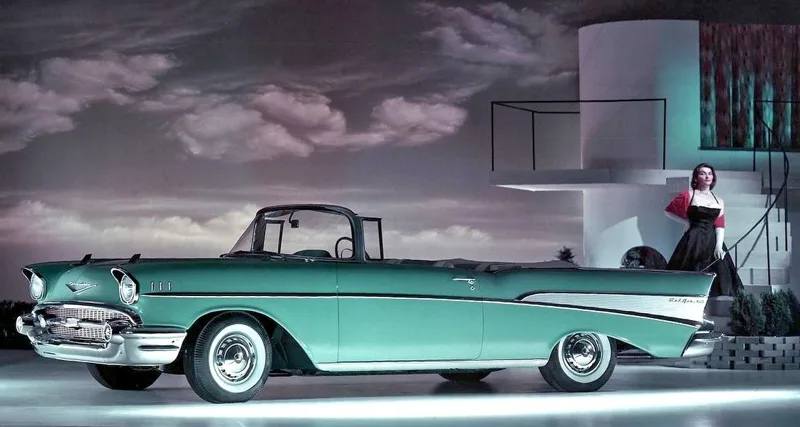
With a new body, real power and rising ambition. The 1956 car brought roll-up windows and a more substantial top, dropped the six and kept only the V8, at 210 to 240 hp (157 to 179 kW). Sales still slid to 3,467. In 1957 the V8 grew to 283 cu in (4.6 L) and a Rochester fuel-injection system delivered 290 hp (216 kW) at 6200 rpm, giving Chevrolet a one-horsepower-per-cubic-inch slogan. A four-speed manual followed on 9 April 1957.
The 1958 car gained quad headlamps and a dashboard with every gauge in front of the driver. The tapered tail with four round lights appeared in 1961 and lasted until 2014. For 1962 the engine was enlarged to 327 cu in (5.36 L) and 250 hp (186 kW), or 360 hp (268 kW) with fuel injection for 12% more than list price, which made it the fastest C1. It was also the last year for the solid rear axle and the convertible-only body.
What made the C2 Sting Ray different?
Almost everything under the skin. The second generation, built from 1963 to 1967, introduced the Sting Ray name and was smaller than its predecessor. It added the first Corvette coupe and independent rear suspension, plus hidden headlamps and a tapering rear deck. Larry Shinoda drew it, building on the "Q Corvette" concept by Peter Brock and Chuck Pohlmann under Mitchell, and on Mitchell's 1959 Sting Ray racer. Mitchell's third inspiration was a mako shark he had caught while fishing.
Power rose to 360 hp (268 kW) in 1963 and 375 hp (280 kW) in 1964. Four-wheel disc brakes and a 396 cu in (6.49 L) big block with 425 hp (317 kW) arrived in 1965, and a 427 cu in (7.00 L) followed in 1966. The big block ended fuel injection, which cost US$538.00 against US$292.70 for the 396 and offered 50 hp (37 kW) less; only 771 injected cars were built in 1965 before it was dropped.
The 1967 car offered the first L88 engine, listed at 430 hp (321 kW) but estimated unofficially at 560 hp (418 kW) or more, with only twenty fitted at the factory. Sales that year slipped more than 15% to 22,940, made up of 8,504 coupes and 14,436 convertibles. The Sting Ray's rear suspension also went to the Chevrolet Corvair, where it cured that rear-engined compact's quirky handling.
What happened to Corvette power in the C3 years?
It peaked, then collapsed under emissions rules. The third generation, introduced for 1968 and built until 1982, was patterned on the Mako Shark II concept and was the first Corvette with T-top roof panels. In 1969 the base engine became a 350 cu in (5.7 L) at 300 hp (224 kW), and an all-aluminium 427 cu in (7.00 L) ZL-1 was listed at 430 hp (321 kW) while reportedly producing 560 hp (418 kW) and covering the quarter mile in 10.89 seconds.
Small-block power peaked at 370 hp (276 kW) with the 1970 LT-1, and the big block grew to 454 cu in (7.44 L) with 390 hp (291 kW). Lower compression for low-lead fuel cut the 1971 base engine from 300 to 270 hp and the LT1 from 370 to 330 hp, though the LS6 454 was rated at 425 hp (317 kW). A switch to SAE net ratings in 1972 dropped the base engine to 200 hp (149 kW) on paper.
Catalytic converters in 1975 pushed outputs down further, to 165 hp (123 kW) for the base ZQ3 and 205 hp (153 kW) for the optional L82, while the 454 was discontinued. The L82 reached 230 hp (172 kW) in 1980. The 25th anniversary in 1978 brought a two-tone Silver Anniversary Edition and a replica of the Indianapolis 500 pace car, the first Corvette to lead that race.
Corvette generations at a glance
| Generation | Years | Defining change |
|---|---|---|
| C1 | 1953 to 1962 | Fibreglass body, solid rear axle; six then V8 |
| C2 | 1963 to 1967 | Sting Ray, coupe, independent rear suspension, big blocks |
| C3 | 1968 to 1982 | Mako Shark II shape, T-tops; power falls under regulations |
| C4 to C7 | 1983 to 2019 | Unibody Y-body platform; front mid-engine |
| C8 | 2020 onwards | Rear mid-engine, aluminium architecture |
How did the C8 Corvette break with tradition?
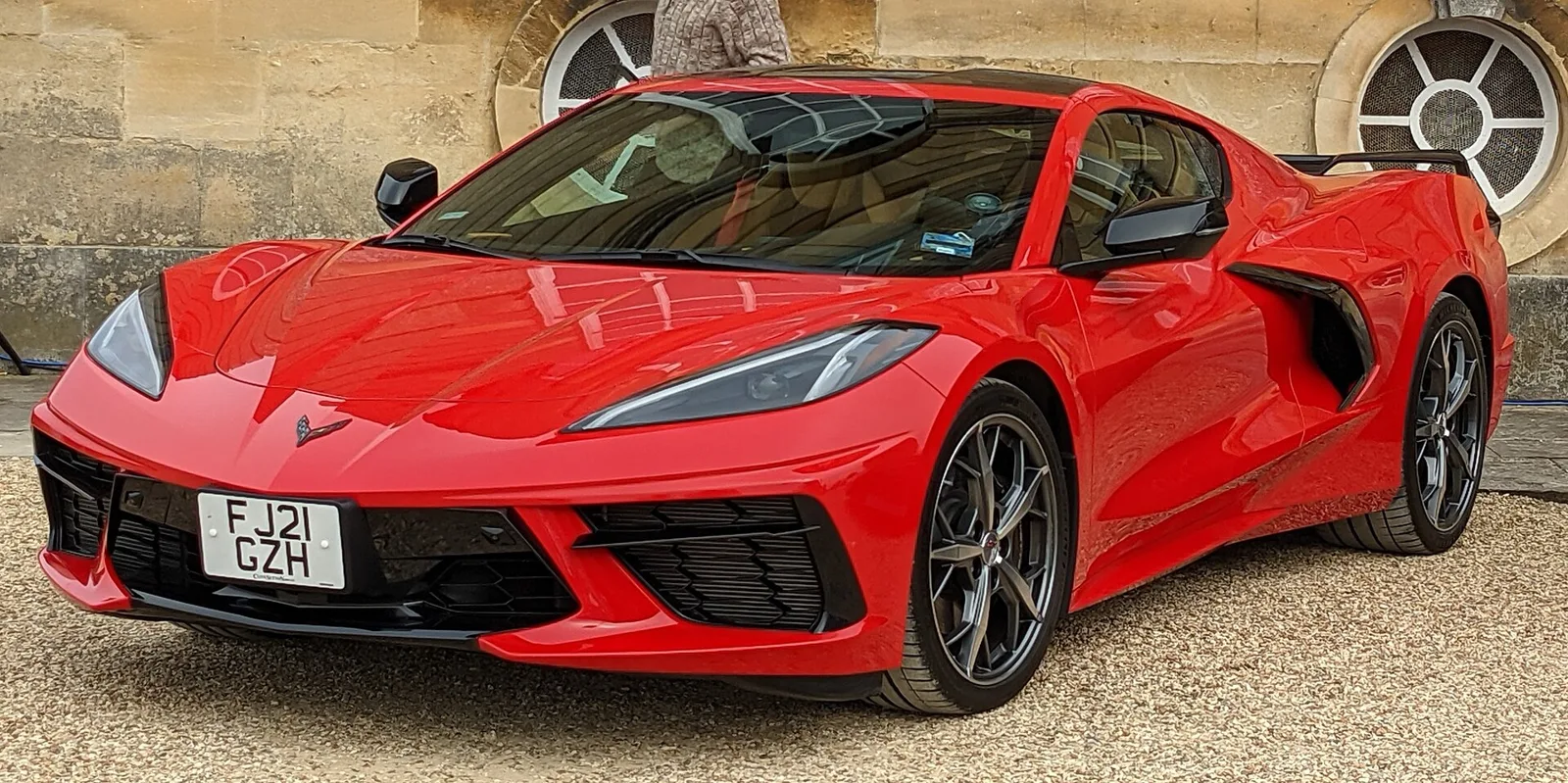
By moving the engine behind the driver. The C8 is the first rear mid-engine Corvette and GM's first such sports car since the Pontiac Fiero. Development started around 2016 for a 2018 model year that slipped to 2019 and then 2020. The coupe made its public debut on 18 July 2019 at Tustin, California, timed to the 50th anniversary of Apollo 11 and a reference to NASA, the convertible followed in October 2019, and production began on 3 February 2020 after the 2019 GM strike delayed a planned late-2019 start.
The aluminium architecture uses coilover springs in place of the transverse mono-leaf spring of earlier cars. Switching layouts shifted the passenger cell 16.5 in (420 mm) forward. Luggage space totals 13 cubic feet (370 L), split between a rear trunk and a front compartment, which is 2 cubic feet (57 L) less than the C7. A 12 in digital screen replaces the instrument cluster, an 8 in touchscreen sits beside it, and a Z button on the steering wheel recalls the Z51, Z06 and ZR1 packages.
The Stingray uses the LT2, a 6.2 L pushrod V8 that makes 490 hp (365 kW) when it reaches 6,450 rpm, and 465 lb.ft (630 N.m) lower down at 5,150 rpm, an improvement of 40 hp (30 kW) over the LT1 that it replaces. The optional NPP sport exhaust lifts output to 495 hp (369 kW), with torque rising to 470 lb.ft (637 N.m). Chevrolet says the Z51 car reaches 60 mph in 2.9 seconds; Car and Driver measured an adjusted 2.8 seconds.
There is no manual option. A Tremec 8-speed dual-clutch automated transmission with steering-wheel paddles is the only gearbox, and the sole earlier years without a manual were 1953 to 1954 and 1982. For the first time since the C1, a right-hand-drive Corvette is built at the factory, for Australia, New Zealand, Japan and the UK; 300 sold within 60 hours in Japan, three times the annual total of its left-hand-drive predecessor.
What are the Z06, E-Ray and Grand Sport?
They are the C8's performance branches. The Z06, unveiled on 26 October 2021 for the 2023 model year, is powered by a 5.5 L LT6 flat-plane crank V8. Its 670 hp (500 kW) arrives at 8,400 rpm, while the 460 lb.ft (624 N.m) of torque peaks at 6,300 rpm. Its 8,600 rpm redline lifts it past the Mercedes-Benz SLS AMG Black Series engine as the most powerful naturally aspirated production V8.
Chevrolet claims 0 to 60 mph in 2.6 seconds, a quarter mile in 10.6 seconds with the Z07 package and 195 mph (314 km/h). The body is widened for 20 in front and 21 in rear wheels, and optional carbon fibre wheels from Carbon Revolution save 41 lb (19 kg). Chevrolet says the Z07 car can pull 1.22g on a skidpad, and the Z06 posted 7:11.826 at the Nurburgring.
The E-Ray, unveiled on 17 January 2023 as a 2024 model, is the first performance hybrid and the first all-wheel-drive Corvette. A 1.9 kWh battery and an electric motor at the front axle add 160 hp (119 kW) and 125 lb.ft (169 N.m) to what the 6.2 L engine sends to the rear wheels, for system totals of 655 hp (488 kW) and 595 lb.ft (807 N.m). Chevrolet quotes 2.5 seconds to 60 mph and a 10.5-second quarter mile.
The C8.R racing car, which made its debut in July 2019 and was based on the base model, took the IMSA SportsCar Championship in 2020 and 2021 and the FIA World Endurance Championship in 2023. A Z06 GT3.R succeeded it in 2024.
Where does the Corvette go next?
Chevrolet unveiled the Grand Sport on 21 March 2026. Its engine is a new 6.7 L naturally aspirated LS6 V8 with a cross-plane crank, producing 535 hp (399 kW) and a peak of 520 lb.ft (705 N.m). Availability is planned for late 2026 as a 2027 model.