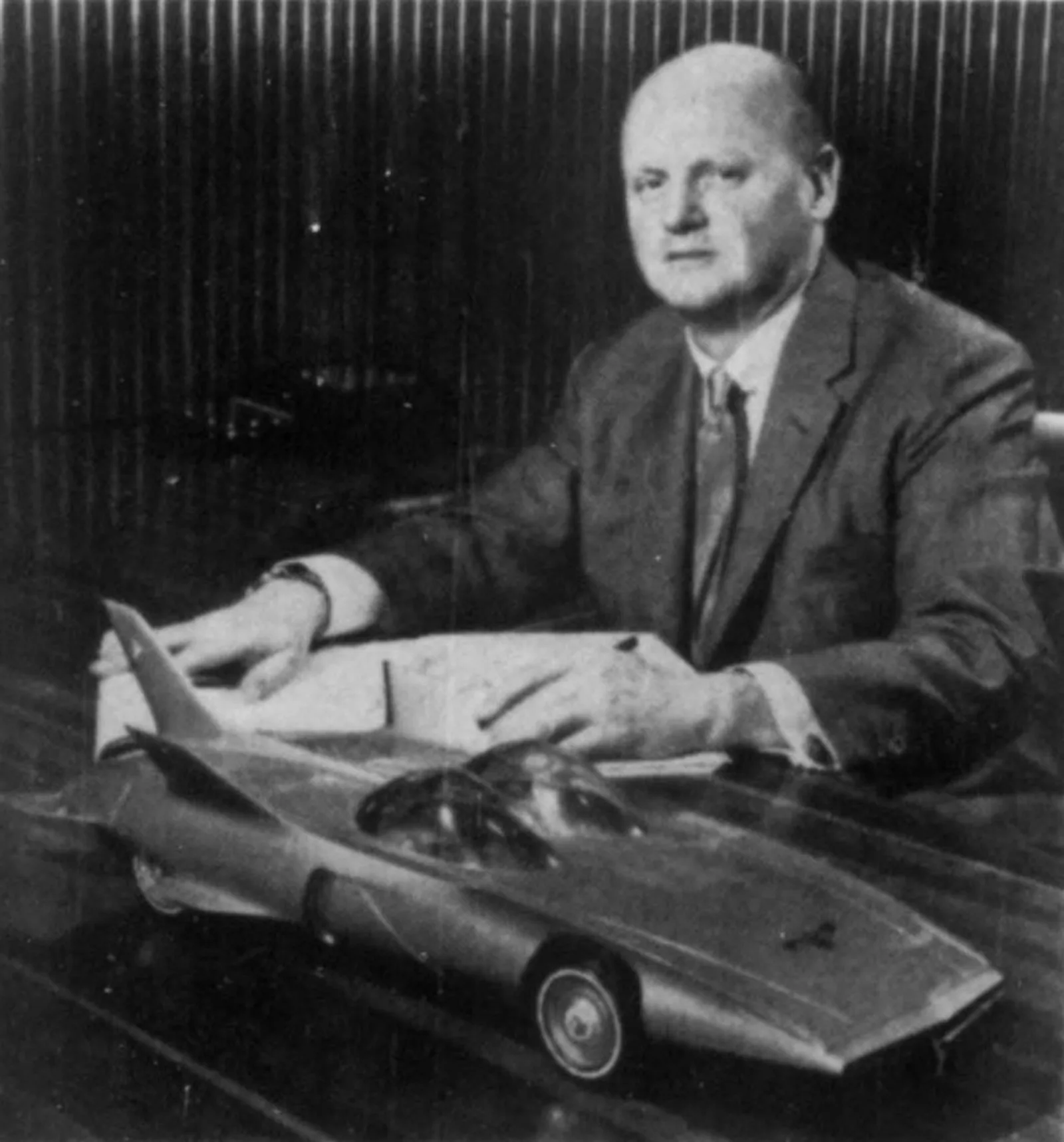
From a studio nicknamed the Beauty Parlor to the Riviera and Stingray: how two men made styling the thing that sold GM cars.
Harley Earl founded General Motors' Art and Colour Section in 1927 and ran GM styling until 1958, introducing clay models, the annual model change, the concept car and the tailfin. His successor Bill Mitchell led design until 1977 and broke with the chrome and fins of the Earl years.
In 1927 a Hollywood coachbuilder's son was handed a job no American carmaker had thought worth doing: making General Motors cars look good. GM's executives dismissed him as a pretty picture boy and his studio as the Beauty Parlor. Thirty-one years later, when he retired, GM had become the biggest corporation on earth and design was widely seen as the leading influence on sales.
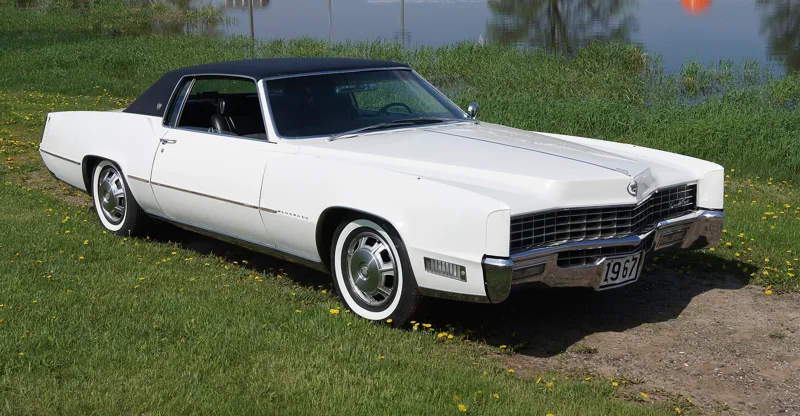
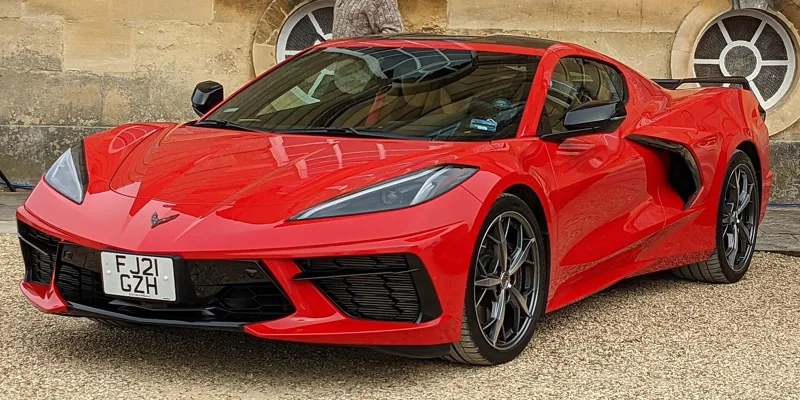
That man was Harley Earl. He gave GM clay models, the annual model change, the concept car and the tailfin, and he put a sports car on the road that became the Corvette. His successor, Bill Mitchell, took the studio in a leaner direction and left his name on the Buick Riviera, the Corvette Stingray and the Chevrolet Caprice.
Who was Harley Earl?
Harley Jarvis Earl was born on 22 November 1893 in Hollywood, California, and died on 10 April 1969, aged 75. He was an American designer and business executive, the first head of design at General Motors, and later a vice president, which made him the first top executive of a big corporation with a designer's background.
Coachbuilding ran in the family. His father, J.W. Earl, began building coaches in 1889, switched from horse-drawn vehicles to custom car bodies and founded Earl Automobile Works in 1908. Harley started at Stanford but left early to learn the trade at the works, which by then was building bodies for film stars such as Roscoe Arbuckle and Tom Mix.
Earl set out to lengthen and lower the American automobile, in fact where he could and in appearance always.
How did Harley Earl get to General Motors?
The Cadillac dealer Don Lee bought the business and kept Earl on to run its custom body shop. Lawrence P. Fisher, who managed Cadillac and was one of the Fisher Body brothers, met Earl at Lee's dealership, watched him work and liked what he saw, including the use of modelling clay to shape his designs.
Fisher gave Earl the 1927 LaSalle, a companion marque for Cadillac. Its success persuaded GM president Alfred P. Sloan to set up an Art and Colour Section with Earl as its first director.
The idea was new. Before the section existed, volume makers let engineers design bodies, with function and cost as the only guides. Many luxury makers, GM among them, did not build bodies at all and sent bare chassis to a coachbuilder chosen by the buyer. GM's engineers, division heads and sales executives saw Earl's ideas as flamboyant and unfounded, and he spent years defending a design approach against managers who prized tradition and production.
The section became the Styling Section in 1937. Sloan promoted Earl to vice president, a first for a styling person at a large corporation as far as Sloan knew. After the early 1930s Earl rarely drew or designed himself and acted as an overlord of GM's stylists, though he kept final authority over the department until he retired in 1958.
What were the Annual Model Change and Dynamic Obsolescence?
Earl and Sloan used the phrase Dynamic Obsolescence, essentially planned obsolescence, and brought in the Annual Model Change, which tied a car's identity to a specific year. The aim was to make design a driver of the company's success.
Earl was careful, though, not to stray too far from the previous year's look. That kept a thread of continuity and meant used GM cars held the best resale values of any American make. He also steered clear of extreme styling that would date quickly and put off conservative buyers. These ideas are taken for granted now, but were unusual then.
Harley Earl cars: Y-Job, fins and the Corvette
The Buick Y-Job. In 1939 the Styling Division built the Y-Job under Earl's instruction. Plenty of one-off custom cars existed already, but this was the first made by a volume manufacturer purely to find out how the public would react to new design ideas. Earl drove it every day afterwards. The 1951 GM Le Sabre followed as its successor.
Camouflage. In 1942 Earl set up a camouflage research and training division at GM. One result was a 22-page document, the Camouflage Manual for General Motors Camouflage.
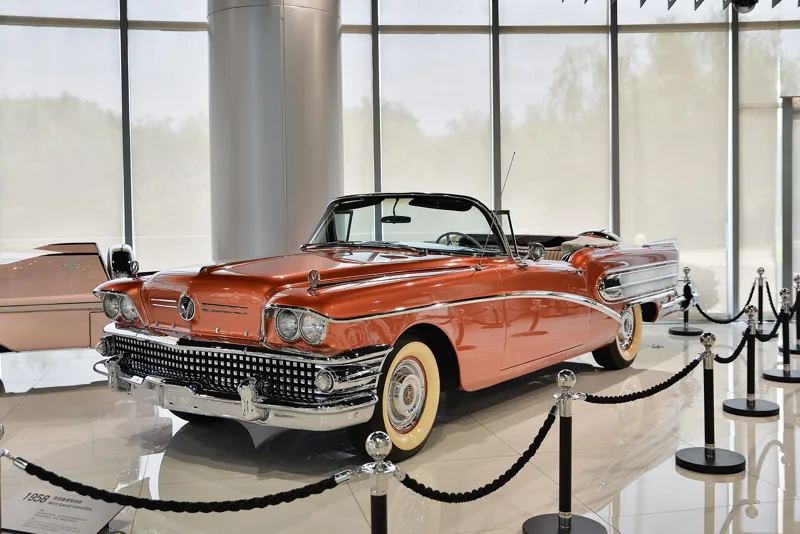
The tailfin. Earl authorised Frank Hershey's design for the 1948 Cadillac, which carried the first automotive tailfin. The inspiration was the Lockheed P-38 Lightning. Rivals such as Hudson, Nash and Lincoln went for fastback "bathtub" shapes in 1948 and 1949, and Earl considered the style for Cadillac but chose a sweeping, aircraft-inspired look instead. That bathtub look soon dated, while the Cadillac predicted the trends of the 1950s. Fins spread through Detroit and set Earl against Chrysler's Virgil Exner in a contest over their size and complexity, which peaked with the 1959 Cadillac models.
The Corvette. Sports cars from England and Europe were drawing attention on road circuits after the war, and Earl decided GM should build one. Project Opel began as a secret. He offered it first to Chevrolet general manager Ed Cole, who accepted it without hesitation, and the public saw it in 1953 as the Corvette.
How did Harley Earl leave GM?
Earl retired in 1958 on reaching the then-mandatory age of 65. His last job was overseeing the 1960-62 models. He is credited as the American industry's first styling chief, the originator of clay modelling, and the man behind the wraparound windshield, the hardtop sedan, two-tone paint from the factory and tailfins. In 1954 he said that for twenty-eight years his purpose had been to make the American car longer and lower, sometimes in fact and always in looks. Detroit's low, long cars across the 1960s and 1970s show how far his influence reached.
The Automotive Hall of Fame inducted him in 1986. A miniature of his turbine-powered Firebird I sits on the Harley J. Earl Trophy, awarded to the winner of the Daytona 500. Buick revived him in advertising during 2001 and 2002, with the actor John Diehl playing Earl, or perhaps his ghost, to stand for what the ads called the Spirit of American Style.
Bill Mitchell, the GM design chief who followed
William Leroy Mitchell was born on 2 July 1912, the son of a Buick dealer. He sketched cars from an early age, spent his youth in Greenville, Pennsylvania, and in New York City, and studied at the Carnegie Institute of Technology and the Art Students' League.
His route into GM ran through advertising. At Barron Collier Advertising in New York he prepared layouts, including US advertisements for MG cars, and there he met the Collier brothers, founders in 1931 of the Automobile Racing Club of America. Mitchell became the club's official illustrator, and his sketches caught Earl's attention. Earl recruited him to the Art and Colour Section on 15 December 1935.
In 1936 Earl made him chief designer in the newly created Cadillac studio. On 1 May 1954 he became GM's Director of Styling under Earl. In December 1958, when Earl hit the mandatory retirement age, the 46-year-old Mitchell succeeded him as Vice President, Styling Section. He spent his entire 42-year career at GM, 19 years of it as vice president until 1977, and the period became known as the Bill Mitchell era.
One count credits Mitchell with shaping, wholly or in part, over 72.5 million GM cars, including the 1938 Cadillac Sixty Special, the 1949 Coupe deVille, the 1955 to 1957 Chevrolet Bel Air, the 1961 to 1976 Corvette Stingray, the 1970 to 1981 Camaro and the Cadillac Seville of 1976 to 1979 and 1980 to 1985.
Earl and Mitchell side by side
| Detail | Harley Earl | Bill Mitchell |
|---|---|---|
| Born | 22 November 1893, Hollywood | 2 July 1912 |
| Died | 10 April 1969 | 12 September 1988 |
| Route to GM | Custom bodies in Hollywood, then the 1927 LaSalle | Advertising illustrator, recruited in 1935 |
| Led GM styling | 1927 to 1958 | December 1958 to July 1977 |
| Look of the cars | Long, low, chrome and fins | Sheer look, fewer ornaments |
| Signature cars | Y-Job, 1948 Cadillac, Corvette | 1963 Riviera, Stingray, 1977 Caprice |
How did Bill Mitchell change GM styling in the 1960s?
Mitchell set out to break with the Earl look and get rid of chrome excess, fat fins and similar signature touches. He pushed a style he labelled the sheer look: a shoulderless line that dropped more aerodynamically from window level to the flanks.
He asked GM designers to combine Rolls-Royce and Ferrari styling cues in the 1963 Buick Riviera. According to a popular story the idea came to him in Paris, and he first imagined it as a new LaSalle for Cadillac, a baby Cadillac. Frameless glass in the front doors gave the hardtop a sleeker look.
A shark he met while skin diving in the Bahamas inspired the Corvette Shark show car, the Stingray racer and the production 1963 Corvette Stingray, which Larry Shinoda largely designed under Mitchell's direction. The divisions accepted the 1963 Corvette and the 1963 Riviera on Christmas Eve 1961, which Mitchell called perhaps the greatest moment of his life.
Not every idea survived. Mitchell liked split rear windows, as on the 1957 Buick and the 1963 Stingray coupe, but other stylists and buyers did not, and both cars dropped them. The 1964 Corvette coupe used one curved pane. From 1963 to 1967 the Stingray, with slightly bulged front and rear quarter-panels, was among the first GM cars with the "Coke bottle" look. Mitchell also influenced the second-generation 1965 Corvair, which used curved side glass for the same profile.
What did Bill Mitchell do in the 1970s?
The energy crisis of 1973-74 pushed buyers towards small cars, and Mitchell oversaw the downsized full-size and intermediate GM cars introduced in the late 1970s, nearly all built on themes from his 1976 Cadillac Seville. He designed the popular 1977 Chevrolet Caprice. On compacts and subcompacts he was less enthusiastic, and he compared small cars to vodka: people try them but do not stay with them.
He stepped down as chief stylist in July 1977, after turning 65. His last GM design was the 1977 Pontiac Phantom concept, which now sits in the Sloan Museum, and he was also involved in what became the 1980 to 1985 Cadillac Seville. Irv Rybicki took over as head of GM Design on 1 August 1977.
After retiring he ran a design consultancy, William L. Mitchell Design, from 1977 to 1984, and criticised the fourth-generation Corvette as "bland". He died of heart failure on 12 September 1988, aged 76. The National Corvette Museum inducted him into the Corvette Hall of Fame in 1998.
What this meant for the people who bought GM cars
For anyone buying or driving a GM car, Earl's yearly model change, with each new look kept close to the last, kept trade-ins at the top of the American resale league. Under Mitchell the showroom cars of the 1960s lost the fins and the chrome, took on the sheer look and the Coke bottle shape, and by the late 1970s shrank in size as the energy crisis shifted demand.