From 532 hand-finished convertibles in 1953 to the 1959 fins, the Brougham and a small Seville that turned Cadillac's pricing upside down.
The Cadillac Eldorado was Cadillac's flagship luxury car from 1952 until 2002, across twelve generations. It began as a 532-car convertible in 1953, grew tailfins by 1959, and gave its Seville name to a separate smaller Cadillac in 1976 that ran until 2004.
Cadillac built just 532 Eldorados for 1953, a sliver of 0.5% of its sales that year, and priced each one at nearly double the Packard Caribbean convertible. Yet the name that began on that limited-edition convertible lasted until 2002, across twelve generations, and a second Cadillac nameplate, Seville, grew out of it.
Cadillac Eldorado history in brief
General Motors' Cadillac Motor Car Division built the Eldorado from 1952 until 2002, across twelve generations. For most of that time it sat at or near the top of the range. The first convertible of 1953 and the Eldorado Brougham sold from 1957 to 1960 had bodyshells of their own. Until 1966 the Eldorado was never less than second in price, behind only the Series 75 limousine.
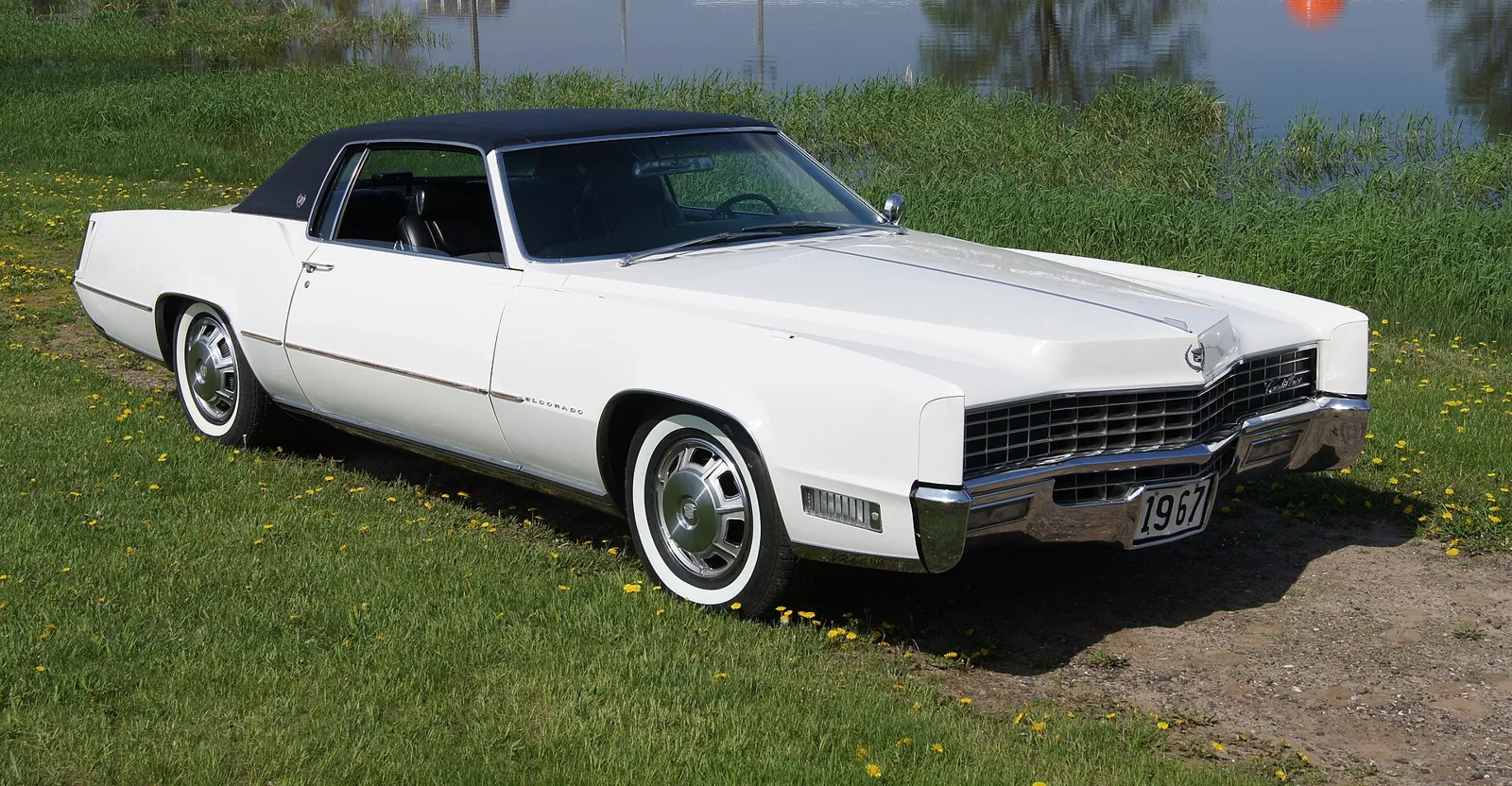
From 1967 the car changed character. It kept its premium position in the price list but was now built in high volumes on a platform made just for it, a two-door personal luxury car. Between 1965 and 1972 it wore the Fleetwood designation, and observers saw it as a modern successor to the pre-war Cadillac V-12 and V-16 roadsters and convertibles.
The Seville was the smallest Cadillac and the most expensive apart from the limousines, which turned the old bigger-is-better pricing upside down.
Where does the name Eldorado come from?
It squeezes two Spanish words into one, meaning the gilded one, and it also points at El Dorado, the legendary Lost City of Gold that drew Spanish explorers. Staff chose it in an internal competition to name a 1952 concept that marked Cadillac's golden anniversary. A limited-edition convertible for the 1953 model year then inherited it.
Two more names joined it in 1956. The hardtop became the Eldorado Seville, named for a city in the south of Spain, and the convertible became the Eldorado Biarritz, named for a luxury resort by the sea in the south of France. The hardtop ended in 1961 and took the Seville name with it. Biarritz carried on through 1964, the Eldorado became the Fleetwood Eldorado in 1965, and Biarritz came back as an up-level trim package that ran from 1976 until 1991.
The 1953 Cadillac Eldorado convertible
General Motors launched three specialty convertibles for 1953 to advertise its design leadership: the Oldsmobile 98 Fiesta, the Buick Roadmaster Skylark and this Series 62 Eldorado. All were limited-run cars, and the Cadillac was the production form of the Golden Anniversary concept car shown in 1952. It borrowed its bumper bullets from the 1951 Le Sabre show car and introduced a wraparound windshield and a cut-down beltline.
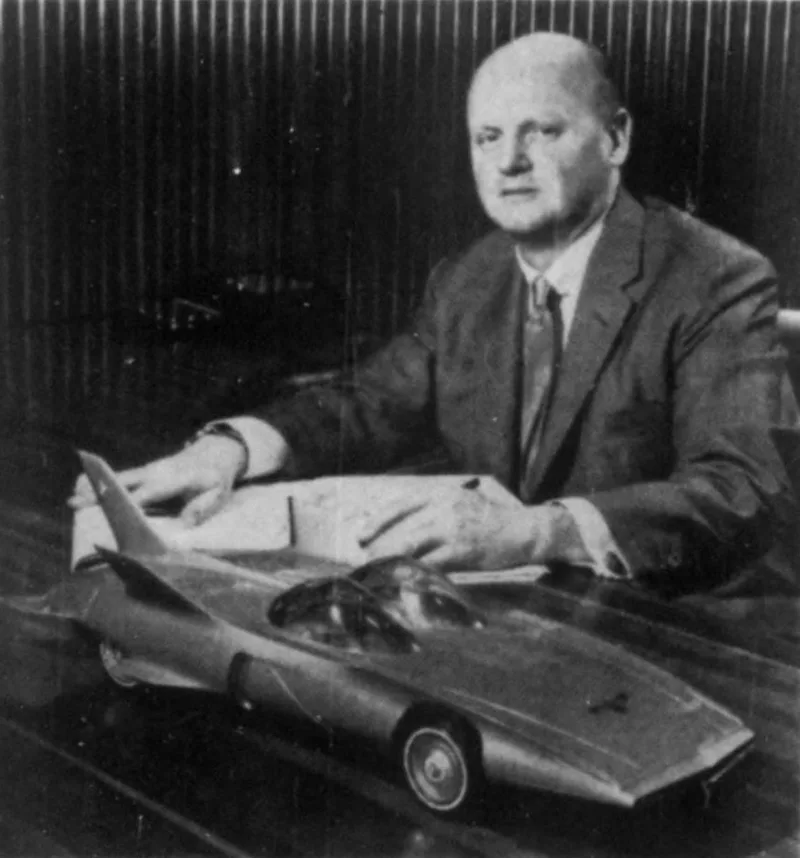
Harley Earl, GM's styling chief, was especially fond of the broad expanse of glass and the dip in the sheet metal under the side windows. Other manufacturers copied both. The paint list ran from Aztec Red and Alpine White to Azure Blue and Artisan Ochre, with a black or white Orlon top, and a hard tonneau cover sat flush with the rear deck to hide the folded roof. Outside there was no special badge at all. The only mark of rank was a gold-coloured Eldorado nameplate in the middle of the dash.
Technically the Eldorado was a subseries of the Series 62, built from the regular convertible and sharing its engine, but the price said otherwise: US$7,750, which is $93,260 in 2025 dollars. Air conditioning added US$620 ($7,461 in 2025 dollars) and wire wheels US$325 ($3,911). The body measured 5,610 mm (220.8 inches) long and 2,030 mm (80.1 inches) wide, and buyers received a heater, power windows, windshield washers and a signal-seeking radio without paying extra.
Cheaper bodies and bigger fins, 1954 to 1956
GM wanted more buyers, so for 1954 the Eldorado gave up its special sheet metal and took the same basic body shell as the standard Cadillacs. What remained were trim details: golden crests behind the air-slot fender breaks, wide fluted beauty panels of extruded aluminium on the lower rear sides, wire wheels, door monogram plates and a Cadillac crest embossed into the seat bolsters. The same aluminium panels appeared on a one-off Eldorado coupe made for the Reynolds Aluminum Corporation. The base price fell to US$5,738 ($68,792 in 2025 dollars), and sales nearly quadrupled to 2,150.
The 1955 car regained its own rear end, with higher, slimmer and more sharply pointed tailfins. It was an early hint of the exaggeration still to come. Wide chrome belt mouldings and a pair of round taillights set midway up the fenders set it apart, and sales almost doubled to 3,950.
Then came the split that shaped the next five years. For 1956 Cadillac offered the Seville hardtop coupe and the Biarritz convertible side by side, each with Eldorado script, a fender crest and twin hood ornaments. The convertible added a ribbed chrome saddle moulding linking the windshield with the rear window pillar. Of 6,050 cars sold, 2,150 were Sevilles, and sales rose by 60%. Even so, Eldorados made up only 4% of all Cadillacs sold. This was a halo car, not a volume one.
Early Eldorado sales, year by year
| Year | What defined the car | Units sold |
|---|---|---|
| 1953 | Own bodyshell, US$7,750 | 532 |
| 1954 | Standard Cadillac body, US$5,738 | 2,150 |
| 1955 | Own rear end with pointed tailfins | 3,950 |
| 1956 | Seville hardtop and Biarritz convertible | 6,050 (2,150 Sevilles) |
The 1957 and 1958 Eldorado Seville and Biarritz
Cadillac restyled and re-engineered the range for 1957. The Eldorado gained a low, downswept fenderline that ended in pointed inboard fins, and broad sculptured stainless steel panels on the lower rear quarters flowed into the split wraparound rear bumpers. A version of that treatment, without the fins, had first appeared on the post-war Cadillac Interceptor prototype. Four four-door hardtop Sevilles were also built specially that year.
In 1958 the front end took quad headlights and a new hood, and a full-width jewelled grille arrived. Ten vertical chrome slashes sat in front of the open rear wheel arches, and crest medallions decorated the sides of the tailfins. GM was marking its 50th year of production, so each division fielded an anniversary flagship. Cadillac's was the Eldorado Seville, Buick's the Limited Riviera and Oldsmobile's the Starfire 98, with Pontiac's Bonneville Catalina and the new Chevrolet Bel-Air Impala completing the set.
The Eldorado Brougham, a four-door built by hand
The Series 70 Eldorado Brougham was a different animal. Announced in December 1956, it reached buyers around March 1957 as a hand-built four-door that grew out of two show cars, Park Avenue and Orleans, from 1953 and 1954, drawn by Ed Glowacke, who led Cadillac's design studio in the 1950s. It carried the first quad headlights, which were still unlawful in the United States at the time, and a brushed stainless steel roof on a pillarless hardtop body. Like the 1961 Lincoln Continental, it had doors at the rear that were hinged at the back, but the Cadillac was a genuine pillarless design: the doors latched onto a stub that never rose above the beltline.
The price was US$13,074 (equal to $149,871 in 2025 dollars), double the cost of an ordinary 1957 Eldorado and above a Rolls-Royce Silver Cloud, a Facel Vega Excellence or a Continental Mark II. Buyers numbered 400 in 1957 and 304 in 1958. After 1958 Cadillac stopped building the body in Detroit, and Pinin Farina in Turin, Italy took over the special bodies.
The equipment list read like a catalogue of firsts. Self-levelling air suspension, the first automatic power seats with two memory positions, a dual four-barrel V-8, a boot that opened and closed itself, polarised sun visors, an electric aerial, electric door locks, forged aluminium wheels and air conditioning all came as standard, as did an automatic starter that would restart the engine. Delco supplied an all-transistor signal-seeking radio with 13 transistors, first fitted to the 1957 Brougham. Silver magnetic tumblers lived in the glovebox, and a leather vanity kit held a lipstick holder, powder puff, comb, bevelled mirror, gold mechanical pencil and an atomiser of Arpege Extrait De Lanvin perfume. Owners could pick from 44 full-leather trim combinations and carpets in Mouton, Karakul or lambskin.
The air suspension was the weak point. It proved troublesome in use, and some owners found it cheaper to swap in ordinary coil springs than to keep fixing the air system. The car had Fleetwood bodies, but no Fleetwood script appeared on the outside. For 1958 the upper door panels moved from metal to leather and 15 special monotone colours joined the palette.
The 1959 Cadillac Eldorado and the tailfin peak
The 1959 car is the one people picture when they say tailfins. Cadillac dropped a bulky first proposal for a lower, longer and wider look, a late reply to Virgil Exner's dramatic 1957 Chrysler redesign. The result had huge sharp fins with dual bullet tail lights, two different rooflines, grille patterns that looked like jewellery, with beauty panels on the deck lid to match.
Behind the glamour sat some reshuffling. The Series 62 turned into the Series 6200, De Villes went to Series 6300, two-door Eldorados to Series 6400 and the four-door Brougham to Series 6900, all on a 3,302 mm (130 in) wheelbase. A three-deck jewelled insert in the rear echoed the texture of the front grille, a treatment shared with the Fleetwood Sixty Special and used through 1966. The 6.4-litre (390 cu in) engine made 257 kW (345 hp). Standard equipment covered power brakes, power steering, automatic transmission, power windows, six-way power seats, air suspension, fog lamps and a remote-control deck lid; the Brougham added air conditioning, an automatic headlight dimmer and cruise control.
For 1960 the look calmed down. Much lower tailfins and smoother lines made the car more restrained, and that was the final model year for the Eldorado Seville.
What is the Cadillac Seville?
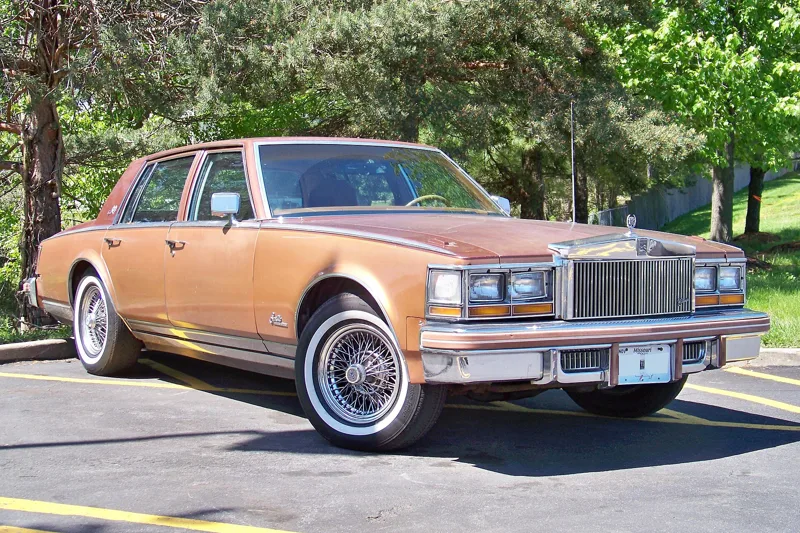
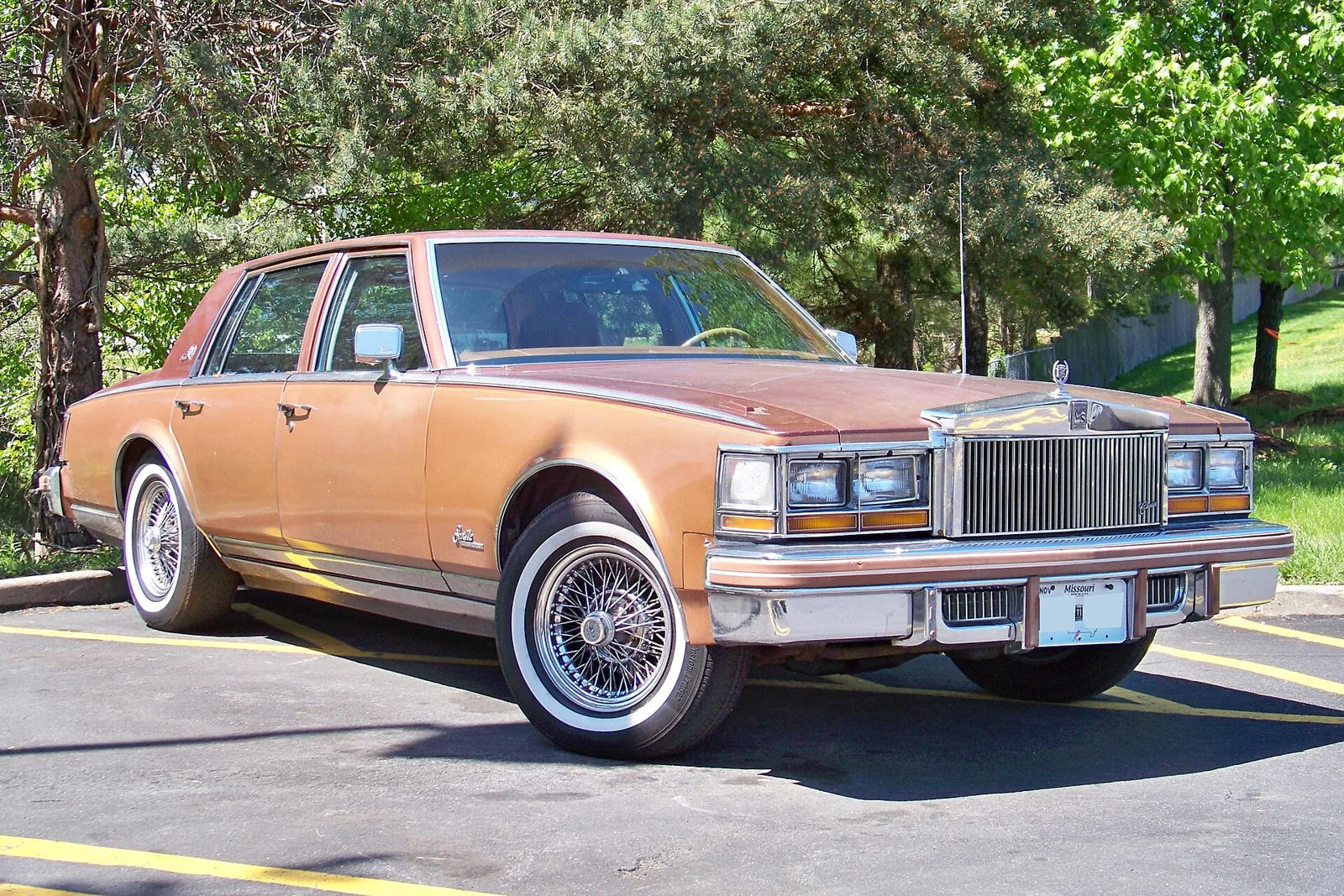
The Seville nameplate returned for 1976 on a very different car. It arrived in May 1975 as an early 1976 model and was Cadillac's reply to Mercedes-Benz, Audi and BMW, whose imports were taking sales. GM planners feared that the division's old claim to be the standard of the world was slipping, especially with younger buyers. Imports had grown more luxurious and often cost more than the large Cadillacs, so bigger no longer meant better.
The Seville flipped the usual pricing logic: the smallest Cadillac was also the dearest apart from the Series 75 limousines, at US$12,479 (equal to $74,666 in 2025 dollars). It weighed almost 450 kg (1,000 pounds) less than the full-sized Deville. The name came out of research. LaSalle was the favourite, with St. Moritz a distant second and Seville further back, but LaSalle had a troubled past and St. Moritz was hard to say. According to GM marketing director Gordon Horsburgh, Seville won because it had no negatives. Leland, for Cadillac co-founder Henry M. Leland, was rejected because he also helped found Lincoln.
Styling took cues from the Rolls-Royce Silver Shadow, with a crisp, angular body and a wide track. The car was a unibody on a bolt-on subframe, its rear suspension based on the X-body compacts that began in 1968, and it was given its own K-body label. Budget settled the engineering: an Opel Diplomat base was dropped as costlier to rework, and a front-wheel-drive layout like the Eldorado's was rejected because the Eldorado transaxle was made in small numbers. The first 2,000 cars were all Georgian silver with the same options, which let the factory ramp up before offering variety.
The 5.7-litre (350 cu in) Oldsmobile-sourced V8 used Bendix analog port fuel injection and made 134 kW (180 hp). It returned 15 MPG around town and 21 on the highway, and 0-60 mph (97 km/h) took 11.5 seconds, which was good for the period. A diesel version of the 350 followed in 1978. Output rose from 43,772 cars in 1976 to 45,060 in 1977 and a peak of 56,985 in the final year of the generation. Lincoln answered with the unsuccessful Versailles, and the Chrysler LeBaron, renamed Fifth Avenue after 1982, followed.
Tripmaster, coachbuilt specials and Iranian Sevilles
For 1978 and 1979 the Seville offered Tripmaster, a trip computer costing $920 that swapped the fuel gauge, speedometer and clock for digital readouts. A 12-button panel selected data such as coolant temperature, battery voltage or fuel range, and the driver could enter trip details so that it estimated arrival time. The Seville was the first American car with full electronic instrumentation, a step Lincoln did not match until 1980. Tripmaster sold poorly because of its price, but it worked as a test bed for later electronics across GM.
Coachbuilders went further. Grandeur Motor Car Company of Florida turned an estimated 600 Sevilles into neoclassical Opera Coupes with long hoods and fake spare tyre covers. In Iran, Pars Khodro assembled 2,653 Cadillacs between 1978 and 1987, making that country the only one outside the United States to build them until the Opel Omega-based Catera started in Germany in 1997.
The second-generation Seville, 1980 to 1985
The first Seville had not won over younger import buyers. Research showed it appealed most to older women who wanted a smaller Cadillac. For 1980 the K-body switched to front-wheel drive, sharing its basis with the Eldorado, Buick Riviera and Oldsmobile Toronado, and gained independent rear suspension, with the new digitally injected 6.0-litre (368 cu in) Cadillac L62 V8 as the standard engine.
The razor-edged bustle-back rear took inspiration from the Empress Line designs of the English coachbuilder Hooper in the early 1950s. It was the fullest expression of ideas by GM designer Wayne Kady, and one of the last cars drawn under design chief Bill Mitchell, whom Harley Earl had made Cadillac's first chief designer in 1936. The Lincoln Continental sedan of 1982 to 1987 and the 1981 to 1983 Imperial coupe borrowed the shape. Sales began strongly, but diesel engines, the unloved V-8-6-4 variable displacement petrol engine and uneven build quality wore down the Seville's standing.
Along the way it introduced features that later became routine: memory seats with two stored positions in 1981, a digital instrument panel that it shared with the Eldorado, and puncture-sealing tyres. The 4.1-litre (250 cu in) HT-4100 engine of 1982 had weak, porous aluminium blocks and failure-prone intake manifold gaskets. In 1983 a Delco/Bose cassette stereo cost $895, and it was the last year an 8-track player could be ordered.
What this means if you are buying or driving one
Details date an Eldorado. In 1959 the Seville and Biarritz spelled out the Eldorado name behind the front wheel opening, while the golden crests and fluted aluminium panels point to 1954 and the twin hood ornaments to 1956. On a Brougham, remember that some owners replaced the troublesome air suspension with coil springs. On early Sevilles the wheel bolt pattern changed: cars built to the end of the 1976 model year use five lugs on a 121 mm (4.75 in) circle, and from 1977 the larger pattern common to full-size GM cars applied, along with rear disc brakes. A painted steel roof arrived in 1977, after the first cars used a vinyl-covered two-piece roof.
Where this goes next
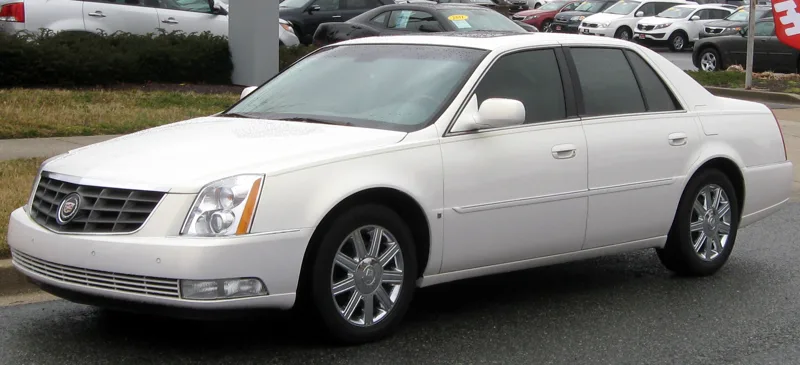
The Eldorado ended in 2002 after twelve generations. The Seville ran through the 2004 model year, and the STS replaced it for 2005. Cadillac's European-market BLS, built in Sweden, was introduced in 2006, and the Catera had already been assembled in Germany since 1997. The Biarritz trim, revived for 1976, was last offered in 1991.