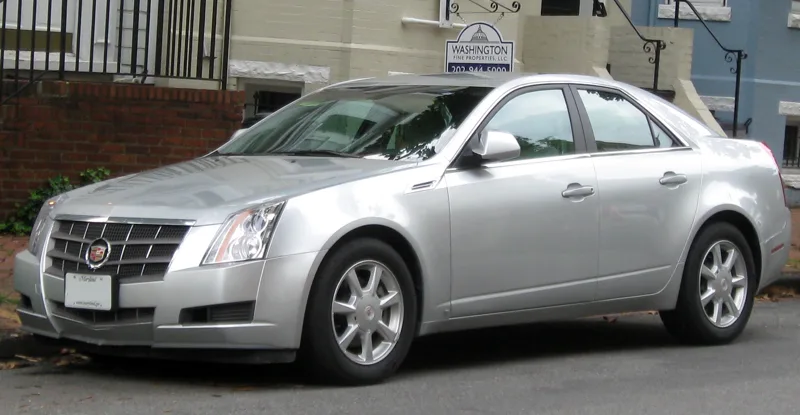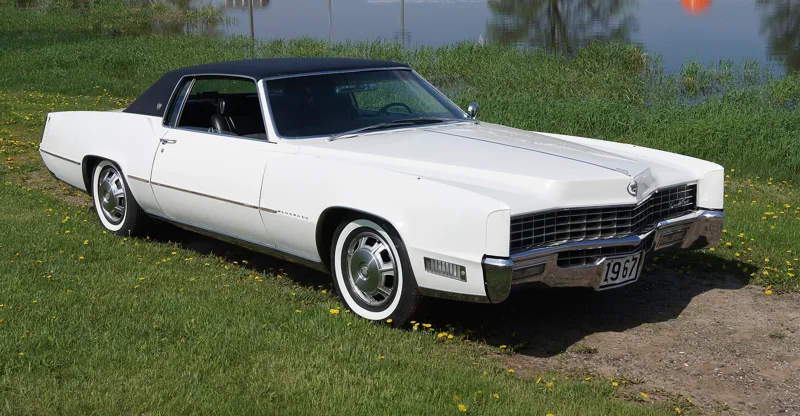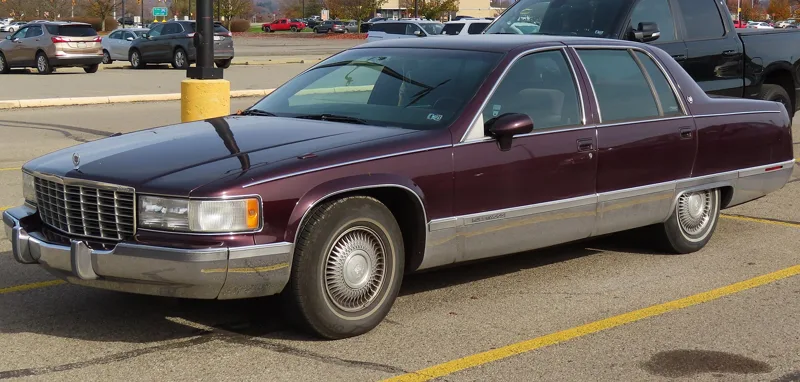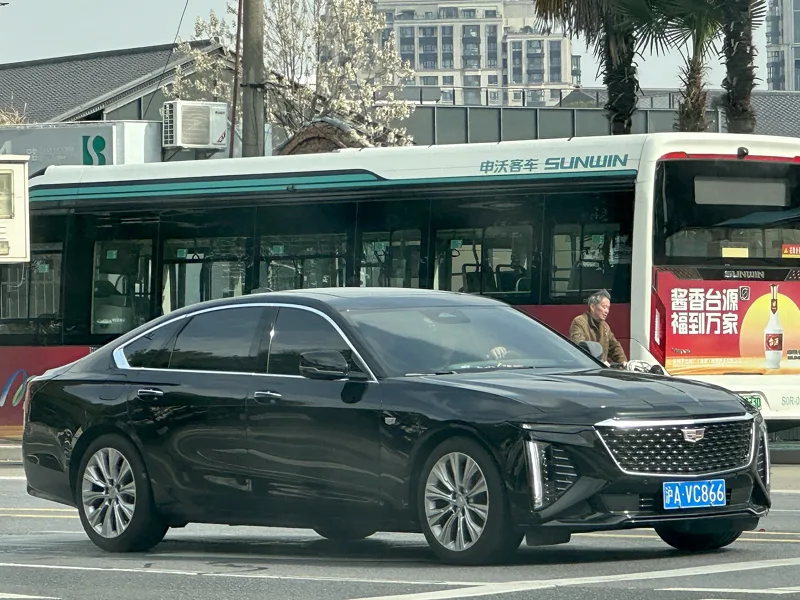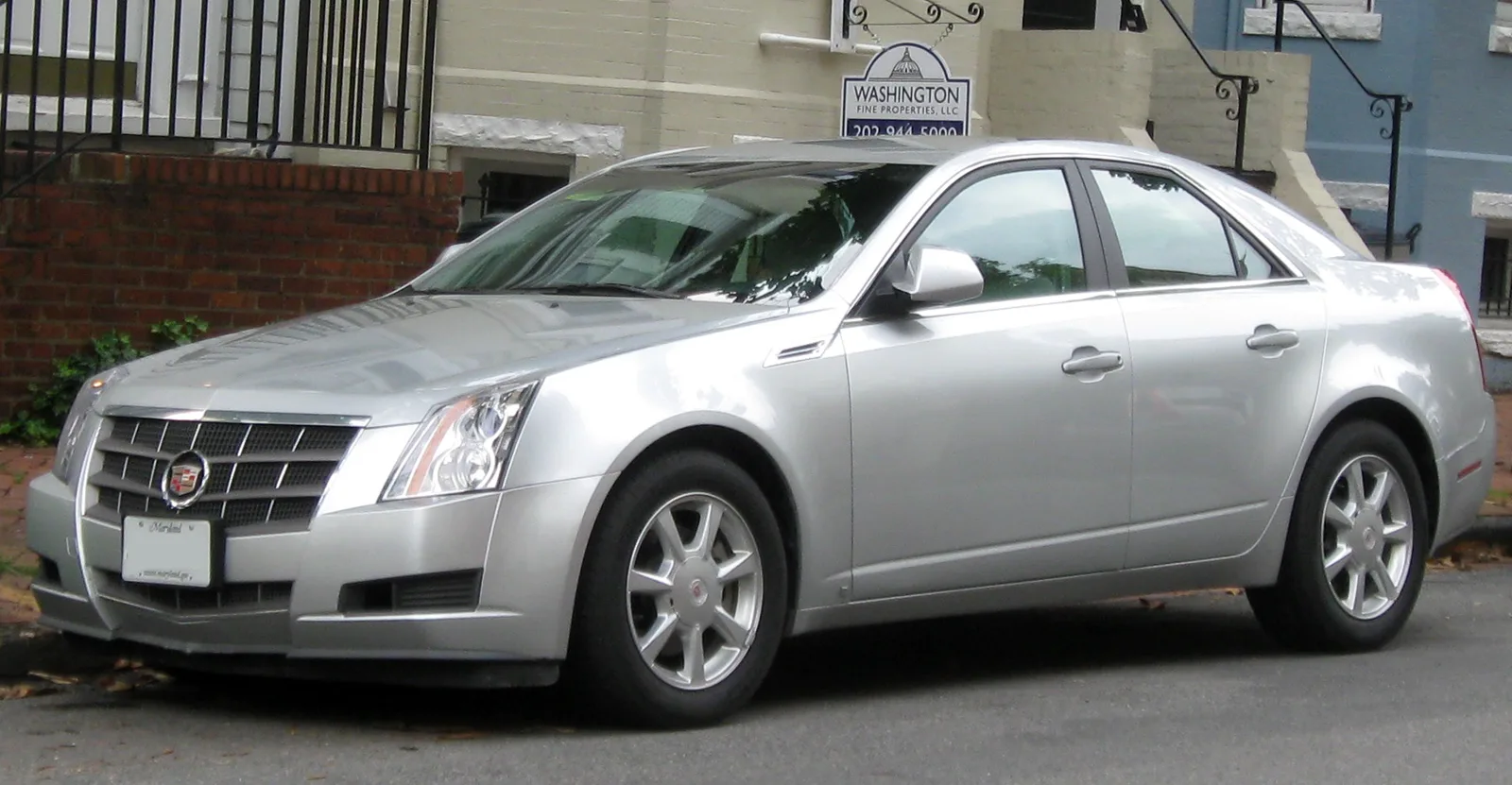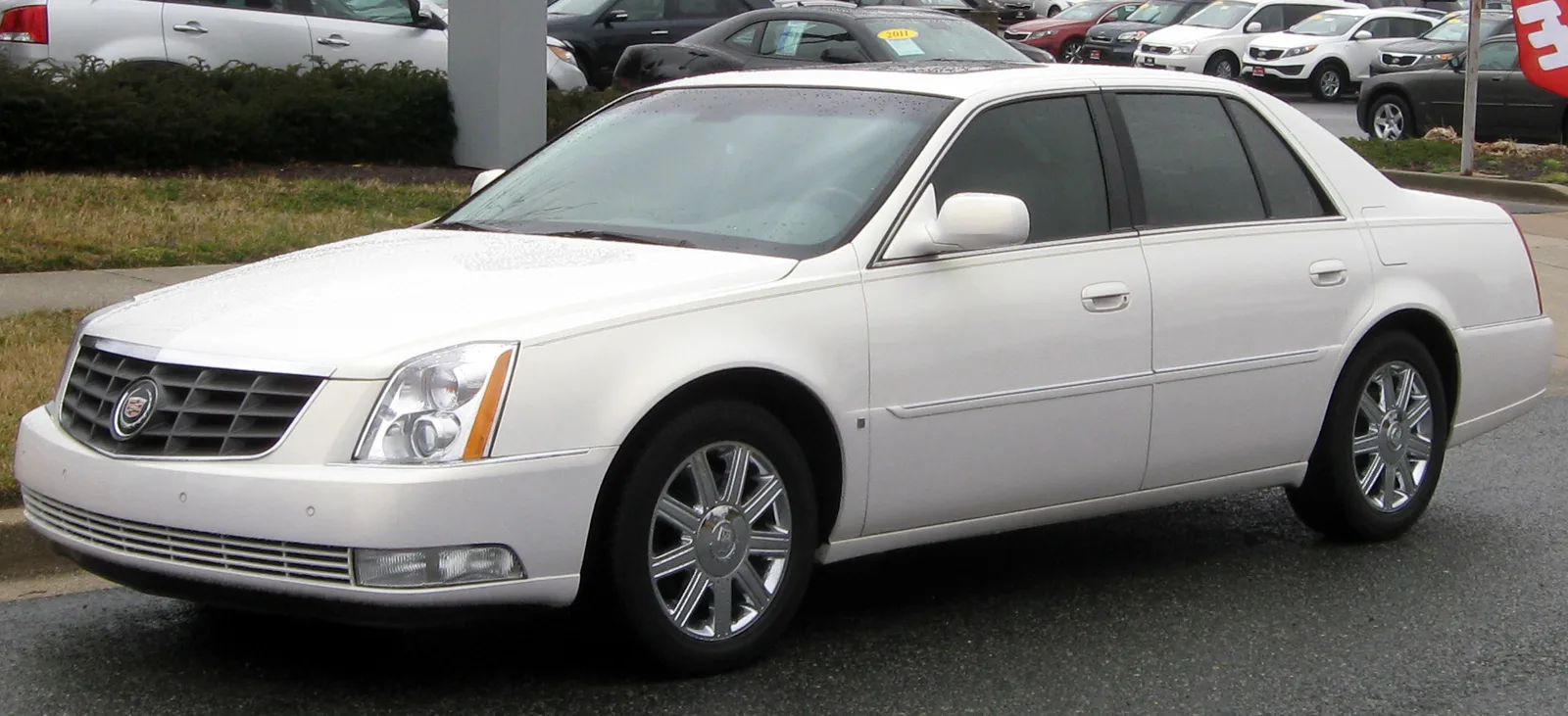
A Cavalier in a Cadillac suit, a roadster flown in from Turin, a plug-in coupe and a big front-drive sedan priced below the car it replaced.
The Cimarron was a 1982 to 1988 compact built on GM's J platform, the Allante a 1987 to 1993 roadster bodied by Pininfarina, the ELR a 2014 and 2016 plug-in coupe and the DTS a 2005 to 2011 full-size sedan. The Cimarron and ELR sold poorly or slowly, and Allante output slid after 1990.
Cadillac gave itself ten months to turn a Chevrolet Cavalier into a luxury car. GM's president had warned the division's general manager that there was not enough time, and the Cimarron that emerged went on sale in 1981 at roughly twice the price of the car it was built from.
Cadillac's other detours were just as ambitious: an Italian-bodied roadster whose shells crossed the Atlantic by Boeing 747s, a plug-in hybrid coupe, and a big front-drive sedan priced below the car it replaced.
Why is the Cadillac Cimarron on lists of the worst Cadillacs?
The Cimarron was a Cadillac mainly in badge and trim. It rode on GM's front-drive J platform and shared most of its design, exterior included, with the Chevrolet Cavalier and the other J-cars, yet it cost about twice as much. Sales fell short, performance was modest, and critics have long cited it as a low point of GM product planning.
The thinking behind it was sensible enough. The Seville had sold well after its 1975 introduction, but Cadillac's research showed that its buyers were increasingly American-brand owners who wanted something smaller, not drivers converted from European marques. Dealers wanted a car below the Seville to take on European compacts. Development of a Cadillac J-car began in early 1980, and the window was ten months. Aside from modest interior changes, the work was limited to a reworked grille, the plastic panels around it, and the taillights.
The J-car itself had been in the works since 1976 as the replacement for the H-body, and it brought two big changes: front-wheel drive and a move into the compact class. Cadillac joined a programme that was within 14 months of showroom arrival, so the launch slipped from the mid-1980s plan to early 1981 to line up with the 1982 model-year debut of the Cavalier, Buick Skyhawk, Oldsmobile Firenza and Pontiac J2000. GM president Pete Estes cautioned Cadillac general manager Edward Kennard that there was no time to make a Cadillac out of the J-car.
A Cadillac that did not say so
The car reached showrooms on 21 May 1981, with a name picked from a shortlist that also held Carmel, Cascade, Caville, Envoy and Series 62. For 1982 it was sold as the Cimarron by Cadillac, and the Cadillac name appeared nowhere on the car. Salespeople were told to say Cimarron and nothing more. From 1983 it became the Cadillac Cimarron, though the script sat only on the grille.
Cadillac tried to justify the price by fitting nearly everything as standard. The 1982 car listed at US$12,181 and came with air conditioning, extra sound insulation, deep-pile carpet, alloy wheels, twin power mirrors, a leather-wrapped steering wheel, intermittent wipers and a rear defogger. It was also the only Cadillac of its day with a tachometer. Leather was available on the seats and door panels, with the Cimarron name embroidered on the seatback.
The weakness was that a buyer could do much the same at another GM showroom. J-cars from other divisions could be optioned almost identically, apart from upholstery and the Cimarron's own suspension tuning, although the total crept close to the Cimarron's base price.
Under the bonnet
Power for 1982 came from a Chevrolet 1.8-litre four making 88 hp (66 kW). That was the first four-cylinder Cadillac since 1914 and the first engine below 2.0 litres since 1908. A 2.0-litre with throttle-body injection followed in 1983, tuned to 86 hp (64 kW). A 2.8-litre V6 arrived as an option for 1985 with 130 hp (97 kW), and it became standard in 1988. Transmissions were a four- or five-speed manual, or a three-speed automatic.
Cadillac kept refreshing it. The 1984 and 1985 d'Oro package added gold-finished trim, and the 1985 facelift brought a new grille and a power dome bonnet. Wraparound tail lamps, digital instruments and Touch Climate Control came for 1986, the car's last year in Canada, and composite-lens headlamps in 1987 made it the first American J-body to carry them.
Why did GM stop building it?
The Cimarron was still selling 15,000 to 20,000 cars a year at the end, and many of its buyers were new to Cadillac and younger than the typical customer. Cadillac wanted to carry on. General Motors management voted 9 to 1 the other way. Sales had disappointed, resources were needed for the 1988 Eldorado and Seville and the 1989 Sedan de Ville and Fleetwood, and GM wanted less price overlap between Cadillac, Buick and Oldsmobile.
Cadillac's share of the US market fell from 3.8% in 1979 to 2.2% in 1997, and the Cimarron is routinely named among the causes. Dan Neil put it on his 2007 list of the worst cars of all time. Forbes listed it among car flops, CarBuzz called it a textbook case of badge engineering, and CNN Money judged it a Cavalier that cost thousands more. Car and Driver reported that a Cadillac product director kept a photograph of one on his wall under the caption "Lest we forget".
It did bring Cadillac some firsts: its first manual gearbox since 1951, its first compact and its first export-style taillamps with separate amber indicators. Cadillac has never built a direct successor. The Catera and the BLS, based on Opel and Saab cars, were not compact executives in size, and the CT4 and its ATS predecessor are bigger than the Cimarron.
Cadillac tried small, Italian, electric and plush, and each experiment ended for its own reason.
How was the Cadillac Allante built across two continents?
The Allante had a Cadillac chassis and mechanicals, but Pininfarina designed and built its body in Italy, and specially equipped Boeing 747s carried the finished shells to Detroit, 56 at a time. They landed at Detroit City Airport, about 3 miles (4.8 km) from the Hamtramck plant. More than 21,000 Allantes were built over seven years.
Its targets were the Mercedes-Benz SL and Jaguar XJS. It was the first modern two-seat Cadillac roadster and the first to wear the name since the Series 355 of the 1930s. In 1982 Cadillac's general manager, Bob Burger, dispatched engineers to Italy, and the team chose Pininfarina, working under Sergio Pininfarina with designers including Mario Vernacchia.
Inside GM, the choice hurt. Chuck Jordan was torn, because handing the design to an Italian house implied that GM's 3,000 designers could not manage it, and Wayne Kady and Irv Rybicki argued for doing it in-house. Burger's answer was that Cadillac wanted a designer name on the car, much as a pair of jeans carries a label. Pininfarina built a plant for the purpose at San Giorgio Canavese, outside Turin.
GM had recently shut Fisher Body Plant 18, its source of Cadillac bodies since 1921, and building the shells in Italy and flying them over became the practical route. The arrangement echoed the early-1950s Nash-Healey, and Cadillac had worked with Pininfarina before, on the 1959 Eldorado Brougham and several one-offs. It became known as the world's longest assembly line.
What changed from 1987 to 1993?
The first Allante used a transverse, multi-port-injected 4.1-litre V8 from the HT-4100 family, with Bosch ABS III brakes and an aluminium hardtop as standard. It was priced at US$54,700. The cabin carried an all-electronic instrument and control panel angled toward the driver. Unlike the Buick Reatta, Riviera or Oldsmobile Toronado Trofeo, it had no touchscreen. In 1988, Popular Science placed it second to the Mercedes 560 SL and above the new Reatta.
A 4.5-litre V8 followed in 1989 with 200 hp (149 kW; 203 PS) and 270 lb ft (366 N m). The suspension got Speed Dependent Damping Control, which stiffened the dampers once at 25 mph (40 km/h) and a second time at 60 mph (97 km/h). In 1990 came a cheaper cloth-roof convertible at US$53,050 and traction control, a first for a front-drive V8 car. Cadillac backed the Allante with a seven-year, 100,000 mi (160,000 km) warranty, three years longer than its other models.
Production slid after that: 2,523 cars for 1990, 1,928 for 1991 and 1,698 for 1992. The final 1993 car got the 4.6-litre Northstar V8, producing 295 hp (220 kW) and 290 ft lb (393 N m), at 5600 and 4400 rpm, along with a new rear suspension shared with the Seville and Eldorado and a Road Sensing Suspension. To offset costs, Cadillac dropped the Bose stereo and swapped the Recaro seats for cheaper Lear units. It was sold in one soft-top form at US$59,975, with the 60.5 lb (27.4 kg) hardtop optional, and one served as the pace car for the 76th Indianapolis 500 with Bobby Unser at the wheel.
What was the Cadillac ELR, and why did it stop after 2016?
The ELR was a two-door luxury plug-in hybrid coupe built for the 2014 and 2016 model years, using a retuned Chevrolet Volt drivetrain. It cost roughly US$75,000, which was US$35,000 more than the Volt. Slow early sales led Cadillac to skip 2015, and production ended on 18 February 2016 with just under 3,000 built.
Its roots lay in the Converj concept shown in Detroit in January 2009, and the path to production was erratic. Motor Trend reported in April 2009 that GM had approved it, and GM replied that it was a concept under review. Vice chairman Robert Lutz said in 2010 that the Converj was cleared for production, though not next year or the year after. Then in March 2010, BusinessWeek reported that GM had stopped work because the car had too little equipment and electric range to attract buyers or make a profit. In August 2011, GM reversed course and announced the ELR, at a price below that of the US$57,400 Tesla Model S. The production car, however, listed at US$75,000.
The car was built at Detroit-Hamtramck alongside the Volt, Ampera and Holden Volt, after an extra US$35 million investment that took the plant's total to US$561 million. Retail production began in December 2013, and the first ten cars, six for the US and four for Canada, were delivered that month.
How did the ELR drivetrain work?
Think of the ELR as an electric car with a small petrol generator in reserve. A 119 to 135 kW electric motor did the driving, a 16.5 kWh lithium-ion battery supplied it, and a four-cylinder engine-generator took over when the charge ran out. The EPA rated the electric range at 37 miles (60 km) and the total range at 340 mi (550 km). A full charge took 12.5 to 18 hours on a 120-volt supply, or about five on a 240-volt charger.
Top speed was 106 mph (171 km/h), and 0 to 60 mph took 7.8 seconds in range-extended mode. Steering-wheel paddles controlled regenerative braking, and the driver chose between Tour, Hold, Mountain and Sport modes. The EPA put fuel economy at 82 MPG-e on electricity and 33 mpg-US (7.1 L/100 km) on petrol alone. The ELR was 300 lb (140 kg) heavier than the Volt. Its EPA utility factor, an estimate of the share of miles driven on electricity, was 65%, against 66% for the Volt and 29% for the Toyota Prius plug-in.
What did the 2016 update change?
For 2016 Cadillac cut the price by US$10,000, so that it started at US$58,495 after the US federal tax credit. Output rose from 217 to 233 hp and torque from 295 to 373 lb ft, which took 1.5 seconds off the 0 to 60 mph time. Electric range grew to 39 miles (63 km). Blind-spot monitoring and rear cross-traffic alert became standard, along with a 4G LTE connection with a Wi-Fi hotspot. An optional performance pack brought 20-inch wheels, Brembo four-piston front calipers with 13.6-inch rotors, and cost about four miles of electric range.
The marketing relied on a 60-second television spot called Poolside, starring Neal McDonough, aired during the 2014 Winter Olympics opening ceremony and before and during the Academy Awards. GM aimed it at viewers earning US$200,000 a year. USA Today called it possibly the best TV ad of the year, while Ad Age described it as contentious, and Ford parodied it in a C-Max hybrid commercial. The car's Regen on Demand system won a Green Car Technology Award in 2014, and the second-generation Volt adopted a refined version for 2016. The 2016 ELR also took Vincentric's Best Value in America prize in its class, for the cheapest upkeep.
What was the Cadillac DTS?
The DTS, short for DeVille Touring Sedan, was a full-size front-drive luxury sedan built from 2005 until May 2011. It debuted at the 2005 Chicago Auto Show and was a mildly revised version of the eighth-generation DeVille. Its launch price of US$41,195 was more than 10% below the DeVille it replaced.
The name followed the convention set by the CTS and STS. The DTS used GM's G-platform and was built at Detroit/Hamtramck Assembly, with new front sheet metal, front and rear fascias, decklid and rear quarters. A transverse 32V Northstar V8 made 275 bhp (205 kW) in Standard, Luxury and Premium trims, and the Platinum model, added in 2007 with special trim and badging, made 292 bhp (218 kW). Seating was for five, or six with a front bench.
Xenon headlamps, leather and power seats were standard. The options list included heated and cooled front seats, rain-sensing wipers, Bose audio, DVD navigation, adaptive cruise control and Magnetic Ride Control.
Limousines, hearses and state cars
The DTS-L, a lightly stretched limousine finished by Accubuilt, arrived in November 2006 for 2007. Early cars had a wide rear pillar, because the standard-length rear door left an awkward gap, and a 2008 version added longer doors. Production was low and the DTS-L soon disappeared. Cadillac also supplied incomplete coachbuilder chassis, coded V4U for limousines and B9Q for hearses, to certified Master Coachbuilders only.
The DTS styling also reached the White House. An armoured vehicle debuted at George W. Bush's second inauguration in 2005, a modified GMC medium-duty truck with DTS lines, codenamed Stagecoach, and shorter-wheelbase armoured DTS cars have carried the US vice president since at least 2010. Canada's Stephen Harper used a modified DTS too.
How do the four Cadillacs compare?
| Model | Years | Layout and base | Launch price | How it ended |
|---|---|---|---|---|
| Cimarron | 1982-1988 | Front-drive compact on GM's J platform | US$12,181 (1982) | 9-to-1 management vote to stop, still selling 15,000 to 20,000 a year |
| Allante | 1987-1993 | Two-seat roadster, Pininfarina body | US$54,700 (1987) | Output fell to 1,698 cars in 1992 |
| ELR | 2014 and 2016 | Plug-in hybrid coupe on Volt hardware | Roughly US$75,000 | Slow sales; ended 18 February 2016 |
| DTS | 2005-2011 | Full-size front-drive sedan on the G-platform | US$41,195 | Replaced by the XTS in 2012 |
What should a buyer of one of these Cadillacs know?
A Cimarron is an early J-car with a Cadillac name on the grille and an engine range from 88 hp to 130 hp. Of the Allantes, only the 1993 car has the Northstar V8. The ELR is an unusual plug-in with a short production run, and the 2016 car has the better numbers: 233 hp, 39 miles of electric range and the lower launch price. A DTS is the simplest ownership proposition of the four, a large, comfortable sedan with a 275 bhp V8.
What replaced the DTS and the ELR
Cadillac's line-up moved on from each of these. The XTS took over from the DTS in June 2012, and a rear-drive CT6 joined in 2016. Before GM's bankruptcy the company had considered a rear-drive sedan with the new Ultra V8, due around 2010, but it later stopped developing new North American Zeta-based models and cancelled the engine. When the ELR ended, Cadillac said it would launch a plug-in hybrid CT6 in late 2016.