A front-drive two-stroke start, the rear-engined Daruma years, Giugiaro's coupe and the front-engined generations that ended the name.
The Suzuki Fronte was a kei car nameplate used from 1962 into the late 1980s. The first Fronte was a front-wheel-drive sedan based on the Suzulight Van, and later versions ranged from rear-engined sedans to front-engined hatchbacks and vans. The name was eventually dropped in favour of the Alto.
The Suzuki Fronte was a Japanese kei car nameplate that Suzuki used from March 1962 until the late 1980s. It began as a front-wheel-drive sedan, moved to a rear-engined layout in the 1960s and later became a front-engined hatchback. The name carried the company's aim of standing at the front of the kei class.
Where did the Fronte begin?
The first Fronte went on sale in March 1962 as a passenger version of the Suzulight Van. Its transversely mounted two-cylinder, two-stroke engine drove the front wheels, and the car had independent suspension on all four wheels. Production reached 2,565 cars in the first year.
The original TLA engine displaced 360 cc, with its cylinders cast separately, which lowered production costs and improved cooling. Power was 25 PS (18 kW) at 6000 rpm, but the unit seized after prolonged high revs, so the FEA engine replaced it within a year with 21 PS (15 kW) and a four-speed gearbox.
Suzuki's competition debut came at the inaugural Japanese Grand Prix in May 1963. Two Frontes finished first and second in class C1 for engines under 400 cc, averaging 89.763 km/h (55.776 mph). The winner was Osamu Mochizuki, just ahead of teammate Haruhisa Fujita.
Production reached 2,101 cars in 1963. The CCI engine arrived in October 1965 with an extra horsepower for a total of 22, and by 1967 the Suzulight Fronte looked dated, especially at the rear.
Suzuki's longest-running nameplate, from a front-drive two-stroke in 1962 to a 1988 hatchback that ended the name.
What made the 1967 Fronte 360 different?
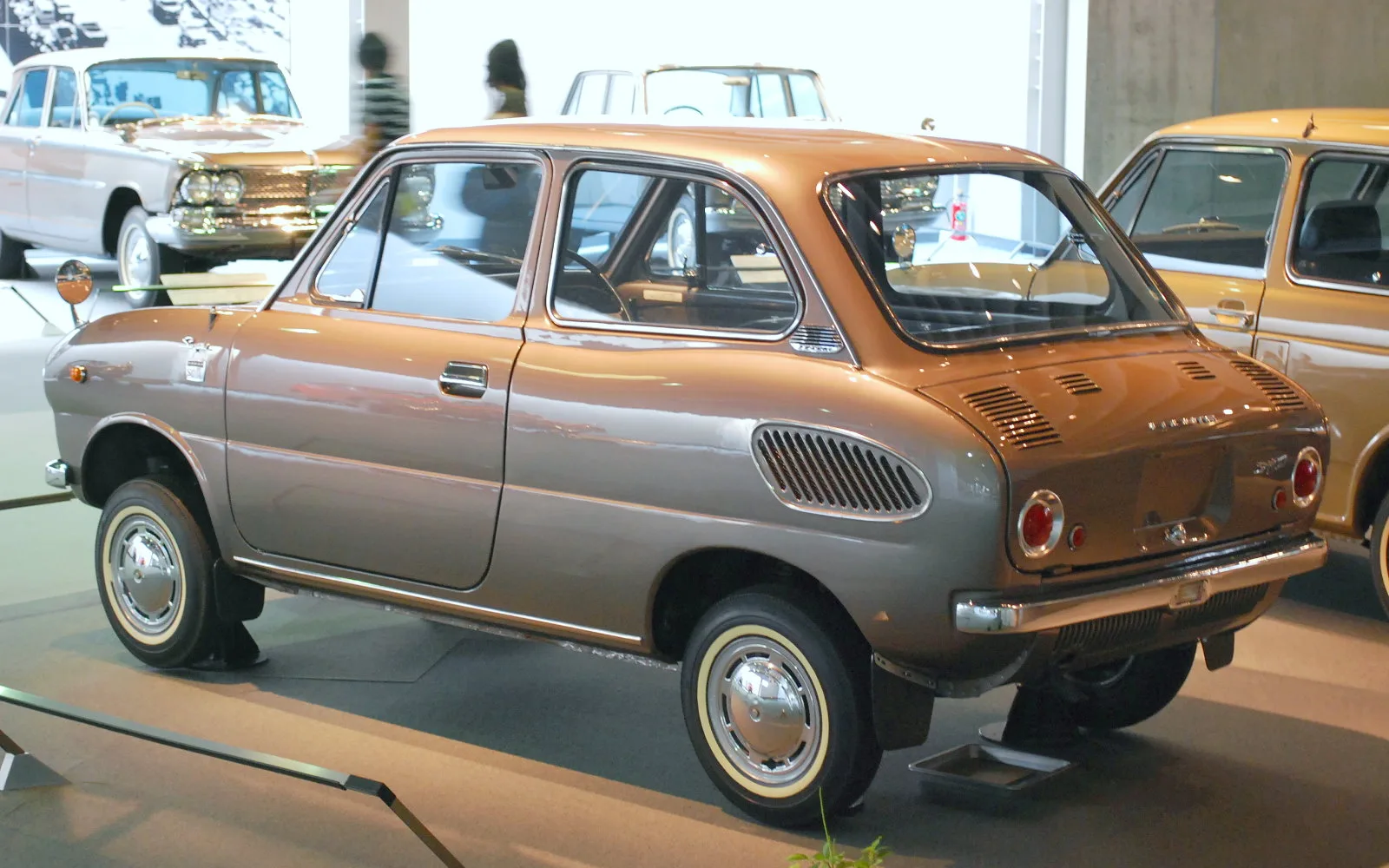
The Fronte 360 arrived in March 1967 as the LC10, a two-door sedan with a rear-mounted engine, ten-inch wheels and a rounded profile nicknamed Daruma. It used a new 356 cc three-cylinder two-stroke engine, and it was arguably the only kei car with coke bottle styling.
Its wheelbase was 1,960 mm (77.2 in), and the suspension was independent with coil springs. The powertrain sat transversely at the rear, a break from the front-drive tradition of the early Fronte.
Suzuki launched the car with a large advertising campaign that included television commercials. Dealers received the car on 27 May 1967. The original target of 3000 per month was nearly tripled, and monthly output stayed above 8000 until the LC10 ended.
A new factory in Iwata opened in August 1967 to add capacity. By October 1968 the car had an integrated headrest on the driver's side, front seat belts and turn signal flashers on all four corners.
The triple carburettors were awkward to reach. A mechanic had to work through a small egg-shaped opening from the back seat to adjust them, and luggage space was very limited.
What were the SS and SSS sporting versions?
The SS 360 arrived in November 1968 with 36 PS (26 kW). It was the quickest kei car of its day, reaching 400 metres from a standing start in 19.95 seconds. The sportier SSS followed in April 1970.
For the launch Suzuki staged a publicity drive. Stirling Moss and the TT-winning motorcycle racer Mitsuo Itoh took two SS models along the 750 km (466 mi) Autostrada del Sole from Milan to Naples, averaging 122.44 km/h (76.08 mph).
An export Fronte 500 with a 475 cc engine arrived in January 1969, producing 29 PS (21 kW) at 6000 rpm. The first real facelift followed in May 1969, with two square gauges replacing the large oval dial.
What were the Van, Estate and Custom versions?
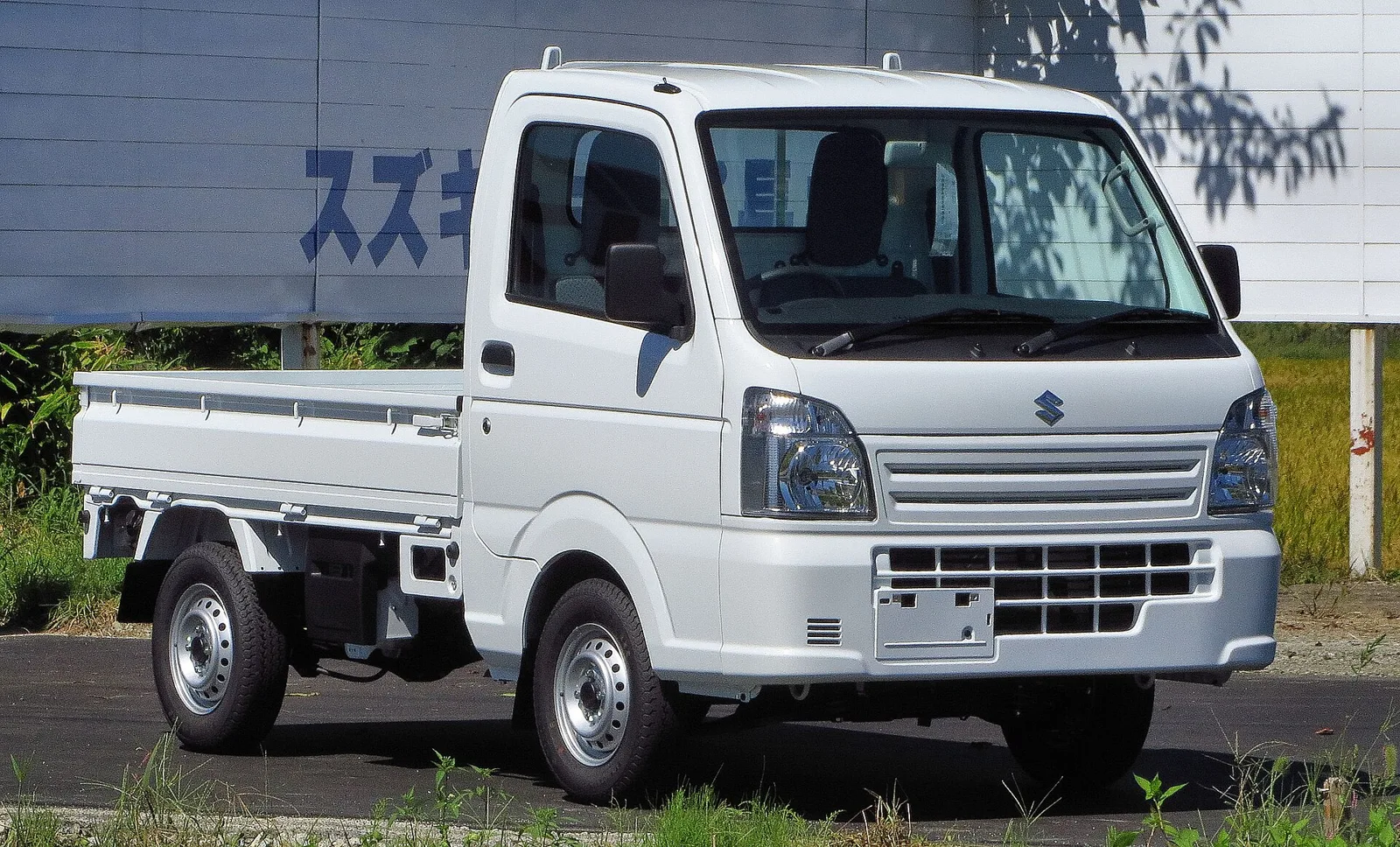
The Fronte Van arrived in January 1969 as a three-door wagon with a conventional front-engined, rear-wheel-drive layout. It used the 356 cc three-cylinder detuned to 25 PS (18 kW), and a private-use Estate followed in July 1969. The Custom replaced the Estate in June 1970.
The Van mounted its spare wheel in the engine bay, something more common on French cars, which freed up luggage space. The Estate offered a folding rear seat and a luggage shelf, and a total of 5,719 LS11 cars were built across the Estate, Custom and Hi-Custom versions.
The Custom lacked the top-hinged rear opening and used a downward-opening boot lid instead. A stronger Hi-Custom with 30 PS (22 kW) and a top speed of 110 km/h was added two months later, and the whole Custom range was deleted in February 1971.
In March 1972 the Fronte Van switched to a water-cooled 28 PS (21 kW) two-stroke engine and became the LS20. Just under 28,000 LS20 Vans were built in the thirteen months it was in production.
What was the Sting Ray Fronte and the Coupe?
The third-generation LC10 II arrived in November 1970 with an aggressive look that became known as the Sting Ray. It kept the rear-engined layout but gained a longer 2,010 millimetres (79.1 in) wheelbase, a front anti-roll bar and semi-trailing arm rear suspension.
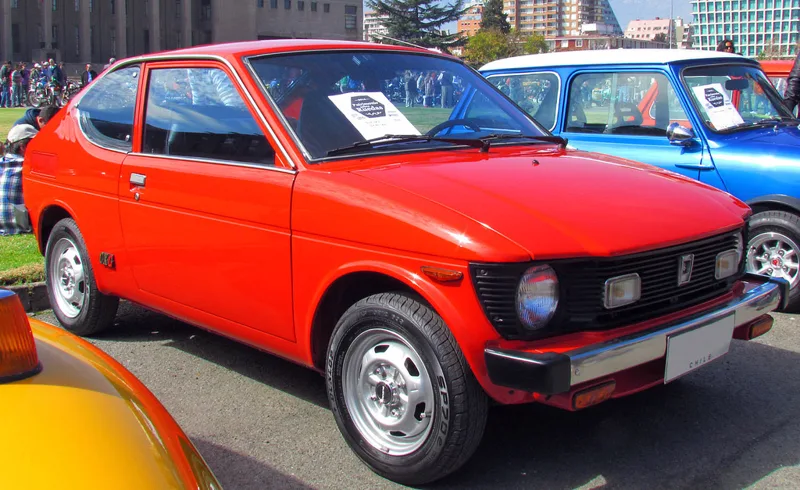
Giugiaro's design for the Fronte Coupe was shown in September 1971 and became the predecessor of the Cervo range. Its model changes included a four-seater 2+2 in February 1972, and from May 1974 it used only a 35 PS (26 kW) engine after tighter emissions rules.
What was the Fronte LC20 Oval Shell?
The LC20, introduced in July 1973, was a radical departure with its rounded Oval Shell design. The body kept the water-cooled engine and suspension of the LC10, with a wheelbase 20 mm longer at 2030 mm, and overall dimensions of 2995x1295 mm set by kei car rules.
Suzuki offered a four-door version for the first time, although it followed Daihatsu, Subaru and Honda. The range became confusing, with two-door and four-door bodies and several equipment levels. In July 1974 the 37 hp GT engine was downgraded to 35 PS.
The LC20 also entered production in Indonesia, first as completely built units in 1974 and then as CKD kits from 1976 with PT Indomobil Group.
How did the Fronte 7-S meet emissions rules?
The Fronte 7-S, introduced in June 1976, was a 443 cc two-stroke that Suzuki said met the provisional 1975 emissions standards with a two-way catalyst and a secondary air supply. Its output dropped to 26 PS (19 kW) at 4500 rpm, below the 32 PS of the 360 cc engine it replaced.
Four-doors made up about 70 percent of production, and Suzuki advertised the car with the slogan It's Still Alive. The Suzuki TC, meaning Two Catalyst, was the emissions system fitted to the 7-S.
Suzuki struck a deal with Daihatsu, its main competitor, to buy up to 1,000 engines a month. The SS11 used Daihatsu's catalysed four-stroke AB10 from 1 June 1977, rated at 28 PS (21 kW), but four-stroke Frontes were sold only in Tokyo at first and their torque was weaker.
Suzuki's own TC53 two-stroke arrived in the SS12 on 25 May 1977. Only 6,421 SS12s were built in the five-month run, compared with 66,540 SS10 Frontes.
The full-scale 550 cc SS20 followed on 27 October 1977 with the T5A engine, first seen in the Jimny. Its 539 cc produced 28 PS (21 kW) at 5000 rpm and lifted top speed from 105 to 110 km/h (65 to 68 mph).
When did the Fronte become front-wheel drive?
The fifth-generation Fronte, sold as the SS30 and SS40 from May 1979, switched to a transversely mounted engine driving the front wheels. Its wheelbase grew from 2030 to 2150 mm, and the SS40 used a 543 cc four-stroke three-cylinder developing 31 PS (23 kW).
The Alto name took over for commercial versions and became the export name. A 796 cc four-stroke three reached Europe from July 1981 as the SS80, riding on larger 12-inch wheels.
From 1984 until 1986 Maruti built the four-door SS80 in India as the 800, and Cooper Motor Corporation of Nairobi, Kenya, also assembled it during the eighties.
What was the Pakistan FX 800?
In Pakistan the four-door car was sold as the FX 800 with an 800 cc engine producing 40 hp. The FX ran from 1983 to 1988 before the Mehran replaced it. It appears as the car driven by the protagonist in Mohsin Hamid's debut work Moth Smoke.
What did the sixth and seventh generations change?
The CB71 arrived in September 1984 as a five-door hatchback on a 2,175 mm (85.6 in) wheelbase, with the 543 cc F5A engine. In July 1986 it became the CB72, with wraparound headlights and the ITL rear suspension, and the top FG model gained front disc brakes.
The CB72's Isolated Trailing Link rear suspension was a three-link rigid setup that considerably improved the ride. The Fronte Wit Custom of November 1987 added climate control, a first for the kei class.
A three-door version with the FS Twin Cam 12 arrived in February 1987, with a DOHC 12-valve F5A rated at 40 PS (29 kW) at 7500 rpm. A part-time four-wheel-drive CD72S followed in January 1988.
How did the Fronte name end?
The seventh-generation CN11S debuted in September 1988 with a wheelbase stretched by 160 mm (6.3 in) to 2,335 mm (91.9 in). Six months later the name was dropped, because the Alto had long outsold the Fronte and tax changes made kei commercials less attractive.
The CN11S used the 547 cc 12-valve SOHC F5B engine from the Cervo, developing 40 PS (29 kW) at 7500 rpm. A four-wheel-drive CP11 was offered, but there was no three-door version.
Under the Alto name the car became a five-door and three-door sedan as well as a three-door van. Anchi built the CN11S in China as the 6330, and Daewoo built it in South Korea as the Tico, which sold heavily in Eastern Europe.
Specifications at a glance
| Specification | Detail |
|---|---|
| Launch | March 1962, Suzulight Fronte (TLA) |
| Early engine | 360 cc two-stroke; 25 PS (18 kW) at 6000 rpm |
| Daruma sedan | LC10, March 1967, 356 cc three-cylinder two-stroke |
| Sporting version | SS 360, November 1968, 36 PS (26 kW) |
| Export Fronte 500 | 475 cc, 29 PS (21 kW) |
| Sting Ray | LC10 II, November 1970, 2,010 millimetres wheelbase |
| Fronte 7-S | SS10, June 1976, 443 cc two-stroke |
| Front-wheel drive | SS30 and SS40, May 1979; SS40 543 cc F5A, 31 PS (23 kW) |
| Sixth generation | CB71, September 1984, five-door, 2,175 mm wheelbase |
| Seventh generation | CN11S, September 1988; 547 cc F5B, 40 PS (29 kW) |