The rules, the history and the tiny sports cars behind Japan's yellow-plate class, and which ones reached other countries.
A kei car is a class of ultra-compact Japanese cars created in 1949, limited since October 1998 to 3.4 m long, 1.48 m wide and 660 cc, with output held at 64 PS by agreement. In return, owners pay lower tax and insurance, and sports models such as the Honda Beat were built to the class.
Every modern kei car stops growing at 3.4 metres long and 660 cc, and the 64 PS power ceiling that every Japanese maker obeys is a gentleman's agreement among the makers.
What is a kei car?
Kei car is short for kei-jidosha, which means light automobile. The class exists only in Japan and covers the smallest vehicles allowed on the country's expressways. Makers build microvans and kei trucks to the same rules as the passenger cars.
The Japanese government created the category in 1949 to stimulate both car ownership and the growth of the country's car industry. Since October 1998 the limits have stayed fixed: no more than 3.4 m (11.2 ft) long and 1.48 m (4 ft 10.3 in) wide, lower than 2.0 m (6 ft 6.7 in), with an engine under 660 cc (40.3 cu in). On top of that, makers and lawmakers informally agreed a power ceiling of 64 PS (63 hp; 47 kW).
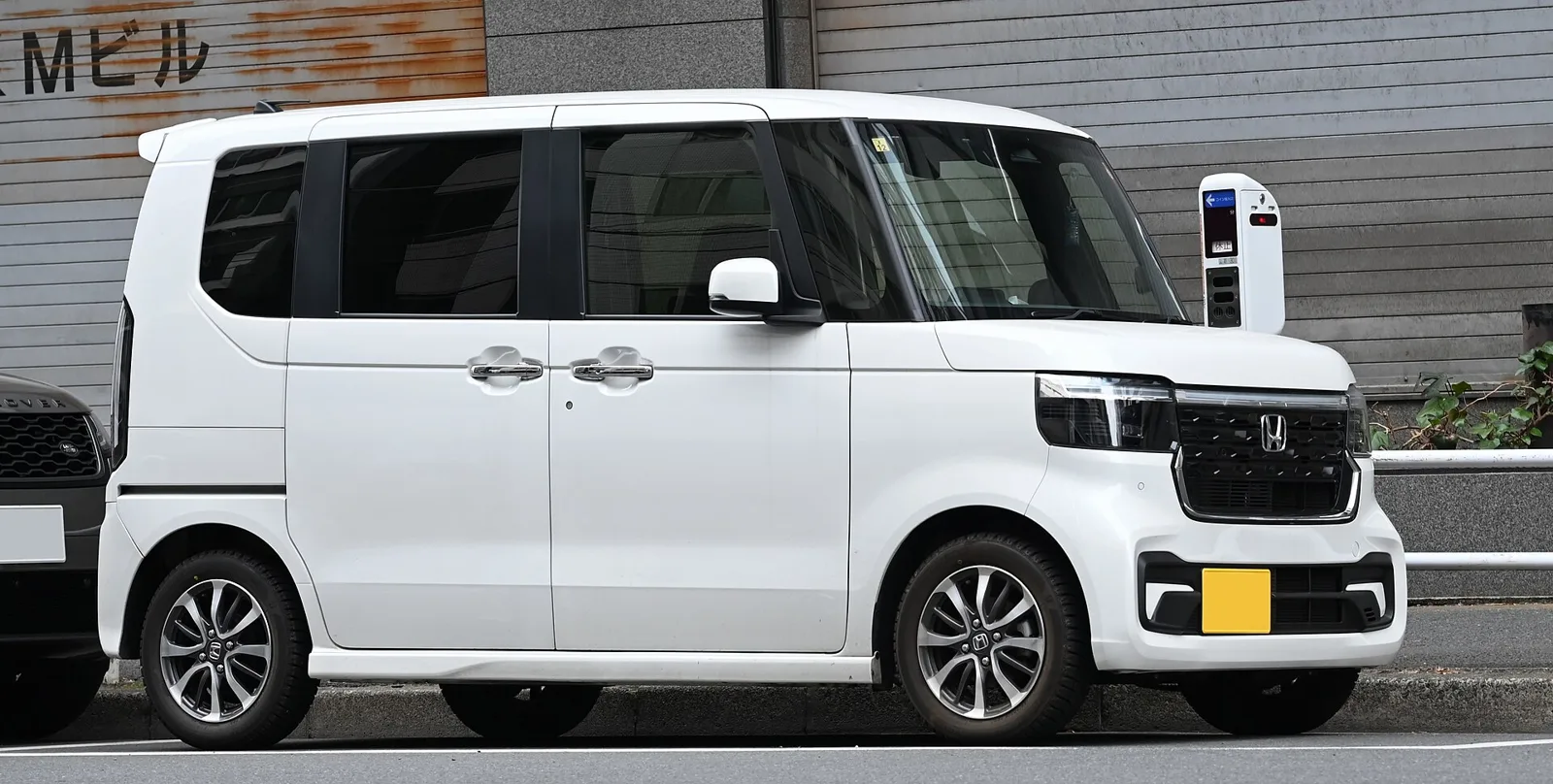
The reward for staying small is money. Owners pay lower tax and lower insurance, so the overall cost of ownership falls. In most rural areas a kei car is also exempt from the shako shomeisho, the certificate of parking space ownership that Japanese buyers must otherwise provide before they can legally buy a vehicle, since public street parking is generally restricted. Kei cars carry their own number plates: black numbers on yellow for private use, yellow numbers on black for commercial use, which is why English speakers call them yellow-plate cars.
Do not picture a golf cart. Modern kei cars often come with turbocharged engines, automatic or continuously variable transmissions, and a choice of front or all-wheel drive. By the end of the 1980s they had grown so much stronger, quicker and safer in a crash that lower top speeds no longer applied. Japanese makers have since agreed a self-imposed limit of 140 km/h (87 mph), mostly because of their narrow bodies.
Is a kei car the same as a European city car?
People often call kei cars the Japanese version of the European A-segment, but the comparison misleads. No European law offers A-segment cars any special status, restriction or benefit. Kei cars are built around rules that exist only in Japan, and the great majority are made for the home market alone, mainly with the steering on the right.
The 64 PS figure comes from a gentleman's agreement reached to prevent a horsepower race, since the strongest kei car on sale at the time was rated at that figure. The number has barely moved since.
The 64 PS power ceiling that every Japanese maker obeys is a gentleman's agreement among the makers.
Why did Japan create kei cars?
After the Second World War most Japanese people could not stretch to a full-size car, though many could manage a light motorcycle. The government created the kei category, with a lighter tax burden and legal maximums for essential transport, to stimulate the car industry and offer an alternative way to commute and make small deliveries.
The first limit in 1949 was just 150 cc, or 100 cc for two-stroke engines. Dimensions and engine size were relaxed in 1950, 1951 and 1955 to make the cars more attractive to buyers and more viable to build. The 1955 change set the cap at 360 cc for engines of either type, and new models followed, notably the 1955 Suzuki Suzulight and the 1958 Subaru 360, regarded as the first true volume kei cars. The small size matched Japanese conditions: urban speed limits realistically never passed 40 km/h (24.9 mph), and kei cars were held to that speed until the mid-1960s, when the limit moved to 60 km/h (37.3 mph). The early cars compare with the European bubble-cars of the time.
Growth took off with the Honda N360 of 1968. Honda launched it on 6 March 1968; until then, kei passenger cars were selling at under 10,000 a month. The monthly figure hit 16,000 by March and passed 18,000 by May. The class kept gaining sophistication: an automatic transmission arrived in the N360 in August 1968, and front disc brakes appeared on sporting kei cars from the Honda Z GS of January 1971. The Daihatsu Fellow Max SS of July 1970 marked the power peak, at 40 PS (29 kW; 39 hp), and sales hit a high of 750,000 that year.
How did the kei limits change over time?
The limits were widened in steps as the industry argued its case, and each change reshaped the cars.
- 1949: 150 cc, or 100 cc for two-strokes.
- 1955: 360 cc for all engines.
- 1 January 1976: 550 cc, with length up by 200 mm (7.9 in) and width up by 100 mm (3.9 in).
- March 1990: 660 cc, an increase of 110 cc or twenty percent, with length up by 100 mm.
- October 1998: the present limits of 3.4 m by 1.48 m by under 2.0 m.
The 550 cc change came out of crisis. Throughout the 1970s the government whittled away at kei benefits. Mandatory annual inspections, previously waived, were added in 1973, and emissions rules tightened. Honda withdrew from passenger kei cars in 1974 and Mazda in 1976. Sales fell to a low of 150,000 passenger cars in 1975, which was 80% below 1970. Suzuki, a small firm whose whole range ran on two-stroke engines, faced the worst of the emissions problem, while Daihatsu could lean on its owner Toyota. The makers insisted a functional 360 cc engine could not meet the new standards, and the legislature relented. Announced on 26 August 1975 and effective from 1 January 1976, the 550 cc limit left manufacturers very little time. Most had expected a 500 cc cap and had already built engines for it, so interim units of between 443 and 490 cc appeared for a model year or so. Only Daihatsu had a 550 cc engine ready.
Exports became a bonus. In 1976 kei cars and trucks sold abroad numbered 74,633, up 171% on the year before, and in 1980 the total reached 94,301, up 80.3%, with microtrucks making up 77.6% of it. Chile took nearly a quarter of the exported vehicles, and nearly 17% went to Europe.
The Suzuki Alto then changed the market. Suzuki built a car that could pass as a commercial vehicle while being meant for private buyers, which sidestepped a 15.5% excise tax, and kei sales of cars and trucks reached 1,229,809 in 1981, the highest since 1970. The Alto's efficient, bare-bones design set the tone for the 1980s, and light commercials nearly displaced the passenger versions until the excise tax was abolished in 1989. As Japanese buyers grew better off, kei cars gained air conditioning, turbochargers, four-wheel drive and electric windows. After the March 1990 revision, all the major models switched from 550 cc to 660 cc engines within five months, during the Japanese economic bubble.
Why do the Japanese still buy kei cars?
Affordability and ease of use. Kei cars are popular with the elderly and with younger buyers, including young families, and they have sold strongly since the 1960s. In fiscal year 2016 they made up more than a third of new cars sold at home, down from a record 40 percent market share in 2013.
The government tried to cool the category. It raised taxes on kei cars by 50% in 2014. It did not break the habit: in 2018, seven of the ten best sellers in Japan were kei cars, tall sliding-door models among them: the Daihatsu Tanto, Nissan Dayz, Suzuki Spacia and Honda N-Box. Almost every kei car is engineered and built in Japan, though exceptions exist. A version of the European Smart Fortwo was briefly imported and classed as a kei car after modifications to reduce its width, and the Polski Fiat 126p (after 1990) and Britain's Caterham 7 160 received the same classification.
Which sporty kei cars are worth knowing?
The early 1990s produced a short burst of tiny sports cars built to exploit the tax rules. Three of them, the Honda Beat, Suzuki Cappuccino and Autozam AZ-1, became known as the Sporty Kei car ABC. They anticipated the Smart Roadster by more than a decade, and Japan saw no new kei sports model after them until the 2002 Daihatsu Copen.
| Model | Built | Layout | Engine and output | Cars built |
|---|---|---|---|---|
| Honda Beat | May 1991 to February 1996 | Rear mid-engine, rear-wheel drive | 656 cc, no turbo, 64 PS at 8,100 rpm | About 33,600 |
| Suzuki Cappuccino | 1991 to 1998 | Front mid-engine, rear-wheel drive | 657 cc turbo, 64 PS at 6500 rpm | 28,010 |
| Autozam AZ-1 | October 1992 to October 1994 | Rear mid-engine, rear-wheel drive | 657 cc turbo, 64 PS at 6,500 rpm | 4,392, plus 531 Suzuki Cara |
Honda Beat
The Beat was the last car Soichiro Honda approved before he died in 1991. The design began at Pininfarina, which sold it to Honda. Its engine did without a turbocharger, using instead three individual throttle bodies, one per cylinder, in a system called MTREC. Output was 64 PS with an electronic top-speed limit of 135 km/h (84 mph), and a five-speed manual was the only gearbox. It was the first kei car with disc brakes on all four wheels. Roughly two-thirds of the output came in the first year, and Honda sold it only in Japan. On 9 May 2010, 569 Beats paraded at Twin Ring Motegi, which Guinness World Records certified as the largest parade of Honda cars.
Suzuki Cappuccino
The Cappuccino weighed 725 kg (1,598 lb) and could be run as a coupe, T-top, targa or full convertible by removing roof panels, with the bonnet, roof, roll bar and lower front panels made of aluminium. The turbocharged three-cylinder engine was tuned to a claimed 64 PS so as not to exceed the kei limit, and its body was 3,295 mm long and 1,395 mm wide. Suzuki began the project in 1987 and showed it at the Tokyo Motor Show within two years, with sales opening in November 1991. In the first two years 15,113 cars were built, and 13,318 of them (88%) sold in Japan.
Autozam AZ-1
Mazda built the AZ-1 under its Autozam brand, with a Suzuki engine and a gullwing-door body. It is the rarest of the trio. The recession had just hit when it reached showrooms, and it was judged pricey and tight on space even by kei standards, and it missed a target of 800 a month. Mazda then brought out special versions to clear stock, among them the Mazdaspeed and the M2 1015. Of the M2, fifty were planned and only about half sold, so the rest were parted out.
Which kei cars can you find outside Japan?
Few. Kei cars are generally too small and specialised to be profitable in other markets, but there are exceptions. Exports of the Suzuki Alto and Daihatsu Cuore have run steadily from about 1980, and the export version of the Suzuki Jimny, widened and given more power, has gained a following outside Japan.
The Cappuccino is the sports kei with the best documented history abroad. Suzuki had not planned to export it, but after 18 months of negotiation and 23 adaptations to meet British type approval, it launched in the UK in October 1993 at 11,995 pounds. Following a first public showing at the British International Motor Show in October 1992, it won two IBCAM Design awards there. A tight import quota trimmed an initial allocation of 1,500 cars to 1,182, and colours were limited to red and silver at a ratio of 4:1. A total of 1,110 were registered in the UK between 1993 and 1995, and the remainder went to Germany, France, the Netherlands and Sweden. Tougher European emissions rules in 1995 ended it: Suzuki decided not to revise the car for Europe because of the expense and its limited production run. The Cappuccino was also regularly sold in Hong Kong.
The Beat was sold exclusively in Japan, and the AZ-1 was never intended for sale outside it, even though much of its testing took place at Millbrook Proving Ground in Britain. Kei cars are mainly built with right-hand steering.
Where does the kei car go next?
The newest sign is electric. In mid-2026, the Chinese maker BYD introduced the battery-electric Racco, designed specifically for the Japanese market. It stands out because almost every kei car has been engineered and built in Japan.
What does this mean for a buyer?
Know what you are paying for. The low tax and insurance that make a kei car cheap to own are features of Japanese law, so they belong to the car's home market. The cars themselves are built around very specific rules, which is why most are right-hand-drive, narrow and limited to 140 km/h.
If a tiny sports car is the goal, rarity is the obvious variable. The AZ-1 numbers 4,392, the Cappuccino 28,010 and the Beat about 33,600. The Cappuccino alone has a European and British production history, with 1,110 registered in the UK, and it has owners' clubs: ClubCappo and the Suzuki Cappuccino Owners Register for Enthusiasts, known as SCORE. A UK owners club also publishes specifications for the Beat.