From a 1962 computer-controlled car to truck convoys with no drivers in the following lorries, with the radio spectrum fight in between.
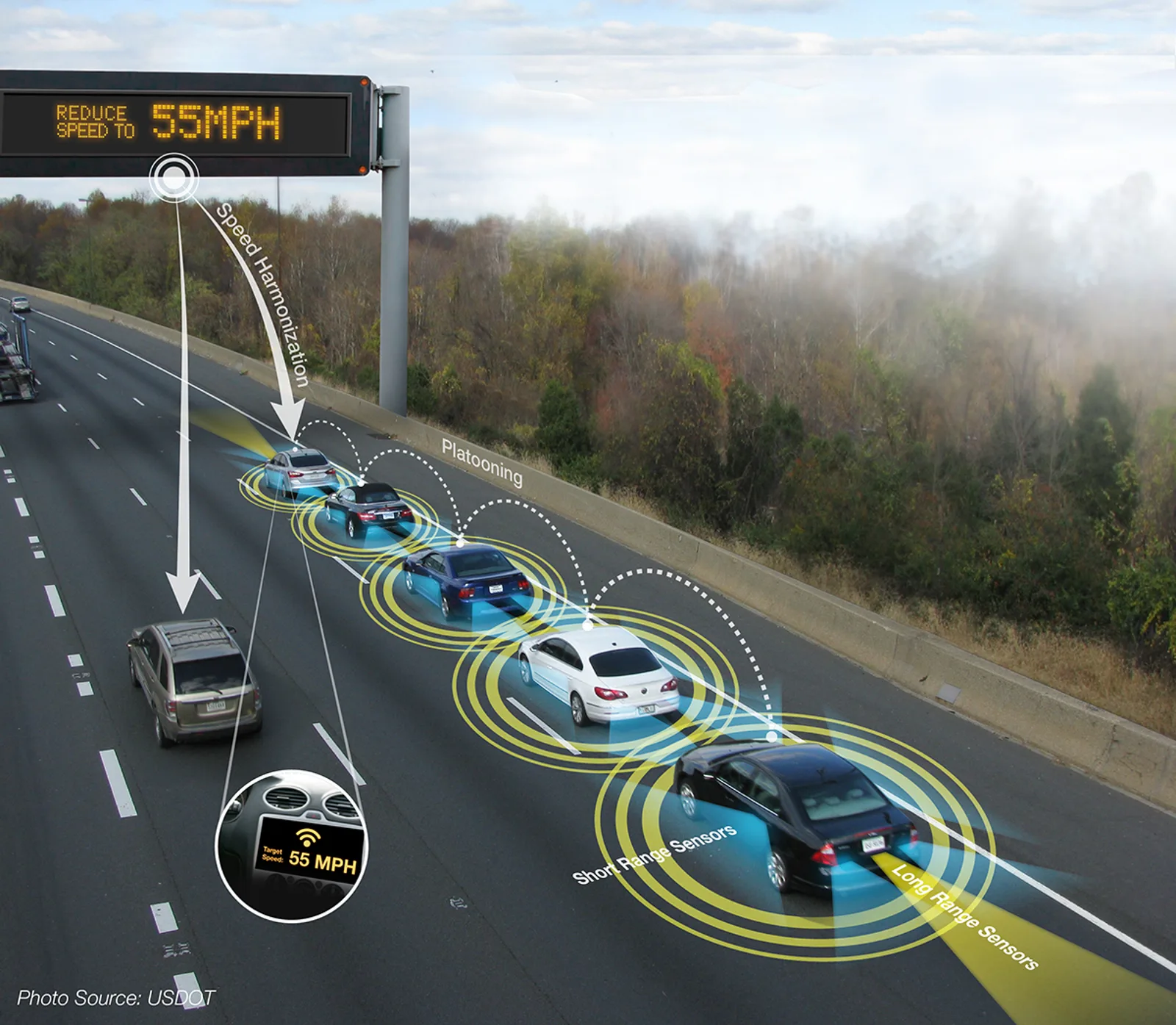
V2V communication lets vehicles and roadside units exchange safety warnings and traffic data over short-range radio such as DSRC. Platooning uses it to link vehicles into close convoys that brake and accelerate together. A 2010 US federal study put the possible accident reduction at up to 79 percent.
A slice of the American radio spectrum was set aside in 1999 so that cars could talk to one another, and it then went unused while cable and technology companies lined up to claim it. The idea at stake is an old one, and its promise is large: the US National Highway Traffic Safety Administration estimated in 2010 that vehicles talking to each other might prevent as many as 79 percent of crashes.
V2V communication, V2X and platooning rest on one principle: cars that share what they sense can act before a human could. That principle explains both the safety claims and the arguments that have slowed deployment.
What is V2X, and how does car to car communication work?
A vehicular communication system is a computer network in which the nodes are vehicles and roadside units. They swap information such as safety warnings and traffic conditions. Both kinds of node carry dedicated short-range communications (DSRC) hardware, which works in the 5.9 GHz band with a bandwidth of 75 MHz and a range of about 300 metres (980 ft).
The letters vary with who is talking to whom. V2V means vehicle to vehicle. Add the infrastructure at the roadside and the umbrella term becomes V2X, vehicle to everything. A closely related name is the vehicular ad hoc network, or VANET. An ad hoc network needs no fixed base station: cars within range simply form a network among themselves and pass messages along. The idea was first put forward in 2001 as car-to-car ad hoc mobile communication and networking, and one early paper pointed out that such networks could help overcome blind spots and avoid accidents.
Cars are an easier kind of network member than the nodes of a general mobile ad hoc network. Vehicles do not wander at random; they tend to move in an organised fashion, they are tied to paved roads, and their dealings with roadside equipment can be described fairly accurately.
Platooning only works when enough vehicles with the same software are driving together.
Where vehicle to vehicle communication came from
Work began in the 1970s, with the Electronic Route Guidance System in the United States and CACS in Japan. The term inter-vehicle communication was in circulation by the early 1980s, and before any standards existed, researchers tried lasers, infrared and radio. The PATH project in the United States, which ran from 1986 to 1997, was an important breakthrough, and Europe launched PROMETHEUS over 1986 to 1995. CHAUFFEUR, FleetNet and CarTALK 2000 followed.
The VANET label itself arrived in the early 2000s. By 2015 it had become mostly interchangeable with inter-vehicle communication, though the focus stayed on spontaneous networking rather than roadside units or cellular networks. General Motors demonstrated a V2V system on Cadillacs in 2006, and Toyota, BMW, Daimler, Honda, Audi and Volvo are among the makers that have worked on it.
One caution applies: VANETs remain in development and are not in use by commercially available vehicles.
What cars would say to each other
The messages range from a simple one-hop broadcast to relays across long distances. The applications on the list include these.
- Electronic brake lights. A driver, or an autonomous vehicle, learns that traffic ahead is braking even when other vehicles hide it.
- Platooning. Vehicles follow a leader very closely by wirelessly receiving its acceleration and steering information, forming electronically coupled road trains.
- Traffic information. Up-to-the-minute obstacle reports reach the satellite navigation system.
- Emergency services. Warnings and status information can cut delays and speed rescue.
- Roadside services. Shops, petrol stations and restaurants could advertise to drivers.
- Electronic tolling. This needs a reliable fix on where the vehicle is when it crosses the tollgate and a secure exchange during the transaction.
The safety logic is simplest at junctions. A car about to leave the highway can say so. A car arriving at an intersection can warn others crossing it, and vehicles can announce a lane change or a traffic jam. In Turin in November 2019, a 5G demonstration on open city streets and a test track showed cars broadcasting a message to the vehicles behind in the event of sudden braking, and alerting drivers to a pedestrian crossing.
Why the safety case is so large
The World Health Organization puts road deaths at approximately 1.2 million a year, about a quarter of all deaths from injury, with some 50 million people hurt. Road death was the ninth-leading cause of death in 1990. A study by the American Automobile Association concluded that car crashes cost the United States $300 billion a year.
The US Department of Transportation says 21,000 of the 43,000 road deaths a year in the country come from roadway departures and intersection-related incidents, the very situations local warning messages are meant to address. Speed matters too: in Western Europe, a decrease of just 5 km/h in average vehicle speeds could bring a 25 percent drop in deaths.
Radio, standards and the fight over spectrum
The two families of radio technology being weighed are cellular, based on 3GPP Release 16, and WiFi, based on IEEE 802.11p. Both have proven to be potential technologies for connected vehicles, and other options, including visible light, ZigBee, WiMAX and millimetre wave, remain areas of research.
| Region | Standard | Basis | Notes |
|---|---|---|---|
| United States | IEEE 1609 WAVE | IEEE 802.11p, seven reserved channels in the 5.9 GHz band | In 1999 the FCC allocated 75 MHz between 5.850 and 5.925 GHz |
| Europe | ETSI ITS, called ITS-G5 in policy documents | IEEE 802.11p | Commission Decision 2008/671/EC harmonised the 5 875-5 905 MHz band for transport safety |
| Australia | None | Not applicable | No spectrum reserved, so vehicles would suffer interference from non-vehicle communications |
The American slice was set aside by the government in 1999 and has gone unused. Cable television and other technology firms want a large part of it for high-speed internet, and the carmakers say they desperately need it. The Federal Communications Commission took the side of the technology companies, while the National Transportation Safety Board backed the car industry. Internet providers argue that autonomous cars will make V2V unnecessary. The industry has said it would share, provided V2V service stays fast and uninterrupted, and the FCC planned to try out several ways of splitting the band. That is the position as of 2016.
The patchwork matters because governments in different places support incompatible spectra, which may discourage manufacturers from adopting the technology for some markets. Security rests on public key infrastructure.
The regulators step in
The US Department of Transportation has worked on V2X with many stakeholders. In 2012, in Ann Arbor, Michigan, a trial ahead of full deployment put 2800 vehicles on the road, including cars, motorcycles, buses and heavy goods vehicles from different brands, using equipment from different manufacturers. NHTSA took it as proof that road safety could improve and that WAVE technology was interoperable. In August 2014 it published a report arguing that vehicle-to-vehicle technology was technically proven as ready for deployment.
The same agency then made a commercial argument. On 20 August 2014 it published an advance notice of proposed rulemaking, reasoning that the safety benefits only appear once a significant part of the fleet is equipped. Because early adopters would get little immediate benefit, NHTSA proposed making the technology mandatory. The House of Representatives held a hearing on the matter on 25 June 2015, and in December 2016 the department proposed draft rules to gradually make V2V capability compulsory for light-duty vehicles. Critics responded that the technology was not completely specified, so manufacturers could not know their responsibilities under the safety standards.
In the European Union, the ITS Directive 2010/40/EU was adopted in 2010 to make intelligent transport applications interoperable across borders. In 2014 the Commission's C-ITS Deployment Platform began work on a regulatory framework covering an EU-wide security infrastructure, data protection and a way to stop radio interference with road-charging systems. Test projects include SCOOP@F, the Rotterdam-Vienna ITS Corridor, Nordic Way and C-ROADS, among others.
Smart junctions without traffic lights
Vehicle-to-infrastructure communication goes further than warning messages. In 2012 computer scientists at the University of Texas in Austin began developing junctions for automated cars with no traffic lights and no stop signs, relying on computer programs that talk directly to each car. In 2017 researchers at Arizona State University built a one-tenth scale intersection and proposed a management technique called Crossroads, which proved resilient to network delay. A 2018 approach added resilience to model mismatch and outside disturbances such as wind and bumps.
What is platooning?
Platooning, sometimes called flocking, is a method of driving a group of vehicles together. The point is to increase the capacity of roads. Electronic coupling, and possibly mechanical coupling, shrinks the gap between cars or trucks. Many vehicles can then accelerate or brake simultaneously, and the closer headway comes from removing the distance a human needs to react.
One proposal is the automated highway system. In one version the road has magnetised stainless-steel spikes driven in along its centre, one metre apart. The car senses them to measure its speed and find the middle of the lane, and because each spike can face north or south, the road also carries small amounts of digital data about interchanges and recommended speeds. Cars with power steering and computer-controlled speed organise themselves into platoons of 8 to 25, driving a metre apart to cut air resistance. The gap between platoons is a conventional braking distance, so if anything goes wrong the damage should be limited to one platoon.
Promised gains and the objections
The benefits listed for platooning are better fuel economy from less air resistance and less accelerating and stopping, reduced congestion, shorter commutes at peak times, mostly unattended following on long highway trips and vehicle-to-vehicle charging. Platooning of trucks has also been proposed as a way to cut the energy use of semi-trucks and make electric ones more feasible.
Against that stands a longer list of worries.
- Some systems have failed in traffic after being hacked by remote computers.
- Drivers are less in control and may be less attentive, and close spacing leaves no time to react if the software or hardware fails.
- Platooning only works when enough vehicles share the same software, which is hard in a mixed traffic stream.
- A platoon may block lane changes and merging, and vehicles outside it have different headways and driving styles.
- If the lead vehicle is hit, the whole platoon may be caught in a multiple-vehicle collision.
- Tight following could normalise tailgating among other drivers.
There are practical questions for owners as well. Platoon capability might mean buying new vehicles or might be retrofitted, and drivers would probably need a special licence endorsement, especially when leading.
Platooning trials, from 1962 to 2021
Research on automated highways began with a team at Ohio State University led by Robert E. Fenton, funded by the US Federal Highway Administration. Their first automated vehicle, built in 1962, is believed to be the first land vehicle to contain a computer. Its electronics filled the trunk, the back seat and most of the front passenger side. Work continued until federal funding was cut in the early 1980s.
| Year | Where | What happened |
|---|---|---|
| 1997 | San Diego County, California | The National Automated Highway System Consortium tested a prototype on Interstate 15 |
| 2011 | Gothenburg, Sweden | SARTRE showed a lead truck followed by a car at the Volvo Proving Ground |
| 2012 | Barcelona, Spain | A lead truck led three cars driven entirely autonomously at up to 90 km/h (56 mph), with gaps of at most 6 m (20 ft) |
| 2016 | Europe to the Netherlands | Six truck brands ran automated platoons on public roads in the European Truck Platooning Challenge |
| 2018 | Shin-Tomei Expressway, Japan | Trucks from different manufacturers platooned for the first time |
| 2019 | South Korea | Hyundai Motor Group ran its first highway truck platoon |
| 2021 | Shin-Tomei Expressway, Japan | Following trucks had no drivers at all, with staff in the passenger seat for security |
The San Diego test was a technical success, but investment moved toward autonomous intelligent vehicles rather than specialised infrastructure. The Federal Highway Administration funded two heavy-truck platooning projects in 2013, one led by Auburn University with Peterbilt and Peloton Technology, the other by the California Department of Transportation with UC Berkeley and Volvo Trucks. Neither involved steering automation.
SARTRE, short for Safe Road Trains for the Environment, was a European Commission funded project that started in September 2009 and aimed at unmodified motorways. A professional driver leads a line of vehicles, each of which measures the distance, speed and direction of the one ahead and adjusts, and once in the platoon drivers can do other things. Any vehicle can leave at will. Volvo Trucks and Volvo Car Corporation took part. The Netherlands organised the 2016 challenge during its EU presidency, with DAF, Daimler, Iveco, MAN, Scania and Volvo trucks. In Korea, the Hyundai demonstration covered cut-in and cut-out of other vehicles, simultaneous emergency braking and V2V communication.
Where this goes next
Research is accelerating. Scientific work on platooning has gained momentum over the past decade, especially from 2018, and patents are rising: Toyota, Volvo, Baidu and Alphabet are among the companies filing on V2V protocols, control systems and safety mechanisms. Published patent families per year grew from fewer than 200 in 2014 to more than 1,000 in 2023, though they have declined after peaking at almost 1,400 in 2020.
On the standards side, 3GPP is working on cellular V2X, while the IEEE's Next Generation V2X study group is developing 802.11bd. Vehicular networks could evolve into a broader Internet of vehicles and then an Internet of autonomous vehicles. In the United States, the regulatory path described above reached draft rules in December 2016.