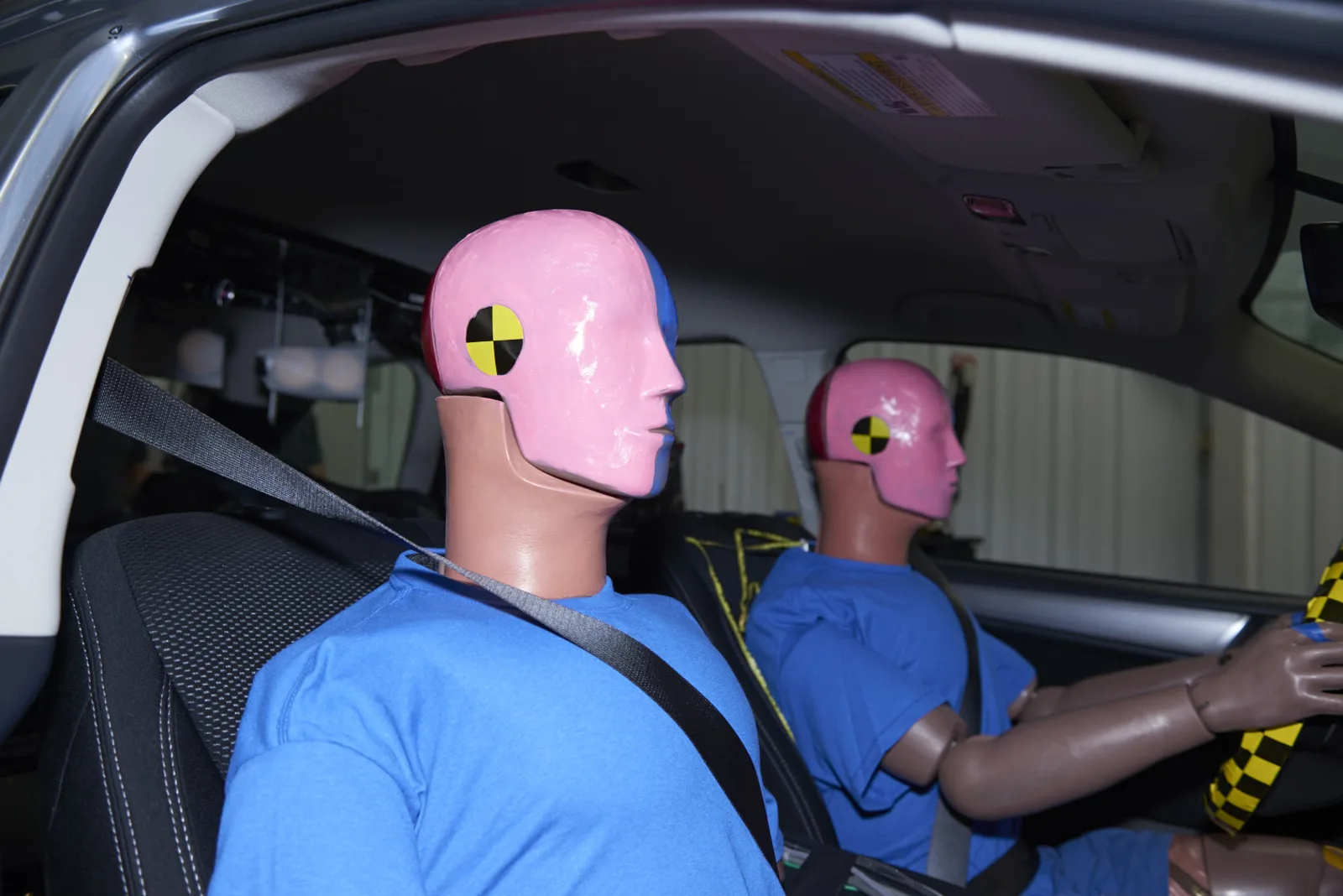
Why cars are crashed with sensor-filled stand-ins, what whiplash does to the neck, and how fixed and active head restraints try to stop it.
A crash test dummy is a human-sized, sensor-filled stand-in that records impact speed, crushing force, bending, torque and deceleration, so injuries can be predicted without harming people. Head restraints, including active ones, aim to limit the backward head movement that causes whiplash.
In 1954 a United States Air Force colonel, John Paul Stapp, was strapped to a rocket sled, propelled to more than 1000 km/h and brought to a stop in 1.4 seconds. He volunteered. Researchers of that era often made themselves the test subjects, and the work pointed to a limit every crash laboratory came to accept: people cannot be pushed past a certain degree of injury, so something else has to take the beating.
That something is the crash test dummy.
What is a crash test dummy?
A crash test dummy is formally a full-scale anthropomorphic test device, or ATD. It copies the dimensions, weight proportions and joint movement of a human body in a traffic collision. Researchers, car makers and aircraft makers use it to forecast what injuries a person could sustain in a crash.
The word that matters is instrumented. Modern dummies are usually fitted with sensors that log how fast the impact happened, how hard the body was crushed, how far parts of it bent or folded, how much torque twisted it, and how sharply it decelerated. Think of a flight recorder shaped like a passenger. The crash itself lasts a fraction of a second; the data it leaves behind is what engineers study for months.
The work never finishes. Every new vehicle is designed differently, and as technology moves on, dummies must be developed to test it accurately. Alongside the physical dummy, virtual models of the human body are used more and more in industry and research.
Living people could not be exposed to tests that went beyond a certain degree of injury, so something else had to take the beating.
How did crash testing work before the dummy?
The need became obvious soon after commercial car production began in the late 1890s. Mary Ward of Parsonstown, Ireland, is the first person on record to die in a car accident, thrown from a steam-powered vehicle in 1869, and in 1899 Henry Bliss was the first motor vehicle fatality in North America, when a car hit him as he stepped off a New York City trolley. By the 1930s the car was part of daily life and deaths were rising.
The cars of that period offered little help. A 1930 interior had a rigid metal dashboard, a non-collapsible steering column and protruding knobs and levers. Without belts, occupants in a frontal crash could be thrown against the cabin or through the windscreen, and a rigid body passed impact forces straight to them. As late as the 1950s manufacturers were on public record saying that crashes could not be made survivable, the forces being too great.
Cadavers and volunteers
Wayne State University in Detroit did the first serious work on how the human body responds to high-speed collisions. In the late 1930s nobody had reliable data, or the tools to gather it, and biomechanics was barely a field. Human cadavers gave the first information on how much crushing and tearing the body can take, and some were fitted with crude accelerometers and strapped into cars for head-on crashes and rollovers.
The value was real. Albert King's 1995 paper in the Journal of Trauma calculated that, as a result of design changes made up to 1987, cadaver research was saving 8,500 lives a year. He reckoned that for every cadaver used, 61 people survive each year thanks to seat belts, 147 thanks to air bags and 68 in windscreen impacts.
But the problems were nearly as numerous. Most available cadavers were older men who had died non-violent deaths, so they did not reflect the range of people hurt in crashes. Accident victims could not be used, because earlier injuries would corrupt the data. No two bodies were alike and any given part could be tested only once, so comparing results was extremely hard. Child cadavers were effectively unusable because of law and public opinion, and as testing became routine, suitable cadavers grew scarce. Data ended up skewed towards older males.
Volunteers filled some gaps. Lawrence Patrick, who taught at Wayne State, took about 400 rides on a rocket sled, and he and his students accepted blows to the chest from heavy pendulums. Patrick later said the work was seminal in building the mathematical models against which later research was compared. But living people could not be exposed to tests that went beyond a certain degree of injury, and the causes of serious injuries needed a different subject.
Animals
By the mid-1950s the bulk of what cadavers could teach had been collected, and researchers needed data on survivability, which cadavers could not supply. Animals filled the role for a time. At the Eighth Stapp Car Crash and Field Demonstration Conference, the writer Mary Roach saw chimpanzees on rocket sleds, a bear swung into an impact, and an anaesthetised pig driven at about 10 mph into a steering wheel with a deep dish.
Pigs were chosen for steering wheel and cabin impacts because their internal structure resembles ours and they can be positioned upright. That allowed designers to study dashboard padding, the shape of knobs and levers, and the rear-view mirror, which is struck often in frontal collisions. General Motors introduced a collapsible steering column in the early 1960s, and it is credited with halving the risk of death from steering-wheel impact.
Animal work drew far more protest than cadaver work. Welfare groups such as the ASPCA objected strongly, even though researchers such as Patrick backed it for the reliable data it gave. Anatomical differences and the difficulty of fitting instruments inside the animals also limited its usefulness. The Highway Safety Research Institute at the University of Michigan turned to baboons in 1978 and stopped because it had enough data, not because of the objections. By 1991 animal use was declining as computers and technology advanced, and General Motors discontinued live testing in 1993, with other makers following soon after.
Four kinds of test subject compared
| Subject | What it offered | Main limit |
|---|---|---|
| Human cadaver | Direct data on crushing and tearing forces | Ethics, scarcity, mostly older men, each part usable once |
| Volunteer | Live responses to deceleration and impact | Cannot be injured beyond a certain degree |
| Animal | Data on survivability, such as steering column impacts | Anatomical differences, hard to instrument, strong objections |
| Instrumented dummy | Repeatable measurements of forces, bending and deceleration | Tissue is not alive, so it does not respond like a living body |
How a dummy measures injury today
A dummy gets round most of those limits. It can be crashed again and again without ethical weight, and it can be built to represent different bodies. The range has grown to include specialised dummies for men, women, children, the elderly and the obese, as well as dummies built to study rib and spinal impacts. That variety matters because the human tests showed how different bodies behave. In one University of Michigan comparison, obese cadavers suffered more lower-limb injuries than non-obese ones, and the researchers wondered whether body fat cushioned some of the blow.
The dummy has a weakness of its own. It is not living tissue, so it will not respond in precisely the way a live animal or a person would, which is why researchers describe virtual models as a complement rather than a replacement. Finite element models of the human head, which began with work on neck injuries in three-year-olds, have become increasingly important to the study of head injury.
What is whiplash?
Whiplash is the injury that head restraints are designed to limit. It is formally called whiplash associated disorders, or WAD. The mechanism is known as cervical acceleration-deceleration. Its name is a colloquialism, and the exact injury mechanisms remain unknown.
It is most closely linked with rear-end crashes, though headbanging, bungee jumping, falls, amusement rides and skiing accidents can cause it too. Before the car it was called railway spine, because it showed up mainly after train collisions; the first documented case of severe neck pain from a train collision dates to around 1919.
The financial scale is large. In 2007, 430,000 people in the United Kingdom made an insurance claim for whiplash, accounting for 14 per cent of every driver's premium. In the United States an estimated 65 per cent or more of bodily injury claims are whiplash-related, costing around $8 billion a year. Opinion on chronic whiplash is divided: studies in at least three countries have shown zero to low prevalence, and some academics suggest a link to financial issues.
What happens inside the neck
The neck holds seven cervical vertebrae. The top two, the atlas and axis, are shaped differently from the rest and do most of the work of turning and nodding the head. In a rear impact the injury is a sudden hyperextension of the neck followed by hyperflexion, which sprains ligaments.
Researchers describe four phases. At the start there is no load on the neck. During retraction, the actual whiplash, the seat back pushes the torso forward and the spine is forced into an S-shape, with the upper section flexing and the lower section hyperextending. In extension, the whole neck and head swing back, and the head restraint stops or limits that movement. Rebound follows. Most injuries are to the C-5 and C-6 vertebrae.
Symptoms include neck and back pain, pain referred to the shoulders, pins and needles in the arms and legs, and headaches. They can appear immediately but are often not felt for days. The Quebec Task Force grades the disorders from 0, with no neck pain, to 4, with a fracture, dislocation or spinal cord injury. Symptoms that last more than six months are labelled whiplash syndrome.
How do head restraints reduce whiplash?
A head restraint, or headrest, is attached to or built into the top of the seat to limit how far the occupant's head moves backwards relative to the torso. Its job in the extension phase is to catch the head before the neck is over-stretched. Since mandatory introduction in some countries from the late 1960s, restraints have prevented or reduced thousands of serious injuries.
The idea is old. Benjamin Katz of Oakland, California, was granted a patent for an automobile headrest in 1921, and more followed in 1930 and 1950. Karobes, the main British supplier, patented its designs in the late 1950s and was still competing when British tests assessed such devices in 1973. Optional restraints turned up in North American showrooms in the mid-1960s, and the US National Highway Traffic Safety Administration required them in all new US cars sold after 1 January 1969.
What the law demands
American Federal Motor Vehicle Safety Standard 202 lets a maker pass in one of two ways. The first is a dynamic test: when the seat structure is accelerated forward by at least 8g, the head reference line may rotate back no more than 45 degrees from the torso line. The second is dimensional. The restraint must reach at least 700 mm (27.6 in) above the seating reference point at its highest, deflect no more than 100 mm (3.9 in) under a 372 N-m moment, be at least 254 mm (10.0 in) wide on bench seats or 171 mm (6.73 in) on individual seats, and withstand an increasing rearward load until the seat fails or 890 N (200 lbf) is reached.
A 1982 NHTSA evaluation of passenger cars found that integral restraints, where the seat back extends high enough, reduced injury by 17 per cent, against 10 per cent for adjustable restraints on sliding shafts. NHTSA has said the gap may come from adjustable restraints being badly positioned. For cars made after 2008, a revised standard added a backset requirement for the first time: a gap of 55mm (2.1 in) behind the head of an average posture.
Active head restraints and the systems that move
A fixed or integrated restraint cannot be moved without tools. An adjustable one can be tilted, raised or both. An active head restraint goes further: it is designed to improve its own position or geometry automatically during an impact. There are also automatically adjusting restraints, which reposition when the seat does.
Several makers have built their own versions because few occupants adjust the standard fitment correctly. Saab is credited with the first active head restraint, and Nissan, Subaru, Hyundai, Peugeot, Opel, Ford and SEAT use active head restraint systems. Mercedes-Benz fits an Active Head Restraint called NECK-PRO on the A-Class, Volvo and Jaguar use the Whiplash Protection System known as WHIPS, and Toyota calls its version Whiplash Injury Lessening. The Insurance Institute for Highway Safety and other test centres have found that over 60 per cent of new vehicles have head restraints rated "good".
How well do head restraints work?
The honest answer is that the figures vary. The injury-reducing effect of head restraints so far appears to be low, approximately 5 to 10 per cent, in part because seats have become stiffer to protect people in high-speed rear crashes, which may raise the risk of whiplash in low-speed ones. The same account points out that the whole approach rests on the idea that whiplash has purely mechanical causes, which is unproven, and suggests better seat geometry and improved energy absorption might bring further gains.
Where a restraint is placed properly the numbers look better, though accounts differ. One says a well-placed restraint lowers the chance of neck injury by up to 43 per cent in a rear-end crash. Another puts the reduction in head injury at up to 35 per cent. The most effective restraint, according to the research, allows less than 60 mm of backset to prevent the neck hyperextending. A badly positioned restraint, by contrast, may increase the risk of neck injury.
Comfort plays a part too. When a headrest pushes the head forward, there is no gap behind the head, and about 16 per cent of the population experience discomfort for that reason. Regulated specifications are written around the average posture, which by definition not everyone has.
Where this goes next
Researchers are still working. Manufacturers and safety organisations are studying how different restraint and seat-back geometries might reduce head and torso injuries in rear-end impacts. On the testing side, the range of specialised dummies is growing, and virtual models of the human body are being used more and more to complement them.
What it means for a buyer or a driver
Setting the restraint correctly matters. Where a restraint is manually adjustable, using it properly demands knowledge and awareness from the occupant. Its height is the critical factor: it should reach at least the height of the head's centre of gravity, roughly 9 cm (3.5 in) below the top of the head. The backset, the gap between head and restraint, should be kept as small as it can be, and backsets of more than 10 cm (about 4 in) have been linked with more neck symptoms in crashes.