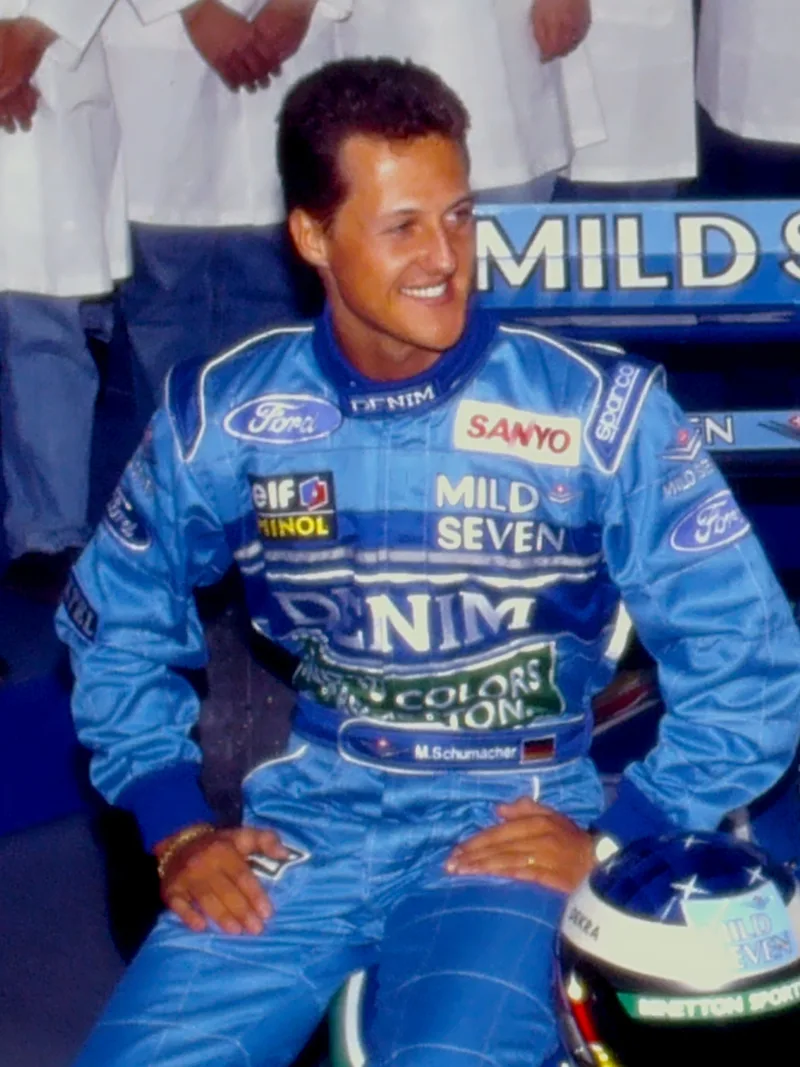
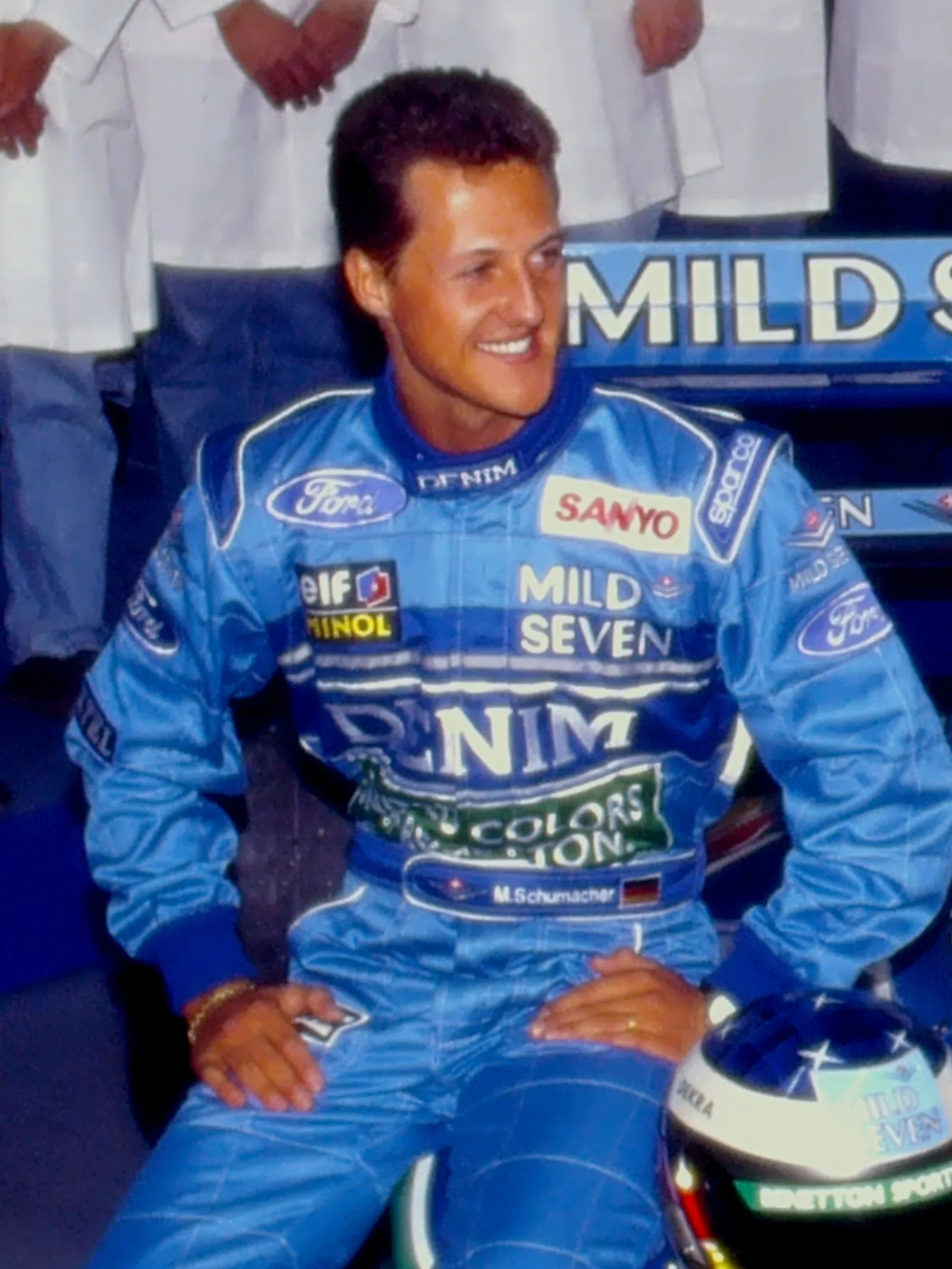
A start penalty, a rapid climb through the field and a driveshaft failure framed Michael Schumacher's ninth win, which gave Benetton the 1995 Constructors' Championship.
The 1995 Japanese Grand Prix took place on 29 October 1995 at Suzuka, the penultimate round of the season. Michael Schumacher won the 53-lap race from pole, and Herbert's third place for Benetton was enough to secure the constructors' title.
Michael Schumacher won the 1995 Japanese Grand Prix at Suzuka from pole, in a race run on a damp track. Mika Hakkinen was second for McLaren and Johnny Herbert third for Benetton, and that result gave Benetton the constructors' championship. Jean Alesi's drive from the back of the field after a start penalty is the moment the race is best remembered for.
What was at stake at Suzuka?
Schumacher had already become champion at the previous race, the Pacific Grand Prix, with 92 points to Damon Hill's 59. Benetton led the constructors' table on 123 points from Williams on 102, with 32 points still available in the two remaining races.
Hill had been criticised by the British media after a run of poor results, and there was continued speculation that Williams might replace him with Heinz-Harald Frentzen or Gerhard Berger for 1996. Frank Williams gave Hill an unequivocal vote of confidence before the race.
The constructors' title was therefore still open, and Williams needed a strong result to threaten Benetton's lead. Schumacher's position at the top of the drivers' table meant that his race was about the team's prize rather than his own.
Alesi climbed from a start penalty to second place before his driveshaft failed, and he called it the race of his life.
Driver changes and the late entries
Two driver changes were made before the race. Karl Wendlinger returned to Sauber in place of Jean-Christophe Boullion, who had been in one of the two Sauber cars since the fifth round of the season at Monaco and was then released by the team.
Wendlinger was being given another chance after his 1994 Monaco accident, which had left him in a coma for weeks. Hakkinen was back at McLaren after missing the Pacific race with an appendix operation.
The Japanese race also brought a notable withdrawal. Aguri Suzuki crashed his Ligier during Saturday qualifying, and a broken rib meant that he was in hospital and could not start the race.
How did qualifying set the grid?
Schumacher took his tenth career pole in his Benetton B195 with a time of 1:38.023. Alesi was second, eight-tenths of a second behind, and Hakkinen qualified third for McLaren, his best qualifying effort of the season alongside his Belgian third place. Only 24 cars qualified, and the grid was one car short after Suzuki's crash.
The Benetton was excellent, Schumacher said, and he felt confident for the race. Alesi was pleased with his run but worried about a mechanical problem that had caused him to crash on the Friday, and he accused the Ferrari team of holding back information from him.
Alesi was due to swap seats with Schumacher at the end of the season, so the relationship between him and the team was already strained.
Hill qualified fourth, a second slower than Schumacher. Mark Blundell crashed into the wall in the first part of qualifying and could not set a time, then crashed again at the 130R corner in Saturday practice. On medical advice he did not take part in the second qualifying session, which left him unable to set a time and at the back of the grid.
Practice and the damp warm-up
The two practice sessions each lasted 1 hour and 45 minutes, and the tracks were dry. Schumacher was fastest in the first at 1:40.410, two-tenths ahead of Hakkinen. The Williams and Ferrari cars took the rest of the top six, with Hill and Coulthard third and fifth.
In the second session Hakkinen was quickest at 1:40.389, three-tenths ahead of Irvine, who was second in the Jordan. Hill was third, two-tenths behind Hakkinen, with Schumacher fourth behind him. Both Williams cars went off into the gravel during the session, but Hill and Coulthard still made the top ten.
The 30-minute warm-up was held in wet conditions. Hill had the fastest time at 2:00.025, with Schumacher second and Coulthard third. Alesi was fourth, eight-tenths behind Hill, and the damp track made the lap times far slower than in the dry sessions.
How did Alesi's start penalty shape the race?
Alesi, who had started second alongside Schumacher, was judged to have jumped the start, and he served a 10-second stop-and-go penalty on lap three. He returned to the race in tenth place, and Berger had been given the same penalty for the same offence.
The race began at 14:00 JST, and all the drivers started on wet-weather tyres because the track was damp from the morning rain. Tickets did not sell out for the first time since 1987 at Suzuka, despite three Japanese drivers entering the race. Schumacher held the lead into the first corner, while Gianni Morbidelli, near the back in one of the Footwork cars, was hit from behind by Wendlinger's Sauber, stalled and retired at the first corner.
Alesi pitted on lap seven to change to dry slick tyres as the track began to dry. He then began setting the fastest laps of the race, the first of them 1:54.416, five seconds faster than the rest of the field.
Alesi's progress was interrupted when he spun while trying to pass Pedro Lamy's Minardi for fifteenth place, but he was back up to second by lap ten, overtaking Hill around the outside into the final chicane.
Alerted by Alesi's pace on slicks, the other drivers pitted for their own dry tyres. Schumacher himself pitted on lap ten, handing the lead briefly to Hakkinen before he too stopped for slicks.
How did the race unfold at the front?
Alesi was six seconds behind Schumacher when his Ferrari suffered a driveshaft failure on lap 25, possibly as a result of his earlier spin. Schumacher made a second stop on lap 31 and rejoined in second place behind Hill, and by then the leaders were running within striking distance of each other.
Schumacher set the race's fastest lap on lap 33, and he regained the lead on the following lap when Hill made his stop. Hakkinen and Coulthard had been third and fourth before their stops, but Coulthard pitted six laps after Hakkinen and rejoined in third, one place ahead of the Finn.
Herbert was fifth after the second round of stops, with Irvine sixth. Rain began to fall again, though only at the Spoon Curve end of the circuit, and the Williams drivers had been second and third before Hill ran off there.
Two laps after his stop, Hill went wide at Spoon Curve and damaged his front wing. He pitted again, rejoined fifth, and picked up a 10-second penalty for speeding in the pit lane. The team told him to speed up, even though he had not yet taken the penalty.
Coulthard made the same error, running through the gravel at Spoon Curve, but he seemed set to escape with only minor damage. As he braked for the next corner, the gravel lodged in his sidepods flew out, and he lost control and became stuck in the gravel trap.
Hill later spun at Spoon Curve and retired without serving the penalty. Blundell, Irvine and Frentzen had also run wide at Spoon, but all three finished.
The finishing order at Suzuka
| Position | Driver | Detail |
|---|---|---|
| First | Michael Schumacher | Benetton, from pole, 53 laps |
| Second | Mika Hakkinen | McLaren, 20 seconds behind the winner |
| Third | Johnny Herbert | Benetton, took the constructors' title |
| Fourth | Eddie Irvine | Jordan |
| Fifth | Olivier Panis | Ligier |
| Sixth | Mika Salo | Tyrrell, took the final point |
Mark Blundell, who had started at the back, finished seventh, 1.6 seconds behind Salo. Frentzen, Badoer, Wendlinger, Lamy and Inoue completed the finishers, from the 22 cars that started the race.
How was Alesi's drive received afterwards?
Alan Jones called Alesi's performance one of the great drives in Grand Prix racing. Alesi said that without the driveshaft failure he would have battled for the win until the end, and he later described the day as the race of his life.
Alesi believed he had not jumped the start, but he admitted that the car had crept forward a few centimetres because of the downhill slope of the grid. Before the race he had gone to see the race director to find out how he could avoid a penalty, and he later said he was totally fed up with the decision.
Berger also questioned his own penalty, claiming that his car had not moved before the green light.
Hill was disappointed with the race and the season as a whole. He later said that 1995 had gone down mentally for him, and he believed that Frank Williams and Patrick Head had decided to replace him for 1997 that year. Williams were fined $10,000 by the FIA because Hill had not taken his stop-and-go penalty before he retired.
Schumacher's win was his ninth of the season, matching Nigel Mansell's record set in 1992. It was also his last win for Benetton before he moved to Ferrari for 1996, and Herbert said the team had done a fantastic job.