Two kinds of planetary gearset, one decisive change in power flow, and an Aisin-Warner family whose codes can be read like a recipe.
ZF's 3HP (1963-1990) and 5HP (1990-2008) automatics moved from Ravigneaux to Simpson gearsets and, with the 5HP 30, to combined parallel and serial power flow. Toyota's Aisin-Warner A-series, from the 1959 A10 to the A340, spread through Toyota, Volvo, Jeep and other models.
One family of Toyota automatics ended up in a Volvo 240, a Jeep Cherokee, a Mazda Miata and a Lexus LS 400. Built by Aisin-Warner, the A series spread through so many badges that the family name tells you little about which car you are looking at.
ZF's 3HP and 5HP automatics followed a different course. They moved through two kinds of planetary gearset and one big change in how power travels through the box, and the lessons shaped everything the company built next.
What is a Toyota A transmission?
Toyota's A family is a range of automatics for front-, rear-, four- and all-wheel-drive cars, built by Aisin-Warner. They have much in common with Volvo's AW7 series and Aisin-Warner's own 03-71 units, and relatives of them were fitted to Suzukis, Mitsubishis and other Asian vehicles.
The codes can be read like a recipe. The letter A stands for Aisin-Warner Automatic, followed by two or three digits. In older two-digit names the first digit is the generation, not the number of gears, which is why an A10 and an A20 are different designs, and so are an A30, an A40 and an A40D. In newer three-digit names the first digit is the generation, counted 1 to 9 and then A and B, the second is the number of gears, and the last identifies the application. An A340 is therefore a third-generation four-speed, and an A130 a first-generation three-speed. Letters add features: D separates the three-speed A4x from the four-speed A4xD, E means electronic control, F four-wheel drive, H all-wheel drive with a transverse engine, and L a lock-up torque converter.
One family of Toyota automatics ended up in a Volvo, a Jeep, a Mazda and a Lexus.
How did the A family grow?
It began in 1959 with the A10, the Toyoglide two-speed semi-automatic. It was largely based on GM's cast-iron Powerglide and was the first torque-converter automatic built in Japan. The A20 of 1963 was a fully automatic two-speed. The three-speed A30 followed, first in the 1967 Crown and Corona Mark II and then in the Corona, Celica, Carina and Corolla, and a 1970 A32 added electronic control.
The A40 was a three-speed that served from 1975 into the mid-1980s in cars such as the Carina 1600, Celica 2000 and Starlet 1300, and, as the AW55, in Volvo 200 series cars from 1977 to 1981. The four-speed A40D arrived in the Celica Supra of 1977 to 1980. The A42D, also sold as the AW70, went into the Volvo 240 from 1982 to 1993 and the Toyota Chaser, Mark II and Cresta from 1996 to 2001. The A43D, built as Aisin-Warner's 03-71, had no lock-up and no electronics, and was controlled by throttle position and a governor. It sat behind Toyota 22R pickups, a run of Volvo 240, 740, 760, 780 and 940 models, and the Tacoma 2WD from 1995 to 2000.
Lock-up and electronics came with the E and L suffixes. The A43DL went into the Land Cruiser in 1982 to 1985, and the A44DL into the Toyota Van, the Mitsubishi Montero and the Hyundai Galloper. The A44DE reached the Suzuki Sidekick, the Kia Sportage 4WD in 1998 to 2002, the Mazda Miata from 1999 to 2005 and the Chevrolet Tracker. The A46DE sat in the Previa and Tarago, with an A46DF variant adding a viscous coupling centre differential for four-wheel drive, and the A47DE served the Lexus IS 200 from 1998 to 2005. The little A55 was odd: a front-wheel-drive three-speed in the Tercel, mounted longitudinally.
| Code | Gears | Features | Example fitments |
|---|---|---|---|
| A40 | 3 | Hydraulic, rear drive | Carina 1600, Celica 2000, Volvo 200 (AW55) |
| A43D | 4 | No lock-up, no electronics; governor and throttle control | 22R pickups, Volvo 240 to 940 (AW71) |
| A44DE | 4 | Lock-up, electronic | Mazda Miata, Kia Sportage, Suzuki Sidekick |
| A131L | 3 | Front-drive transaxle, lock-up | Corolla, Chevrolet Nova, Geo Prizm |
| A140E | 4 | Front-drive transaxle, electronic | Camry 4-cylinder, Celica GT |
| A245E | 4 | Smaller, lighter A240E derivative | Corolla 1.6 and 1.8 |
| A340E | 4 | Electronic, rear drive | Supra, Lexus LS 400, Tacoma, Tundra |
Who else used the A-series?
Volvo was the most loyal customer. The A40 was the AW55 in Volvo 200 series cars with the 2.1L four-cylinder engine from 1977 to 1981, and the 2.7L V6 Volvo 260 got a British-built Borg-Warner 55 that was identical to the A40. The A42D (AW70) went into the 240 and the non-turbo 740, while the A43D family, as the AW71, was used in turbocharged four-cylinder and V6 versions of the 240, 260, 760, 780 and 940 from 1982 to 1995. The A43DL (AW71L) and A44DL (AW72L) reached the 740 and 940 as well, and the A340E, labelled AW30-43LE, powered the 960, S90 and V90 from 1995 to 1998.
Other badges came from further afield. The A44DL went into the Mitsubishi L300 and Express vans between 1992 and 1995 and the Hyundai Galloper in 1997 to 1999, and the A44DE reached the Kia Sportage and the Suzuki Sidekick, which put one family of gearboxes behind the badges of Suzuki, Kia, Mitsubishi, Hyundai, Mazda and Chevrolet.
What are the front-drive A100 and A200 transaxles?
The A100 and A200 groups are transaxles for front-drive cars. The three-speed A131L ran from 1984 to 2002 in the Corolla and also went into the Chevrolet Nova of 1985 to 1988 and the Geo Prizm. The four-speed electronically controlled A140E served the 4-cylinder Camry from 1991 to 2001, the Celica GT and the Camry Solara.
The A140L has a known quirk. It selects gears with a plastic governor gear whose teeth wear and shred over time, leaving a transmission that shifts only into first and reverse. Replacing the part is relatively inexpensive compared with a new transmission and can be done without removing the unit from the car.
In the A200 group the A240E went into the MR2 from 1984, and the A241E served the later MR2, the Celica GT, the Corona, the RAV4 of 1996 to 1997 and the Avensis. The A245E took the A240E from the 1989 MR2 as its base and shrank it in size and weight. It then spent years in the Corolla, including the 1.8 litre 1ZZ-FE until 2008. In 2005 the number of discs in its B3 clutch changed from six to five. The A246E carried on into the Matrix from 2003 to 2007 and the Pontiac Vibe, which shared its engine.
Where does the A340 transmission fit?
The A340 is the rear-drive branch. The A340H, the four-wheel-drive version, went into the Jeep Cherokee XJ with its 4.0L engine, known there as the AW4, from 1987 to 2001, as well as the Comanche, the Grand Cherokee ZJ of 1992 and 1993, the Toyota 4Runner 4x4 and the Isuzu Trooper.
The A340E, also coded 30-40LE, is the one most enthusiasts know. It took on an engine-specific bell housing, with a cast-in letter J for the straight-six JZ engines and U for the UZ V8. It was fitted to the Supra (MA70 from 1986 to 1993 and JZA80 from 1993 to 1996), the Cressida of 1987 to 1992, the Century V8 from 1987 to 1997, the Lexus LS 400 and SC 300, the Volvo 960, the Tacoma, the Tundra 4x2, the Sequoia 4x2 and the Isuzu D-Max. A separate heavy-duty 30-40LS was built only for twin-turbocharged 2JZ-GTE engines. Its case is similar but not interchangeable, with J3 cast into the bell housing and a larger converter and flex plate, and it was fitted to the Supra RZ of 1997 to 2002, the Aristo V300 and a few Isuzus.
What is the ZF 3HP automatic?
The 3HP is a three-speed automatic family from ZF Friedrichshafen with a hydrodynamic torque converter and hydraulic control. In selector position P, the output is locked mechanically. Its first form, the 3HP 12 of 1963, used a Ravigneaux planetary gearset and was produced into the mid-seventies in versions for longitudinal and transverse engines. The all-new Simpson design of 1973, the 3HP 22, ran until 1990 and found its way into many cars from Alfa Romeo, BMW, Citroen, Peugeot and Fiat.
What is the ZF 5HP, and why does its gearset matter?
The name reads as five speeds, a hydraulic converter and planetary gearsets. The 5HP is made for longitudinal engines, designed and built by ZF's subsidiary in Saarbruecken. There were two families, and they differ in more than gearset type.
The first, the 5HP 18 of 1990 and 5HP 19 of 1997, used Ravigneaux gearsets and was ZF's first five-speed. It was built through 2008. Its power flow was purely serial: to get more gears, ZF simply added components. That made the transmissions larger, heavier and more costly, and with 10 main components the progress was unsatisfactory, an obvious transitional solution and the last conventionally designed ZF transmission.
The second, the 5HP 30 of 1992 and 5HP 24 of 1996, used Simpson gearsets and ran through 2000. It was the first ZF family to mix parallel and serial power flow in one design. Imagine a road network where traffic can use side streets as well as the main road: computer-aided design made it possible, it produced a globally patented gearset concept, and it kept transmissions from growing larger, heavier and dearer as gears were added. It improved the ratio of gears to components compared with earlier layouts.
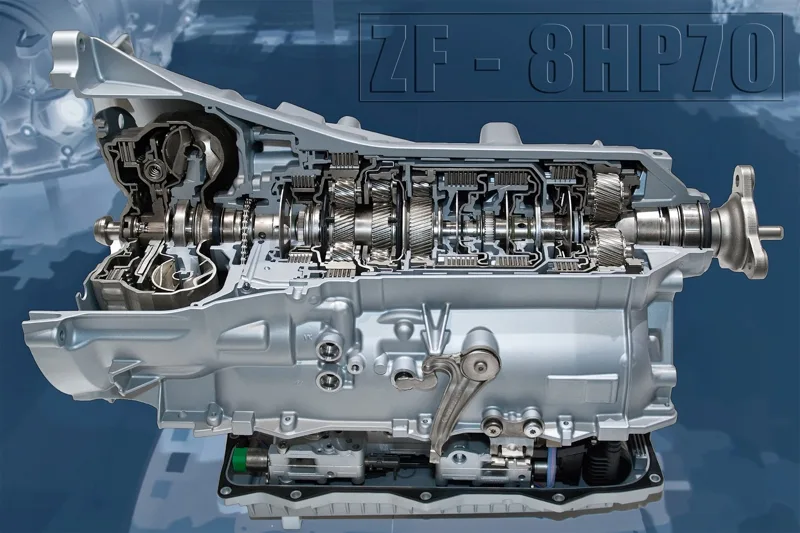
The six-speed 6HP launched in 2000 and could be made at significantly lower cost, so most 5HP gearboxes were replaced soon after. The later 8HP became the benchmark for automatics, and every ZF transmission after the 5HP, including the 8HP, uses fewer main components. As with all these upgrades, the stated goal of added speeds and a wider gear span was better fuel economy through downspeeding, with less noise and vibration as a bonus.
What else does ZF build?
ZF supplies transmissions for passenger cars and SUVs, vans and light trucks, as well as trucks, buses and special vehicles. Gearboxes are either manual or automatic, and installed longitudinally or transversely. A transaxle, which puts gearbox and final drive in one housing, is common with transverse engines. With longitudinal engines it is rare, although the Citroen 2CV and Renault R4 are examples.
The list reads like a roll call of enthusiast cars. The 5 DS 25 transaxle sat behind the engine in the Ford GT40 (Mk1 and Mk3), the De Tomaso Mangusta and Pantera, the Maserati Bora, the Lancia 037 and the BMW M1. The S5-39 manual served the BMW E46 3 Series, E39 5 Series, E38 7 Series and E53 X5, while the S6-40 appeared from 1989 to 1996 in the Aston Martin Vantage V550, Lotus Carlton and Corvette. The S6-53 has been used since 1999 in cars such as the Alfa Romeo Giulia Quadrifoglio, and the S7-45 has been in the Porsche 911 since 2011. For heavy vehicles, the AS Tronic, a 12-speed automated manual with a hydraulic retarder, dates from 1997.
Where this goes next
The direction was set by the 5HP. Every ZF transmission built after it, the eight-speed 8HP included, needs fewer main components, and the 8HP has become the benchmark for automatic transmissions. The A family, for its part, stretches from the 1959 Toyoglide to A340E units listed in the Toyota Comfort until 2018.