A planetary gearset designed by computer, a shift from eighth to second in one move, and the carmakers from BMW to Ram that built their automatics around it.
The ZF 8HP is an eight-speed automatic that gets its gears from a computer-designed planetary gearset of only nine components. First fitted to the 2008 BMW 760Li, it has been adopted by more than 20 brands and over 15 million were built by 2023.
A ZF 8HP can jump from eighth gear straight to second by changing a single shift element: it actuates brake B and releases clutch D. That trick is a by-product of a gearset that gets eight forward speeds out of just nine components, and by 2023 more than 15 million transmissions built on the idea had left the factory.
One supplier's gearbox now sits in the cars of more than 20 brands, among them direct rivals of one another. It reached that position through a change in the way planetary gearsets are drawn up.
How does the ZF 8HP transmission work?
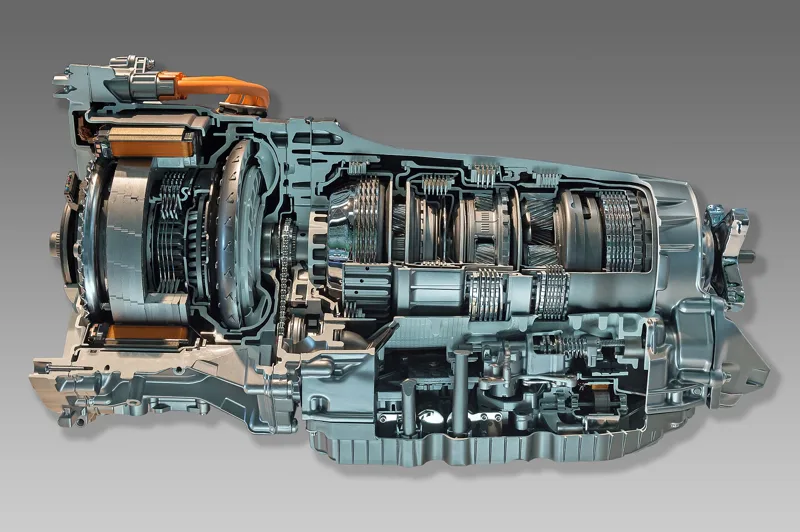
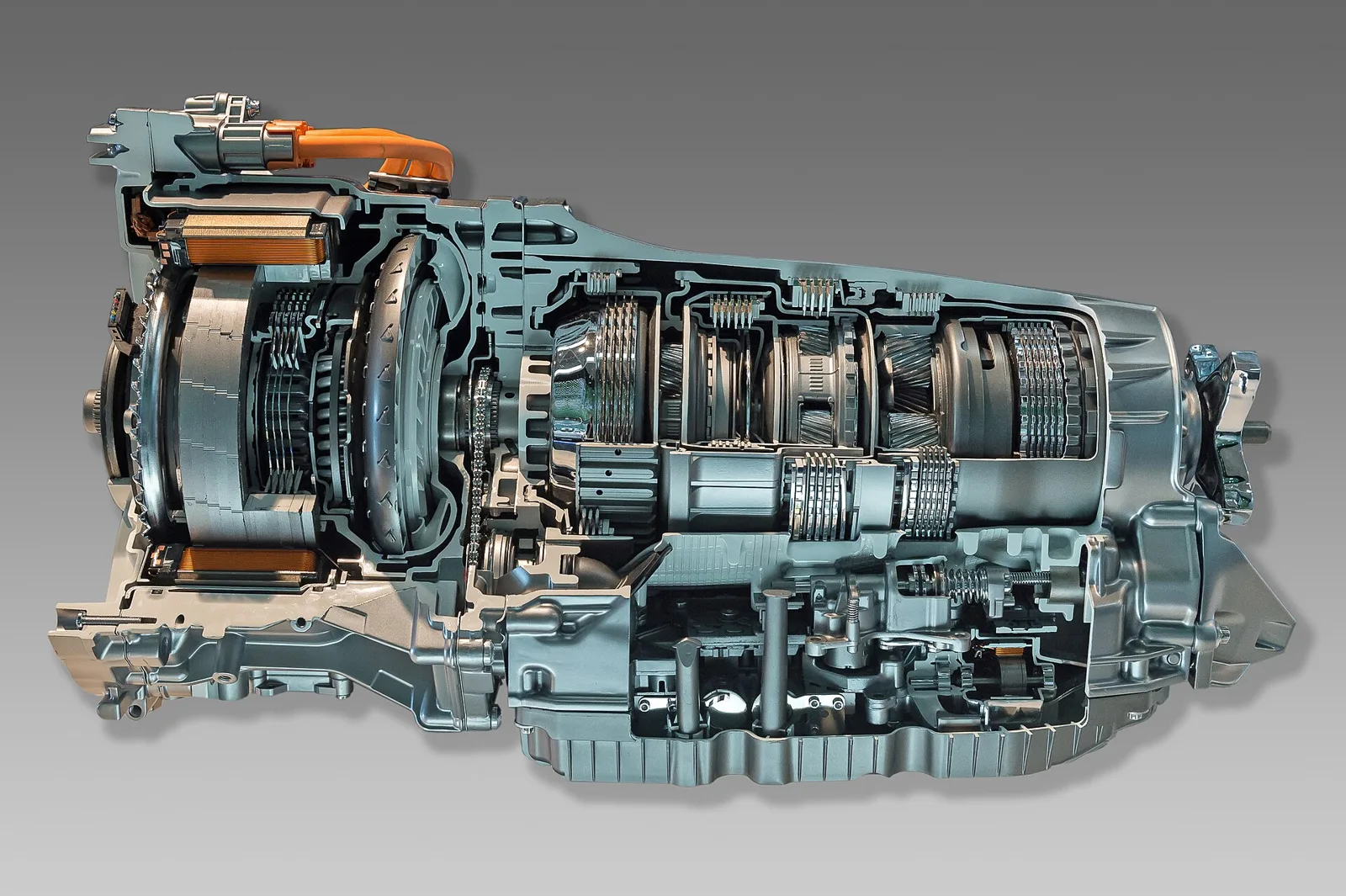
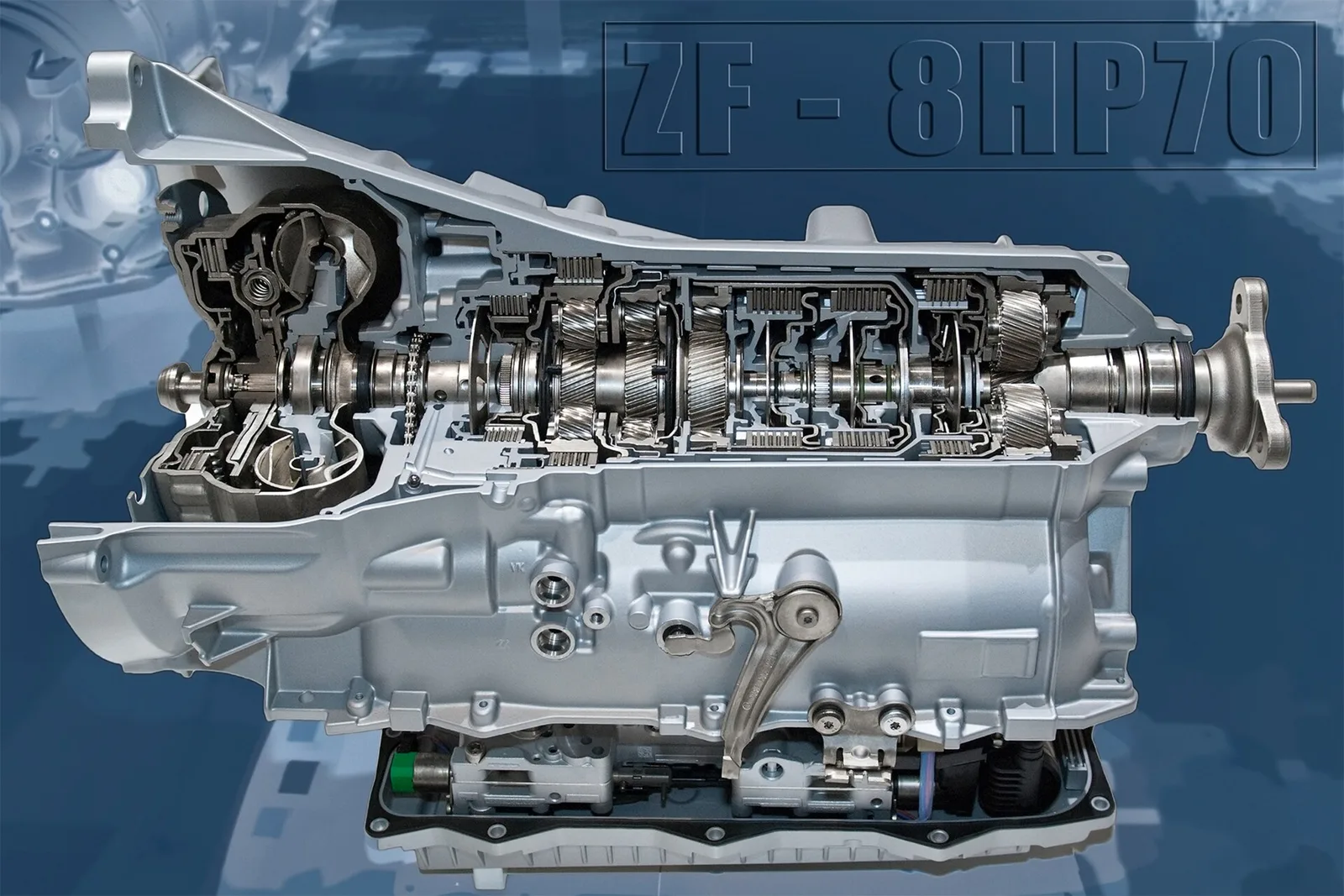
8HP is ZF Friedrichshafen's trademark name for its eight-speed automatic with a hydraulic torque converter and planetary gearsets, built for engines mounted lengthways. It was the first transmission to use this particular eight-speed gearset concept. Because the design is so economical, with only nine components, it became established as the standard form of torque-converter automatic.
Think of a planetary gearset as a set of gears that sit inside and around one another, so that locking different parts together produces different ratios. Conventional automatic designs were limited to a serial, or in-line, flow of power from one gearset to the next. ZF moved to a design in which the power flows in parallel and in series at the same time. That was possible only with computer-aided design, and it produced a globally patented gearset concept. The payoff is more gears for fewer parts than earlier layouts managed, and the 8HP became the benchmark for automatic transmissions.
Most gearboxes work their way through the gears one at a time. This one can leap. In extreme situations the gearset allows a shift from eighth to second simply by changing one shift element, which is a consequence of the combined parallel and serial layout.
The concept is not confined to ZF's own badge. The GM 8L is based on the same patented gearset concept and keeps its logic fully. The one difference is in the patented arrangement of the parts, with gearsets 1 and 3 swapped.
In extreme situations the gearbox can go from eighth gear to second by changing a single shift element.
How much fuel does a ZF 8 speed automatic save?
The main reason to replace the older transmission was fuel economy. Extra speeds and a wider spread between the lowest and highest gear let the engine turn more slowly, a step known as downspeeding, which is a decisive factor in efficiency. The lower engine speed also improves comfort in terms of noise, vibration and harshness and reduces exterior noise. Compared with ZF's six-speed 6HP, the 8HP uses 12% less fuel, and it uses 14% less than a five-speed. Shift times have fallen to 0.2 seconds because of changes in the internal design.
Early claims were a little more modest. When ZF showed one of the world's first eight-speed automatics in 2007, it claimed an 11% improvement in fuel economy over a standard six-speed automatic.
What changed in each generation of the 8HP?
| Year | Generation | Key figures |
|---|---|---|
| 2008 | Pilot series, 8HP70 | Torque limit 700 N.m (516 lb.ft); weight 87 kg (192 lb) |
| 2010 | First | 300 to 1,000 N.m (221 to 738 lb.ft); rear-drive and two four-wheel-drive versions |
| 2014 | Second | Ratio span 7.81; about 3% better economy than first, ZF estimates |
| 2018 | Third | Ratio span 8.59; 2.5% better economy than second; mild and plug-in hybrid options |
| 2022 | Fourth | Modular system; plug-in hybrid up to 160 kW (215 hp) and 280 N.m (207 lb.ft) |
The 2008 pilot series, the 8HP70, carried no generation number. It debuted in the BMW 7 Series (F01) 760Li and had a gearset 4 with a 23-85 tooth configuration.
In 2010 the first generation added a rear-drive version plus two four-wheel-drive versions, one of them for Volkswagen Group applications and fitted with a Torsen centre differential. It covers torque from 300 N.m to 1,000 N.m, which stretches from middle-class cars to large luxury SUVs. Gearset 4 is meshing in almost every gear up to fifth, so large gear wheels help durability. But first gear, with its very high ratio, is formed by gearset 4 alone, which gives that gearset an unusually small sun gear. ZF therefore enlarged it by over 20% for the first generation, and then gave that advantage up again in the second generation to widen the total span.
The 2014 second generation improved efficiency over the earlier versions with a wider ratio span of 7.81, less drag torque from the shift elements, a lower required oil pump pressure and broader use of coasting and start-stop systems. ZF estimated the fuel economy gain over the first generation at 3%, and refined the vibration behaviour too.
The third generation, in 2018, widened the span to 8.59 and cut fuel use by a further 2.5% against the second. It came with a choice of maximum torque, and in mild-hybrid and plug-in versions. One supports boosting and recuperation with an electric motor of 15 kW (20 hp) and 200 N.m (148 lb.ft) alongside 48-volt technology. A higher-voltage version goes up to 90 kW (121 hp) and 250 N.m (184 lb.ft).
The fourth generation, in 2022, moved the 8HP to a versatile modular system so that carmakers can electrify their models flexibly. Its plug-in hybrid versions offer up to 160 kW and can cut carbon emissions by as much as 70% against a conventional-only 8HP, according to ZF, on the Worldwide Harmonised Light Vehicles Test Procedure. A change to gearset 3 raised the reverse ratio, making reverse less disadvantageous.
Which carmakers use the ZF 8HP?
ZF's subsidiary in Saarbrucken, Germany, designed and first built the 8HP. It made its debut in 2008 in the BMW 7 Series 760Li with the V12 engine, and BMW remains a major customer. More than 20 brands, running from BMW to Ram, have taken it up, and the fourth generation is now current. Production passed 15 million by 2023.
Stellantis is another major customer. It holds a licence to build the transmission and also runs a joint-venture plant with ZF. Since 2013 it has produced the gearbox at its own Kokomo Transmission plant, under the name Torqueflite 8. The two companies also run a joint-venture plant at Gray Court, South Carolina.
Does the ZF 8HP have any weak points on paper?
The eight ratios are relatively unevenly spread in every version. Two steps stand out: a step between third and fourth that is too small, and one between seventh and eighth that is too large. They cannot be corrected without disturbing all the other ratios. On the other hand, the gearset concept gives two to three more gears than conventional transmissions of comparable manufacturing cost, which more than makes up for the weaknesses. The fourth generation increased the step between seventh and eighth slightly, while the change to gearset 3 made its reverse gear less of a drawback.
Who is ZF?
ZF Friedrichshafen began as the Zahnradfabrik, German for gear factory. Count Ferdinand von Zeppelin, inventor of the zeppelin airship, and the engineer Alfred von Soden-Fraunhofen founded it in 1915 as a subsidiary of Luftschiffbau Zeppelin, to make gears for zeppelins and other airships. In 1919 the company entered the car market, a move prompted by the heavy restrictions on aircraft manufacturing under the Treaty of Versailles. A patent for the Soden six-speed transmission followed in 1920, and in 1921 the company went public as the Zepernicker Zahnradfabrik, with Zeppelin Luftschiffbau holding 80% of the stock. It moved to Friedrichshafen in 1927 and took the name ZF Friedrichshafen, and in 1929 the helical ZF Aphon transmission went into series production for cars and commercial vehicles.
The company is headquartered in Friedrichshafen in Baden-Wurttemberg and ranks among the biggest suppliers to the car industry. It has 162 production locations in 29 countries and approximately 153,000 employees as of 2025.
Its automatic transmission story runs through the 20th century. ZF began developing a fully automatic transmission for passenger cars in 1961, and the 3HP20 reached series production in 1969, built to be swappable with ZF's manual gearboxes. Through the 1960s its customers included DKW, Mercedes-Benz, Porsche and BMW, along with Peugeot and Alfa Romeo. The 5HP18 of 1991 was the first five-speed automatic for passenger cars, introduced on the BMW E36 320i and 325i and the E34 5 Series. In 1999 came the world premiere of the first automatic six-speed, which reached series production in 2001 with the BMW 7 Series as its first client, and ZF still makes around one million six-speed automatics a year. By 2006 it had produced its 10-millionth passenger car automatic.
The nine-speed 9HP followed in 2011, designed for transverse engines, with Land Rover as lead partner. Land Rover demonstrated the first nine-speed automatic in a passenger car at Geneva in 2013, and in the same year Jeep announced that ZF had developed a nine-speed for the 2014 Cherokee. In 2014 ZF agreed to buy TRW Automotive Holdings in a $13.5 billion deal that would create the second largest automotive parts concern in the world, behind Robert Bosch.
Why does one supplier's gearbox end up in so many cars?
ZF has a long habit of supplying other people's cars. ZF was a major supplier to Ford in the 1980s, and in 1986 it began transmission production in the United States, in Gainesville, Georgia, for pickup trucks. In 2004 Ford started volume production of continuously variable transmissions that ZF had developed. BMW has been first in the queue for each step in ZF's passenger car automatics: the five-speed 5HP18 of 1991, the six-speed that went into series production with the 7 Series in 2001, and the 8HP of 2008.
ZF is organised into nine divisions. The largest by 2020 sales is Electrified Powertrain Technology at 8,459 million euros, whose products run from automatic, automated manual, manual and dual-clutch transmissions to electric motors and electric vehicle drives. Car Chassis Technology followed with 6,680 million euros and Active Safety Systems with 4,987 million euros. The firm's catalogue stretches from ball joints, shock absorbers and torque converters to trucks, buses, rail vehicles, helicopters and wind turbines.
Stellantis shows another route to the same gearbox. Instead of simply buying units, it took a licence and built its own capacity. The GM 8L shows a third. It does not carry the ZF name, yet it rests on the same patented gearset concept.
Where this goes next
The fourth generation points to the direction of travel for the 8HP. ZF describes it as a modular system that lets vehicle manufacturers electrify their models as comprehensively and flexibly as they need, with plug-in hybrid versions at up to 160 kW and 280 N.m.
The company around it is changing shape as well. In 2025 it was announced that ZF would sell its passenger-car driver assistance business to Harman International for 1.5 billion euros, while keeping chassis electronics, passive safety technologies and driver assistance development for commercial vehicles. The Electrified Powertrain Technology division, where automatic transmissions sit beside electric drives, was the largest by 2020 sales.