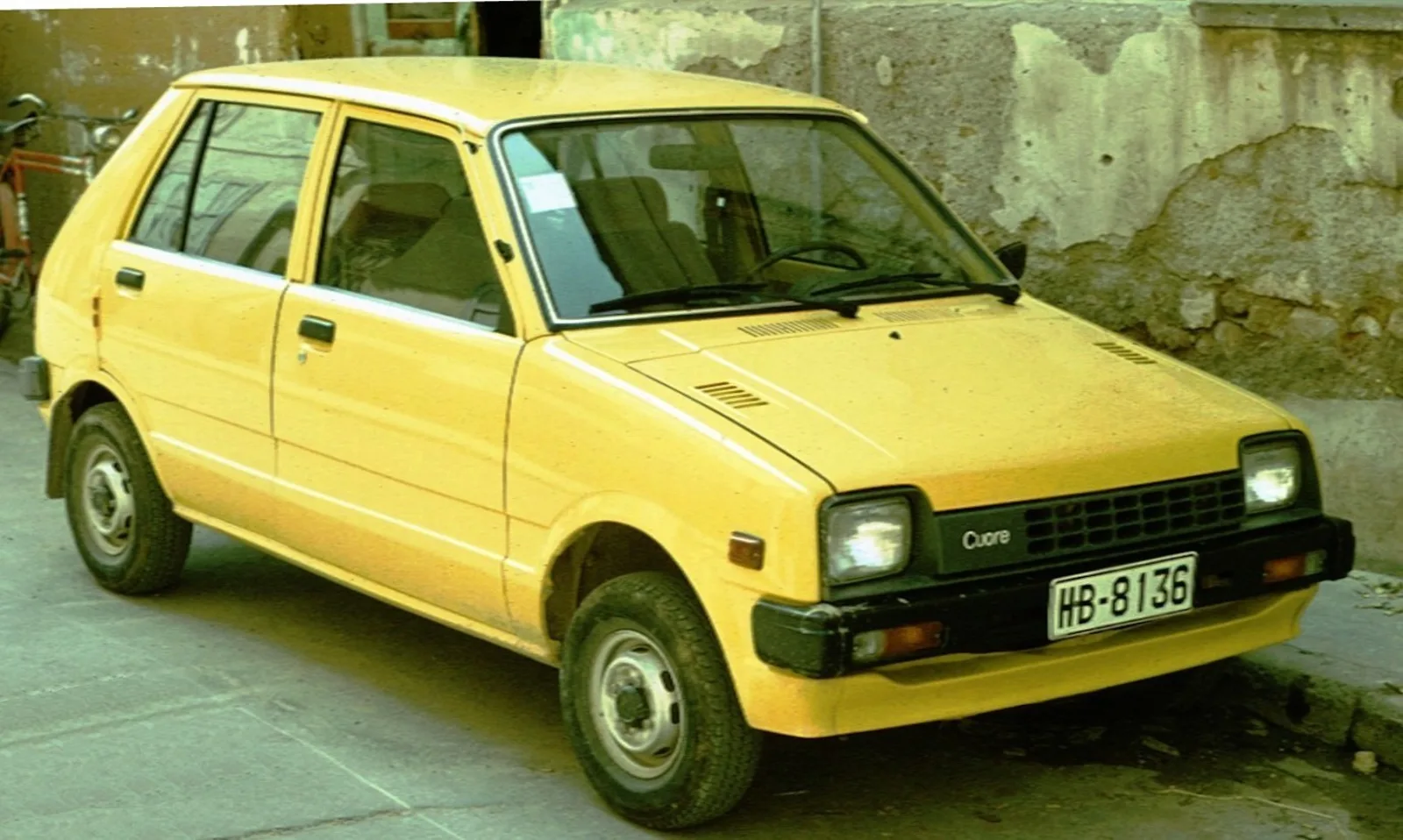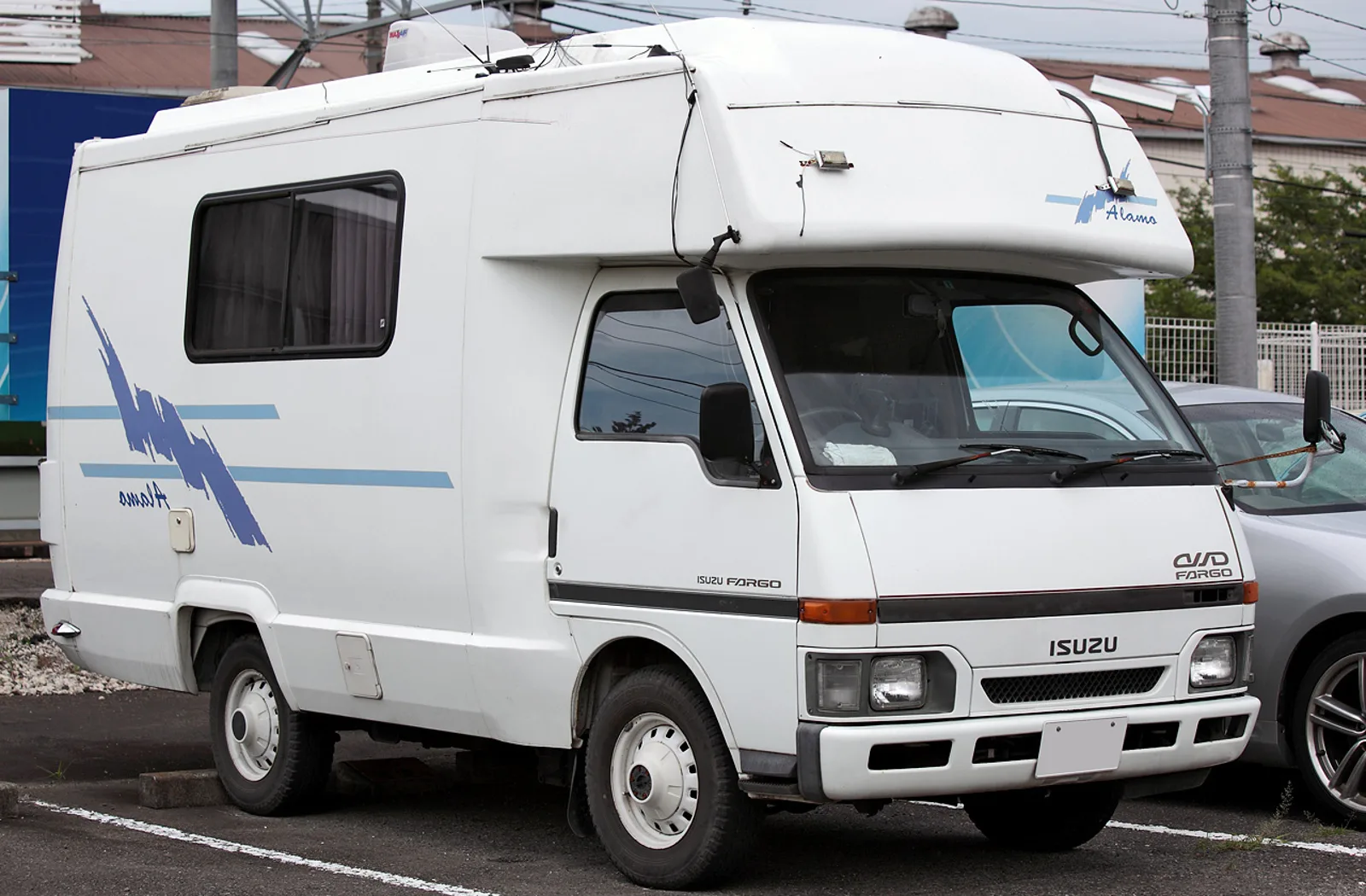
A Renault 4CV in Japanese hands that won a Los Angeles race, a front-drive kei car, a mid-engined kei box and a van that Holden and Vauxhall rebadged.
The Hino Contessa was a Renault 4CV-based rear-engined car built from 1961 to 1967. The Daihatsu Fellow Max was a kei car sold from 1970, the Mitsubishi Town Box a mid-engined kei car from 1999, and the Isuzu Fargo a light van from 1980 to 2001 that Holden and Vauxhall also sold.
A Japanese sedan built around a Renault 4CV powertrain won a surprise race in Los Angeles in 1966. Hino had asked Pete Brock and BRE Racing to prepare two Contessas for a planned push into America, and one took the LA Times Grand Prix. Three more small Japanese models share its story: the Fellow Max, Town Box and Fargo.
What was the Hino Contessa?
The Contessa was a car made by Hino Motors from 1961 to 1967, built largely around the Renault 4CV's powertrain, licensed to Hino. It came as a coupe and a sedan and replaced the Hino Renault, which was the 4CV that Hino built for Japan.
Its engine sat at the back and drove the rear wheels, as in the 4CV and Dauphine, but Hino kept water cooling where many rear-engined cars used air. A small pickup, the Briska, was adapted from it with the engine at the front. Contessa is the Italian word for countess.
One of two Contessa sedans prepared by Pete Brock won a surprise victory at the 1966 LA Times Grand Prix.
What was the Hino Contessa 900?
The Contessa 900, the PC series, was built from April 1961 to the second quarter of 1964, and 47,299 were produced. An 893 cc Renault-derived GP engine gave it 35 PS (26 kW; 35 hp) and a top speed of 110 km/h (68 mph).
Early cars had a three-speed column shift. A four-speed manual later became optional, with an electromagnetic clutch system that Hino called Shinko-Hinomatic. Critics disliked the gear change, whose linkage ran a long way from the steering column back to the rear transmission.
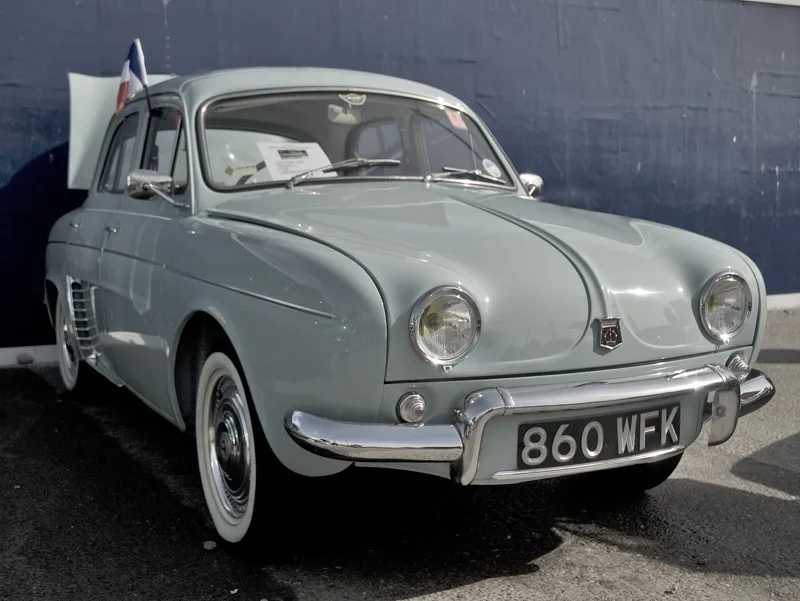
The drivetrain and suspension came from the Hino Renault 4CV, the PA series, and the resemblance to the Dauphine is plain. The big gain over the 4CV was seating for five. The engine was mounted lengthways and slanted to the left, with a crossflow head. Its radiator sat at the side of the bay, where Renault put its own against the bulkhead, and the rear used swing axles.
Export was never planned, but foreign-language brochures were printed for the Sprint Coupe, designed by Giovanni Michelotti. The Sprint weighed 650 kg (1,430 lb), 100 kg less than the sedan, and had an engine tuned by Officine Nardi with Weber carburettors, 45 PS (33 kW; 44 hp) and a matching steering wheel. Shown at the Tokyo and Turin shows in 1962 and in New York in 1963, it had a claimed top speed of 140 km/h (87 mph) and a floor-mounted shifter, and its door scuff plates read "Hino-Michelotti".
How did the Hino Contessa 1300 differ?
The second generation, the PD series, debuted in September 1964. It was longer, wider and heavier, and Michelotti styled the coupe in a design much like one he had sold to Triumph for its 1300. Power came from a new 1,251 cc four-cylinder with five main bearings.
| Contessa | Engine | Power | Top speed |
|---|---|---|---|
| 900 (PC series) | 893 cc | 35 PS (26 kW; 35 hp) | 110 km/h (68 mph) |
| 900 Sprint Coupe | 893 cc, Nardi-tuned | 45 PS (33 kW; 44 hp) | 140 km/h (87 mph), claimed |
| 1300 (PD series) | 1,251 cc | 55 PS (40 kW; 54 hp) | 130 km/h (81 mph) |
A coupe arrived in April 1965, and from November it had twin carburettors and higher compression for 65 PS (48 kW; 64 hp). Sold as the 1300S, it carried chassis code PD300/400, against PD100/200 for the sedan. Right-hand-drive cars were the 100 and 300 series, left-hand-drive the 200 and 400.
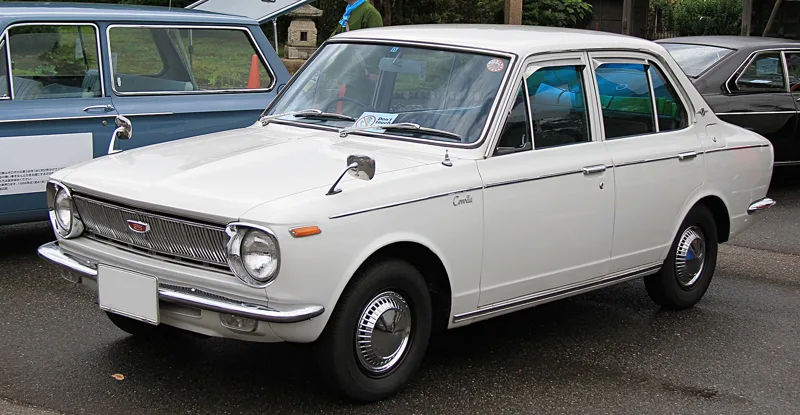
The twin headlights, and the absence of a grille on a rear-engined car, give the PD a passing likeness to the Renault 8 and second-generation Chevrolet Corvair. A bored-out 1,471 cc engine of 70 PS (51 kW), codenamed YE30, was developed in 1966, but Hino shelved it after its strategic alliance with Toyota, which was preparing a Contessa-sized car of its own, the Corolla.
How many Hino Contessas were built, and where?
Hino built 55,027 PD-series Contessas, of which 3,868 were coupes. Exports went to Australia, Switzerland and the Netherlands among others, and cars were assembled locally in New Zealand by Campbell Motors, probably around 600, and in Israel by Autocars.
Series production stopped in March 1967, following the Toyota alliance of late 1966. Slow assembly of leftover shells carried on into the summer of 1968, using more Toyota parts, and a last 175 were built in October 1969 to clear stock. The Hamura factory moved on to the Toyota Hilux and Publica trucks and then the Sprinter. By 2007 just 105 Contessas were left on Japanese roads, though many New Zealand-built cars have been shipped back.
Israel took about 10 percent of all Contessas. Hino agreed a 10-year assembly deal with Kaiser-Illin Industries of Haifa in 1963, assembly of the 900 began in 1964, and the Briska and the 1300 sedan followed. In 1964 and 1965 Israel was Hino's second most important Contessa market. When Toyota took over Hino the contract ended, and the last Israeli car was built in March 1968, with more than 8,000 Contessas and Briskas assembled in total.
Did the Hino Contessa race?
It did, with some success. To prepare the American market before a planned launch, Hino had Pete Brock and BRE Racing build two competition sedans. One won the LA Times Grand Prix in 1966, a surprise result. Brock afterwards raced a lighter, faster coupe, the Samurai.
The cars also ran in many Japanese events. In 1966 Hino built 20 stripped Contessa 1300 L models, the L standing for lightened, with thinner sheet metal and no hubcaps or sound deadening.
What was the Daihatsu Fellow Max?
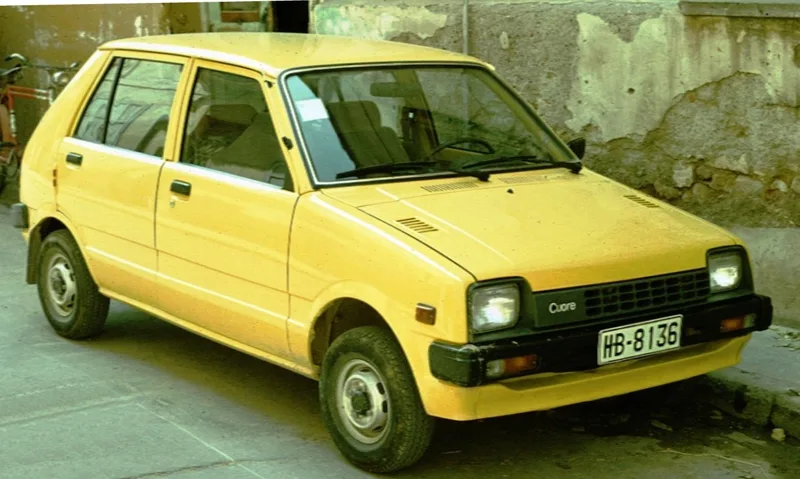
The Fellow Max was a Japanese kei car. The line began as the Daihatsu Fellow in 1966, passed through the Max Cuore of 1977 and was revived in 2001 as the Daihatsu Max.
The Fellow appeared on 9 November 1966, and export buyers knew it as the Daihatsu 360. The L37 had its engine at the front and drove the rear wheels, through a four-speed manual. The engine was a 23 PS version of the 356 cc two-cylinder, water-cooled two-stroke from the Hijet. It lubricated itself and weighed just 58 kg (128 lb), and the Fellow was Japan's first car with rectangular headlights.
Honda's 31 PS N360 of early 1967 started a horsepower war among kei makers. Daihatsu replied with the Fellow SS, a 32 PS car unveiled at the Tokyo Motor Show that October yet only on sale from June 1968. It covered 400 metres in 21.2 seconds and topped out at 115 km/h (71 mph). A sports-prototype, the P-5, was shown with it. An electric Fellow Van EV followed in September 1969.
The Fellow Buggy was a beach version offered with the other bodies. Collectors prize it, yet only about 100 were sold in one model year. At 440 kg it was not a real Fellow underneath: it used the chassis of the Hijet S37, plastic bodywork and the Hijet's 26 PS (19 kW) engine, for 95 km/h (59 mph).
How did the Fellow Max replace the Fellow?
In April 1970 the front-drive L38 Fellow Max took over from the rear-drive Fellow. It started as a two-door sedan and a three-door van, gained round headlights in March 1971, and added a hardtop coupe with a lower roof and baroque nose that August. A four-door followed in October 1972, the only four-door kei car on sale.
The kei rules fixed its size at 2,995 mm by 1,295 mm, but the wheelbase grew by 100 mm to 2,090 mm. The 360 cc two-stroke ZM4 gave 33 PS (24 kW) when new. In July 1970 came the SS, with a twin-carburettor ZM5 of 40 PS SAE, more than 112 PS per litre, a top speed of 120 km/h against 115 km/h for the milder cars (75 and 71 mph), 11:1 compression and a need for high-octane fuel. Its narrow power band and expansion chambers made it loud.
Stricter emissions rules cut outputs to 31 and 37 PS in October 1972 (the ZM12 and ZM13), and the twin-carburettor model was dropped in February 1975. The hardtops ended in May 1976.
Abroad, the car was generally the Daihatsu 360. In Australia, from early 1972, it was the Max 360X, a two-door sedan and the cheapest new car on sale, with the full 33 PS because emissions rules did not apply there. Wheels magazine saw 109 km/h (68 mph) and 33.2 seconds to 97 km/h (60 mph). New Zealand sold it as the Daihatsu 360X.
What was the Daihatsu Max Cuore?
The Max Cuore was the 550 cc successor. In May 1976 new kei rules let Daihatsu raise the engine to 547 cc, with chassis code L40 (L40V for the van), and some literature simply called the car the Max 550. The new AB10 four-stroke twin replaced the two-stroke, with a belt-driven overhead camshaft and balance shafts, and was developed with help from Toyota. Suzuki briefly used it in the Fronte 7-S.
The four-stroke gave 28 PS (21 kW) at 6,000 rpm, less than the revvy 360, and 38 N.m (3.9 kg.m) of torque at a much lower 3,500 rpm. New bumpers lengthened the car to 3,120 mm (122.8 in), and it was 1,305 mm (51.4 in) wide, with a claimed 110 km/h (68 mph). After Honda left the kei passenger-car segment, Daihatsu alone offered front-wheel drive in one.
July 1977 brought the Max Cuore name (L45) and a wider body of 1,395 mm (54.9 in). By March 1979 it was the Daihatsu Cuore with 31 PS (23 kW), though Max badges remained, and in 1980 the Mira appeared and the Max name left the Cuore altogether. Daihatsu revived it on 10 October 2001 with a five-door wagon built on the second-generation Move's technical data, 10 mm lower, until the Sonica replaced it in 2006.
What was the Mitsubishi Town Box?
The Town Box was a kei car built for the Japanese market, with a larger minivan sibling, the Town Box Wide. The first generation went on sale in April 1999 and was discontinued in November 2011, a twelve-year run. It was also badged in Japan as the Nissan Clipper Rio.
It was mid-engined and rear-drive, with optional four-wheel drive and a short bonnet, aimed more at passengers than Mitsubishi's Bravo. The rear seats were individual chairs with floor recesses for legroom, and the parking brake was oddly placed next to the driver's door. After the car met market resistance, a facelift in November 2000 brought conventional headlamps, a split folding bench and a handbrake between the seats.
The first line-up was the SX, LX and turbocharged RX. The LX and SX used the lean-burn 3G83 three-cylinder with 48 PS (35 kW) and 62 N.m (46 lb ft). The RX had the turbocharged, intercooled 20-valve 4A30 four-cylinder, claiming 64 PS (47 kW) and 98 N.m (72 lb ft). In August 2002, ahead of tougher emissions rules, the RX moved to a turbocharged 3G83 with the same claimed 64 PS but 86 N.m (64 lb ft), most likely because the earlier engine's output had been under-reported to stay within the gentlemen's agreement on kei power.
The name returned in February 2014 on a rebadged Suzuki Every Wagon, as Mitsubishi began selling Suzuki's Carry and Every as the Minicab. A new Every Wagon and Town Box arrived in March 2015 with a longer wheelbase, more space and the turbocharged Suzuki R06A engine, in G and G Special grades.
Why did the Mitsubishi Town Box Wide fail?
The Town Box Wide was presented in June 1999 with a 1.1-litre 4A31 engine making 75 PS (55 kW) and 100 N.m (74 lb ft). Since it was not a kei car it could be wider and longer without tax penalties, so it received plastic overfenders and bigger bumpers, plus a lower, flat roof and six seats in three rows of two. Mitsubishi called it a 4 + 2 seater, because the last row was cramped by emergency seats that folded into the side panels.
It came in one version, rear-drive or with switchable Easy Select four-wheel drive, and Proton built it in Malaysia as the Juara with an extra body kit. Neither sold well. Its oddly shaped body gave no more interior space than the kei Town Box while costing much more to own and run. Production ended in August 2001, with just under 4,300 sold in Japan, nearly four-fifths of them in 1999, and 3,300 exported to Malaysia.
What was the Isuzu Fargo?
The Isuzu Fargo was a light commercial van made in Japan from 1980 to 2001. The first generation, sold until 1995 as a van and a pickup, was an Isuzu design with an underfloor engine. The second, a van only from 1995, was a Nissan Caravan (E24) with Isuzu badges.
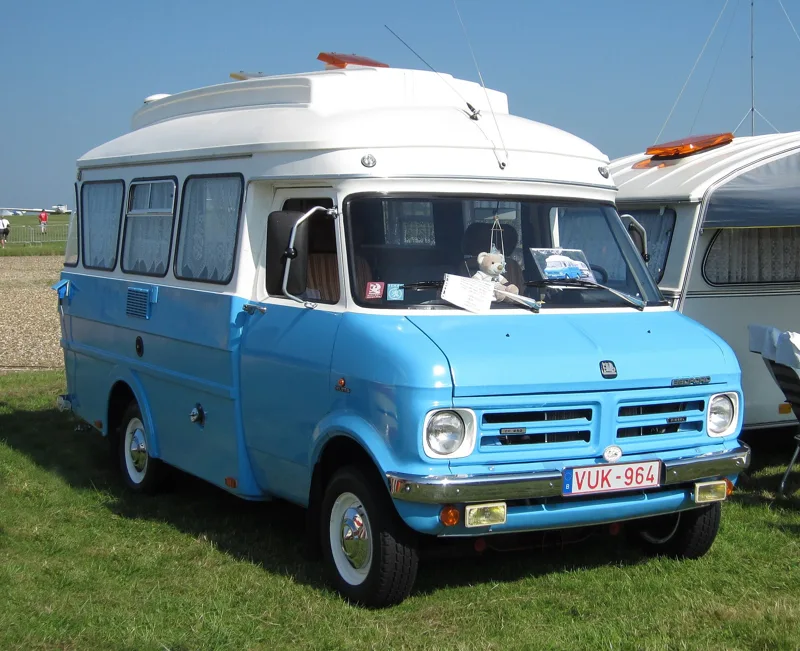
Many badges followed. Holden sold the first generation in Australia from 1982 to 1990 as the Holden Shuttle, Europe and New Zealand called it the Isuzu WFR and Colombia the Chevrolet WFR. Vauxhall built it in Britain as the Bedford Midi, later the Vauxhall Midi, and other European names included the GME Midi in Spain, the Isuzu Midi and the Bedford Seta in Portugal.
How did the first-generation Isuzu Fargo develop?
It was launched in December 1980 with a choice of 1.6- or 1.8-litre petrol engines, or a 1.8-litre diesel. A 2.0-litre diesel came first in the wagon only and reached the van in August 1981. In March 1982 2.0-litre units replaced the 1.8s, and a nine-seat LS Wagon with a standard sunroof joined that July, when floor shifters replaced column changes.
Four-wheel-drive diesels followed in November 1983, a turbodiesel Wagon LF in January 1984, and four-wheel drive on wagons that November. A January 1986 facelift gave wider, trapezoidal headlights and a new instrument panel, and an automatic reached rear-drive cars in 1987. A cab-forward pickup of October 1988 was soon supplanted by Isuzu Faster trucks.
In January 1991 a 2.4-litre 4FG1 diesel replaced the 1.8- and 2.0-litre units, and the 4FG1-T turbodiesel became standard in August 1993, when rear seats gained three-point belts and the air conditioning went CFC-free. The second generation arrived in August 1995, got a modified petrol engine in June 1999 and ended in May 2001.
What was the Bedford Midi?
The Bedford Midi was Vauxhall's Fargo, built at Luton from 1985 to 1994 and renamed Vauxhall Midi after Bedford was sold to AWD. It changed little from the Japanese van and replaced the old Bedford CF as a stop-gap, but no true CF replacement ever followed. It also marked the end of Bedford's own designs, since GM turned to designs from companies it co-owned. Talks on building the Freight Rover Sherpa 300 series under licence in 1985 were abandoned by the end of 1986.
Engines were 1.8- and 2.0-litre petrols and 2.0-, 2.2- or 2.4-litre turbodiesels. Buyers could pick a column gear change, which allowed a third central front seat, or a conventional floor shift, short or long wheelbase, and a standard or high roof, and a minibus named the Albany was also made. In Tunisia, Industries Mecaniques Maghrebines built the Isuzu Midi at Kairouan from 1983 to 1988. Doubts about crashworthiness arose after a test on the Japanese-built WFR.
The Midi was restyled in 1989 and ended in 1994. The short-wheelbase models were replaced by the Vauxhall Arena and the long ones in 1997 by the Vauxhall Movano, both Renault-based.
What was the Holden Shuttle?
Holden launched the Fargo in February 1982 as the WFR-series Shuttle, in short or long wheelbase, low or high roof, with or without side windows. It had a 1.8-litre 4ZB1 petrol of 65 kW (87 hp) or a 2.0-litre 4FC1 diesel of 44 kW (59 hp). In 1986 a 2.0-litre 4ZC1 petrol of 69 kW (93 hp) replaced the 1.8, and all three engines had a four-speed manual.
The LS, a limited, highly specified nine-seat people-mover, followed in October 1982, with only 250 built for Australia. The cheaper LT nine-seater, without the LS's dual-zone air conditioning, arrived in August 1983, and both used the petrol engine. A centre front seat was added in mid-1983.
The range was reorganised in June 1985, when the five-speed manual from the LS and LT became standard on the base model, and a June 1986 facelift moved the badges, reshaped the headlamps and cut the diesel and long wheelbase. A four-speed automatic came in December 1987, the LT left, and the Shuttle became one model. Holden dropped it in 1990 without a replacement; its predecessor had been the Bedford CF vans from Britain, which were not sold as Holdens.