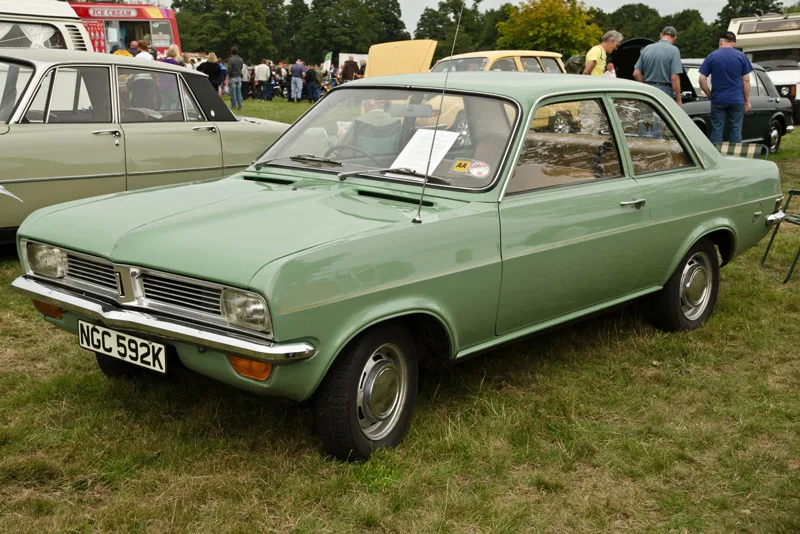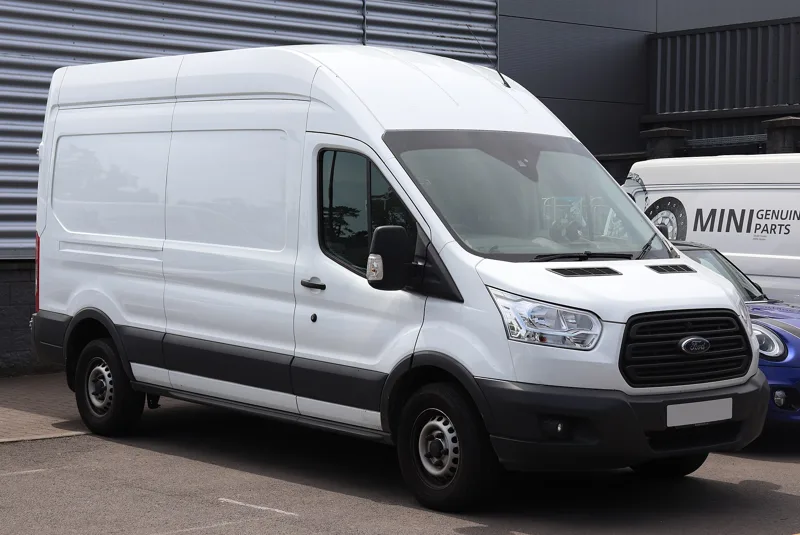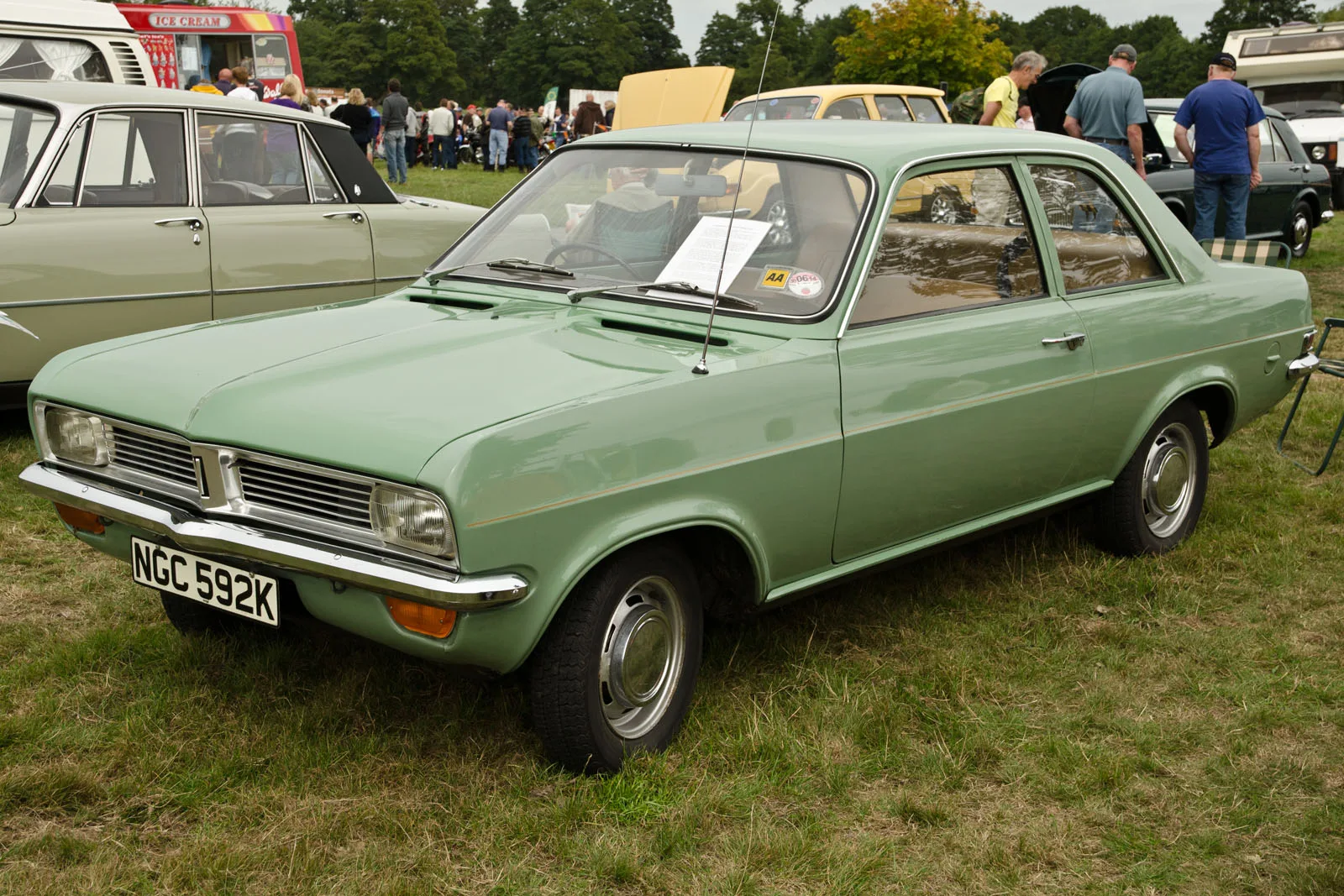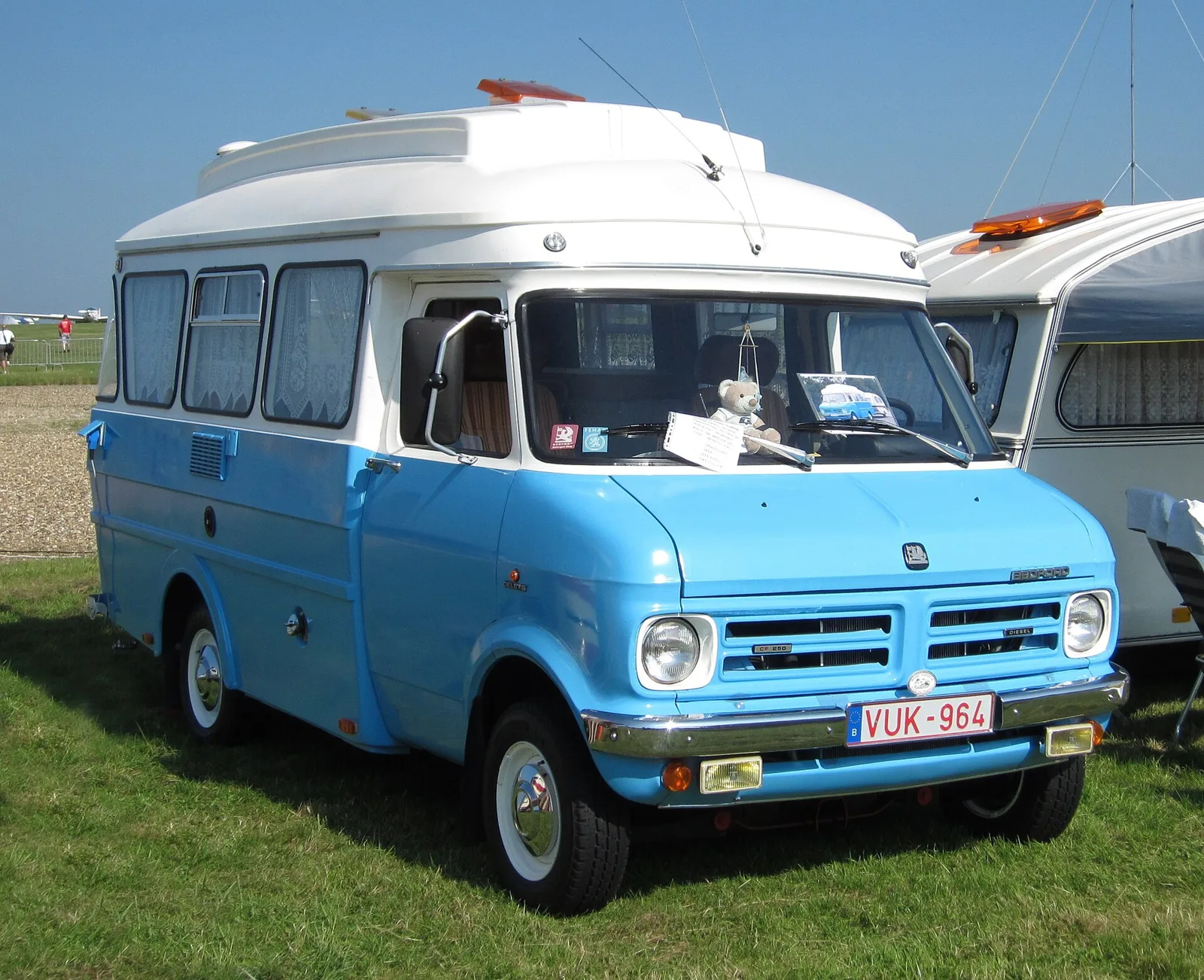
The Viva-derived HA that served Royal Mail and British Rail, the CF that became Britain's second most popular van, and the electric CF that GM sold in America as the Griffon.
The Bedford HA was a small van built from August 1964 on the Vauxhall Viva's underpinnings, and the CF was a larger panel van that replaced the CA in November 1969 to take on the Ford Transit. Both came from Bedford, Vauxhall's commercial vehicle division, and both were built for years.
By the 1970s the Bedford CF was the second most popular van in Britain, beaten only by the Ford Transit, and a heavily modified one went on to play the Mystery Machine in the 2002 film Scooby-Doo. Before it came the HA, a small van built from a Vauxhall Viva that delivered the post, repaired the phones and carried the meals-on-wheels.
What were the Bedford HA and CF?
The HA was a small car-derived van that Bedford introduced in August 1964, built on the Vauxhall Viva. The CF was a full-size panel van that replaced the Bedford CA in November 1969 and was sized to take on the Ford Transit. Bedford was the commercial vehicle division of Vauxhall.
By the 1970s the Bedford CF was Britain's second most popular van, behind only the Transit, and a heavily modified one later played the Mystery Machine.
What was the Bedford HA?
Bedford launched the HA in August 1964 as a van built from the Vauxhall Viva. Estate buyers knew it as the Beagle, and as a small campervan it was sold as the Roma. Australians bought it from 1964 until 1970 under the name Handi-Van.
It stayed in production for almost twenty years. The last one was built in September 1983, by which time the total stood at 689,512. A cheap fleet derivative of the Astra van took over from it.
Who used the Bedford HA?
Utility companies loved it. The Royal Mail, British Rail, the electricity boards, the GPO (later British Telecom) and British Gas all ran big fleets, as did British European Airways and the Meals on Wheels services. It also inspired the first van driven by Postman Pat.
What payload models did the HA offer?
There were two to begin with, a 6 cwt van with chassis code HAE and a tougher 8 cwt coded HAV. They carried 670 or 900 lb (300 or 410 kg), and weighed 2,400 and 2,615 lb (1,090 and 1,185 kg) fully laden. To carry the extra, the 8 cwt had a stronger rear axle, bigger tyres, and a sixth leaf added to the rear springs.
The 8 cwt was also the better-equipped van, with chromed bumpers and mirrors and a slightly plusher cabin. By 1971 Bedford had stripped the 6 cwt back further: it came with just a driver's seat, and a fold-down rear seat cost extra. Late in the 1970s the two became the HA 110 and HA 130, rated for 371 and 546 kg (818 and 1,204 lb).
The HA also absorbed the Viva's small updates. For the 1965 model year, from September 1964, it gained a faster steering rack, fresh door trim and a revised choke control.
What were the Beagle, Roma and HA pickup?
Martin Walter of Folkestone, Kent, turned the 8 cwt van into the Beagle with Bedford's blessing. The conversion added windows in the rear sides plus a rear seat that folded down, and with that seat occupied the load space measured 28 inches (710 mm).
The Roma was a campervan that slept three under a roof which opened sideways like a clamshell, with canvas walls. Production ran from October 1967 until 1973. A pickup was also built, by Martin Walter's Dormobile business and by Walker Bodies of Watford, but only about 60 were made and few survive.
What engines did the Bedford HA use?
The first HA had a 1,057 cc (64.5 cu in) engine tuned for lower compression than the Viva saloon's, at 7.3:1 against 8.5:1. Output was 47.8 hp (35.6 kW) gross and 40.3 hp (30.1 kW) net, reached at 5,200 rpm. In 1967 the van took on the revised Viva engine, a 1,159 cc (70.7 cu in) unit claimed at 32.2 hp (24.0 kW) net at 4,600 rpm, which could run on the cheapest petrol available.
Its carburettor had a 17 mm (0.67 in) bore, chosen to stretch every gallon. A 1,256 cc (76.6 cu in) engine followed in 1972, rated at 48 hp (36 kW) gross at 5,400 rpm or 39 hp (29 kW) net at 4,600. By 1977 only net figures were quoted, up to 31.7 kW (42.5 bhp) at 4,800 rpm. The compression ratio stayed at 7.3 to 1 throughout.
Customers for the lighter HA 110 could specify an Economy model with a constant-depression carburettor, a new manifold and a different camshaft. Fuel use fell by up to 30%, and output dropped to 18 kW (24.4 bhp) at 3,800 rpm.
How did the HA end?
The Chevette-based Bedford Chevanne supplanted the HA in 1976, and the Opel-based Astravan and Astramax took over from the Chevanne in September 1982. The HA nevertheless stayed on sale for one more year as a low-cost alternative with maximum interior space.
Its bodywork never changed, although it did gain some technical updates from the later HB and HC Vivas.
What was the Bedford BTV?
In the early 1970s several manufacturers, Volkswagen with the EA489 and Citroen with the FAF among them, tried to design cheap, basic transport that poorer countries could build locally with little capital. General Motors Overseas Operations answered with the Basic Transportation Vehicle, or BTV: a small truck with a body of flat panels on a simple frame, and mechanicals and interior parts taken from the HA.
The engine was the HA's 1,256 cc low-compression unit, in a 37 hp (28 kW) form, supplied from Vauxhall's Luton plant together with other complex parts. The Bedford Harimau of Malaysia was the first, built from May 1972. Others carried names such as Amigo, Andino, Cherito, Chato, Pinolero, Compadre and Moetete 1200/1300, across Central and South America, Portugal, the Philippines and Suriname.
Indonesia's version, the Morina, was built in 1977 and 1978 by the P.T. Garuda Diesel arm of GM, and was claimed at 58.5 hp (43.6 kW) SAE. The name abbreviates MObil Rakyat INdonesiA, or Indonesian People's Car. Paraguay's Mitai wore its own body that wrapped fully around the front wheels, offered in red, white or blue to match the national flag.
Estimates put the worldwide total at no more than 3,000 BTVs. GM Philippines developed a more car-like four-door wagon, the GM Harabas, mainly for taxi work.
What was the Bedford CF?
The CF was Bedford's full-size panel van. The company, Vauxhall's commercial arm, launched it in November 1969 as the successor to the 17-year-old CA. Its target was the Ford Transit, which had been in production four years already, and its design had much in common with the American Chevrolet Van.
In some countries beyond Britain and Ireland, Opel dealers sold it as the Opel Bedford Blitz from 1973, once the original Opel Blitz had been phased out. Norway was one of the markets where it kept its own name. When it was discontinued in 1986, the CF was the final vehicle designed solely by Vauxhall.
The Bedford name lingered on Isuzu and Suzuki light vans and pickups assembled under licence at Luton by IBC Vehicles. By 1991 it had gone, with Vauxhall or Opel badges used instead.
What body styles did the CF come in?
The CF1 had three. The standard panel van was the Transit rival. The special van body was in effect a complete cab on a general-purpose chassis, ready for a wide variety of custom bodies or beds. The third was the Dormobile caravanette.
Buyers could ask for a hinged side door just behind the passenger door, and a van built that way was the usual starting point for a caravanette.
What engines did the Bedford CF use?
Power came from the proven Slant Four, first seen in the Vauxhall FD Victor of 1967. A 1972 enlargement took one version from 1.6 L (1,598 cc) to 1.8 L (1,759 cc), and the other from 2.0 L (1,975 cc) to 2.3 L (2,279 cc). Little else about the petrol engines changed.
For an extra 130 pounds in 1969, a buyer could have a four-cylinder Perkins diesel of 1.8 L (1,760 cc), and heavier versions used a 2.5 L (2,523 cc) Perkins. DIN ratings were 50 and 61 PS (37 and 45 kW; 49 and 60 hp). In 1976 an Opel diesel of 2.1 L (2,064 cc) with an overhead camshaft took the place of the dated Perkins units.
In Australasia, the CF could be ordered with a Holden six-cylinder of 2,850 cc (173.9 cu in) or 3,310 cc (202.0 cu in), a reply to the Transit, whose Australian version had sixes borrowed from the Ford Falcon.
Underneath, the CF borrowed the Victor's layout, with more clearance in the wheel arches and settings meant for heavier loads. At the front were double wishbones with coil springs and telescopic dampers; at the rear sat a live axle on long single-leaf springs. Gearbox options spanned Vauxhall three- and four-speeds, a Bedford four-speed, ZF four- and five-speeds and a GM automatic, and a Laycock overdrive was available to order or on later Vauxhall four-speed models.
How can you tell a CF1 facelift from a CF2?
The facelift CF1 arrived in 1980 with the Opel 23D diesel, a 2.3 L (2,260 cc) engine of 61 hp (45.5 kW). German-market vans, sold as the Bedford Blitz, got a smaller 2.0 L (1,998 cc) diesel of 60 PS (44 kW; 59 hp). It also went into other places where tax favoured engines below two litres, the Benelux countries and Finland among them. The 1.8 and 2.3 litre petrol engines carried on.
The new front end was designed to come off as a single panel once 8 bolts were undone. Mechanics could then lift the engine out forwards instead of dropping it from underneath, as on the earlier CF1.
Outsiders often confuse the facelift with the CF2, since the two look so alike. The simplest test is to look at the door handles and mirrors: the facelift keeps the metal ones of the CF1, whereas the CF2 has new plastic ones.
What changed with the CF2?
For 1984 the CF was renamed CF2, with mechanical upgrades and little else. Diesels stayed at 2.3 L (2.0 L in continental Europe), but the Opel CIH four-cylinder of 2.0 L (1,979 cc), rated at 78 hp (58 kW), replaced the old Vauxhall slant fours.
Short-wheelbase models got a four-speed GM gearbox with synchromesh on every gear. Long-wheelbase models had a five-speed ZF box with overdrive as standard, and others could have it as an option. GM automatic was optional on most models, and nearly all offered a choice of axle ratios. Braking improved too, with front discs and self-adjusting rear drums on the CF2/230 to CF2/280, self-adjusting drums all round on the CF2/350, and a load-sensing valve across the range.
In 1985 the CF2 shared UK showrooms with the Bedford Midi, a smaller Isuzu Fargo with Bedford badges, built at the newly formed IBC Vehicles venture with Isuzu. A planned CF successor was shelved, then abandoned, once Bedford judged that rebadging vehicles from other GM brands would be far cheaper. UK sales of the last CF2s came in 1987, ending the line of vans Bedford had designed itself.
What was the Bedford CF Electric?
Bedford introduced the CF Electric in 1982. Over 100 prototypes had been built and run at the Millbrook Proving Ground between 1977 and 1983, under a five-year grant scheme with Lucas, Chloride Group and the UK government. It has been called the first electric vehicle planned for mass production on the platform of a conventional one.
Most went to trials run by government bodies, the Royal Mail and councils, and together they clocked up more than 7,000,000 mi (11,000,000 km). Still, the van cost far more than a standard CF, and battery technology was slow to improve. In July 1986 Bedford cancelled the programme, with somewhere between 300 and 475 vehicles built. The grant scheme ran down in 1987, the van was withdrawn and spares quickly vanished.
Southern California Edison bought a prototype in 1980. The lead-acid batteries lived in a compartment under the floor, and a DC motor at the back drove the standard differential via a step-down gearbox. There were 36 six-volt cells wired in series, for 216 V and 180 A-hr (38.9 kW-hr), weighing 1,000 kg (2,205 lb), and they needed topping up with water every fortnight, which took roughly three hours.
The motor was a Lucas MT286 rated at 37 kW (50 hp), and a small diesel heater warmed the cab. Regenerative braking worked, but it could be turned off, since in the wet the motor risked locking the rear wheels. During the 1980 tests, range ran from 15 mi (24 km) with a full load on steep hills up to 74 mi (119 km) on motorway-style roads with nothing aboard.
What was the GMC Griffon?
The Griffon was a CF Electric reworked heavily for the United States, in left-hand drive, and sold with GMC badges. Its payload was around 1,000 kg (2,200 lb) and its gross vehicle weight rating 3,401 kg (7,498 lb), which let GM slot it in with its full-size vans, although it was a little shorter than they were.
A Tennessee Valley Authority test published in 1988 recorded 53 mph (85 km/h) at the top end and an urban range of 54 mi (87 km). More than 30 went out for trials with electric utilities through the Electric Power Research Institute (EPRI), yet like its British sibling it never sold widely. It was still the first electric van GM sold in the US, and the company stayed out of that field until VIA Motors began converting Chevrolet Express vans around 2014.
One Griffon also served as a test bed for a 36 V lithium and iron sulfide battery invented at Argonne National Laboratory. In a simulated run it went 200 mi (320 km) carrying 900 lb (410 kg), with triple the energy density of a lead-acid pack of equal weight. EPRI's work with the Griffon led to the G-Van of 1990 and then to the Chrysler TEVan, which gained range from nickel-iron batteries.
CF Electric Prototype and GMC Griffon Compared
| Spec | CF Electric prototype (1980 test) | GMC Griffon (1988 test) |
|---|---|---|
| Top speed | 54 mph (87 km/h) unladen | 53 mph (85 km/h) |
| Range | 15 mi (24 km) to 74 mi (119 km) | 54 mi (87 km) urban |
| Battery weight | 1,000 kg (2,205 lb) | 1,100 kg (2,500 lb) |
| Usable battery capacity | 38.9 kW-hr | 32.5 kW-hr (estimated) |
| Vehicle weight | About 2,500 kg (5,511 lb) estimated | 3,073 kg (6,775 lb) |
Who used the Bedford CF?
The CF was everywhere. Only the Transit outsold it in the UK, and both stood out for their width against competing models from Austin-Morris, Rootes and Volkswagen. It was the commonest base for a caravanette, and customisers favoured it through the 1970s and 1980s.
Police in Britain used them to move prisoners and as riot vans, and so did the Garda Siochana in the Republic of Ireland. Some ambulance services held on to theirs beyond the end of production because crews liked them. The British military ran a fleet, and so did builders, builders' merchants, couriers and the Post Office. In Britain and Australia they sold ice cream, too.
Why did Bedford stop making the CF?
Bedford first hoped to team up with Leyland Motors on a replacement, but the idea foundered because the British government did not want a foreign firm controlling a major truck maker. Falling sales and economic trouble then led General Motors to break up the business. Luton became a joint venture with Isuzu called IBC Vehicles, and the Dunstable factory went to AWD Trucks.
From 1986 IBC built the Isuzu Fargo as the Bedford Midi, modified for Europe. GM Europe did not re-enter the large panel van segment until 1997 and 1998, when the Renault-based Opel and Vauxhall Arena and Movano appeared and became the true successors to the CF. Vauxhall went on supplying the CF's taillights to Bristol Cars for the Bristol Britannia until 2000.
What should you know before looking for a Bedford CF for sale?
Work out which CF you are looking at. A CF1 and its facelift resemble one another, and the facelift is easily taken for a CF2, so check whether the door handles and mirrors are metal or plastic. The facelift of 1980 is the one with the 2.3 L Opel diesel, and the CF2 of 1984 swapped the slant fours for Opel petrol engines.
Factory-built Dormobile caravanettes were offered on the standard van, and the special van body was designed to take custom conversions, so a CF camper may be either factory-built or a later conversion. The smaller HA is the van to look for if you want a Bedford Beagle or Roma.