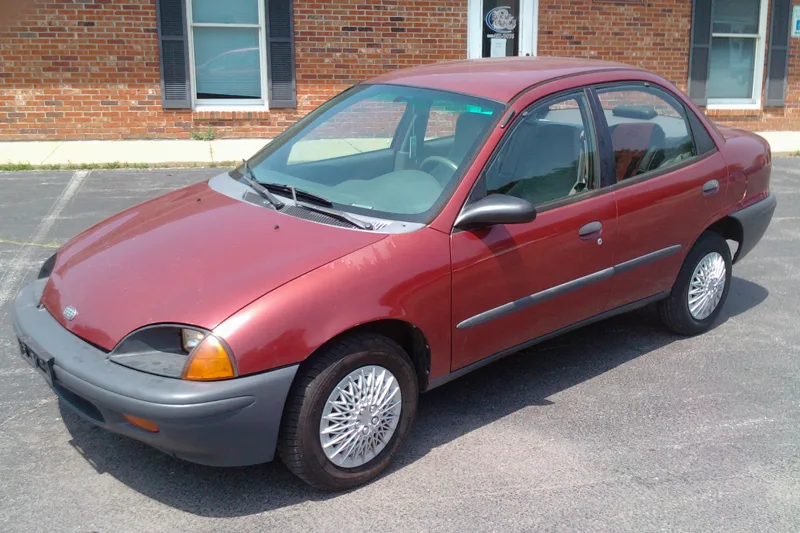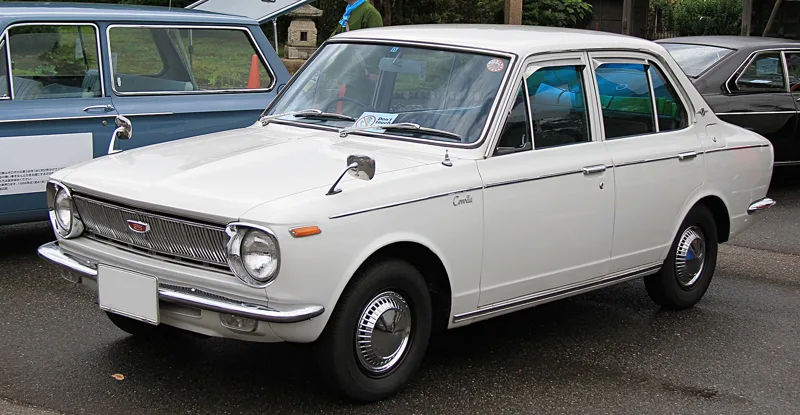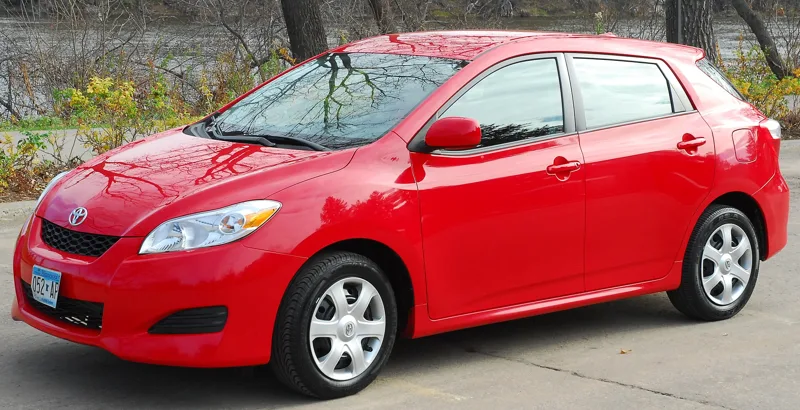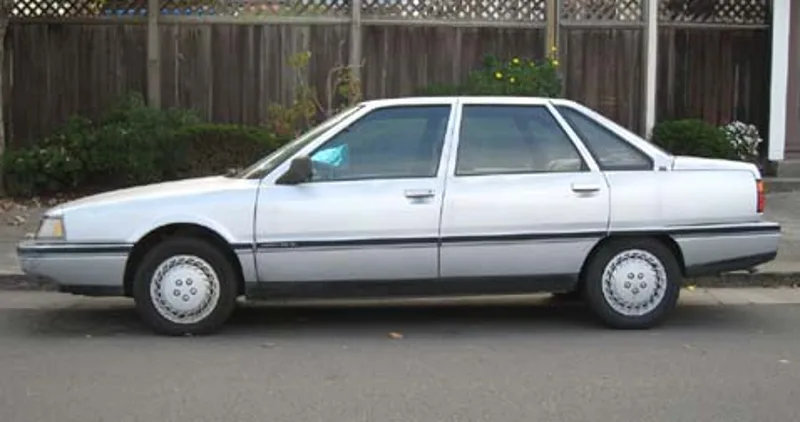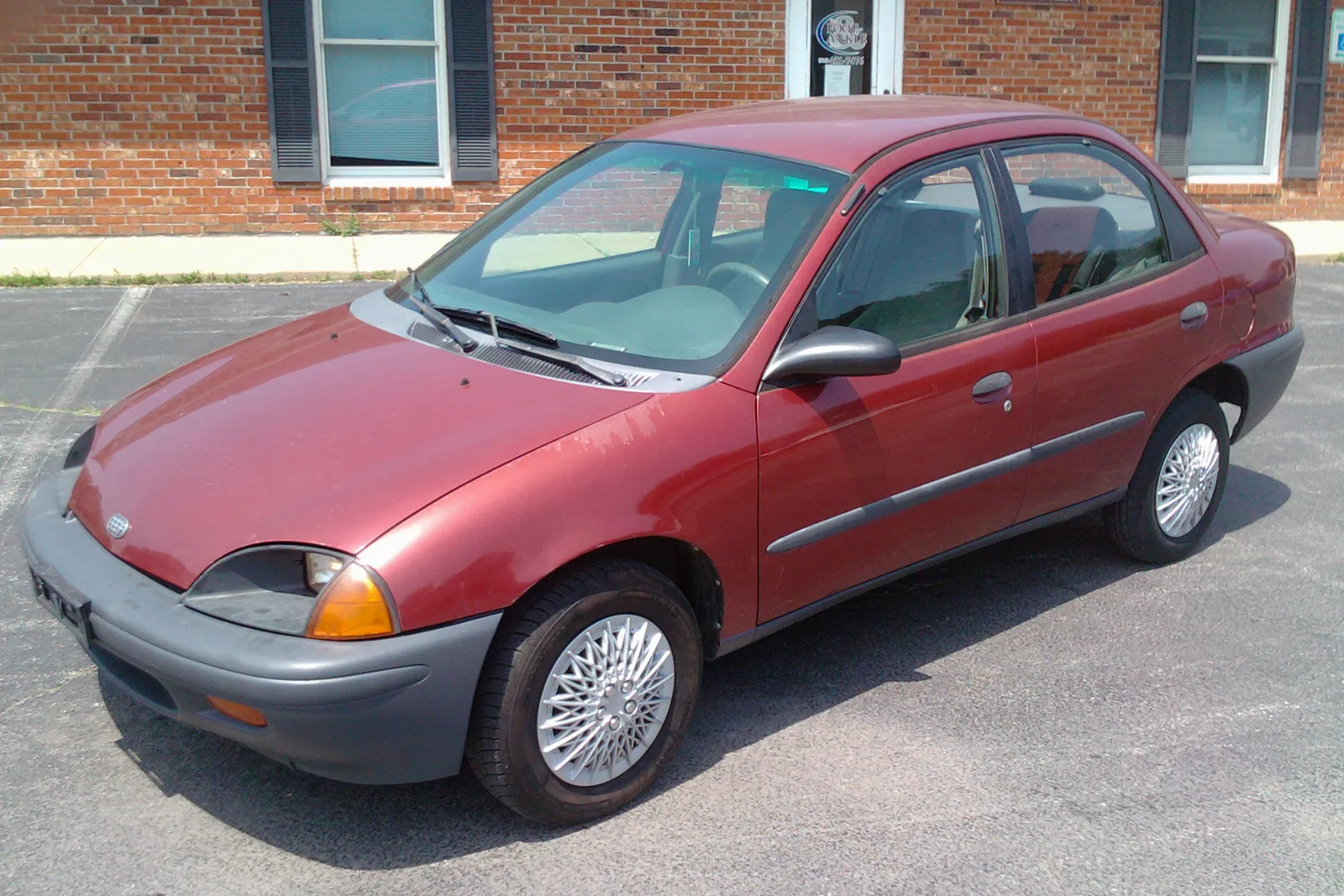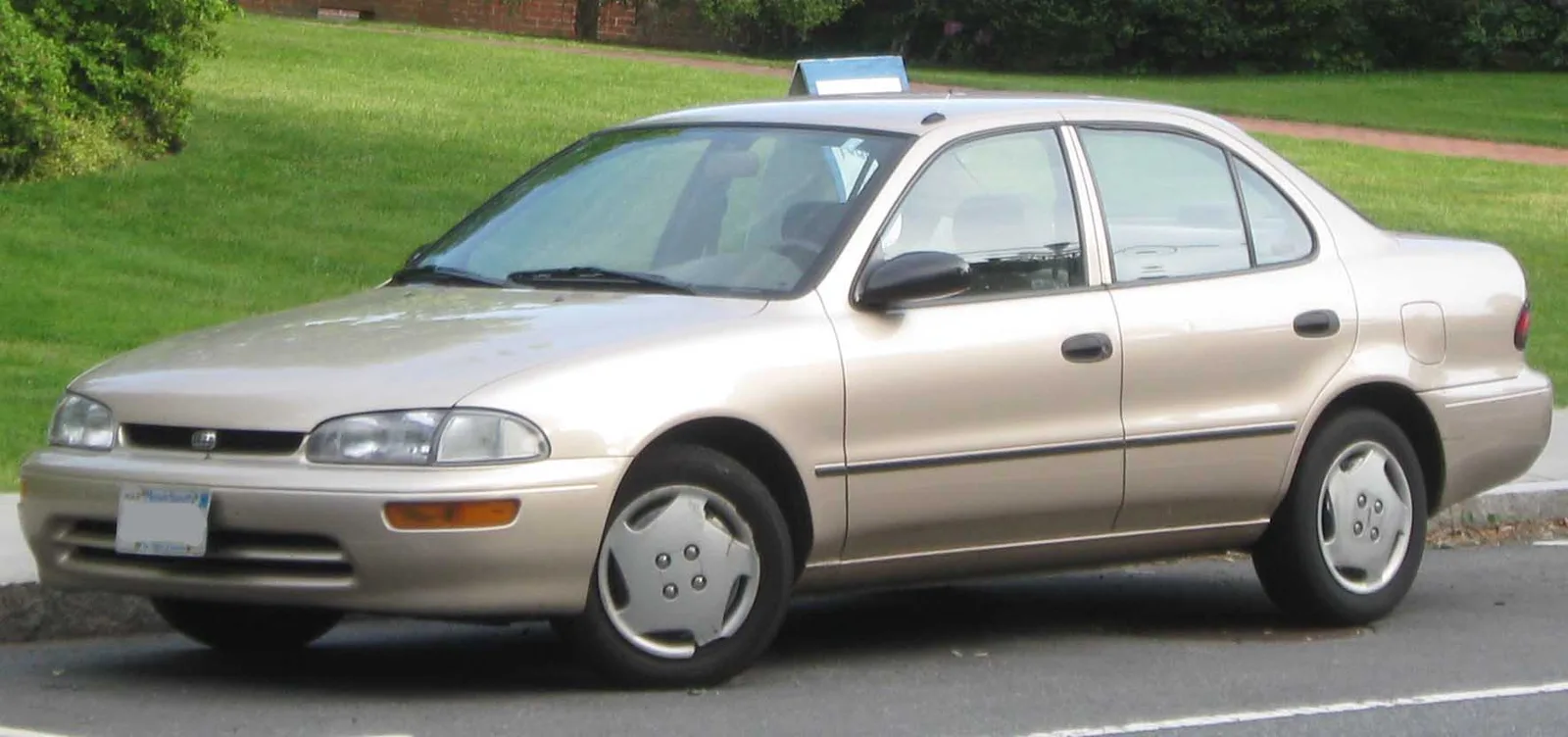
A Corolla-based Prizm, an Isuzu-built Storm, a Mitsubishi-based Summit and a Delta-platform Ion: who built each, how each differed and what replaced it.
The Geo Prizm, Geo Storm, Eagle Summit and Saturn Ion were small cars from General Motors and Chrysler brands that no longer exist. The Prizm, Storm and Summit were rebadged Toyota, Isuzu and Mitsubishi models, while the Ion used GM's Delta platform and ended with the 2007 model year.
Three of these four small cars were someone else's design in an American badge. The Geo Prizm was a Toyota Corolla built in California, the Geo Storm was built by Isuzu in Japan, and the Eagle Summit was a Mitsubishi Mirage. Only the Saturn Ion, on GM's Delta platform, was a General Motors design. When GM folded Geo into Chevrolet after 1997, the old Geo models turned out to have outsold the rebadged Chevrolets by three to one.
What was the Geo Prizm?
The Geo Prizm was a compact car that GM sold as a rebadged Toyota Sprinter, a model Toyota never sold directly in North America. The Sprinter itself came from the Toyota Corolla. The Prizm wore a Geo badge until the 1997 model year, then became the Chevrolet Prizm, and it was sold only in the United States.
Every Prizm was built at NUMMI, the joint venture between Toyota and General Motors at Fremont, California. The same plant had made the Prizm's predecessor, the 1985 to 1988 Chevrolet Nova, and would later build the Pontiac Vibe. GM called the Prizm and other Corolla-derived cars the GM S platform. Production ran from 1988 to 2001, and the last car was built on 13 December 2001, which is why a brief 2002 model year exists.
First generation, 1990 to 1992
The Prizm arrived in February 1989 for the 1990 model year, as part of Geo's new range of imports. A hatchback, sold through 1991, was a rebadged Sprinter Cielo, though it received the same front end as the sedan. The sporty GSi of 1990 to 1992 paired 130 hp (97 kW) from a twin-cam engine with sport suspension, disc brakes and 14-inch wheels. It followed the 1988 Chevrolet Nova twin-cam in spirit but came in both body styles and every colour, where the Nova had been a black sedan only. In America, no other four-door Toyota ever offered the same 4A-GE engine. The regular engine made 102 hp (76 kW), and the better-equipped LSi added body-coloured bumpers.
Canadians never got a Prizm. GM gave them a Geo Metro sedan instead. American buyers could not find a Metro sedan at Chevrolet dealers until 1995, though a Suzuki Swift-badged one was on sale from 1990.
Second generation, 1993 to 1997
The E100 Prizm debuted in 1992 for the 1993 model year and was the last under the Geo name. It gained enough room to move up to the United States Environmental Protection Agency's compact class, along with a driver's airbag and a new 1.8-litre four-cylinder, optional on the LSi. The bigger engine brought a rear stabilizer bar, wider tyres and an optional four-speed automatic in place of a three-speed. A second airbag became standard for the 1994 model year. Unlike the Sprinters sold in Japan, this Prizm had no front stabilizer bar.
One unusual spin-off: U.S. Electricar converted the Prizm to electric power in 1994, replacing the petrol drivetrain with a traction motor and a high-voltage lead-acid battery.
Third generation, 1998 to 2002
The 1998 redesign coincided with the end of the Geo brand. Its most important change was an all-new 1.8-litre engine, the 1ZZ-FE, shared with every Corolla and Prizm. It was all aluminium, ran on a timing chain instead of a belt and made more power at the same fuel economy. It also had laser-etched valve guides cut straight into the cylinder head, meant to prevent oil burning and valve guide failure, though a flawed piston ring design on engines without VVT-i did eventually cause oil burning at higher mileages.
The Prizm and the Corolla were the first cars in the compact class with optional side airbags. Consumer Reports singled out 1998 cars without the LSi's optional handling package, which included a front stabilizer bar, for sloppy emergency handling, and Toyota made the package standard for 1999. In 2000 variable valve timing arrived, lifting output from 120 to 125 hp (89 to 93 kW).
Sales faded all the same. The Prizm was squeezed by the Chevrolet Cavalier and by Saturn's S-series, GM's more direct rival to the Corolla, and from 2003 the Pontiac Vibe replaced it, built alongside the Toyota Matrix at NUMMI.
The Geo Storm outsold most small GM cars of its day, yet Isuzu ended it in 1993.
How different was the Prizm from the Corolla?
Barely. Across its three generations the Prizm was a Corolla in all but name, with closer ties to other Toyotas of its time than to any Geo or Chevrolet. The first and second generations shared body shells with the Japanese Sprinter, and the third used the E110 Corolla sedan body.
The differences were small: a Delco radio after 1992, no wagon in any generation, and the hatchback sold from 1989 to 1991, a body the Corolla did not offer in North America at the time. The third generation had a Delphi air conditioning system in place of the Corolla's Denso, along with its own headlights, front indicators and taillights. Engines followed the Corolla too: 4A-FE or optional 4A-GE for 1990 to 1992, 4A-FE or optional 7A-FE for 1993 to 1997, and the 1ZZ-FE for 1998 to 2002.
What was the Geo Storm?
Isuzu built the Geo Storm, a sport compact, at its Fujisawa plant in Japan, and Geo sold it in the United States from 1990 to 1993. Canada received it in 1992 and 1993. The idea was a budget car that looked and felt like a sports car, offered as a liftback and as a hatchback.
Underneath it was the second-generation Isuzu Impulse minus some of the pricier features: the Lotus-tuned suspension, the optional turbo and the all-wheel drive were gone, and base models had a weaker single-cam engine. In Japan it was sold as the Gemini Coupe and, through Yanase dealerships, as the PA Nero. In North America it outsold the Impulse comfortably, and in fact beat most of GM's small cars of the day.
That success was fragile. Isuzu stopped building passenger cars in 1993 after the crash of the Japanese bubble economy, and the Storm went with it. Geo offered no sport coupe to replace it before the brand was folded into Chevrolet after 1997. As of 2010, only 40,300 Storms were registered for road use.
Versions and engines
Most Storms were three-door liftbacks. Every one had front disc and rear drum brakes and an anti-sway bar. The base car cost $10,390 and had a 95 hp (71 kW) single-cam four with a 9.1:1 compression ratio. The 1990 and 1991 GSi, at $11,650, had a 1.6-litre twin-cam making 130 hp (97 kW), along with a spoiler, driving lights, a rear anti-sway bar and a gearbox ratio tuned a little more for acceleration.
A two-door hatchback, also called a wagonback, was added for 1991 and 1992. It started at $11,450 and was never offered with the stronger engine. In 1992 the Storm was restyled with a smoother nose, losing its pop-up headlight covers, and the GSi grew a 1.8-litre engine of 140 hp (104 kW), pushing its price to between $13,645 and $14,560. In 1993 the hatchback was dropped and the base car's rating fell from 95 to 90 hp because a camshaft redesign had been made to give more torque. In all, the Storm came in six versions.
How the Storm drove, and how it looked
For an economical compact of that era, the Storm's figures were respectable. Skidpad tests produced between 0.81 g and 0.85 g, matching or beating the Mazda RX-7 convertible, and Road and Track, comparing ten sport compacts, credited it with the highest skidpad rating at 0.85 g. Sport Compact Car ranked it third in its Top Ten of 1992. A Geo Storm set up for SCCA Super Production was judged by Hot Rod's Jeff Smith to be every bit as demanding as racing a Trans-Am car, and two celebrity races were held in 1991, in Des Moines and Denver.
Reviews were mixed. Writers poked at the styling, which Car and Driver's Kevin Smith compared to something from Planet Zarkon, and AutoWeek found that students loved it while baby boomers found it odd. The engine was called noisy, the cargo area small and rear headroom missing. Yet reviewers also praised its wide power band and its willingness to rev to the 7600 rpm redline, and Automobile Magazine liked the firm but compliant ride on twisty roads.
What was the Eagle Summit?
The Eagle Summit was a subcompact built by Mitsubishi for two generations and sold by Eagle from 1989 to 1996. It was a captive import marketed through Jeep-Eagle, the sales division formed after Chrysler bought American Motors in 1987.
The Eagle name came from the all-wheel-drive AMC Eagle of the 1980 model year. Both the AMC brand and the original Eagle were discontinued after 1988, replaced by badge-engineered products that Chrysler said were meant to take on hot-selling imports. The Summit joined the Dodge Colt and Plymouth Colt in 1989, as Chrysler wound down the Plymouth Horizon and Dodge Omni, and arrived with the third-generation Mitsubishi Mirage. It also took the subcompact slot at Jeep-Eagle dealers left by the Renault Alliance.
First generation, 1989 to 1992
The Summit was a badge-engineered Mirage. Popular Mechanics put the Japanese car next to the identical Eagle to test Lee Iacocca's theory about American brand preference, and concluded that buyers did not follow it: the Japanese makers offered more of the cars Americans needed, priced better, through dealers who were easier to deal with.
The 1989 Summit came as a DL or LX sedan with a 1.5-litre 8-valve four of 81 hp (60 kW), and the LX could have a 1.6-litre 16-valve twin-cam of 123 hp (92 kW). Its 100.7 cubic feet (2.85 m3) of interior volume put it in the compact class, when most rivals were still subcompacts, and it was noted for generous rear legroom. A cheap base model arrived for 1990, together with a new ES, which paired the 1.6 with sport suspension, four-wheel disc brakes and 14-inch alloy wheels.
In 1991 the 1.5 gained four more valves, three per cylinder, raising output to 92 hp (69 kW; 93 PS), and a two-door hatchback joined the sedan. From that model year, Diamond-Star Motors, the Chrysler and Mitsubishi joint venture in Normal, Illinois, built Summits too. In 1992 the Summit Wagon arrived, a completely different vehicle with a high roofline and a sliding rear door. It was a rebadged Mitsubishi RVR, offered in DL and LX trims and in a four-wheel-drive version, and was marketed as a mix of small-car agility and minivan room, with removable rear seats and seating for five.
Second generation, 1993 to 1996
The 1993 cars were all new, roomier and lighter, based on the fourth-generation Mirage chassis with a multilink rear suspension and a rounder body. The hatchback gave way to a two-door coupe, and a four-door sedan stayed. The 1.5-litre base engine now made 113 hp (84 kW; 115 PS), and a new 1.8-litre single-cam produced the same figure. The Wagon took over from the Canada-only Eagle Vista wagon.
A driver's airbag replaced one motorized seat belt in 1994, and a passenger airbag replaced the other in 1995, when the ES models were renamed ESi. The 1994 demise of both Colts had left the Summit the only Mirage clone, and the cancellation of the Mirage sedan at the end of 1994 left it the only four-door one. The 1996 cars, the last, had new paint colours and seat fabrics.
Why Eagle ended
The Chrysler Neon arrived in January 1994 through Dodge and Plymouth dealers. Chrysler officials said no Eagle version was planned, which left Eagle dealers with nothing to rival the Neon and, given the Summit's Mitsubishi roots, made the Eagle line expendable. The Summit Wagon ran from 1992 to 1996, and the line ended with the fourth-generation Mirage in 1996.
What was the Saturn Ion?
The Saturn Ion was a compact car sold by Saturn for the 2003 to 2007 model years. It rode on the GM Delta platform, took over from the S-Series in 2002 and gave way to the Saturn Astra in 2008. Production ended on 29 March 2007, closing the book on Saturn passenger cars at the Spring Hill plant in Tennessee.
That plant had been tied to Saturn's branding, and owners had attended homecoming events there. It was also the last Saturn with the brand-specific features that began with the S-Series, such as plastic body panels.
Trims and doors
The Ion came in Level 1, Level 2 and Level 3, plus a Red Line later on. Level 1, a sedan only, had manual windows and locks, no standard air conditioning, a 2.2-litre twin-cam four and a five-speed manual. Level 2 was the entry Quad Coupe and the step up for the sedan, adding 15-inch wheels, air conditioning and a CD player. Level 3 topped both bodies with power windows and locks, keyless entry and 16-inch alloys. The Red Line was a coupe only, with a supercharged 2.0L four, a body kit and a rear spoiler.
The Quad Coupe had half-size clamshell rear doors, and the sedan had conventional ones. The Ion's instrument panel sat at the top centre of the dashboard, not behind the steering wheel. The production car made its first appearance at the 2002 New York auto show with a 2.2-litre Ecotec of 140 hp (104 kW). The sedan reached showrooms in mid-October 2002 and the coupe in early 2003.
Gearboxes and updates
A Getrag F23 five-speed manual or an Aisin AF33 five-speed automatic were available at first. The Aisin lacked an overdrive, which let five forward gears fit in the space of a four-speed manual, giving close ratios and less heat and drag. It was fill-for-life, not meant to be serviced. Coupes could instead have a VTi continuously variable transmission.
In 2005 the Aisin and the CVT were dropped, and GM's four-speed 4T45-E became the only automatic. The sedans received a bigger grille opening and Quiet Steel sound-deadening laminate. In 2006 a 2.4-litre four with variable valve timing, making 170 hp (127 kW) and 162 lb.ft (220 N.m), became available on the Ion 3. For 2007 the 2.2 rose from 140 hp (104 kW) to 145 hp (108 kW) at 5600 rpm, with torque rising from 145 lb.ft (197 N.m) to 150 lb.ft (203 N.m), and the 2.4 gained five horsepower to 175 hp (130 kW).
The Ion Red Line
The Red Line, built from 2004 to 2007, shared its powertrain with the Chevrolet Cobalt SS Supercharged, which started in the 2005 model year. It kept the coupe's rear clamshell doors. An optional Competition Package for 2005 added 17-inch alloys, shift lights and a limited-slip differential.
GM offered two engine kits for the Red Line and the Cobalt SS from mid-2006. The Stage 1 kit, about US$500, added higher-flow injectors and an ECU recalibration, lifting the stock 205 hp (153 kW) and 200 lb.ft (271 N.m) to 236 hp (176 kW) and 205 lb.ft (278 N.m). Stage 2, about $750, added a smaller supercharger pulley and belt for 241 hp (180 kW) and 218 lb.ft (296 N.m).
On 17 October 2003 the Saturn Land Speed Record Project of GM Performance Division ran a Red Line at the Bonneville Salt Flats in Utah and set a class record, 212.684 mph in G/Blown Fuel Altered. It beat the previous record of 183.086 mph, set in 2001.
The Astra and the recall
GM decided to drop the Ion after 2007. The Astra that replaced it shared the Delta platform but was a captive import: a rebadged Opel Astra H brought in from Belgium. Opel sold the Astra in several body types and with performance options, but Saturn imported none of them, and the Astra came only as a three-door or five-door hatchback with a single base engine, in two trim levels.
In February 2014 General Motors added the Ion to its recall for faulty ignition switches. The defect had caused 13 deaths in Chevrolet Cobalts, which prompted the recall of the Ion and related cars.
How do the four cars compare?
| Car | Brand | Years sold | Built by |
|---|---|---|---|
| Prizm | Geo, then Chevrolet | 1990 to 2002 model years | NUMMI, Fremont (Toyota Corolla-based) |
| Storm | Geo | 1990 to 1993 | Isuzu, Fujisawa, Japan |
| Summit | Eagle | 1989 to 1996 | Mitsubishi in Japan; Diamond-Star Motors in Illinois from 1991 |
| Ion | Saturn | 2003 to 2007 model years | Spring Hill, Tennessee (GM Delta platform) |
What replaced the Prizm, Storm, Summit and Ion?
The Prizm lived on as the Pontiac Vibe from 2003, built with the Toyota Matrix at NUMMI. Geo offered no sport coupe to replace the Storm, and the Summit ended in 1996 with the fourth-generation Mirage, after Chrysler said no Eagle version of the Neon was planned. The Ion gave way to the Astra for 2008. Geo itself was discontinued after 1997 and its models became Chevrolets for 1998.