A youth brand with a fixed price, a dealer-law workaround born from a Jeep deal and a small hatchback that lost its Geo badge: what three North American sub-brands were for and why they ended.
Toyota launched Scion in 2003 to attract young buyers and closed it in 2016 after sales fell from a 2006 peak of 173,034. Chrysler created Eagle after buying AMC in 1987 and dropped it after the 1998 model year. The Geo Metro, a GM and Suzuki small car, wore a Geo badge from 1989 to 1997.
Chrysler bought American Motors in 1987 for one reason: Jeep. The passenger cars came as a condition, because Renault, AMC's French partner, forced Chrysler to take on those contractual obligations, and state franchise laws meant Chrysler could not simply sell Jeeps in its own showrooms. The answer was a separate brand, Eagle.
That kind of origin makes sub-brands interesting. Scion, Geo and Eagle came from three different carmakers with three different problems, and each is gone.
Scion: Toyota's attempt to win over young buyers
Scion was a Toyota marque that debuted in 2003 and was sold only in the United States and Canada. It was aimed at millennials and focused on cheap, stylish and distinctive sport compacts. The name means the descendant of a family or an heir, and refers to both the cars and their owners. Scion relied mostly on guerrilla and viral marketing, with posters, cinema advertising and web sites such as the "want2bsquare" pages rather than traditional campaigns.
From Project Genesis to Project Exodus
Toyota's first try was Project Genesis in 1999, an effort to bring younger buyers into the Toyota marque with a "marque within a marque" approach. It covered the Echo economy car and late-generation MR2 and Celica models, was judged unsuccessful and was cancelled in 2001. Toyota then launched Project Exodus to build a separate marque. A Los Angeles digital design company, Fresh Machine, was hired to create the brand, logo and website. Toyota had already experimented with young-buyer brands in Japan, where it made three vehicles under the WiLL name for its Netz Store dealerships.
Scion was introduced at the New York Auto Show in March 2002 with just two concepts, the bbX that became the xB and the ccX that became the tC. The production xA and xB made their debut at the Greater Los Angeles show on 2 January 2003 and went on sale on 9 June 2003 at 105 Toyota dealerships in California. The South, Southeast and East Coast followed in February 2004, and nationwide sales began in June 2004 alongside the 2005 tC. A Canadian launch came in September 2010 with 45 dealers in Toronto, Montreal and Vancouver.
The pure price model
Scion sold each car in a single trim at a fixed, non-negotiable base price, which it called Pure Price. The price shown on the car, in an advertisement or on a dealership display board was meant to be the price the customer paid, covering the vehicle, accessories and finance and insurance products. Individual personalisation came through about 150 dealer-installed accessories rather than trim levels. For comparison, a Toyota Camry came in four trims for budget, mainstream, sporty and luxury buyers.
Pure Price did not remove all haggling in practice, since dealers commonly added aftermarket accessories and raised prices to increase profit. And the idea was not new: Geo and Saturn, two General Motors marques, had introduced it in the early 1990s.
Limited Release Series cars, starting with the 2004 xB RS 1.0 in Hot Lava Orange, were produced in small batches in loud colours. Most dealers received only two or three of each, so they sold out quickly. Accessories could go too far: the tC offered a supercharger that lifted output from 161 to 200 hp, but it was withdrawn in 2007 after the bearings inside the blower failed early.
Why Scion failed
Sales peaked in 2006 at 173,034 units, then slid. The 2010 model year brought a low of 45,678. Toyota's original promises of short product cycles and sharp pricing built on low dealer margins became unsustainable after the 2008 financial crisis. The tC was redesigned for 2011 in hopes of selling 35,000 to 45,000 a year, and the little iQ city car arrived as a 2012 model, but it never met expectations and by 2014 observers were calling it a disappointment. In April 2012 the brand's vice president, Jack Hollis, said the xB and xD would not survive beyond 2012, and the FR-S sports car went on sale that month as a 2013 model.
By late 2013 the xD and the second-generation xB had gone seven years without a substantial update, and Toyota began letting dealers drop the Scion marque without penalty. Analysts concluded that the new FR-S was cannibalising the similar tC, since combined sales of the two did not match the tC's sales alone between 2005 and 2008. A second problem sat in the brand's founding goal. Scion was meant to introduce young first-time buyers to Toyota, but few moved on to the more profitable Toyota and Lexus lines, and Generation Y buyers turned out to be more pragmatic than expected in a tougher economy.
For 2015 the iQ, xB and xD were dropped and the line-up leaned on the new iM hatchback, built on the global Toyota Auris, and the iA sedan, a rebadged Mazda2. On 3 February 2016 Toyota announced that Scion would be wound down in August, once the 2016 model year ended, saying it no longer needed a separate marque to reach younger buyers. The FR-S, iA and iM moved to Toyota as the Toyota 86, Yaris iA and Corolla iM, the tC was discontinued, and the upcoming C-HR, first unveiled as a Scion, became a Toyota. Scion cars were already sold and serviced at Toyota dealerships, so owners saw little disruption.
What Scion achieved
It did reach younger people. In 2007 the median age of a Toyota customer was 54, while the average Scion buyer was 39, the lowest in the industry, and tC buyers averaged 29. By the end, over a million Scion cars had been sold; over 70% went to people new to Toyota, and just over 50% to buyers under 35. The tC alone made up over 40% of all Scions sold up to 2010. The xB fell from a peak of over 60,000 sales to 17,017 in 2011, and xD sales fell from 32,603 in 2006 to 9,573 in 2011.
Eagle exists because state franchise laws kept Jeeps and Chrysler products in separate showrooms.
Geo: the Metro and the small-car nameplate
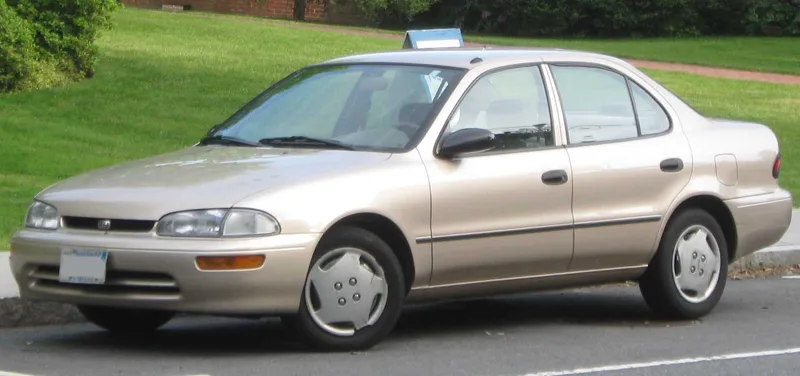
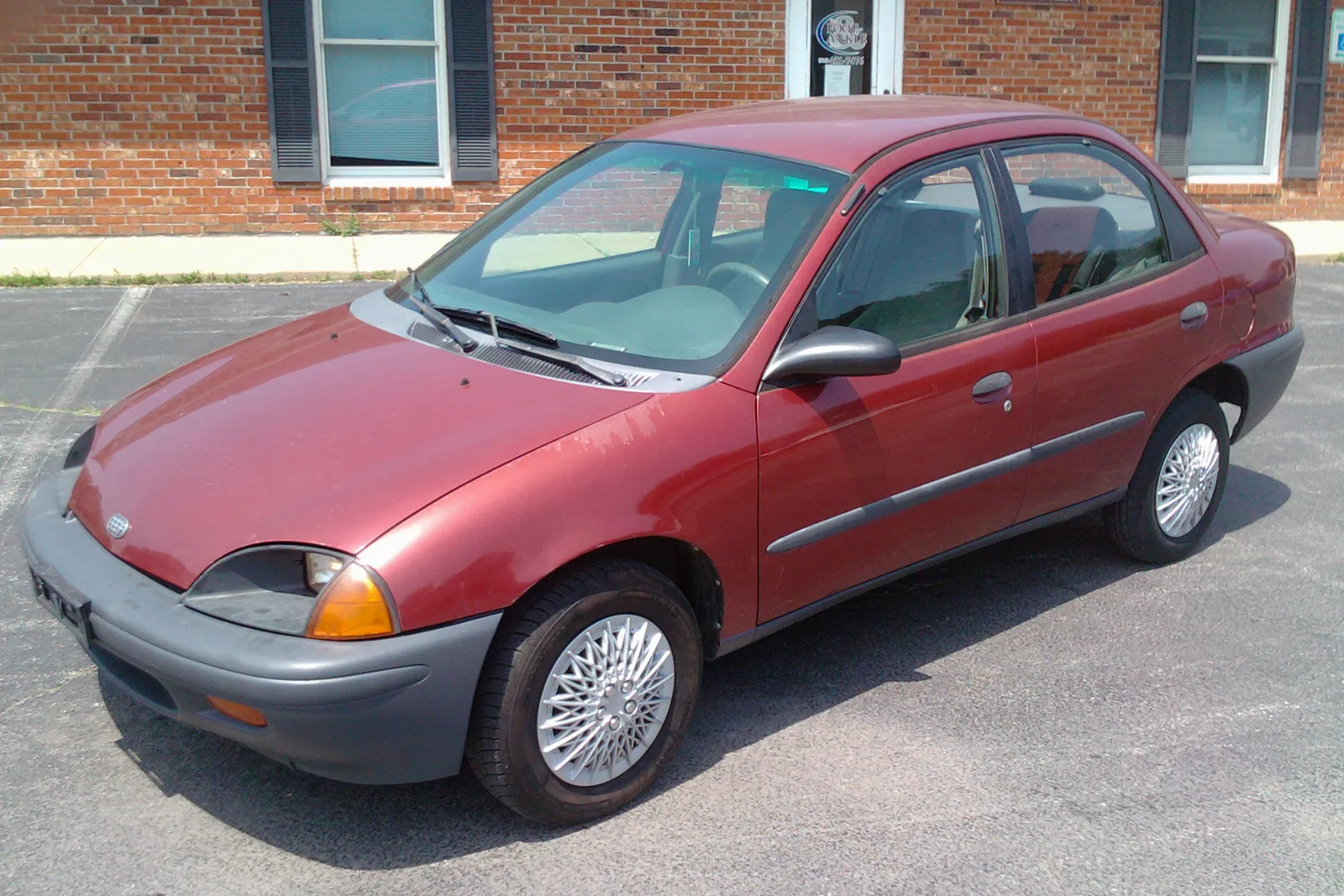
Geo was the badge on General Motors' small cars made with Suzuki, and the Metro is the model that carried it longest. The Geo Metro was GM and Suzuki's North American take on the Suzuki Cultus, on sale from 1989 to 2001. In the United States it wore the Geo name from 1989 through 1997 and a Chevrolet badge from 1998 to 2001. Across 13 years it passed through three generations and appeared as a three-door hatchback, a four-door sedan, a five-door hatchback and a two-door convertible.
Where it came from
The Metro's predecessors were Cultus-derived cars sold as the Suzuki Forsa, Suzuki Swift, Chevrolet Sprint and Pontiac Firefly. The Sprint stayed in the western United States until 1986, when it went nationwide, and the Metro name first appeared in 1987 on a naturally aspirated Sprint. Production of the first Geo Metro began at Suzuki's plant in Hamamatsu, Japan, in late 1988, and in 1989 it replaced the Sprint in the United States. From 1990 all North American cars were built at CAMI Automotive, a 50-50 joint venture between GM and Suzuki in Ingersoll, Ontario, though CAMI never reached its intended capacity.
The 1995 second generation was a three-door hatchback and four-door sedan on Suzuki's M platform, with styling cues borrowed from the bigger Chevrolet Cavalier. It was built only at CAMI and sold only in North America. When launched it was the smallest car anywhere that could satisfy the coming 1997 North American side-impact rules, and its drag coefficient was 0.32. Two engines were offered: a 1.0-litre three-cylinder and a 1.3-litre four-cylinder with 70 hp, later raised to 79 hp with a sixteen-valve head. When it launched, 41 percent of buyers were buying their first car, 62 percent were female and the median buyer age was 37. GM sent a car carrier with 1995 Metros around college campuses for what it called "Metro University" seminars.
The end of the Geo name
The year 1997 was the last for the Geo brand, and the Metro returned in 1998 under a Chevrolet nameplate. Demand for small cars in North America was waning: Chevrolet and Geo sold 55,600 Metros in 1997, down from 88,700 the year before. Canadian production, which at its peak topped 100,000 vehicles a year, fell to 32,000 in 2000. CAMI confirmed in April 2001 that it had ended Metro production, and the last Metro, a red sedan, was built on 26 April 2001. GM announced the Metro would not be in the 2002 Chevrolet line-up, though it stayed on sale in Canada. The car that took over its slot was the Chevrolet Aveo, built from the Daewoo Kalos, which reached showrooms in late 2003 as a 2004 model.
The Metro afterwards
The car outlived its badge. In 1998 and 1999 the American Council for an Energy-Efficient Economy placed the Chevrolet Metro and Suzuki Swift first and second among gasoline vehicles in its Top 12 Greenest Vehicles. When fuel prices rose in 2008 the Metro became popular again on the used market, and in July 2009 Car and Driver tested a 1998 Metro against hybrids. It matched the Toyota Prius at 42 mpg-US (5.6 L/100 km) and finished third overall behind the Honda Insight and the Prius. Solectria Corporation of Massachusetts converted about 500 Metros from 1996 and 1997 to electric power, sold as the Solectria Force. In 2010 an artist hung nine Chevrolet Metros in the air for the 17th Biennale of Sydney.
Eagle: the brand Chrysler built from AMC
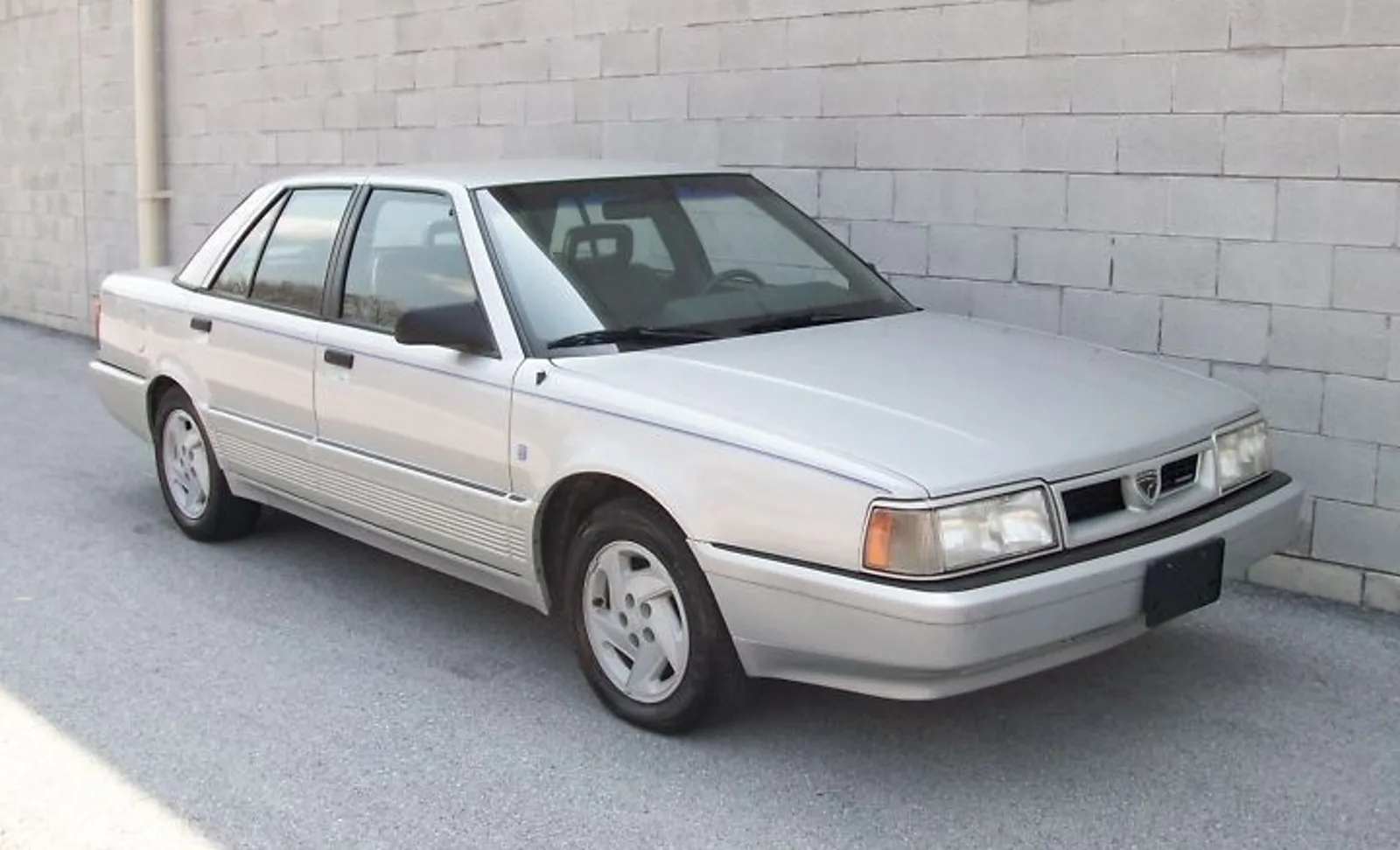
Eagle was a Chrysler Corporation brand created after the 1987 purchase of AMC and sold through the 1998 model year. It was aimed at enthusiast drivers and promoted as more European than similar Chrysler products. The name came from the four-wheel drive AMC Eagle introduced for 1980, the last wholly US-designed AMC vehicle, a car later called the first modern mass-production crossover built in the United States.
The dealer-law problem
Chrysler wanted Jeep. Renault pushed it to accept AMC's passenger-car contracts too, and franchise laws in nearly every state, which protect dealers' territorial exclusivity, blocked Chrysler from selling Jeeps through its existing network, or ex-AMC dealers from selling other Chrysler products. A second problem was that AMC had sold passenger cars under its own initials since 1970, leaving Chrysler with legacy models and no brand to hang them on. It formed the Jeep-Eagle division and used the Eagle name.
Chrysler had earlier promised a rival to GM's Saturn, codenamed Liberty, in a press release from its chairman Lee Iacocca. That plan never came to anything, and the AMC-developed Premier took its place. The Liberty name later went to a Jeep model for 2002.
The Eagle range
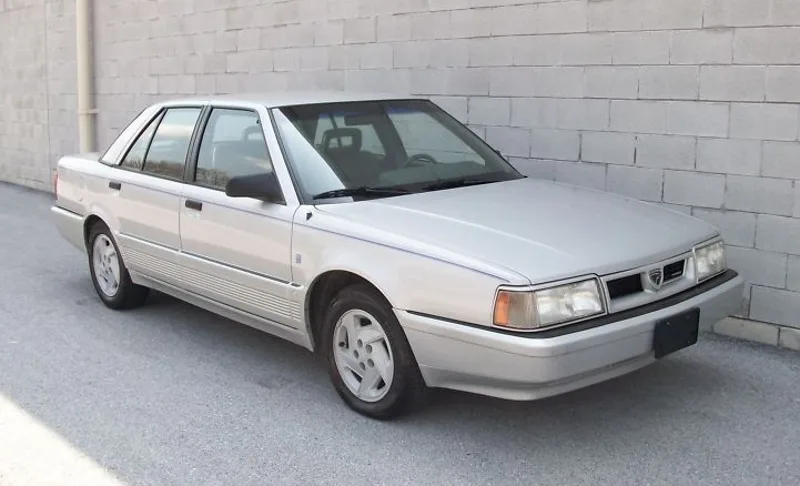
Two of the first Eagles, the Premier and the Medallion, were designed by AMC with Renault, its former partner and 46.4 percent owner. The rest were rebadged Chrysler cars and imports built by Mitsubishi.
| Model | Years | Basis |
|---|---|---|
| Eagle Wagon | 1988 | Four-wheel drive AMC Eagle; production ended December 1987 |
| Eagle Premier | 1988-1992 | Designed by AMC; basis of the 1993 LH cars |
| Eagle Medallion | 1989 | Imported from France; similar to the Renault 21 |
| Eagle Vista | 1988-1992 | Rebadged Mitsubishi Mirage; sold only in Canada |
| Eagle Summit | 1989-1996 | Rebadged Mitsubishi Mirage and Dodge/Plymouth Colt |
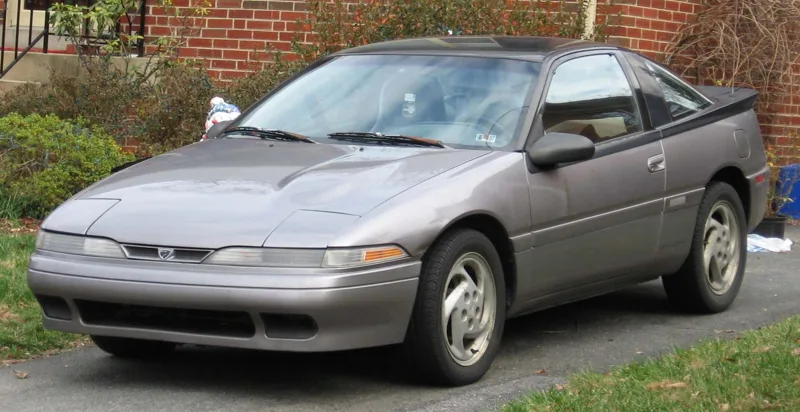
| Eagle Talon | 1990-1998 | Sporty halo car, shared with Mitsubishi Eclipse |
| Eagle 2000GTX | 1991-1992 | Rebadged Mitsubishi Galant |
| Eagle Vision | 1993-1997 | One of the three original LH cars |
Why Eagle closed
The brand never found a clear identity. Most Eagle models could also be bought at Chrysler-Plymouth, Dodge and Mitsubishi dealerships under other names, and unlike other Chrysler products they wore an Eagle head logo rather than the pentastar. Chrysler's finances were poor at the end of the 1980s, leaving little to spend on a new division, and most marketing money went to Jeep, which had stronger recognition and bigger margins. Many dealers pushed Jeeps and treated Eagle passenger cars as a distraction.
Phase-out came in stages. The Mitsubishi Mirage-based Summit ended in 1996, Chrysler announced the end of the brand in September 1997 after a decade of slow sales, and the final 1998 Eagle Talon was built soon after. The Vision ended at the close of its design cycle in 1997. Chrysler had planned a redesigned Vision for 1999, and prototypes wore Eagle badges, but executives dropped the brand months later and the car became the Chrysler 300M. Commentators put the failure down to the lack of a coherent strategy for such a mixed range and to weak promotion, with Chrysler not fully committed to the nameplate and customers unsure what an Eagle was.
It was not a total failure. The Vision sold respectably, with 115,699 built from 1993 to 1997, and the Talon was made in two generations with more than 200,000 produced. The Premier was the foundation for Chrysler's successful LH series introduced for 1993. Concepts such as the 1990 Eagle Optima, with a 32-valve aluminium V8 and all-wheel drive, previewed the LH sedans.
Three sub-brands compared
| Brand | Maker | Run | Reason for creation | Closure |
|---|---|---|---|---|
| Scion | Toyota | 2003 to 2016 | Reach younger buyers with fixed pricing | Announced 3 February 2016 after sales fell from 173,034 in 2006 |
| Geo (Metro) | General Motors with Suzuki | Geo name 1989 to 1997 | Small cars from a joint venture | Geo name dropped after 1997; Metro ended April 2001 |
| Eagle | Chrysler | 1987 acquisition to 1998 model year | Carry AMC passenger cars separately from Jeep | Announced September 1997 |
What these brands mean for used-car buyers
All three leave cars that are still on the road. Scion vehicles were sold and serviced at Toyota dealerships, and the FR-S continues in spirit as the Toyota 86. The Metro held its own against hybrids on fuel economy in a 2009 test. Eagle's Talon is a Mitsubishi Eclipse underneath, and the Premier underpins the LH family. The lesson is the same for each: look at the platform underneath the badge.
Will Scion, Geo or Eagle ever come back?
None of the three has a stated future. Scion's models live on under Toyota names, and the Eagle idea survives only in the LH platform history and in the cars still around. The Metro lives on in the used-car market and in conversions such as the Solectria Force.