A small car that sits below the Mazda3, won the 2008 World Car of the Year title, and was rebadged as a Toyota in North America.
The Mazda2 is a subcompact sedan and hatchback that Mazda has sold since 2002. It won the 2008 World Car of the Year title as a second-generation car, and in North America the third generation was sold by Toyota.
The Mazda2 is a subcompact car that Mazda has sold since 2002, first as a hatchback and sedan and now in its third generation. It sits below the Mazda3 in the range and serves as the brand's entry-level model outside Japan. In its home market it was called the Demio until 2019.
Where did the Mazda2 come from?
The Mazda2 was developed from the B-segment Ford B3 platform, the same architecture used by the fifth-generation Ford Fiesta, and it shared suspension design with that car. The project was led by chief engineer Kiyoshi Fujiwara, who had also overseen the development of the B3 platform at Ford's European research centre.
Its direct predecessor was exported as the Mazda 121. The new car replaced that model with a larger and more modern package, and it was the start of the line that has since been sold in dozens of markets.
The Mazda2 has also been sold as the Mazda Demio, the name it kept in Japan until 2019. The two names describe the same car, with the Japanese market following its own naming.
A subcompact that sits below the Mazda3, won a World Car of the Year title and became a Toyota in North America.
How did the first-generation Mazda2 differ?
The first generation, known as DY, arrived in 2002. Production for the European market was assigned to the Almussafes Ford plant in Valencia, Spain, from 20 January 2003.
Every model came with ABS and EBD, while stability control was optional. Japan received a distinctive system called e-4WD, which used an electric motor to power the rear wheels of this front-wheel-drive car when they were needed.
The European-only version used a pedal box taken from the Ford Fiesta, and it kept the Ford 4x10⁸ bolt pattern rather than the 4x100 used by the Japanese cars. That made it a clearly different car under the skin, even though the outward design looked similar.
Which trims and engines did the first generation offer?
Japan offered three trim levels, Cozy, Sport and Casual. In Europe the trims were S, TS and TS2, with the last two renamed Antares and Capella in 2004.
The Japanese 1.3 and 1.5 gasoline engines were not sold in Europe. Instead the car used Ford's 1.25-litre 16-valve Sigma engine, along with Mazda's 1.4 and 1.6 gasoline units and a Ford 1.4 TDCi diesel, which Mazda called the 1.4 CDTi. New Zealand cars used a 1.5 ZY-VE straight-four.
In 2004 Mazda introduced the Verisa in Japan. Based on the Demio and Mazda2, it was aimed further upmarket than its siblings. The Demio itself received a facelift on 13 April 2005.
What changed with the second generation?
The second generation, known as DE/DH, was launched at the 2007 Geneva Motor Show and later at the Shanghai show that same year. It was built on a platform similar to that of the sixth-generation Ford Fiesta, and it used lighter materials while reducing the car's overall dimensions.
This generation dropped the high-roof styling of its predecessor in favour of a more conventional hatchback look. The lead designer was Ikuo Maeda, who was promoted to Head of Design at Mazda in 2009.
Sales in Japan opened on 5 July 2007 through Mazda, Efini and Autozam outlets. The 100,000-unit production mark in Japan was passed at the close of January 2008, and by August 2010 some 400,000 had been sold in Europe, Australia and Japan.
What engines did the second generation use?
In Europe the car was offered with MZR 1.3-litre and 1.5-litre gasoline engines, and an MZ-CD 1.4-litre common-rail turbo diesel. In some countries, including the Netherlands, buyers could order the gasoline car in a bi-fuel LPG version from the factory.
Transmission choices were a five-speed manual, a four-speed automatic and a CVT. The CVT was available only in Japan and Hong Kong, and a CVT with a sport mode, seven simulated ratios and paddle shifters was sold only in Japan.
A three-door variant was released for Europe at the 2008 Geneva Motor Show. It sat alongside the five-door hatchback, which was the main body style in most markets.
How did the second generation perform in safety tests?
In frontal crash testing by the Insurance Institute for Highway Safety, the car earned a Good rating. It was rated Acceptable for side crashes and Acceptable for rear crash protection, while its roof strength earned a Good rating.
Those results gave the car a respectable profile in its class, although the ratings also showed where the design still had room to improve. The safety results were part of the reason the model won broad recognition across markets.
Where was the second-generation Mazda2 built?
The vehicles were built at Ujina Plant No. 1 in Hiroshima, with additional production starting at Ujina Plant No. 2 in June 2007. More cars were built at Hofu, Japan.
Chinese models were built at Changan Ford Mazda's Nanjing plant from the end of October 2007. Asia-Pacific models were produced by AutoAlliance Thailand from 2009, and local assembly in Vietnam began in October 2011 at a plant owned by Vina Mazda Automobile Manufacturing.
What did the 2010 facelift bring?
The facelifted hatchback was first revealed in Thailand in October 2009 and launched in Thailand and Indonesia that November. Malaysia followed on 5 April 2010, with sedan and hatchback bodies in V and R grades, powered by a 1.5-litre MZR engine and a four-speed automatic.
In Australia the sedan arrived with the facelifted hatchback in May 2010, sold in a single Maxx grade. In February 2011 Mazda Australia returned to Japanese-sourced production, and the sedan was dropped after just nine months on sale.
The facelift reached Europe at the end of 2010 as a 2011 model. It refreshed the look without changing the basic formula that had carried the car through its first years.
How was the Mazda2 sold in North America?
The North American version debuted at the 2009 Los Angeles Auto Show and later at the 2010 Canadian International AutoShow. It went on sale in July 2010 with a 1.5-litre four-cylinder rated at 100 hp, paired with either a five-speed manual or a four-speed automatic.
Two trims were offered in the United States, the base Sport and the upper Touring. Sport models came with 15-inch steel wheels with covers, air conditioning and power accessories, while Touring added fog lights, a rear spoiler, aluminium wheels and a six-speaker audio system.
The car was discontinued in the United States and Canada after the 2014 model year, which marked the end of Mazda's own sales of the car in those markets.
What were the 2011 Japanese updates?
The 2011 update for the Japanese models brought premium seat upholstery, a black meter panel and silver instrument garnish. It also added Burgundy Red Mica to the palette and a standard trip computer, and the 15C and 13C models received Mazda's eco-lamp.
The 13-Skyactiv model carried the first Skyactiv engine, a 1.3-litre unit producing 62 kW (84 PS; 83 hp) and 113 N-m of torque. It came with the intelligent Drive Master system, a CVT, 14-inch alloy wheels and dynamic stability control.
Preorders for the new model started on 9 June 2011, and sales followed on 30 June 2011. The Demio 13-Skyactiv reached the Car of the Year Japan shortlist in 2012.
What electric and range-extender versions were built?
The Demio EV was a limited electric vehicle for the Japanese market, with 100 units offered on lease. It used a 346-volt 20 kWh lithium-ion battery with a driving range of 200 km (124 miles), and leasing began in October 2012.
A 2013 prototype range extender added a 0.33-litre rotary engine, lithium-ion batteries and a 10-litre fuel tank. The car weighed 1,280 kg (2,820 lb), and its 75 kW electric motor was supported by a 28 kW rotary generator. The fuel tank could be filled with gasoline, butane or propane, and it was claimed to almost double the range to 380 km (235 miles).
What is the third-generation Mazda2?
Mazda unveiled the third-generation hatchback in July 2014. Its design had been previewed by the Hazumi concept, which appeared at the 2014 Geneva Motor Show, and it was designed under chief designer Ryo Yanagisawa in the Kodo style.
The car used Skyactiv engines, transmissions, body and chassis, loosely derived from the CX-5. It was longer and wider than its predecessor, with larger front and rear tracks, although rear-seat room and front headroom were reduced.
Production started at the Hofu plant in July 2014, with Japanese sales beginning that September. The sedan debuted at the Thailand International Motor Expo in November 2014, and the Demio won the 2014-2015 Car of the Year award from the Japan Car of the Year Committee in October 2014.
How were the Mazda2 models built for the Americas?
Production for North and South American markets began in October 2014 at the new Mazda de Mexico Vehicle Operation factory in Salamanca, Guanajuato. Mazda did not sell the car in Canada or the United States, except in Puerto Rico.
Toyota sold the car in those markets instead. It was marketed first as the Scion iA and then as the Toyota Yaris iA, and later simply as the Yaris, between 2015 and 2020.
How were the North American Toyota versions named?
In Canada the car was sold as the Yaris Sedan across all model years. In Mexico it was sold as the Yaris R, alongside the larger and cheaper Yaris Sedan, and the Yaris R came in three versions.
In the United States the sedan carried several names. The first 2016 model was sold as the Scion iA by Toyota's youth-oriented Scion brand, and it was the only four-door sedan that brand sold that was not built in Japan. After the Scion brand was discontinued, it became the Toyota Yaris iA for 2017 and 2018, and then the Yaris Sedan for 2019 and 2020.
The iA launched with a single trim and a choice of exterior colour and transmission. For 2019 the Yaris Sedan received a minor facelift, and L, LE and XLE trims were introduced with a range of interior and exterior options.
The hatchback was not initially sold by Toyota, which offered the Yaris Liftback based on the Toyota Vitz instead. The Mazda2-based Yaris Hatchback arrived in October 2019 as a 2020 model. Exports of both body styles to the United States stopped in June 2020, and the car was cancelled in Canada in July.
How did the 2019 and 2023 facelifts change the car?
The 2019 facelift brought exterior and interior changes, revised suspension tuning for better ride quality and improved energy recovery under deceleration. It also added adaptive headlights and standard G-Vectoring Control Plus. In September 2019 the Japanese Demio was renamed the Mazda2.
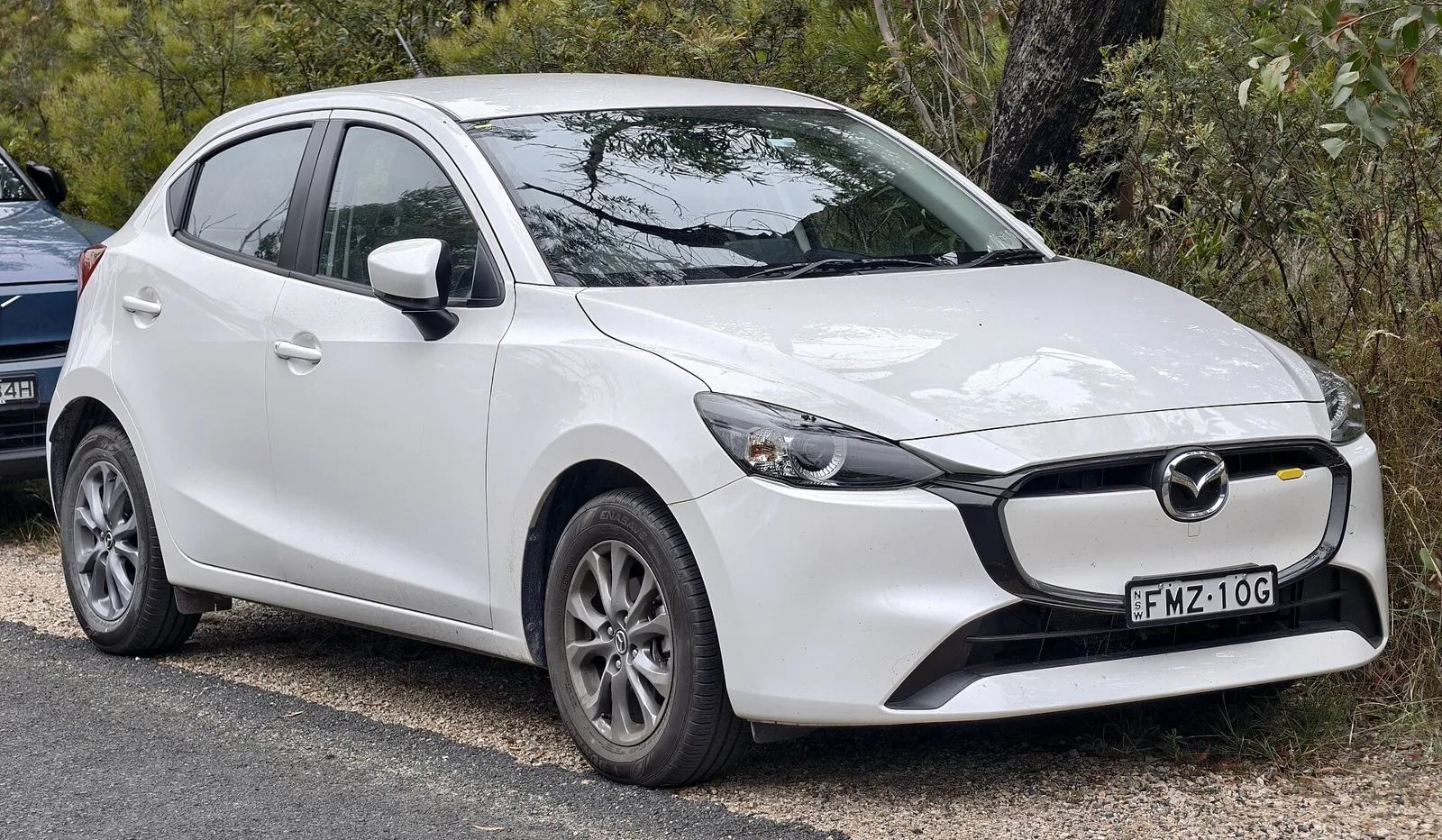
The second facelift arrived on 27 January 2023, with a new black or body-coloured insert, a larger Mazda logo and a restyled front and rear. Yellow or red grille options depended on the trim, and new seat designs and a new key fob were introduced.
The 2023 car also gained auto-folding mirrors, dusk-sensing headlights and rain-sensing wipers. Mazda claimed the updated car had improved CO2 emissions. It went on sale in Australia in June 2023, with deliveries starting in July.
What engines does the current Mazda2 use?
The Mazda2 uses the Skyactiv-Drive six-speed automatic and Skyactiv-MT five- and six-speed manuals, along with i-STOP stop-start, which turns the engine off when the car is stationary, and i-ELOOP regeneration, which stores braking energy in a capacitor.
The car was first offered with a 1.5-litre gasoline engine and a 1.5-litre diesel. The Skyactiv-D diesel debuted at the 2014 Geneva Motor Show, but it was discontinued in Europe in 2019. A 1.5-litre mild-hybrid gasoline engine arrived in 2020, available only with a six-speed manual.
In February 2024 Mazda introduced a Grand Touring LX Carbon Edition hatchback in Colombia. Its 2.0-litre petrol unit made 186 N-m (137 lb-ft) at 2,800 rpm, and 140.8 PS (104 kW; 139 hp) at 6,000 rpm.
What is the Toyota Yaris-based Mazda2 Hybrid?
The Mazda2 Hybrid is based on the Toyota Yaris Hybrid and entered production in December 2021. It went on sale in Europe in 2022, alongside the older Mazda-built gasoline model, and it was updated in 2024.
In the UK the gasoline-powered Mazda2 was discontinued in February 2025, with the Yaris-derived Hybrid taking over as the successor. In 2026 the car was discontinued in Indonesia.
What are the Mazda2 specifications?
| Specification | Detail |
|---|---|
| Class | Subcompact B-segment, sedan or hatchback |
| Launch | 2002, first generation (DY) |
| Generations | Three, with the third from 2014 |
| Platform, first generation | Ford B3, shared with the Ford Fiesta |
| 2011 Skyactiv engine | 1.3-litre, 62 kW (84 PS; 83 hp), 113 N-m |
| 2024 Colombian engine | 2.0-litre gasoline, 140.8 PS (104 kW; 139 hp) |
| Colombian torque | 186 N-m (137 lb-ft) at 2,800 rpm |
| Demio EV battery | 346-volt, 20 kWh lithium-ion |
| Demio EV range | 200 km (124 miles) |
| Range extender prototype | 1,280 kg (2,820 lb), 380 km (235 miles) claimed |
| Japanese name until 2019 | Mazda Demio |
| Current European hybrid | Mazda2 Hybrid, based on the Toyota Yaris Hybrid |