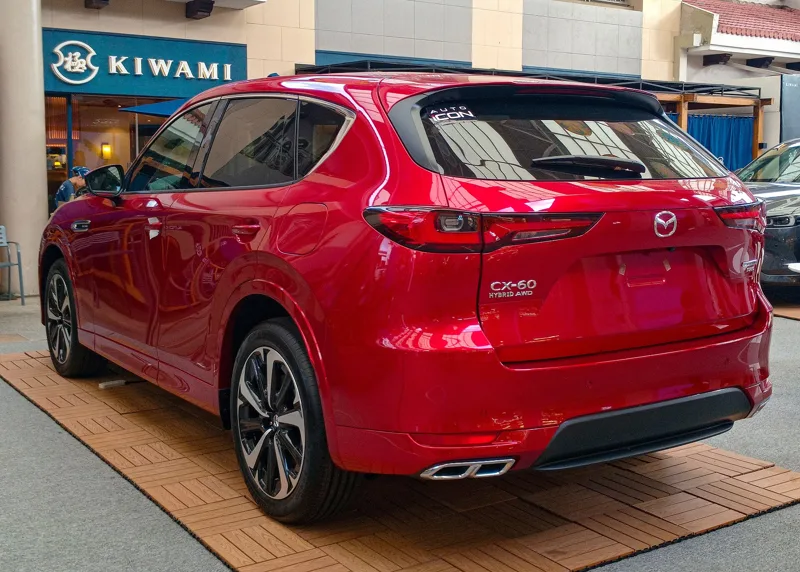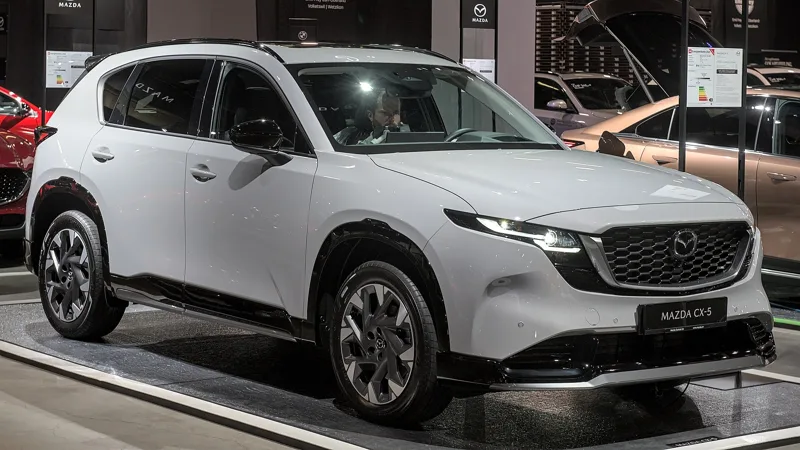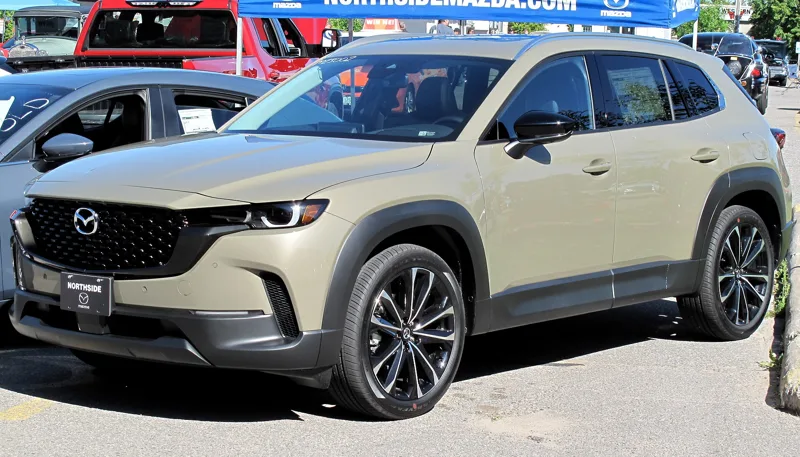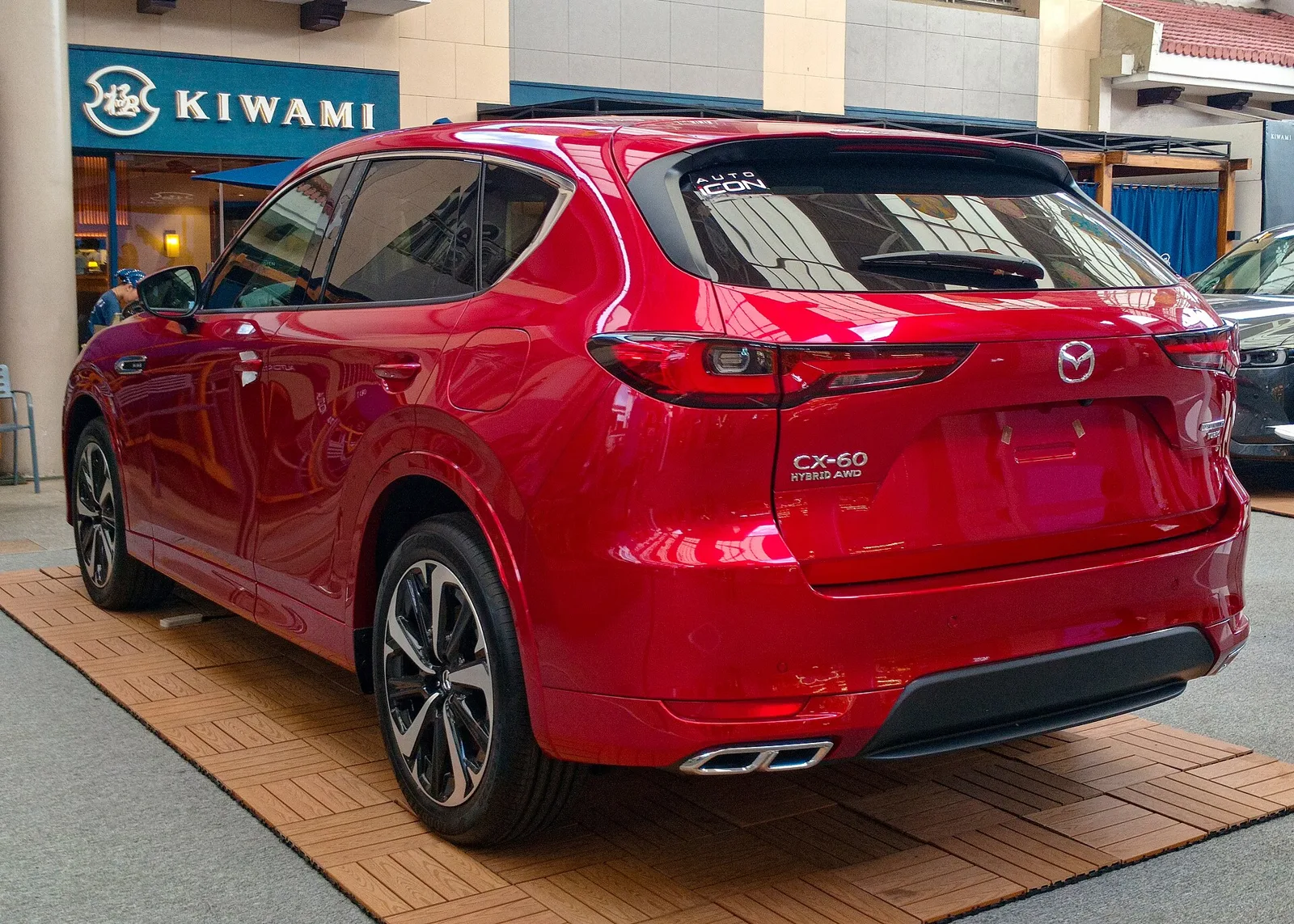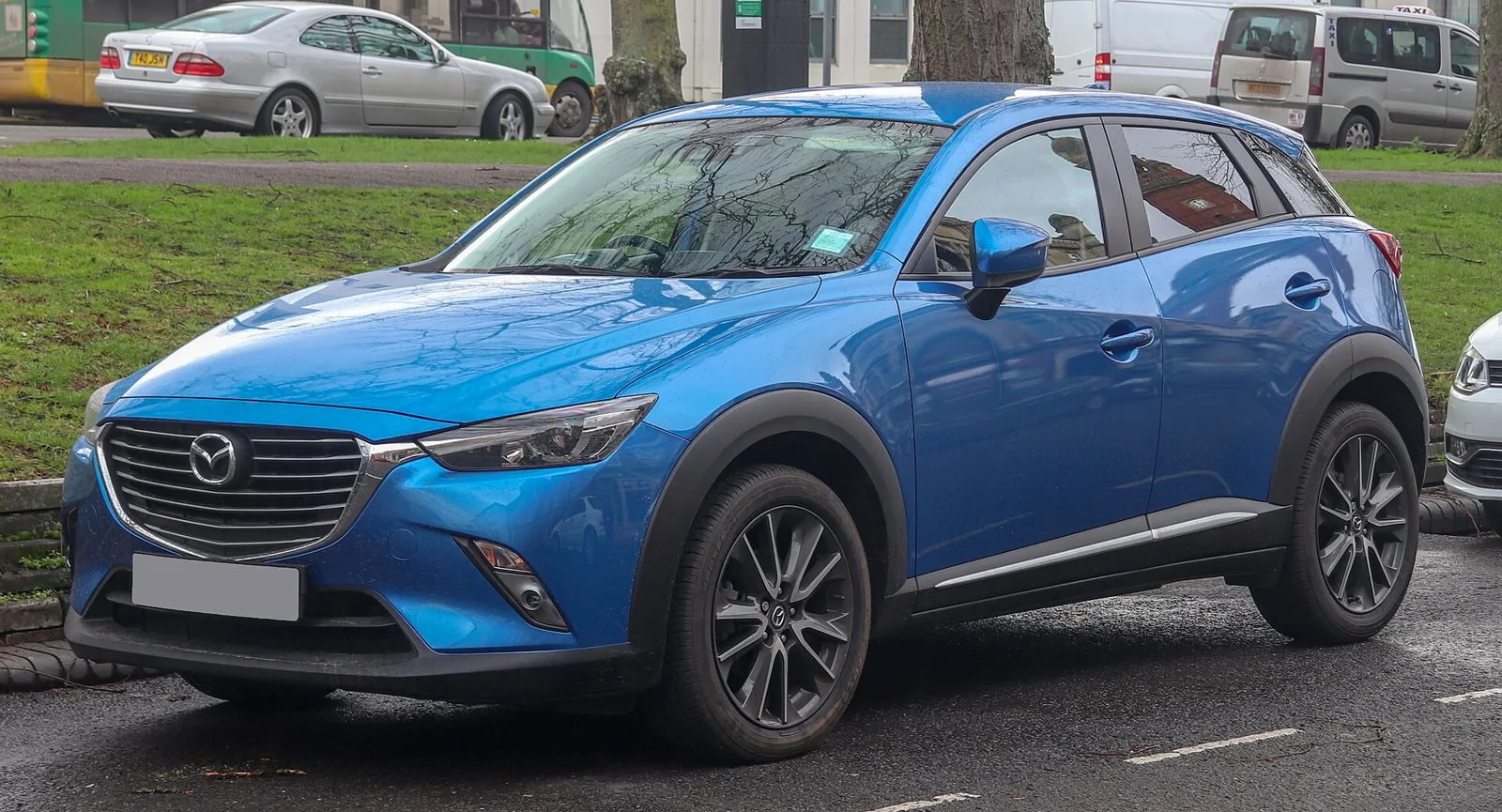
From a Mazda2-based baby to a rear-biased three-row flagship, the four SUVs share a badge but little else, and one was built in Hiroshima without ever being sold in Japan.
The Mazda CX-3 and CX-30 are subcompact crossovers, with the CX-30 slotted between the CX-3 and CX-5. Above them came the mid-size CX-9 and, from 2023, the full-size CX-90, which uses a rear-biased platform with inline-six or plug-in hybrid power.
Mazda built the CX-9 in Hiroshima and never offered it in Japan, where the shorter and narrower CX-8 was sold instead. That says plenty about who its big SUVs are designed for.
The four cars span the whole width of the range: two subcompacts, a mid-size three-row flagship, and a full-size replacement that sits on an entirely different platform from the car it took over from.
Where do the CX-3, CX-30, CX-9 and CX-90 sit in the Mazda SUV range?
The CX-3 and CX-30 are subcompact crossovers, the CX-9 was a mid-size three-row family SUV, and the CX-90 is the full-size three-row model that replaced it in North America. The CX-30 was placed between the CX-3 and the CX-5, so these four names cover the bottom and the top of the lineup.
The numbers are not a pure size ladder, though. Mazda chose the CX-30 name partly to avoid confusion with the CX-4, a car sold only in China, and the CX-90 arrived on a completely different architecture from the CX-9 it replaced.
Mazda built the CX-9 in Hiroshima and never offered it in Japan.
Mazda CX-3: the small crossover built on the Mazda2
Mazda revealed the CX-3 on 19 November 2014, just ahead of the Los Angeles Auto Show, as a 2016 model. Underneath it shared a platform with the third-generation Mazda2. In the United States it went on sale at the end of 2015 and replaced the Mazda2 subcompact in North America.
Engines varied by region. American cars used a 2.0-litre Skyactiv-G petrol four, updated in 2018 to 109 kW (146 bhp) and 201 Nm (148 lb ft), with a six-speed automatic and optional all-wheel drive. Asian markets such as Malaysia, Singapore, Thailand, the Philippines and Indonesia received the same 2.0-litre petrol or a 1.5-litre Skyactiv-D diesel, introduced progressively from 2016. From 23 April 2020 Japan also took a 1.5-litre Skyactiv-G petrol, and the same engine appeared in Indonesia, Egypt, Singapore and Malaysia.
American buyers of the Sport, Touring and Grand Touring versions got cruise control, power windows and locks, a 60/40 split folding rear seat, a rearview camera, Bluetooth and Mazda Connect with a seven-inch screen as standard.
The 2018 facelift and a show-car oddity
The 2018 update brought a split horizontal chrome grille, foglamps, new tail lamps, small chassis tweaks, a centre armrest and extra safety equipment. The manual handbrake gave way to an electronic parking brake. In 2015 Mazda had already shown a CX-3 Racing Concept at the Tokyo Auto Salon and then in Detroit, wearing 19-inch wheels, adjustable suspension, a racing air intake kit and a sports muffler.
How the CX-3 faded out
The CX-3's career ended market by market. For the 2020 model year the American Touring and Grand Touring trims were dropped to make room for the CX-30, leaving only a Sport model with all-wheel drive, now with Apple CarPlay, Android Auto and the i-Activesense safety suite as standard. The 2021 model year was the last in the United States, and sales in Europe stopped in December 2021.
Mazda moved production from Japan to Mexico and Thailand in mid-2022, so Japanese customers were served by imports from Thailand. The Japanese-market CX-3 was then discontinued in 2026 without a successor model. By December 2021 global production of the car stood at 829,843 units and sales at 820,003.
Mazda CX-30 vs CX-3: the car that slotted in between
The CX-30 debuted at the 2019 Geneva Motor Show and went on sale in Japan on 24 October 2019. Where the CX-3 borrowed from the Mazda2, the CX-30 is based on the fourth-generation Mazda3. Mazda placed it between the CX-3 and the CX-5, and it uses lightweight construction to improve performance and economy.
Production is spread across the world. Hiroshima builds cars for global markets, Salamanca in Mexico supplies North and South America, and the AutoAlliance Thailand plant at Rayong made the first Australian units. Changan Mazda builds the China-market version in Nanjing.
Who the CX-30 is for
Naohito Saga, the programme manager, said the car was aimed at drivers in the United States who were still single or were married and starting a family. Chief designer Ryo Yanagisawa said it would be more readily accepted as a family car in Europe and Japan. It is offered with front-wheel drive or all-wheel drive, though from the 2022 model year the American range dropped front-drive altogether.
The rollout was quick: the Philippines on 28 November 2019, the UK in December 2019, Malaysia on 15 January 2020, North America in January 2020, Indonesia on 28 January 2020 and Thailand on 6 March 2020. A 2.5-litre turbo version followed internationally in February 2021.
What the reviews of the CX-30 say
Critics were divided, and instructively so. Car and Driver gave the CX-30 9.5 out of 10 and said it should sit at the top of any small-SUV shopping list. Edmunds scored it 7.9 and Top Gear 7, with Top Gear praising its handling, looks and interior. Autocar gave four stars out of five for agility and a high-quality cabin, with the caveat that it is not the car for anyone who needs vast amounts of space.
Motor Trend was unimpressed, calling it neither sporty nor luxurious and stuck in the middle, while What Car? awarded three stars for a premium feel at a lower price but warned that rear space is tight and the boot is nothing special. Put those scores side by side and the pattern is plain: the cabin wins praise, the packaging does not.
The honours were plentiful. The CX-30 took a 2020 Red Dot Design Award, a 2019 Golden Steering Wheel in the class for crossovers up to 4.4 metres, Wheels magazine's Car of the Year in Australia in 2021 and Thailand's Car of the Year for 2020. Car and Driver listed it among seven subcompact SUVs in its 2024 Editors' Choice.
The CX-9: Mazda's three-row flagship
The first CX-9 was launched at the 2006 New York International Auto Show as a mid-size crossover with three rows of seats. It rode on the Ford CD3 platform, which it shared with the Ford Edge, its close mechanical sibling. The original engine was a 3.5-litre Ford V6. In 2008 the engine changed to a 3.7-litre unit, introduced in June 2007 and built by Mazda, producing 204 kW (274 hp) and 366 Nm (270 lb ft) through a six-speed automatic.
The standard safety list ran to blind spot monitoring, a backup camera, stability, traction and roll stability control, front side airbags and curtain airbags across all three rows. Facelifts in 2010 and 2013 added a new front end and tail lights, three-zone climate control and Bluetooth, then a revised grille, bumper and headlights in line with Mazda's Kodo design philosophy. Motor Trend named it SUV of the Year for 2008, and it was also North American Truck of the Year that year.
The second-generation CX-9
Mazda showed the second car at the 2015 Los Angeles Auto Show, nine years after the first, and started production in February 2016. The Ford underpinnings were gone, replaced by the Skyactiv platform and engines used by Mazdas introduced after 2011. A turbocharged 2.5-litre four produced 169 kW (227 hp) on 87 AKI (91 RON) fuel and 186 kW (250 hp) on premium, with 420 Nm (310 lb ft) of torque and a six-speed automatic.
The body was shorter but sat on a longer wheelbase, trimming the overhangs, and weight fell by 90 kg (198 lb) in front-drive form and 130 kg (287 lb) with all-wheel drive. The active safety list grew to include radar cruise control with stop/start, lane keep assist, lane departure warning, high beam control and low- and high-speed autonomous emergency braking. In 2017 it was awarded the IIHS Top Safety Pick+.
Mazda CX-9 vs CX-90: what changed underneath
The CX-90 is not just a bigger CX-9. Mazda introduced it in 2023 as a full-size, three-row crossover on its Large Product Group platform, which has a longitudinal engine and a rear-biased all-wheel-drive system shared with the smaller CX-60.
According to Mazda, the CX-90 addresses many of the CX-9's weaknesses, in particular its small interior. It can seat six, seven or eight, depending on configuration. A two-row, five-seat sibling called the CX-70 was revealed on 30 January 2024 with different bumpers, black exterior accents in place of chrome, its own wheel designs and different interior colour choices.
| Model | Class | Based on | Revealed or launched | Status |
|---|---|---|---|---|
| CX-3 | Subcompact crossover | Third-generation Mazda2 | Revealed 19 November 2014 | Japanese-market car discontinued in 2026, no successor |
| CX-30 | Subcompact crossover | Fourth-generation Mazda3 | Geneva Motor Show 2019 | Effectively replaced the CX-3 in the United States |
| CX-9 | Mid-size three-row crossover | Ford CD3, then Skyactiv | 2006 and 2015 (second generation) | Replaced by the CX-90 in North America |
| CX-90 | Full-size three-row crossover | Large Product Group platform | Revealed 31 January 2023 | On sale in many markets, including Vietnam from 27 February 2026 |
Mazda CX-90 engines and the hybrid shift
In North America, the CX-90 and CX-70 gave Mazda its first production hybrids. The mild-hybrid range uses two versions of a 3.3-litre turbocharged inline-six with the M Hybrid Boost system. On S trims the high-pressure turbo engine makes 254 kW (340 hp) and 500 Nm (369 lb ft) on premium fuel, or 238 kW (319 hp) on regular. Other trims use a standard-pressure turbo rated at 209 kW (280 hp) and 450 Nm (332 lb ft).
Australia also gets a diesel, with 550 Nm (406 lb ft) of torque and 187 kW (251 hp). In every case a starter-generator and a small 0.33 kWh battery add 12 kW (16.6 hp) and 153 Nm (113 lb ft). The plug-in hybrid pairs a 2.5-litre four-cylinder with an electric motor and a 17.8 kWh battery for a combined 241 kW (323 hp) and 500 Nm (369 lb ft) of torque when fed premium petrol.
Every version uses the rear-biased i-Activ all-wheel-drive system and an eight-speed automatic. That gearbox replaces the usual torque converter with a single wet clutch, a layout intended to increase front-passenger footwell space. The cars also use Kinematic Posture Control, software first developed for the 2022 MX-5 Miata that suppresses body lift in corners.
Mazda CX-90 review results and safety
Car and Driver put the CX-90 and its hybrid among 12 midsize SUVs on its 2024 Editors' Choice list. The 2024 CX-90 and 2025 CX-70 both earned the IIHS Top Safety Pick+ award, with Good ratings in every category except the headlights on non-turbo versions, which earned only an Acceptable rating, since adaptive lights come solely with the turbo engines.
The CX-30 has its own safety record: seven airbags, Isofix, ABS and EBS, plus Top Safety Pick+ awards from the IIHS in 2021 and from 2022 to 2024. The 2021 award came with a caveat, because Premium trims built before October 2020 scored Poor for headlights, the low-beam LED projectors creating excess glare.
Where the CX-90 is sold
The CX-90 reached Mexico on 11 April 2023 and North America in April 2023, then spread through the Philippines on 22 September 2023, Chile on 16 October 2023 and Cambodia on 18 November 2023. In Australia it went on sale on 14 August 2023 in Touring, GT and Azami trims, each with a petrol or diesel mild-hybrid and standard all-wheel drive. The CX-70 followed there on 23 October 2024.
Trim names vary by country. American buyers choose from Select, Preferred, Preferred Plus, Premium, Premium Plus and the S variants, while Canada uses GS, GS-L, GT, GT-P and Signature. New Zealand has a single Takami trim. In Taiwan, nine airbags became standard on every variant in January 2025.
What this means if you are choosing between them
The CX-3 has left most of its markets: sales ended in Europe in December 2021, the American run finished after the 2021 model year, and the Japanese car was discontinued in 2026. The CX-30 is the car that took its place in America, and reviewers broadly agree on its cabin while disagreeing about its space and character.
At the top, the CX-9 versus CX-90 decision is really a choice between two engineering approaches. The second-generation CX-9 pairs a turbo four with a six-speed automatic. The CX-90 is a larger rear-biased car with inline-six or plug-in power, an eight-speed gearbox and, according to Mazda, more interior room.
Recent rollouts and the end of the CX-9
The latest news is about rollouts rather than replacements. The CX-90 reached Vietnam on 27 February 2026, imported from Japan in a single 2.5-litre plug-in hybrid Signature AWD 7S version, and Taiwan's line-up was reworked in January 2025. The CX-3's Japanese run has ended with no successor model.
The end date of CX-9 production is given as 2023 in some places and 2024 in others. The car was dropped in the United States after 2023 but kept being built and sold in markets such as the Middle East. Either way, the CX-90 is its successor.