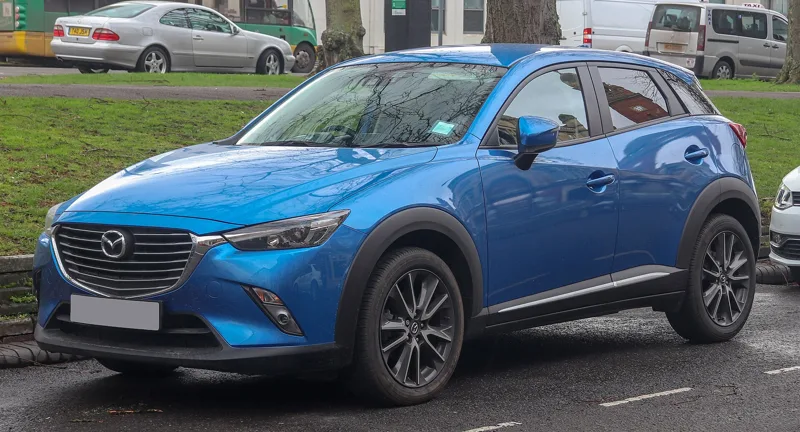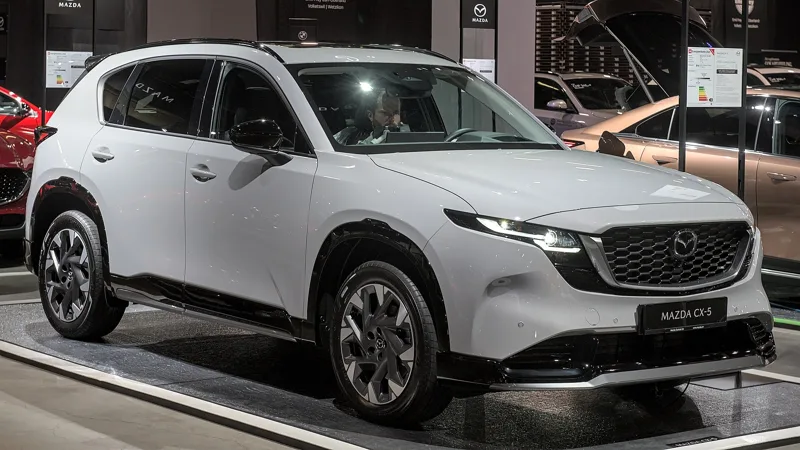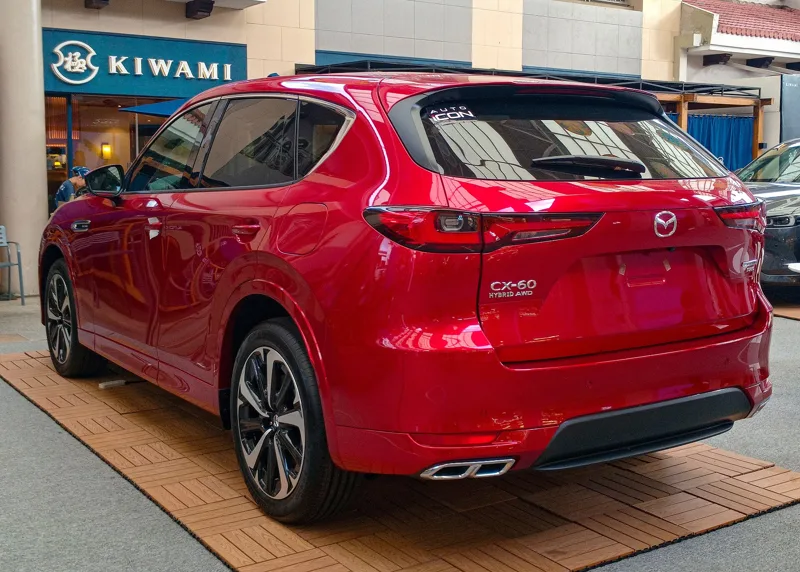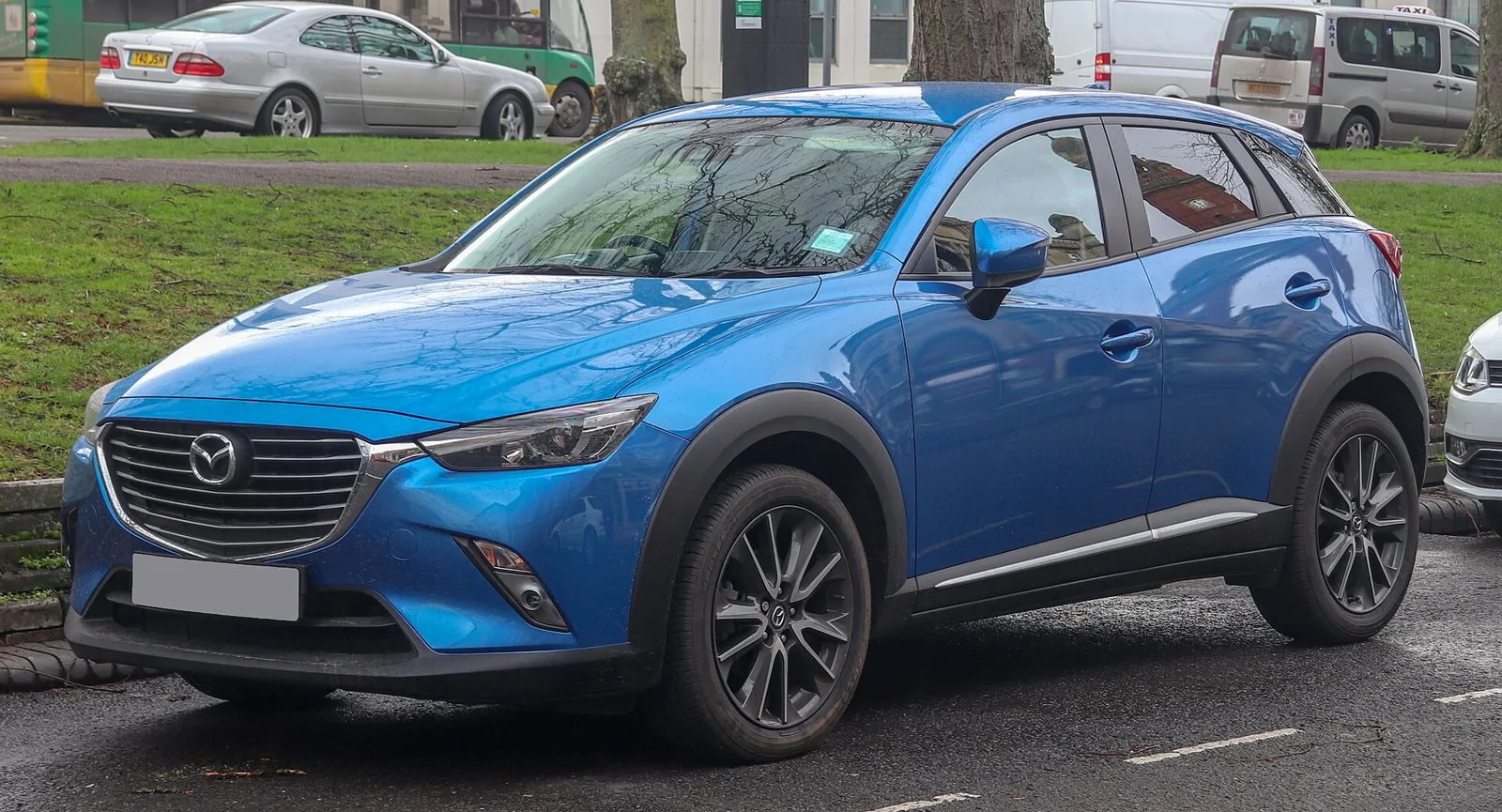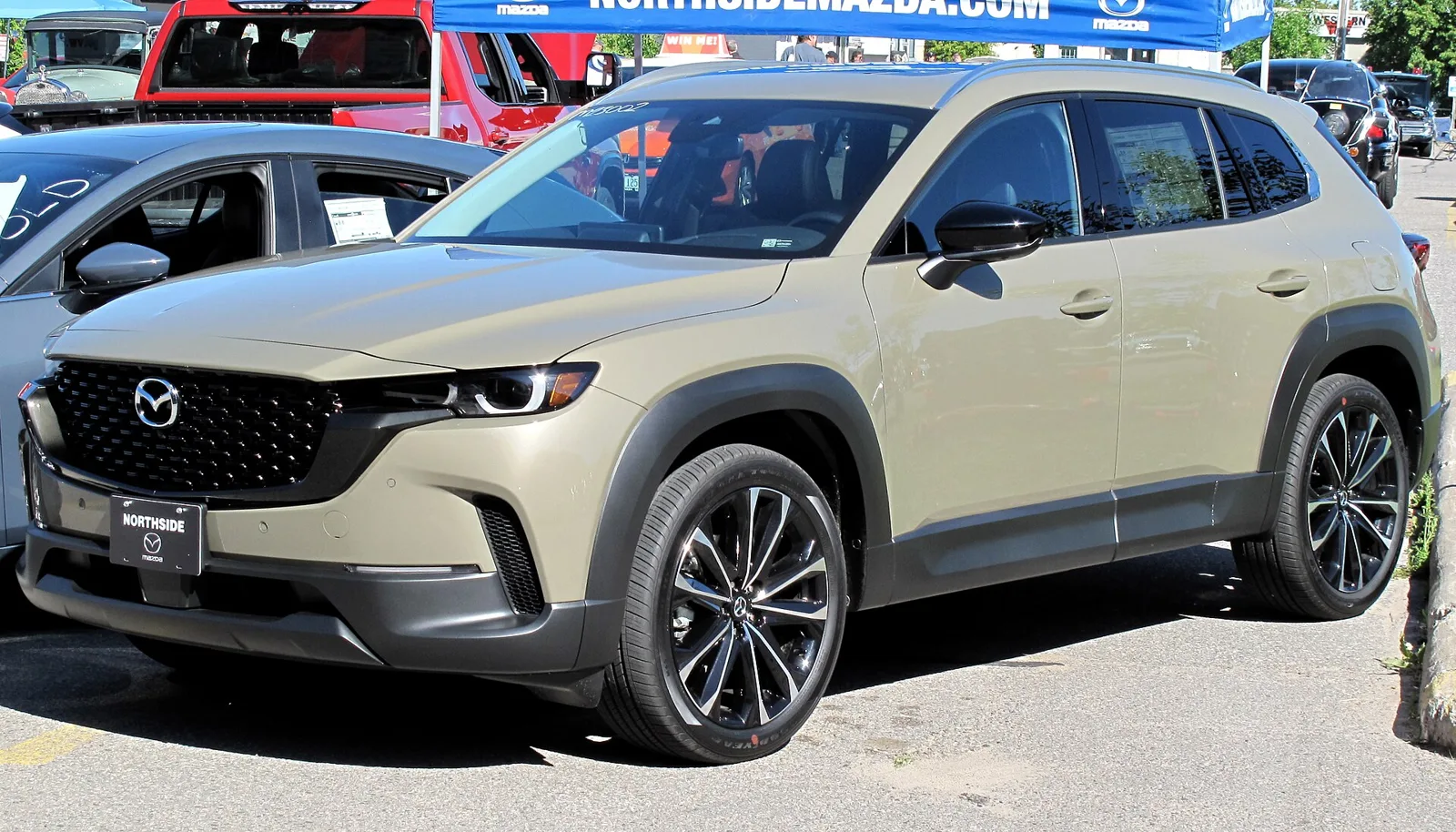
A mid-size turbo SUV from Hiroshima and a compact crossover from Huntsville, Alabama: engines, trims, safety results and why the CX-50 left Canada.
The Mazda CX-7 was a turbocharged mid-size SUV built in Hiroshima from 2006 to 2012. The CX-50 is a compact crossover built in Alabama since 2022 for North America and China, with a 2.5-litre engine, turbo or hybrid, and a rugged outdoor focus.
On 12 May 2025 Mazda Canada suspended all factory imports of the CX-50, and the SUV effectively vanished from Canadian showrooms once remaining stock was sold. A cross-border trade dispute and a retaliatory tariff did it. It is an odd end for a car built specifically for North American buyers, and it is a different story from the one told by its mid-size predecessor, the Mazda CX-7.
What is the Mazda CX-50?
Mazda's CX-50 is a compact crossover that went into production in 2022 as a 2023 model, sold in North America and China. Underneath is the same transverse, front-wheel-drive architecture as the fourth-generation Mazda3 and the CX-30, which means the engine sits across the car rather than along it. The CX-50 is sold next to the slightly smaller CX-5, with the larger CX-70, based on a rear-drive layout, above it.
Mazda officially revealed the CX-50 in the US on 15 November 2021. Compared with the CX-5, its pitch is active and outdoor lifestyles, which is why the styling is squarer and the body cladding larger. Buyers who want even more outdoor character can choose the Meridian Edition, an off-road-styled version. Every CX-50 gets Mazda's i-Activ all-wheel drive technology and Mazda Intelligent Drive Select, known as Mi-Drive.
One practical detail shows how the CX-50 differs from the CX-5. Mazda gave it a lower roof, so owners can reach the roof racks more easily, even though ground clearance is greater. It is also the first Mazda that can be ordered with a panoramic sunroof.
One SUV was replaced by a smaller one with the same cabin space; the other left a country because of where its parts came from.
Where is the Mazda CX-50 built?
Huntsville, Alabama, is where the CX-50 is made, at the joint Mazda Toyota Manufacturing USA plant. Production began on 26 January 2022, alongside the unrelated Toyota Corolla Cross. It brought Mazda back to American assembly after ten years, since the Mazda6 sedan stopped being built there in 2012.
Outside the United States, the CX-50 has been sold in Colombia since December 2022 and in Mexico since March 2023. Changan Mazda also builds it in China, where production started in March 2023. Cars for China get small changes: the rear bumper is longer, and rear passengers gain 55 millimetres (2.2 in) of legroom.
Why did Canada lose the CX-50?
Canadian showrooms got the CX-50 for 2023 and the CX-50 Hybrid for the 2025 model year, all of them shipped from Huntsville. In March 2025 a cross-border trade dispute led Canada to impose a retaliatory 25% surtax on U.S.-assembled passenger vehicles that did not comply with CUSMA. Mazda Canada suspended all factory imports effective 12 May 2025.
The reason it could not simply qualify for free-trade treatment is a sourcing rule. Duty-free status under the agreement requires at least 75% Regional Value Content, in effect a minimum share of parts and labour from within the trade area. Heavy use of international components kept the CX-50 under that line. Mazda therefore reallocated 100% of the Alabama plant's Canadian volume to the United States market.
What engines does the CX-50 have?
Power comes from Mazda's 2.5-litre Skyactiv-G inline-four in two states of tune. In naturally aspirated PY-VPS form it delivers 187 horsepower (190 PS) with 186 pound-feet of torque (252 N m). The turbocharged PY-VPTS variant raises that to 227 horsepower (230 PS) when run on 87 AKI fuel, or 256 horsepower (260 PS) on 93 AKI, and its torque is 320 pound-feet (434 N m).
The two power figures for the turbo follow from how a turbocharged engine protects itself. AKI, the anti-knock index, is the octane rating shown on American pumps, and premium fuel resists knock better than regular, so the engine can run more boost and ignition advance on 93 and make more power than it does on 87. Chinese buyers have had a hybrid since November 2023: the CX-50 HEV pairs a 2.5-litre A25D-FXS engine with the Toyota Hybrid System and an eCVT gearbox.
Which CX-50 trims can you buy?
Five trims make up the US range: Select, Preferred, Preferred Plus, Premium and Premium Plus. Turbo power is limited to Base (Turbo), Premium and Premium Plus. On the turbo car Mazda also offers the more rugged Meridian Edition, with 18-inch wheels on all-terrain tyres, side rocker garnish, hood graphics and other outdoor-minded accessories.
On 9 July 2024 Mazda updated the US car for the 2025 model year. The hybrid powertrain became available on Preferred, Premium and Premium Plus trims, and the base Turbo trim was no longer offered.
How safe is the Mazda CX-50?
The Insurance Institute for Highway Safety awarded the 2023 CX-50 its Top Safety Pick+ rating, with overall Good and Superior results in every category. The exception was headlights on non-turbo cars, which scored Acceptable because only the turbo models come with adaptive headlights.
Car and Driver picked it among five compact SUVs for its 2024 Editors' Choice list.
What was the Mazda CX-7?
The CX-7 was Mazda's mid-size crossover, the road-going version of the MX-Crossport concept car. Its public debut came at the LA Auto Show in January 2006. Hiroshima's Ujina #2 factory started building it on 20 February 2006, and showrooms had it by April, badged as a 2007 model.
No Mazda mid-size SUV had been sold since the Navajo was dropped in 1994, and even the CX-7 is regarded as more of a soft roader than a true off-roader, meaning SUV looks and height with road-biased manners. It sat below the three-row CX-9 without sharing its platform, using instead the Ford C1 architecture found beneath the Ford Focus and Mazda3. Its front suspension came from the Mazda MPV minivan and its rear from the Mazda5, and the steering wheel before the facelift was shared with the third-generation MX-5 and the Biante.
What powered the CX-7?
The CX-7 used the 2.3-litre MZR L3-VDT DISI turbocharged inline-four from the Mazdaspeed3 and Mazdaspeed6, with a six-speed Aisin F21 automatic. It produced 244 hp, or 182 kW (175 kW in the Australian model), at 5000 rpm and 258 lb ft (350 N m) at only 2500 rpm.
That low torque peak was the point. Ninety-nine percent of maximum torque stays available all the way to 5000 rpm, which gives a flat, strong push through the everyday rev range. Mazda retuned the engine for the North American CX-7 to deliver torque at lower revs, trading some power for less turbo lag off the line. The change relied on a redesigned, smaller K04 turbocharger. The UK car kept the larger K04 and the transmission from the Mazdaspeed models.
How did the CX-7 handle grip and fuel?
The CX-7 had fully independent suspension, four ventilated disc brakes, standard ABS, stability control and traction control. The drive options were front-wheel drive or the Active Torque Split all-wheel-drive system. In the all-wheel-drive version, a pair of magnetic clutches under computer control can pass as much as 50% of the torque to the rear wheels, which they do on a slippery surface to keep grip consistent.
The official Australian combined figure was 11.5 L/100 km (25 mpg-imp; 20.5 mpg-US), on a par with the Holden Captiva. Real-world use was thirstier, nearer 18.0 L/100 km (15.7 mpg-imp; 13.1 mpg-US), the same as or worse than a Ford Territory. In North America it was initially turbo only, and a non-turbo engine arrived later.
Which CX-7 trims were sold?
By the 2010 model the range had four trims: iSV, iSport, sTouring and sGrand Touring. Touring and Grand Touring could have all-wheel drive and the 2.3-litre turbo, while SV and Sport trims used a naturally aspirated 2.5-litre MZR L5-VE four-cylinder, rated at 120 kW (161 hp) and 218 N m (161 lb ft) with a five-speed automatic.
Markets differed. Canada had GS and GT models in front- or all-wheel drive. Australia, with all-wheel drive only, offered CX-7 Classic and CX-7 Luxury versions. The United Kingdom, also all-wheel drive only, had the 2.3T and 2.2D Sport Tech, and that diesel, with a manual transmission, was sold in Europe from 2009 to 2012.
How did the CX-7 and CX-50 powertrains compare?
| Model | Engine | Output | Torque |
|---|---|---|---|
| CX-7 turbo | 2.3 L turbo four | 244 hp (182 kW) | 258 lb ft (350 N m) |
| CX-7 non-turbo | 2.5 L four | 161 hp (120 kW) | 161 lb ft (218 N m) |
| CX-50 non-turbo | 2.5 L four | 187 hp (190 PS) | 186 lb ft (252 N m) |
| CX-50 turbo | 2.5 L turbo four | 227 or 256 hp (230 or 260 PS) | 320 lb ft (434 N m) |
What changed in the CX-7 update?
The front and rear fascias were revised, with a larger five-point grille similar to that of the RX-8, MX-5 and Mazda3. The interior gauges were revised too, with blackout meters and three-dimensional dials, a 3.5-inch monochrome and a 4.1-inch colour Multi Information Display, Bluetooth, and a Blind Spot Monitoring System. Mazda showed the updated car at the Canadian International AutoShow in February 2009.
The CX-7 earned a few honours. It won the Crossover category of the 2007 International Car of the Year Awards, the 2008 RJC Car of the Year Special Award for Best SUV, and from 2009 to 2011 Autocar Indonesia's Reader's Choice Award for Favorite Medium SUV 4x4.
Why did Mazda replace the CX-7?
Reviewers liked the way the CX-7 drove and the quality of its cabin, but it used its size poorly: passenger and cargo room matched compact crossovers such as the Honda CR-V. In North America the car came only with a thirsty turbo engine at first. Mazda discontinued it in August 2012 for the CX-5, which is classed as compact yet has similar interior dimensions on a smaller footprint.
The CX-7 name was initially expected to return on a stretched, seven-seat CX-5 as three-row crossovers grew in popularity. In its place came the CX-8, effectively a longer-wheelbase second-generation CX-5; Mazda announced it in the middle of 2017 and Japan received it on 14 September 2017.
Which of the two suits which buyer?
The CX-50 suits someone who wants all-wheel drive on every trim, a lower roof for roof-rack loading, a choice between naturally aspirated, turbo and hybrid power, and a safety record that includes a Top Safety Pick+ rating. It is also the one that is in production, although not for Canadian buyers.
The CX-7 was a stronger choice for someone who valued the push of a turbocharged engine and a driving experience that reviewers praised. Its weaknesses were a footprint that delivered no more usable space than a compact crossover and, in everyday use, fuel consumption well above the official figure.
Where can you still buy a CX-50 hybrid?
The CX-50 range now includes the hybrid on Preferred, Premium and Premium Plus trims in the United States, while the Chinese market has had the CX-50 HEV since November 2023. For Canada, Mazda has withdrawn the car, and its entire Canadian volume from the Alabama plant now goes to the US market.